For thousands of years, medicine worked with what the body was willing to reveal. Pain indicated that something was wrong, fever signaled a reaction, pulse and breathing offered a few clues, and the physician's eye tried to connect these manifestations to an invisible cause. Then instruments gradually opened the body without opening it: the stethoscope allowed doctors to listen to it, X-rays to see through it, the electrocardiogram to record its electrical activity, and ultrasound and medical imaging to observe its internal structures. Technology was, in essence, an extension of the physician's senses.
That relationship is changing. Technology no longer merely helps us look more closely at the human body. It is beginning to measure it continuously, interpret its signals, model its functioning, anticipate some of its failures and, in certain cases, intervene directly in its biological code. Medicine is entering a peculiar period in its history: computing, artificial intelligence, genomics, robotics, biotechnology, sensors and materials science are gradually converging around the same object — the human being.
What is emerging, therefore, is not simply medicine equipped with more machines. It is a new architecture of health.
From the Intermittent Patient to the Measured Body
Traditional medicine operates under a curious constraint: it often observes the patient precisely when that patient enters the healthcare system. A consultation measures blood pressure, a laboratory analyzes a sample, an electrocardiogram records a few seconds or minutes of cardiac activity. Between two examinations, much of the patient's biological life disappears from view.
Connected technologies are beginning to fill that space.
Smartwatches, cardiac sensors, continuous glucose monitors, pulse oximeters, sleep trackers and other medical or consumer devices generate streams of data that can accompany a person for hours, months or years. The difference is not merely quantitative. A measurement taken every six months and several thousand measurements collected under the ordinary conditions of daily life do not describe quite the same organism.
This evolution is giving rise to a potentially more longitudinal form of medicine. Instead of waiting for a symptom to become serious enough to bring the patient to a physician, some systems can search continuous physiological data for unusual variations. The objective gradually shifts from observation toward early detection.
Technology companies have understood this. Apple has progressively transformed its watch into a platform for physiological measurement; medical-device manufacturers are developing increasingly compact sensors; hospitals are experimenting with remote monitoring; insurers and healthcare systems are interested in data that could identify deterioration earlier.
A boundary that once seemed relatively clear is beginning to fade: the boundary separating everyday life from the medical environment.
Artificial Intelligence Enters the Clinic
This accumulation of data creates an obvious problem. Measuring more is useful only if someone — or something — can interpret what is being measured.
This is where artificial intelligence assumes particular importance.
Medicine produces precisely the kind of material algorithmic systems thrive on: images, time series, text, laboratory results and vast quantities of structured data. X-rays, CT scans, MRIs, pathology slides and cardiac signals can all be analyzed for patterns that models have learned to recognize.
This evolution has already moved beyond the laboratory. The US Food and Drug Administration maintains a dedicated list of AI-enabled medical devices authorized for the American market. In 2026, new authorizations continued to cover fields including radiology, neurology, cardiology, orthopedics and gastroenterology.
Medical AI is not limited to diagnosis. It can help automatically segment an image before an intervention, prioritize examinations, assist with clinical documentation, analyze medical records, identify relationships among variables and help flag patients requiring particular attention.
With large multimodal models, another stage is emerging. The same system can theoretically work across text, images and other categories of information. The World Health Organization has already identified potential applications for such models in healthcare, scientific research, public health and pharmaceutical development, while emphasizing the significant governance questions they raise.
The decisive question, therefore, is probably no longer whether artificial intelligence will enter medicine. It already has. The question is how far it will move up the chain of clinical decision-making.
When Biology Becomes Information
Another revolution, less visible to the general public but perhaps even more profound, is transforming medicine at the same time: the growing ability to read biology as information.
Genetic sequencing has dramatically increased the amount of information available about living organisms. The genome can now be analyzed at a scale that would have been inconceivable when the first human genome was sequenced. Companies such as Illumina have industrialized the technologies required for the large-scale reading of DNA.
This knowledge is gradually changing therapeutic logic. Two patients who outwardly appear to have the same disease may possess different molecular characteristics and respond differently to the same treatment. In oncology in particular, identifying mutations and biomarkers already makes it possible to direct certain therapies toward specific groups of patients.
But reading the genome was only the first step. The ability to modify it changes the nature of the problem again.
CRISPR-Cas9 gave researchers a tool capable of targeted intervention in DNA. What recently remained largely an experimental technology has crossed the therapeutic threshold. In December 2023, the FDA approved Casgevy for certain patients with sickle cell disease, making it the first therapy authorized in the United States to use CRISPR-Cas9. In July 2026, the US authorization was expanded to patients aged two and older for certain indications involving sickle cell disease and transfusion-dependent beta thalassemia.
The conceptual shift is immense. Medicine has traditionally compensated for the consequences of biological dysfunction. It is gradually acquiring the ability to intervene in some of the mechanisms that produce it.
A drug is no longer necessarily a molecule taken periodically.
It can be a modified cell.
Biology Meets Computation
This transformation intersects with another: the convergence of molecular biology and computing power.
For decades, understanding the three-dimensional structure of a protein could require lengthy and complex experiments. Machine learning demonstrated that part of this problem could be approached differently. The work surrounding AlphaFold at Google DeepMind came to symbolize this shift, showing how computation could accelerate the prediction of protein structures.
The pharmaceutical industry has taken notice. Drug discovery is traditionally lengthy, expensive and characterized by a formidable rate of failure. Artificial intelligence is now being applied at different stages of this process: identifying biological targets, designing or selecting molecules, predicting properties, analyzing experimental data and optimizing trials.
It would be premature to conclude that computers will soon replace laboratories. A molecule that looks promising inside a model must still confront biological reality, followed by preclinical and clinical trials. Living systems retain a remarkable ability to defeat simplification.
But the laboratory and the computer are gradually ceasing to be separate worlds.
This helps explain why computing infrastructure itself is becoming part of the healthcare economy. NVIDIA develops platforms for life sciences and medical imaging; major cloud providers offer infrastructure for health data and scientific research; pharmaceutical companies are establishing partnerships with artificial-intelligence firms.
Part of the medicine of the future is therefore being built somewhere physicians were once unlikely to be found: the data center.
The Robot Enters the Operating Room
In the operating room, the transformation is far more visible.
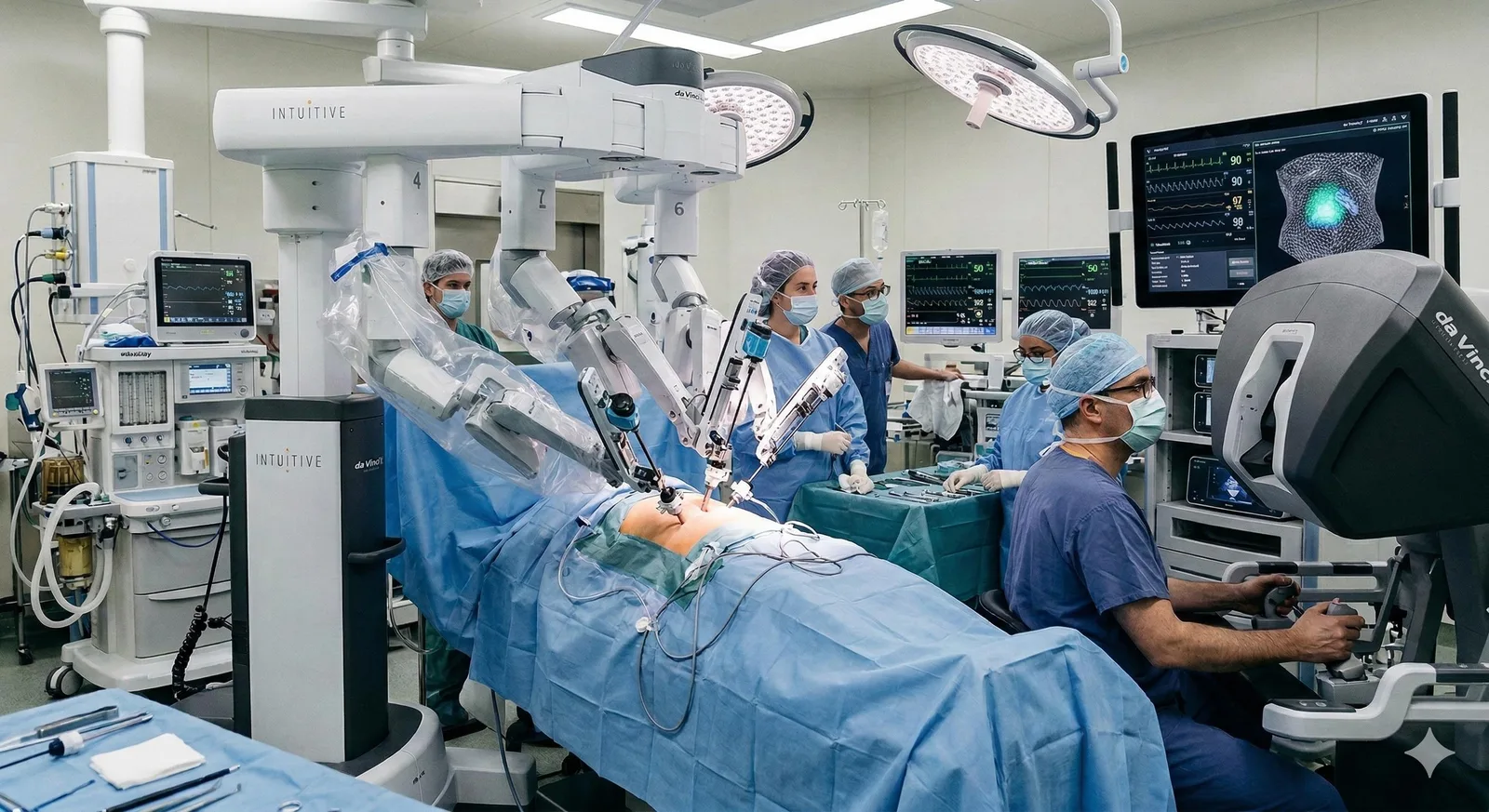
Robot-assisted surgical systems allow surgeons to control miniaturized instruments from a console, providing considerable precision and detailed visualization of the surgical field. They are not autonomous surgeons: the human operator remains at the center of the procedure. But the relationship between the surgeon's hand and the patient now passes through a machine.
Intuitive Surgical illustrates the industrialization of this approach. By the end of 2025, approximately 11,106 da Vinci systems were installed worldwide, and around 3.15 million procedures using those systems had been performed during that year alone. The company also reported that the cumulative number of patients treated using da Vinci systems had exceeded 20 million.
Yet the robot is probably only one stage.
Intraoperative imaging, augmented reality, surgical navigation and artificial intelligence can increasingly be combined. Surgeons may gain access to progressively richer representations of anatomy, information calculated in real time and instruments capable of filtering certain movements or improving the precision of a gesture.
Surgery then becomes a cyberphysical system: the human decides and acts, but that action is increasingly mediated through a layer of computation.
Repair, Replace, Augment
Technological medicine does not stop at information. It enters the body itself.
Pacemakers and cochlear implants have long demonstrated that a machine can become a durable component of the human organism. Advances in materials, microelectronics, batteries and communications are now making it possible to envision smaller and more intelligent devices, some capable of interacting with the nervous system.
Brain-computer interfaces represent one of the most spectacular frontiers of this evolution. Several academic teams and companies are seeking to translate neural activity into commands usable by a computer or an external device. The potential medical applications are considerable, particularly for certain forms of paralysis and neurological impairment.
At the same time, tissue engineering, organoids and bioprinting are attempting to produce biological structures capable of reproducing some functions of human tissue. The transplantation of complete artificially manufactured organs remains a much more difficult objective than spectacular announcements sometimes suggest, but the scientific direction is clear: the boundary between treatment, device and biological tissue is becoming less rigid.
Medicine no longer necessarily administers something to the body. It can add a device, modify cells, replace a function or attempt to reconstruct part of its architecture.
Toward the Patient's Digital Twin
Eventually, all these trajectories may converge.
Imagine not a medical record consisting mainly of successive reports, but a dynamic digital representation of an individual integrating clinical history, medical images, certain genetic parameters, laboratory results, treatments and physiological data recorded over time.
The concept of the “digital twin,” already used in industry to represent machines and complex systems, is beginning to enter medical research. Its most ambitious form would involve constructing models capable of simulating some of a patient's responses before an intervention is chosen.
The difficulty is considerable. A human being is not a jet engine. Biological systems interact across multiple scales, environments change, behavior matters, and our understanding of many diseases remains incomplete.
But it is not necessary to model an entire individual for the principle to become useful. Specialized models can already attempt to represent an organ, a tumor, a physiological system or the probable response to an intervention.
If this approach advances, medicine could undergo a major shift: from statistics applied to populations toward increasingly individualized simulation.
A New Health Industry
This revolution is also transforming the economic boundaries of healthcare.
Health was traditionally structured around a few major categories: hospitals, physicians, pharmaceutical companies, medical-device manufacturers, insurers and public institutions. Those boundaries are becoming increasingly porous.
Technology companies control cloud infrastructure, semiconductors, artificial-intelligence systems and devices worn every day by hundreds of millions of people. Pharmaceutical groups are building capabilities in genomics and data science. Medical-equipment manufacturers are integrating software and AI. Biotechnology companies are directly manipulating cells and genes.
The result is a gradual redistribution of the value chain.
Medical data become a strategic asset. Computing becomes medical infrastructure. Software can itself become a health device. Biology becomes partially programmable.
This convergence could produce some of the most important companies of the coming decades, but it also creates new forms of dependence on private infrastructure. A hospital using artificial-intelligence models, cloud platforms, proprietary devices and robotic equipment is no longer simply purchasing machines. It is entering complex technological ecosystems on which it may become durably dependent.
Two-Speed Medicine
Every medical revolution eventually encounters the same question: who will benefit from it?
A gene therapy can be scientifically extraordinary and remain inaccessible to much of the world's population. A surgical robot may improve certain procedures while requiring investments beyond the reach of many institutions. Artificial intelligence may help compensate for shortages of specialists, but it requires data, digital infrastructure and governance systems that not every country possesses.
This contradiction is particularly important because these technologies could simultaneously reduce and increase health inequalities.
An algorithm capable of assisting a physician in a region lacking specialists could distribute expertise once concentrated in a handful of major hospitals. Telemedicine can bring patients closer to healthcare systems. Low-cost automated diagnostics may expand screening capacity.
Yet the same technologies can create a widening divide between healthcare systems equipped with genomics, advanced computing, robotics and structured medical data and those that still lack basic healthcare infrastructure.
The WHO has warned precisely about this gap between technological adoption and governance. In July 2026, its Regional Office for Europe reported that nearly two-thirds of countries in the region were already using AI-assisted diagnosis, while only 8% had a national strategy specifically addressing AI in health.
Technological speed is overtaking institutional speed.
Who Owns the Digital Body?
A final question then emerges, more political than it initially appears.
When the body becomes a continuous source of data, who owns those data? Who may use them, and for how long? A genome is not a browsing history. Genetic information describes an individual, but potentially also members of that person's family. A cardiac signal, a medical image or the progression of a disease belongs to a category of information whose sensitivity is difficult to compare with ordinary commercial data.
Cybersecurity therefore becomes a medical issue. Digital sovereignty becomes a health issue. The design of artificial-intelligence models becomes a question of clinical responsibility.
Algorithms introduce another difficulty: error changes scale.
A physician can make a mistake involving one patient. A system deployed across thousands of institutions can reproduce the same mistake at scale. Biases embedded in training data may also result in different levels of performance across populations. The WHO has accordingly highlighted persistent questions surrounding data quality, accountability, safety, equity and legal frameworks as AI enters healthcare systems.
Technology does not eliminate medical risk.
Sometimes, it changes its geography.
The Physician Does Not Disappear
It is tempting to describe this transformation as the gradual replacement of the physician by the machine. That would probably miss what is actually happening.
The stethoscope did not eliminate the physician. Neither did the X-ray. MRI, sequencing and robotic surgery did not do so either. Each technology shifted the skills required to practice medicine.
Artificial intelligence could carry this movement much further.
Part of the work of recognition, documentation, measurement and analysis may gradually be automated. But medicine is not merely the identification of an abnormality inside a dataset. It also means making decisions under uncertainty, balancing competing risks, understanding the circumstances of an individual, explaining what science knows and what it does not, and ultimately assuming responsibility for a decision whose consequences affect a human being.
The more capable machines become at manipulating medical information, the more visible this dimension of medicine may become.
The paradox would be remarkable: a vastly more technological form of medicine might ultimately remind us what, in medicine, is not technological.
The Body as the New Technological Frontier
Over the past two centuries, technology has successively transformed factories, transportation, communications, finance and information. It is now reaching a different frontier because that frontier is no longer external to the human being.
It is the human being.
We already know how to build machines that monitor the heart, algorithms that analyze medical images, robots that extend the surgeon's movements and therapies capable of modifying certain cells. We are beginning to connect genomics, artificial intelligence, biology and computing power. Each of these advances has its own history. Their convergence is the larger story.
Twentieth-century medicine learned to see ever deeper into the body. Twenty-first-century medicine is beginning to learn how to read it, model it and sometimes modify it.
The human body has obviously not become a machine. It remains infinitely more complex, unpredictable and fragile than the systems we know how to build.
But for the first time, a civilization simultaneously possesses tools capable of observing its functioning at scale, processing the information it produces and intervening in some of the mechanisms that constitute it.
Technology once stood around the patient.
It is now beginning to enter the patient.
Main Sources
World Health Organization (WHO) — research and guidance on artificial intelligence in health, multimodal models, governance and equity across healthcare systems.
US Food and Drug Administration (FDA) — database of AI-enabled medical devices authorized in the United States; regulatory decisions concerning Casgevy and CRISPR-Cas9-based therapies.
Intuitive Surgical — 2025 operating data, installed base of da Vinci systems and robot-assisted surgical procedure figures.
Google DeepMind — scientific research and resources concerning AlphaFold and the application of artificial intelligence to structural biology.
Illumina — institutional documentation concerning genomic sequencing technologies.
Figures and regulatory decisions cited in this article reflect information available as of September 9, 2026. Prospective developments involving digital twins, brain-computer interfaces, bioprinting and clinical automation are presented as technological trajectories rather than generalized medical capabilities.
Atlas Limits Research Desk
Atlas Limits’ editorial and analytical desk.