For centuries, the answer seemed almost self-evident. A great country was a large country, a populous country, one capable of raising armies, controlling trade routes and imposing its will beyond its borders. Power was measured in territory, soldiers and ships, then in tons of coal, factories, oil, missiles and gross domestic product.
The twenty-first century has not abolished these instruments.
It has layered new ones on top of them.
Russia reminds us that territory, resources and military arsenals still matter. China has demonstrated how an extraordinary industrial base can transform a country's position in the international system within a few decades. The United States continues to combine military reach, financial depth, technological leadership and an exceptional capacity to attract talent. India illustrates what demographic scale can become when it converges with economic growth and strategic ambition. Far smaller states, from Singapore to the United Arab Emirates, show that neither territory nor population alone determines international weight anymore.
Power has not disappeared.
It has become harder to read.
And perhaps harder still to preserve.
Geography Never Stopped Mattering
Globalization sometimes created the impression that geography was becoming secondary. Capital moved across borders, supply chains stretched across continents, information travelled instantaneously and goods seemed capable of being produced almost anywhere.
Successive crises have revived a much older reality.
A country does not choose its neighbours, its access to the sea, its climate or the resources beneath its soil. It cannot move a strait, a mountain range or a river basin. Nor can it abolish the distances separating its industrial centres from its markets.
Geography does not determine everything, but it defines the terrain on which states must operate.
The United States possesses a continental territory protected by two oceans, vast agricultural resources, substantial energy reserves and an enormous domestic market. Russia has exceptional territorial depth and immense natural resources, but must contend with extraordinary distances and constraints on maritime access. China benefits from a long coastline at the heart of the Asian economy while remaining heavily dependent on external trade routes. Europe concentrates wealth, infrastructure and expertise within a relatively compact space, yet remains exposed to several strategic dependencies.
Even the most advanced infrastructure eventually encounters the map.
Ports, straits, pipelines, submarine cables, railway corridors and electricity networks have restored strategic importance to places the digital economy once seemed likely to make less relevant.
Power still begins somewhere on a map.
But it no longer remains confined there.
Numbers Are No Longer Enough
Population was once among the simplest foundations of power. More people meant more soldiers, workers, taxpayers and consumers.
That equation has become considerably more complicated.
A huge population can represent an extraordinary advantage when it is educated, productive, employed and integrated into an economy capable of converting human potential into wealth. It can become a burden when a state cannot provide enough jobs, infrastructure, housing or public services.
At the other end of the demographic cycle, ageing societies face a different problem. Accumulated wealth does not guarantee permanent dynamism when the working-age population contracts and the cost of pensions, healthcare and dependency rises.
The real resource, therefore, is not population alone.
It is human capital.
A country's ability to educate its people, attract skills, enable social mobility and transform individual intelligence into collective capacity is becoming one of the central determinants of power.
An engineer, researcher, entrepreneur or highly skilled technician can now constitute a strategic resource as real as a mineral deposit.
States understand this.
Global competition is increasingly a competition for minds.
Producing Things Is Still an Act of Power
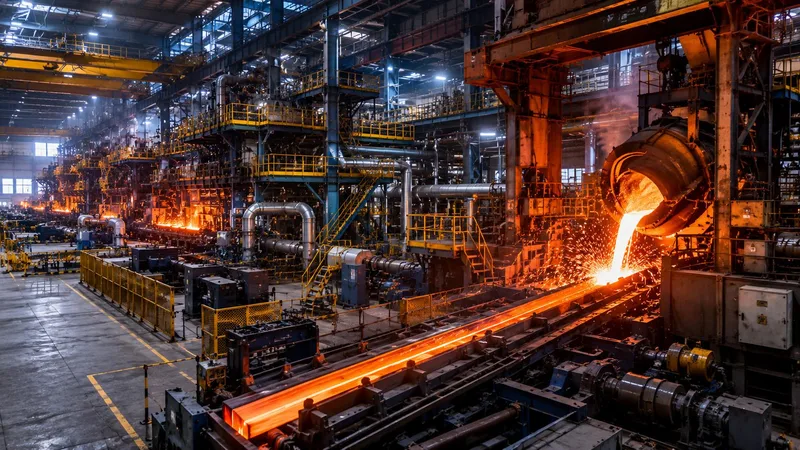
For several decades, parts of the developed world entertained the idea that an advanced economy could progressively abandon material production and concentrate instead on services, finance, design and intellectual property.
Then came the shortages.
Semiconductors, medicines, medical equipment, electronic components, batteries, electrical transformers, ammunition: every disruption in global supply chains exposed the difference between knowing how to design something and being able to manufacture it at scale.
Industry has a distinctive characteristic.
It accumulates knowledge.
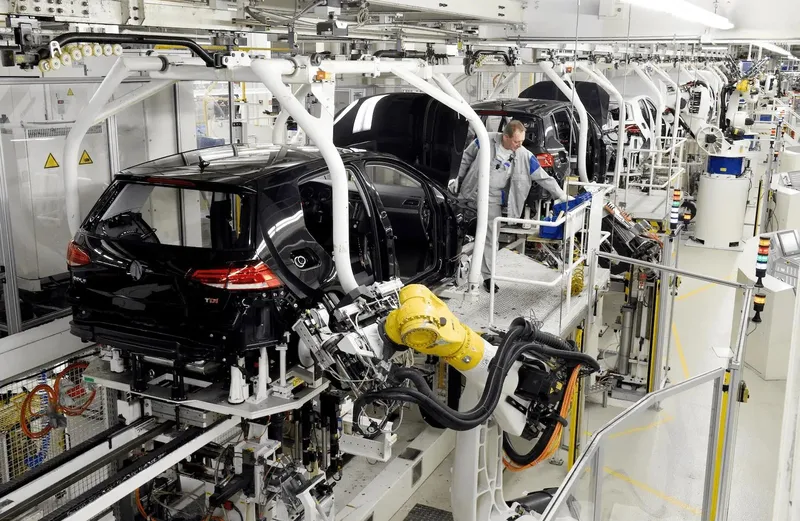
A factory is not merely a building filled with machinery. Around it develop suppliers, engineers, technicians, logistics networks, laboratories, specialist schools and countless forms of expertise that are difficult to recreate once they disappear.
This is one reason China's industrial power extends far beyond the value of its exports. It rests on ecosystems capable of producing at a scale rarely matched elsewhere, from consumer goods to solar panels, batteries, ships and an expanding range of advanced technologies.
The renewed emphasis on industrial policy in the United States, Europe, India and elsewhere reflects the same realization: economic efficiency and strategic security do not always coincide.
Producing something domestically at a higher cost can sometimes be more valuable than depending entirely on an external supplier.
Industry has returned to the centre of power politics because states have rediscovered a simple truth: during a major crisis, what you can actually manufacture matters more than what you thought you could buy.
Money Is an Invisible Frontier
Not every form of power can be seen from space.
Some are contained within a unit of account.
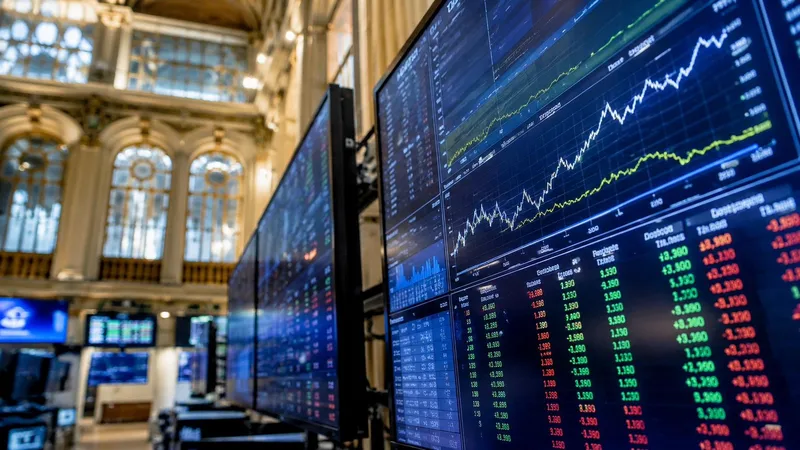
The dollar's position in the international financial system gives the United States an advantage that no military division could precisely replicate. The depth of American capital markets, the role of Treasury securities, the reach of U.S. financial institutions and the international use of the dollar give the country an exceptional capacity to finance its economy and transmit some of its decisions far beyond its borders.
That power is neither absolute nor immutable.
But it reminds us that a currency is more than a means of payment.
It is an infrastructure of trust.
For a currency to become genuinely international, a government cannot simply declare it so. Deep markets, credible institutions, liquid assets, a sufficiently predictable legal system and a large number of foreign actors willing to store their wealth in that currency are all required.
Financial power therefore rests on something paradoxical.
It depends partly on the confidence of others.
And that confidence can take decades to build.
Energy Remains the Circulatory System of Economies
No artificial intelligence operates without electricity. No data centre, steel mill, railway network, industrial fleet or modern metropolis can permanently escape the energy question.
The forms change.
The constraint remains.
Coal stood at the centre of the first industrial revolution. Oil transformed mobility, warfare and twentieth-century geopolitics. Natural gas became essential to many industrial economies. Nuclear power introduced another form of energy sovereignty. Renewables, batteries and electrification are now opening a new cycle.
Yet the energy transition does not eliminate the geopolitics of resources.
It relocates it.
Copper, lithium, nickel, cobalt, uranium, rare earths and graphite: a more electrified economy still requires raw materials, processing infrastructure and supply chains.
The real advantage therefore belongs less to the country that simply possesses a resource than to the one capable of organizing the entire chain around it: extraction, refining, processing, technology, financing and access to markets.
Owning what lies beneath the ground is one thing.
Turning it into power is another.
Technology Accelerates Everything — Including the Gaps
As technologies become more complex, they reshape the international hierarchy.
Advanced semiconductors provide perhaps the clearest example. Behind a chip measuring only a few centimetres lies a chain of expertise distributed across several countries: design software, architectures, lithography equipment, materials, fabrication and assembly.
No state can easily master the entire chain.
This interdependence might appear to be a weakness. It is also a new form of power. Controlling a component that is exceptionally difficult to replace can generate influence far beyond a country's apparent size.
Artificial intelligence intensifies this logic.
Competition is no longer only about algorithms. It is also about data centres, processors, electricity, networks, data, researchers and the capital required to build increasingly expensive systems.
Technological power is therefore not an abstraction.
It has factories, cables, power stations and balance sheets.
Even the digital world rests upon an extraordinarily physical infrastructure.
Military Force Remains the Ultimate Guarantee
Every era announces the end of war before rediscovering its permanence.
Military force retains a unique place in the architecture of power because it becomes decisive when other mechanisms fail.
But possessing a large military is no more sufficient today than it was in the past.
Sustainable military power requires an industry capable of supplying equipment, finances capable of supporting the effort, a population willing to bear its cost, logistics capable of moving forces and technology capable of preserving their effectiveness.
Contemporary conflicts have also demonstrated the coexistence of extraordinarily sophisticated weapons and almost archaic realities. Satellites, drones, cyber capabilities and artificial intelligence operate alongside artillery, trenches, ammunition stockpiles and the industrial capacity to replace what has been destroyed.
Modern warfare has not replaced industrial warfare.
It has been added to it.
Military power therefore reveals a fundamental characteristic of power itself: its different dimensions cannot be sustainably separated.
Alliances Multiply Power
No country is ever as powerful as the sum of its domestic resources.
Others must also be counted.
The United States' capacity to project influence globally does not derive solely from its economy or armed forces. It also rests on a network of alliances, bases, technological partnerships, financial relationships and intelligence cooperation constructed over decades.
The European Union offers another form of multiplication. Individually, its member states possess very different capabilities. Collectively, their market, regulation, trade and financial weight allow them to exercise considerable global influence, even when their political unity remains imperfect.
Conversely, a state rich in resources but diplomatically isolated may discover that possessing assets does not guarantee the ability to use them fully.
Diplomacy transforms capabilities into relationships.
And relationships can become multipliers of power.
There Is Also the Power of Desire
This may be the hardest dimension to measure.
Why do some countries attract students, entrepreneurs, artists, researchers and capital from around the world?
Why do their universities become global references? Why does their culture cross borders? Why do their language, companies, cities or way of life become points of reference for people who do not live there?
Power also has a dimension of attraction.
It replaces neither economics nor military strength, but it changes the conditions under which both operate.
A country capable of attracting talent can compensate for some of its demographic weaknesses. Prestigious universities feed innovation. An influential culture facilitates the circulation of ideas, brands and, sometimes, political or social norms.
This form of power cannot simply be decreed.
It depends on how others perceive a country.
And that is precisely why it is so difficult to manufacture artificially.
Real Power Is the Capacity to Transform
At this point, it would be tempting to add all these variables together.
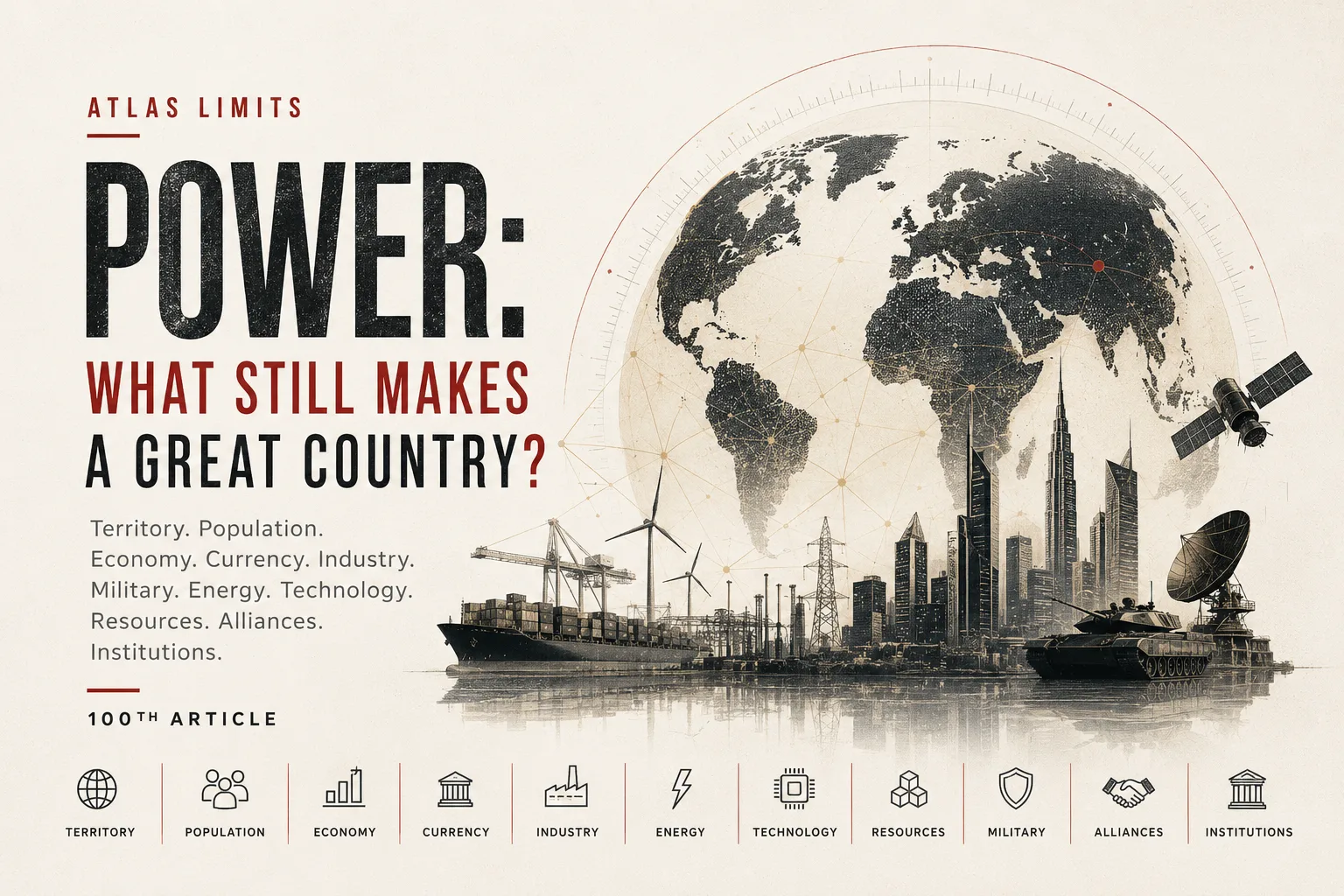
Population. Territory. GDP. Armed forces. Resources. Technology. Currency. Industry. Energy. Alliances.
And then construct a ranking.
That would probably miss the essential point.
History is filled with countries that possessed immense resources but failed to transform them into lasting power. Others, far less favoured by geography or natural wealth, built disproportionate influence through institutions, organization, technology or commercial capacity.
Power is not the sum of available resources.
It is the ability to convert them.
To transform population into human capital. Natural resources into industry. Savings into investment. Invention into enterprise. Armed forces into credible deterrence. Geography into a commercial platform. Alliances into security. Present wealth into future capability.
This is where institutions become decisive.
A state can possess oil and remain poor. It can have a young population and suffer mass unemployment. It can train excellent engineers and watch them leave. It can accumulate capital without investing it effectively. It can purchase technologies without developing the skills required to reproduce them.
Between possession and power lies organization.
And Above All, Endurance
There is one final dimension that rankings struggle to measure: time.
A true power must be capable of absorbing shocks.
A financial crisis. A war. A pandemic. An energy disruption. A technological revolution. A demographic transition. A climate disaster. A political alternation.
The systems that appear most impressive under normal conditions are not necessarily the most resilient when circumstances change.
Resilience then becomes a higher form of power.
It requires institutions capable of correcting their mistakes, an economy sufficiently diversified to absorb disruption, maintained infrastructure, sustainable public finances, a society capable of preserving a minimum degree of cohesion and a political system able to make decisions without destroying its own legitimacy.
To be powerful today therefore means more than being able to impose something on others.
It also means preventing events from imposing their will too easily upon you.
The Great Country of the Twenty-First Century
So what still makes a great country?
Probably no single factor.
Not territory, because some geographical giants remain economically fragile. Not population, because small states can exercise global influence. Not GDP, which does not measure strategic capacity. Not military strength, which cannot function sustainably without an economy. Not natural resources, which can enrich a country as easily as they can trap it. Not even technology, whose advantage can disappear when it ceases to be renewed.
Twenty-first-century power resembles a system more than a pyramid.
Every element strengthens or weakens the others.
Demography feeds the economy, which finances education, which supports technology, which transforms industry, which sustains military power, which protects trade routes, which secure energy and resources, while currency, institutions and alliances give the entire structure additional depth.
Weakness in a single link is not necessarily fatal.
An inability to connect the links may be.
Perhaps this is where the boundary lies between a wealthy country and a powerful one, between temporary power and enduring great-power status.
Great countries are not simply those that possess the most.
They are those capable of transforming what they possess, attracting what they lack, protecting what they build and adapting their model when the world changes.
Yet one final question remains.
Power has traditionally been measured by a state's ability to alter the behaviour of others. But in a century defined by economic interdependence, technological disruption, demographic ageing, environmental pressures and renewed strategic rivalry, another definition may gradually become more important.
Power may increasingly mean a society's capacity to retain control over its own future.
Not to become invulnerable.
No country is.
But to possess enough resources, skills, institutions, alliances and freedom of action to continue making choices when circumstances deteriorate.
Throughout history, powers have sought to expand the limits of what they can do.
In the twenty-first century, their true greatness may be measured by their ability to prevent those limits from being decided by others.
Atlas Limits — 101th article
Atlas Limits Research Desk
Atlas Limits’ editorial and analytical desk.