There is still something strangely misleading about the name Amazon. For hundreds of millions of consumers, it primarily means a website where they can order a book, a phone, a coffee machine, or almost anything else that can fit inside a cardboard box. That image is not wrong. It has simply become profoundly incomplete.
On September 8, 2026, an announcement that could easily have disappeared into the constant flow of artificial intelligence deals provided another illustration of how far the company has moved beyond that original identity. Qualcomm and Amazon unveiled a collaboration spanning multiple generations of custom semiconductors for Amazon Web Services data centers. The work is expected to include processors designed primarily for AI inference — running models that have already been trained — as well as optical connectivity components capable of reaching 1.6 terabits per second.
The agreement is industrial, but its financial architecture says even more about the scale being contemplated. Qualcomm granted an Amazon subsidiary a warrant to acquire up to 25 million Qualcomm shares at an exercise price of $161.26. The regulatory filing submitted to the U.S. Securities and Exchange Commission specifies that 3.75 million of those shares are already vested in connection with initial commitments. Subsequent tranches will vest according to commercial agreements, binding orders and purchases made by Amazon, up to cumulative purchases of $60 billion. The warrant expires in September 2036.
The $60 billion therefore does not represent a firm purchase order. But the fact that a contract between Amazon and a semiconductor company can contemplate such a scale over a decade says something about the distance traveled since Seattle in 1994.
Amazon is no longer simply a company that sells products. It is progressively building part of the physical, digital and logistical infrastructure through which the contemporary economy operates.
From bookseller to system
When Jeff Bezos founded Amazon in 1994 and launched Amazon.com the following year, books were chosen for an almost experimental reason. The potential catalog was enormous, the product standardized and relatively easy to ship. Above all, the internet made it possible to display a selection that no physical bookstore could realistically keep in stock.
The principle that would eventually define Amazon was already visible: use a new infrastructure to eliminate an old economic constraint.
Books were rapidly followed by music, video, electronics, toys and eventually almost every category of consumer goods. Yet the decisive step was not simply the expansion of the catalog. Amazon gradually stopped being only a retailer and became a platform.
Marketplace allowed third-party sellers to access the demand accumulated on Amazon. Fulfillment by Amazon allowed them to use its warehouses and logistics network as well. With Prime, launched in 2005, delivery became a subscription, and the subscription gradually became an ecosystem encompassing commerce, video, music and other services.
Each layer reinforced the others.
More customers attracted more sellers. More sellers expanded selection. Greater selection justified more warehouses. A denser logistics infrastructure enabled faster deliveries. Faster deliveries increased purchasing frequency. That frequency made Prime more attractive, while activity across the platform generated the data required to improve forecasting, recommendations, advertising and inventory allocation.
Amazon was therefore building less a value chain than a loop.
That mechanism partly explains its present scale. In 2025, the group generated $716.9 billion in revenue, up from $638 billion in 2024. North America accounted for $426.3 billion, international operations for $161.9 billion and AWS for $128.7 billion.
Even those figures, however, provide an incomplete picture of the company.
AWS, the accident that became a pillar
In the early 2000s, Amazon encountered a problem very different from that of a traditional retailer. Its growth required enormous computing infrastructure, while internal teams repeatedly found themselves rebuilding many of the same technical capabilities.
Eventually, the company turned that problem into a product.
Amazon Web Services emerged progressively from 2006 with a proposition that seems obvious today but was anything but obvious at the time: instead of purchasing and operating their own servers, companies could rent computing power, storage and other infrastructure on demand.
The modern cloud began to take shape.
AWS changed Amazon's economics. Commerce remained enormous, but behind it appeared a much higher-margin infrastructure business.
In 2025, AWS represented only about 18% of Amazon's consolidated revenue, with $128.7 billion in sales. Yet it generated $45.6 billion of the group's $80 billion in operating income.
In other words, more than half of Amazon's operating profit came from an activity that is almost invisible to the consumer watching a parcel arrive at the door.
And that activity is accelerating again.
In the second quarter of 2026, AWS revenue increased 37% year on year to $42.2 billion. Operating income reached $16.6 billion. Its quarterly revenue therefore implied an annualized sales rate exceeding $169 billion.
The bookseller had become a retailer. The retailer had become a logistics operator. And the logistics operator had also become one of the world's largest owners of computing infrastructure.
Artificial intelligence is now driving another transformation.
After the cloud, the machine
Cloud computing allowed Amazon to sell computing power without requiring customers to own the machines. AI is now pushing the company much deeper into what actually sits inside those machines.
AWS has developed several generations of proprietary semiconductors.
Graviton targets general-purpose computing using the Arm architecture. Inferentia was designed for artificial intelligence inference. Trainium targets model training.
The logic is fundamentally economic. As data centers grow to extraordinary dimensions, even small percentage improvements in computing costs, electricity consumption or server utilization can represent billions of dollars.
The processor therefore ceases to be merely a component purchased from a supplier. It becomes an instrument for controlling the cost of production.
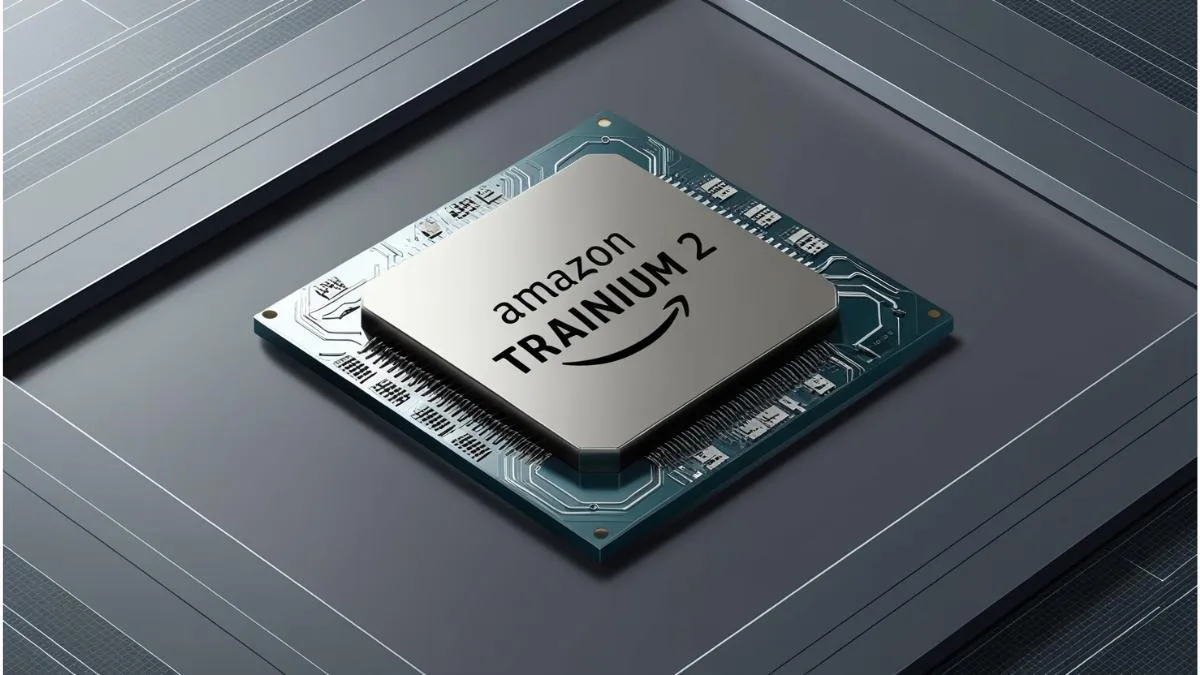
Amazon has gone particularly far with Trainium. Project Rainier, developed with Anthropic, became one of the largest AI computing clusters ever assembled, using nearly half a million Trainium2 chips when it entered operation. Anthropic now uses this infrastructure at enormous scale to develop and run its models.
The relationship between the two companies also extends beyond that of a cloud provider and a customer. Amazon is a major investor in Anthropic.
This is one of the defining characteristics of the emerging AI economy: the boundaries between customer, supplier, investor and industrial partner are becoming increasingly blurred.
Amazon provides infrastructure to AI companies. It finances some of them. Their computing consumption justifies the construction of additional data centers. Those facilities increasingly use processors designed by Amazon itself. The experience accumulated there can then be converted into infrastructure sold by AWS to other customers.
The loop appears again.
Why Qualcomm enters the picture
Against this backdrop, the Qualcomm agreement may initially appear contradictory.
Why would Amazon, while investing heavily in Trainium and Inferentia, help another semiconductor company develop processors for the same data centers?
Because the objective of a hyperscaler is not necessarily to manufacture every chip itself. It is to avoid becoming completely dependent on any single architecture.
Nvidia remains the center of gravity of AI acceleration. AMD is attempting to erode that dominance. Broadcom and Marvell participate in the development of custom silicon for major technology groups. Google, Microsoft and Amazon are simultaneously developing their own architectures.
Qualcomm now adds another variable.
The San Diego company possesses considerable expertise in energy-efficient processors and communications technologies. Its historical empire was built around smartphones and Snapdragon, but that dependence on mobile devices is also a vulnerability. Data centers therefore represent a potentially significant avenue for diversification.
Qualcomm had already announced its Dragonfly data-center roadmap in 2026 and a multiyear collaboration with Meta around server processors. Its portfolio also includes rack-scale inference platforms and interconnection technologies reaching 800 Gbit/s and 1.6 Tbit/s.
Amazon now offers something rarer than simple technological validation: the possibility of gaining an anchor customer capable of absorbing enormous volumes.
The warrant granted to Amazon makes the relationship particularly interesting. As purchases increase, Amazon progressively acquires additional rights to Qualcomm equity. Qualcomm gains the prospect of substantial volumes; Amazon gains an increasing financial interest in the value created by that expansion.
The customer can therefore become a partial owner of its supplier precisely because it is helping that supplier reach a different scale.
The battle shifts toward inference
The agreement also reveals something about the evolution of artificial intelligence itself.
The first phase of the generative AI revolution concentrated attention on training. Building the largest models required tens of thousands of extremely powerful processors, placing Nvidia's accelerators at the center of the new digital infrastructure.
But a model is trained only a limited number of times. Once deployed, it can be queried billions of times.
That is inference.
And if AI agents, assistants, search engines, industrial systems, vehicles, professional software and consumer applications become widespread, the economics of inference could become enormous.
The question is then no longer simply which chip can perform a calculation fastest. It becomes how much each query costs, how much electricity it consumes, how much memory is available, how quickly data can move between processors and how much computing capacity can be installed within the electrical constraints of a data center.
That is precisely the economy Qualcomm is attempting to enter.
Its mobile heritage, long regarded as distant from the data center, could paradoxically become relevant. Inside a smartphone, computing power has always had to negotiate with a brutal constraint: the battery. Inside an AI data center, the constraint changes in scale but not entirely in nature. Electricity, cooling and grid availability are progressively becoming physical limits on computing expansion.
Energy efficiency therefore becomes a strategic variable.
The $200 billion
This evolution helps explain one of the most spectacular numbers associated with Amazon today.
Andy Jassy has indicated that Amazon expects roughly $200 billion in capital expenditure in 2026.
That amount exceeds the annual GDP of many countries.
It is not exclusively dedicated to AI. Amazon continues to invest in logistics networks, buildings, equipment and other infrastructure. But the company has explicitly indicated that artificial intelligence is a major driver of the increase in investment.
The phenomenon is already visible in its cash flows. During the twelve months ended June 2026, Amazon generated $161.4 billion in operating cash flow. Yet free cash flow turned negative to $7.6 billion, primarily because net purchases of property and equipment increased by $66.1 billion.
Amazon is therefore converting a considerable portion of the cash generated by its present businesses into physical capacity for its future ones.
Data centers. Servers. Processors. Networks. Electrical systems. Logistics infrastructure. And increasingly, technologies over whose design the group exercises direct control.
The digital economy here recovers a materiality that is sometimes forgotten. The cloud is not in the sky. It occupies buildings, consumes chips, copper, fiber, electricity and water, mobilizes global supply chains and requires hundreds of billions of dollars in capital.
Amazon sits at the intersection of these flows.
Commerce as infrastructure
None of this means that the old Amazon is disappearing.
On the contrary, its commercial operations continue to grow and evolve. Its network of warehouses, sorting centers and delivery infrastructure constitutes a physical system that few private companies can match. Marketplace allows Amazon to organize a portion of global commerce without necessarily owning the products being sold. Fulfillment turns that marketplace into a logistics service. Prime reduces the friction between the desire to purchase something and its fulfillment.
Another business has developed almost silently on top of that architecture: advertising.
When consumers search for products on Amazon, they reveal exceptionally precise commercial intent. That information has value, which Amazon can sell to brands and merchants seeking visibility at the exact moment when a purchasing decision is being formed.
Amazon has therefore become simultaneously a store, a shopping mall, the owner of the shelves, the logistics operator and the seller of the advertising space positioned in front of those shelves.
AWS reproduces something similar in another universe.
Amazon does not necessarily need to create every application running in the cloud. It seeks to provide the infrastructure on which those applications operate.
With AI, that strategy is moving one layer deeper: toward the processors, networks and electrical capacity required for computation itself.
A company built around reducing friction
There is another way to read Amazon's history.
Perhaps the company is not fundamentally a retailer, a logistics operator or a cloud provider. Perhaps it is a company that identifies economic friction and then builds infrastructure capable of reducing it.
In commerce, the friction was the distance between the consumer and the product.
Amazon built the marketplace and the logistics network.
In enterprise computing, the friction was purchasing, installing and operating servers.
Amazon built AWS.
In artificial intelligence, the friction is becoming the cost of computation, access to accelerators, energy, memory and the movement of data.
Amazon is now building data centers, designing processors, financing model developers and organizing an ecosystem of suppliers around that infrastructure.
But this strategy carries a consequence: the more friction Amazon removes for its users, the more those users can become dependent on the infrastructure that removes it.
This is where economic power intersects with competition.
A merchant can use Marketplace to reach millions of consumers, but then depends on the platform's rules. A company can build its infrastructure on AWS without owning servers, but switching providers can become increasingly difficult as its architecture incorporates more proprietary services. An AI developer can access enormous computing power without building a data center, but that capacity belongs to a small number of hyperscalers.
Convenience and dependence are not necessarily opposites. They can be two sides of the same system.
Amazon after Amazon
With a market capitalization of roughly $2.8 trillion in early September 2026, Amazon now belongs to the small group of companies whose value is measured in trillions of dollars.
Yet its real singularity lies less in its size than in the variety of infrastructures it controls or organizes.
Very few companies can physically transport a product from manufacturer to consumer while simultaneously hosting the software of the company selling it, providing the artificial intelligence models used to optimize demand, selling the advertising that makes the product appear in search results and, increasingly, participating in the design of the processors on which some of those calculations will run.
The Qualcomm agreement should therefore be understood at this scale.
It does not prove that Amazon will purchase $60 billion worth of components. The regulatory filing says something more precise: Amazon's rights will evolve according to commercial agreements, orders and purchases actually made, up to that threshold. Nor does the agreement establish what position Qualcomm will ultimately occupy relative to Nvidia, AWS's existing partners or Amazon's own processors.
But it shows the direction.
The Amazon of the 1990s wanted to build the world's largest store.
The Amazon of the 2000s discovered that it could rent out its computing infrastructure.
The Amazon of the 2010s transformed that activity into one of the principal infrastructures of the global digital economy.
The Amazon of the 2020s is now descending toward the physical layers of artificial intelligence: chips, interconnects, data centers and energy.
The storefront is still there. Millions of cardboard boxes continue to leave it every day.
But behind it, Amazon is building something else: an infrastructure large enough that companies which will never sell a single product on Amazon may nevertheless operate, compute and develop their artificial intelligence inside its world.
Main sources
Amazon.com, 2025 Annual Report and Form 10-K, U.S. Securities and Exchange Commission.
Amazon.com, second-quarter 2026 results, July 30, 2026.
QUALCOMM Incorporated, Form 8-K filed with the U.S. Securities and Exchange Commission on September 8, 2026, concerning the warrant issued to Amazon.com NV Investment Holdings LLC.
Qualcomm, Qualcomm Dragonfly data-center documentation and roadmap, 2026.
Amazon Web Services, documentation relating to AWS Trainium, Inferentia, Graviton and Project Rainier.
Reuters, “Qualcomm, Amazon strike $4 billion custom chip deal,” September 8, 2026.
Atlas Limits Research Desk
Atlas Limits’ editorial and analytical desk.