Money became digital long before the expression “digital currency” entered the vocabulary of central banks. Salaries arrive in bank accounts as electronic entries, cards move bank liabilities without a single banknote changing hands, financial markets transfer trillions every day through electronic infrastructures, and mobile applications have made the act of paying almost invisible. In advanced economies, much of money already has no physical existence.
And yet something different is beginning.
The transformation now underway is no longer simply about digitising payment methods. It reaches into the architecture of money itself: who issues it, in what form it exists, on which ledger it circulates, who can hold it, which institutions guarantee its value, what information accompanies each transaction and, increasingly, what instructions can be embedded into its use.
Behind central bank digital currencies, stablecoins, tokenised bank deposits and cryptoassets, a much broader competition is emerging. Central banks, commercial banks, governments, technology companies, payment networks and blockchain infrastructures are competing not merely to invent a new way to pay, but to determine the technological foundations on which twenty-first-century money will circulate.
The battle is about money. But it is just as much about its operating system.
Money was already digital
The first difficulty is avoiding a confusion of terminology. A central bank digital currency, a bank deposit, a stablecoin and Bitcoin can all appear as numbers displayed on a screen. Economically, however, they represent profoundly different objects.
A €1,000 balance in a bank account is a claim on a commercial bank. A €100 banknote, by contrast, is a liability of the central bank and belongs to what economists call central bank money. A central bank digital currency, or CBDC, would extend this latter principle into the digital realm: it would be denominated in the national unit of account and constitute a direct liability of the central bank.
A stablecoin introduces another relationship. A token pegged to the dollar is issued by a private entity promising to maintain its value relative to official currency through reserves composed, depending on the structure, of cash, bank deposits, government securities or other assets. Its stability therefore depends not only on the dollar it references, but on the quality and liquidity of its reserves, the governance of the issuer and its ability to honour redemptions.
Tokenised deposits constitute yet another category. They remain liabilities of commercial banks, like ordinary deposits, but are represented on programmable infrastructure. The Bank for International Settlements sees them precisely as a way of carrying the characteristics of the two-tier banking system into a tokenised environment.
Bitcoin, finally, occupies a radically different position. It is the liability of no central bank, commercial bank or corporation. Its existence rests on a protocol, a distributed ledger and a consensus mechanism. Its scarcity is determined by code rather than by a monetary institution. That independence is precisely what makes it distinctive, but it also explains why its economic behaviour differs profoundly from that of sovereign money.
To speak of “digital money”, therefore, is to group several competing conceptions of money under a common appearance.
The ledger is the real starting point
Every digital currency rests on an apparently technical question that rapidly becomes political: who keeps the ledger?
In the current banking system, banks record their customers’ claims in their own databases, while central banks maintain the accounts through which final settlement occurs between financial institutions. The systems are interconnected through a succession of messages, clearing procedures, reconciliations and settlements.
Blockchain introduced another possibility: several participants can share a common state of the ledger and collectively determine which transactions are valid.
Bitcoin represents the most radical version of this architecture. Its network is public and permissionless: no central operator decides who may participate in validating the ledger. Proof of work allows participants to reach consensus over its state, at the cost of resource consumption and with transaction capacity fundamentally different from that required of a global retail-payment infrastructure.
But blockchain and digital money are by no means synonymous.
A central bank can perfectly well build a CBDC on a centralised database. It can also use distributed ledger technology, or DLT, in which only authorised participants validate transactions. It can combine several technologies in a hybrid architecture.
This distinction is fundamental. In a public blockchain, the consensus mechanism exists partly because no central authority is assumed to be trusted. A central bank begins from the opposite premise: it is precisely the authority responsible for guaranteeing the currency. Mechanically reproducing Bitcoin’s architecture inside a CBDC would therefore make little sense.
The technological choice depends instead on other criteria: transactions per second, latency, settlement finality, resilience, cybersecurity, privacy, operating costs, offline capability and the ability to connect the system to existing financial infrastructure.
Monetary technology is never neutral. The architecture of the ledger partly determines where power resides.
Account or token: two ways of representing money
A second distinction lies behind the user interface.
In an account-based system, the ledger associates a balance with an identity or account and authorises transfers after the user has been verified. In broad terms, this is how modern banking works.
A token-based architecture shifts more attention towards the instrument itself and towards the holder’s ability to demonstrate that it can legitimately be transferred. Cryptography can then verify this ability without necessarily reproducing the exact functioning of a conventional bank account.
The boundary, however, is not as simple as an opposition between digital coins and digital accounts might suggest. A CBDC can be tokenised while relying on identified intermediaries; a distributed ledger can record accounts; a centralised system can manage instruments displaying some characteristics of tokens.
The real break occurs elsewhere: when a monetary unit becomes a digital object capable of interacting directly with other digital objects.
This is where tokenisation begins.
When money meets code
A traditional financial security and the payment used to purchase it often move through separate systems. A bond is recorded in one infrastructure, the money used to buy it in another. Messages must travel between institutions so that each can update its own records. The arrangement works, but it creates delays, reconciliation requirements, counterparty risks and layers of intermediate processes.
Tokenisation proposes representing the asset and, potentially, the money on compatible programmable infrastructures.
A tokenised bond can then be transferred at the same moment as the money used to purchase it. Delivery versus payment can become atomic: either both transfers occur or neither does. The risk that one party delivers while the other fails to pay can be substantially reduced.
The same principle can apply to two currencies through payment versus payment. In a foreign-exchange transaction, both legs can be linked so that they execute simultaneously.
Smart contracts add another layer. They allow execution rules to be embedded into the transactional environment: releasing a payment once specified conditions have been met, automatically managing collateral, executing margin calls, distributing coupons, performing compliance controls or triggering conditional settlement.
Money then ceases to be merely information transferred between two accounts. It becomes one component of a programmable transaction.
This is probably where the most consequential transformation lies.
From programmable money to programmable payments
The expression “programmable money” nevertheless requires care.
It can describe two very different realities. In the first, the money itself contains restrictions determining where, when or for what purpose it may be spent. In the second, money remains fungible and freely usable, but the infrastructure makes it possible to programme the conditions of a payment.
The political distinction is considerable.
A smart contract capable of automatically paying a supplier once delivery of an asset is confirmed does not necessarily mean that the state has created money whose every use it can control. The architecture can programme the transaction without programming the nature of the monetary unit itself.
The boundary between payment programmability and money programmability is therefore likely to become one of the major regulatory debates of the coming years.
What represents an extraordinary capacity for automation in financial markets could also become, depending on the architecture chosen, an extraordinary instrument of control.
The cryptography behind trust
Digital money must solve a contradiction that the banknote handles with remarkable simplicity.
A banknote can be transferred without a server, internet connection or password and without revealing its holder’s identity to a central infrastructure. Yet it is extremely difficult to reproduce, and payment is immediately final: once the banknote changes hands, settlement is complete.
Replicating these properties in the digital world is extraordinarily difficult.
Public-key cryptography provides part of the answer. A pair of cryptographic keys allows a user to sign a transaction and the network to verify its authenticity without knowing the private key. Digital signatures protect the integrity of instructions. Hash functions make alterations detectable. Hardware security modules, or HSMs, can protect cryptographic secrets inside financial infrastructure.
But this security also shifts responsibility. In a non-custodial wallet, losing a private key can mean losing access to the asset. In a custodial wallet, an intermediary holds the keys, reintroducing a relationship of trust resembling that of traditional finance.
CBDCs must solve the problem differently. A central bank cannot reasonably build a national monetary system in which losing a telephone means permanently losing one’s money. Recovery, identity and intermediation mechanisms therefore become necessary.
Digital money thus rediscovers an old truth: removing an intermediary from a protocol is relatively easy; eliminating all the functions that intermediary performed is considerably harder.
The almost insoluble problem of privacy
The question of identity leads directly to surveillance.
Cash permits local transactions that do not automatically generate a centralised history. Digital money, by contrast, leaves computational traces. The question is therefore not whether data exist, but who can see them, who can link them together and under what circumstances.
A completely anonymous CBDC would reproduce some properties of cash but considerably complicate anti-money-laundering and illicit-finance controls. A fully traceable CBDC would provide powerful compliance capabilities but could create an unprecedented infrastructure for financial surveillance.
Between the two lie more sophisticated cryptographic solutions.
Pseudonymisation can separate some transactions from immediately visible civil identities. Zero-knowledge proofs can, in principle, demonstrate that a condition has been satisfied without revealing all the information used to verify it. BIS Innovation Hub projects have explored privacy-enhancing technologies, including pseudonymisation and zero-knowledge techniques, while seeking to preserve regulatory requirements.
The challenge is considerable: to build infrastructure capable of verifying that a transaction is legitimate without transforming every payment into freely exploitable data.
The future of digital money will therefore depend as much on advances in applied cryptography as on decisions made by central banks.
Paying when the network disappears
Any currency claiming to reproduce some of the functions of cash encounters another problem: what happens when the internet disappears?
A network outage, natural disaster, cyberattack or simply poor connectivity cannot, in principle, make money unusable.
Offline payments therefore constitute one of the most interesting technological challenges for retail CBDCs. Two devices must be capable of transferring value without immediately contacting the central ledger, while preventing a user from spending the same units twice.
This requires secure hardware environments capable of locally storing monetary information and controlling its use before subsequent synchronisation with the central infrastructure.
The Eurosystem has been working on this problem for the digital euro, including technological approaches intended to enable offline payments through secure elements in user devices while keeping sensitive offline-payment information locally protected.
Digital money eventually encounters not only cryptography, but the semiconductor industry.
The digital euro: monetary sovereignty and infrastructure
Europe offers one of the most advanced laboratories for this transformation.
After an investigation phase between 2021 and 2023 and a preparation phase completed in 2025, the Eurosystem has continued the technical and institutional work required for a possible digital euro. Its eventual issuance remains dependent on the European legislative process and subsequent decisions by the European Central Bank.
The project is conceived as a complement to cash and private payment instruments rather than as their replacement. Holdings are expected to be designed in a way that limits the risk of large-scale migration of commercial-bank deposits into central bank money.
But the digital euro also responds to a question of sovereignty.
A significant part of European electronic payments depends on private infrastructure and, for some functions, non-European groups. Maintaining a public digital payment instrument denominated in euros is therefore also about preserving the operational presence of central bank money in an economy where cash represents a declining share of everyday payments.
The ECB has emphasised resilience, offline functionality, privacy and distribution through payment-service providers. Its approach seeks to prevent the Eurosystem from obtaining unnecessary visibility into individual users’ payments while allowing offline transactions to achieve a level of privacy closer to that associated with cash.
The digital euro is therefore not merely another payment instrument. It is an attempt to define what European public monetary infrastructure should look like in the digital age.
China and the United States: diverging trajectories
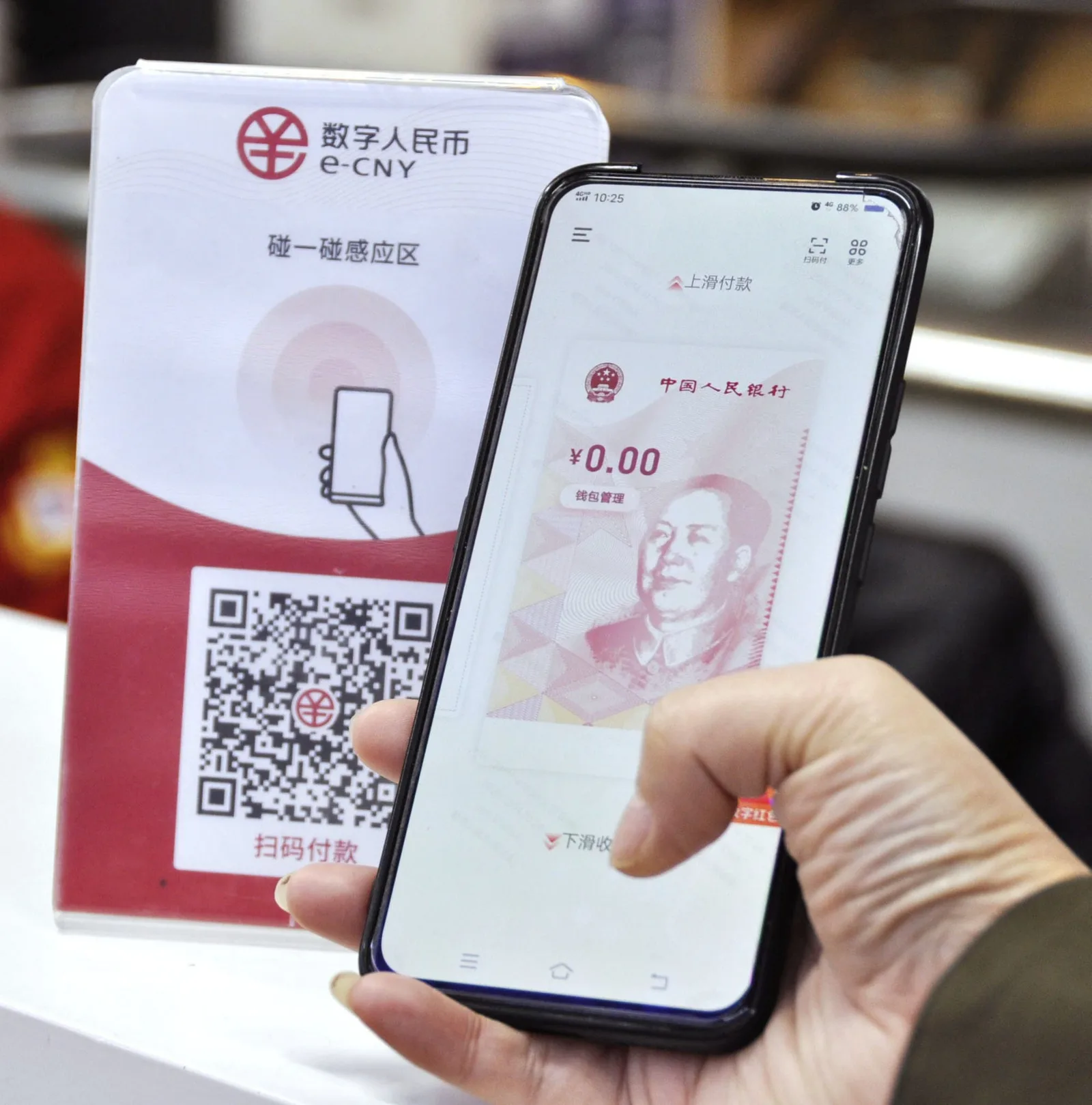
China has followed a different trajectory with the e-CNY, one of the most advanced sovereign digital-currency projects among major economies. Its development takes place in an environment where mobile payments had already profoundly transformed consumer behaviour and where the state possesses considerable capacity to coordinate financial and technological infrastructure.
But the Chinese question extends beyond retail payments. Cross-border experimentation has also placed China at the centre of research into the use of CBDCs for international settlement. Project mBridge, initially developed with the BIS Innovation Hub and participating monetary authorities including those of Hong Kong, Thailand, the United Arab Emirates and China, demonstrated the possibility of direct cross-border payments and settlement using distributed-ledger infrastructure and central bank money.
The United States has taken an almost opposite direction.
Since the January 2025 executive order on digital financial technology, US federal policy has opposed the establishment, issuance or promotion of a federal CBDC while explicitly supporting the development of lawful dollar-backed stablecoins.
The divergence is remarkable.
Europe is pursuing the possibility of public digital money. China has spent years experimenting with a CBDC and associated settlement infrastructure. The United States has leaned towards an architecture in which private actors can extend the dollar onto digital networks.
Three models are emerging: public digitisation of money, highly coordinated sovereign infrastructure, and the private extension of a dominant currency.
Stablecoins: the Trojan horse of the digital dollar
Stablecoins could ultimately produce an unexpected geopolitical outcome.
They emerged within the crypto ecosystem to solve a practical problem: providing a relatively stable blockchain-based asset that allowed trading without constantly returning to the conventional banking system. But the largest stablecoins are denominated in dollars.
Whenever a user outside the United States holds savings or settles a transaction in a dollar stablecoin, that person is effectively using a private digital representation of the American currency.
At scale, this could create a new form of dollarisation.
In countries facing high inflation, capital controls or weak domestic currencies, gaining access to a dollar token through a smartphone may become easier than opening a dollar-denominated bank account. International monetary competition could consequently migrate into applications and globally accessible blockchain networks.
The paradox is striking: while some states develop CBDCs to defend monetary sovereignty, private innovation could simultaneously extend the international reach of the dollar.
But that power has a price. A stablecoin remains dependent on its issuer, its reserves, the banks holding those reserves, the markets in which they are invested, the blockchain on which the token circulates and the mechanisms enabling redemption.
Behind the apparent simplicity of a digital dollar lies a chain of trust.
Technology does not eliminate financial risk. It relocates it.
Banks confronting their own disintermediation
The transformation becomes still more delicate when it reaches bank deposits.
Commercial banks do more than store money. Through lending, they create a substantial proportion of the money used throughout the economy. Deposits are also a fundamental source of bank funding.
An unlimited retail CBDC could alter that balance.
If households could instantly transfer all their deposits into a risk-free claim on the central bank, why would they maintain large balances at commercial banks? During a crisis, the question would become more severe: a bank run could theoretically take place from a smartphone within seconds.
This is one reason why retail CBDC projects commonly consider intermediated architectures, holding limits or other mechanisms designed to preserve financial stability.
Banks are simultaneously exploring a technological response: tokenised deposits.
Instead of allowing stablecoins or CBDCs to occupy programmable infrastructure alone, banks can bring commercial bank money onto those platforms. Legally and economically, the deposit remains a bank liability, but technologically it acquires some of the operational properties of a token.
The battle, therefore, is not simply between “old banking” and crypto. Established institutions are attempting to absorb technologies that initially appeared designed to circumvent them.
The BIS laboratory
This convergence is particularly visible in the work of the Bank for International Settlements.
The BIS has developed the concept of a unified ledger or programmable monetary environment capable of bringing together tokenised central bank money, tokenised commercial-bank deposits and tokenised financial assets. Such an infrastructure does not necessarily require DLT: the objective is less to impose a particular technology than to make money and assets programmable and composable within a coherent environment.
Project Agorá is among the most significant experiments in this direction.
It brings together central banks and a large group of private financial institutions to explore how tokenised commercial-bank deposits and tokenised central-bank reserves could improve cross-border, multi-currency settlement.
The importance of such experiments lies less in the monetary amounts involved than in the mechanics being tested.
A transaction involving several currencies can potentially be settled atomically while central banks retain domestic control over their reserves. Smart contracts can incorporate payment conditions and some compliance processes directly into the transaction workflow.
In other words, the research is no longer concerned only with creating digital money for consumers.
It is exploring the possible reconstruction of the plumbing of international finance.
The real challenge: interoperability
A perfectly designed digital currency that cannot communicate with the rest of the financial system has limited utility.
Interoperability is therefore probably the most strategic technical problem of all.
Public blockchains are themselves fragmented across layer-one networks, secondary layers and protocols whose assets do not naturally move between one another. Bridges designed to overcome this fragmentation introduce their own technical and security risks.
Permissioned infrastructure faces a different difficulty: separate systems may use incompatible governance rules, identity standards, data models and legal regimes.
And beyond these new infrastructures lies the existing financial system: instant-payment networks, card networks, correspondent banks, clearing houses, central securities depositories, securities markets and central-bank real-time gross settlement systems.
The system that ultimately succeeds will therefore not necessarily be the one with the most elegant token. It will be the one capable of connecting these worlds.
APIs, messaging standards, identity protocols, conversion mechanisms and legal frameworks consequently become as important as blockchain itself.
The history of the internet offers a useful analogy. Its power did not come from a single network performing every function, but from protocols that enabled different networks to communicate. Digital money may follow a similar trajectory: strategic value could gradually shift from the instrument itself towards the standards that make different instruments interoperable.
Beneath the software lies physical infrastructure
The dematerialisation of money can create the impression that it is escaping the physical world. The opposite is true.
Digital money depends on data centres, telecommunications networks, fibre-optic links, satellites, submarine cables, processors, cryptographic modules, smartphones, secure elements, cloud systems and electricity.
It also depends on extraordinarily complex software: identity-management systems, fraud engines, public-key infrastructure, APIs, monitoring systems, backup facilities and disaster-recovery mechanisms.
A sovereign digital currency therefore creates a new definition of monetary sovereignty.
Controlling issuance is no longer enough. Governments and central banks must understand where servers operate, who manufactures secure components, who supplies cloud infrastructure, who controls technical standards, who develops critical software, who controls user devices and through which networks the data travel.
Money here joins semiconductors, cloud computing and telecommunications on the list of strategic infrastructure.
Cyber risk becomes monetary risk
The more money depends on software, the more cybersecurity becomes part of financial stability.
An attack against a bank can paralyse an institution. A successful attack against the infrastructure of a sovereign digital currency could potentially affect part of the monetary system itself.
Architectures must therefore withstand not only intrusions, but outages, data corruption, denial-of-service attacks, key compromise, supplier failures and disaster scenarios.
Geographic redundancy, system segmentation, HSMs, key rotation, recovery procedures, cryptographic audits and continuous testing become instruments of monetary policy in the most concrete sense: without them, the money could simply cease to function.
Resilience is no longer a peripheral quality of the system.
It becomes a property of money itself.
What happens to payment networks?
Between central banks and new blockchain networks sit actors sometimes overlooked in the fascination with CBDCs: existing payment networks.
Visa, Mastercard, domestic card schemes, instant-payment systems, acquirers, processors and fintech companies already operate networks connecting billions of users and millions of merchants.
A new currency does not automatically replace this distribution infrastructure.
The strategic question for these companies will be whether they can become interoperability layers between bank money, stablecoins, tokenised deposits and potentially CBDCs. Some established infrastructures may lose part of their traditional role; others could become even more important by providing interfaces between different monetary environments.
The monetary revolution may therefore produce a familiar outcome: new rails do not necessarily destroy incumbent institutions, but they force them to change function.
Geopolitics enters the protocol
Since Bretton Woods, international monetary power has largely been organised around currencies, banks, capital markets and payment infrastructure.
Digital money adds another layer: the protocol.
If CBDCs become directly interoperable between central banks, some international transactions could follow routes different from traditional correspondent banking. If dollar stablecoins become global payment instruments, they could instead extend American monetary influence across new networks. If major economic blocs develop incompatible infrastructures, geopolitical fragmentation could become technological fragmentation of money itself.
Financial sanctions are obviously part of this equation. But the issue is broader.
Whoever defines standards for identity, compliance, interoperability and settlement helps define the rules of international digital commerce.
Control over money has always been an attribute of power.
In the digital age, control over its architecture may become one as well.
A revolution that may remain hybrid
It is tempting to imagine that one technology will eventually eliminate all the others: Bitcoin replacing national currencies, CBDCs eliminating banks, stablecoins replacing payment systems or blockchains absorbing the whole of finance.
Current developments suggest something more complicated.
The monetary system of the future may be even more composite than the one we have today.
Cash may survive as physical infrastructure of last resort. Bank deposits may remain central to financing the economy. CBDCs may provide a digital form of public money. Stablecoins may serve certain international transactions and digital environments. Tokenised deposits may allow banks to participate in programmable markets. Public blockchains may continue to host natively digital assets. Permissioned ledgers may process part of institutional finance.
Above them, interoperability layers could allow value to move from one environment to another.
This would be less the replacement of one monetary system than the emergence of a new monetary architecture.
The battle for twenty-first-century money
For centuries, the form of money has changed without altering one fundamental question: trust.
A coin had value because a sovereign guaranteed its metal or weight. A banknote had value because an institution guaranteed its convertibility and, later, because the state and central bank guaranteed the system giving it legal and economic credibility. A bank deposit has value because a network of institutions, regulations, balance sheets and settlement mechanisms allows a commercial-bank euro to be treated as equivalent to a central-bank euro.
Digital money does not make this architecture of trust disappear.
It makes it visible.
Bitcoin places part of that trust in a protocol and its consensus mechanism. A stablecoin distributes it across code, reserves, issuer and banking system. A tokenised deposit preserves the commercial bank but changes the infrastructure. A CBDC brings the claim back to the central bank’s balance sheet while introducing a new technological chain between that institution and the user.
Behind the wallet, therefore, there are still institutions, servers, cryptographic keys, legal rules and, ultimately, a conception of power.
The decisive question may no longer be whether money will become digital.
It already is.
The real question is which architecture we will choose to trust when it becomes entirely so.
Main sources
Bank for International Settlements (BIS), Annual Economic Report work on the next-generation monetary and financial system, tokenisation, unified ledgers and central bank money; Project Agorá documentation and results; research on retail CBDCs, privacy-enhancing technologies and Project mBridge.
European Central Bank (ECB), official digital euro documentation, investigation and preparation reports, subsequent development work, and documentation on privacy, resilience and offline functionality.
International Monetary Fund (IMF), research on tokenised finance, stablecoins, settlement assets and their macro-financial implications.
The White House, January 23, 2025 Executive Order on digital financial technology and US policy concerning CBDCs and dollar-backed stablecoins.
Atlantic Council, Central Bank Digital Currency Tracker.
Technological and institutional examples are used to describe existing architectures, policies and experiments. Longer-term conclusions concerning the future structure of the monetary system, competition between infrastructures and their geopolitical consequences constitute Atlas Limits analysis.
Atlas Limits Research Desk
Atlas Limits’ editorial and analytical desk.