For ten years, French politics has revolved around Emmanuel Macron. He has been both its centre of gravity and its principal target. His opponents defined themselves against him, his allies in relation to him, and two successive presidential elections eventually established an almost familiar mechanism: a centrist candidate bringing together parts of the moderate left and liberal right, facing Marine Le Pen in the second round. In 2027, that mechanism cannot simply be reproduced. Macron cannot seek a third consecutive term and, as the election approaches, it is not merely a president preparing to leave the Élysée Palace. The political architecture built around him is beginning to come apart.
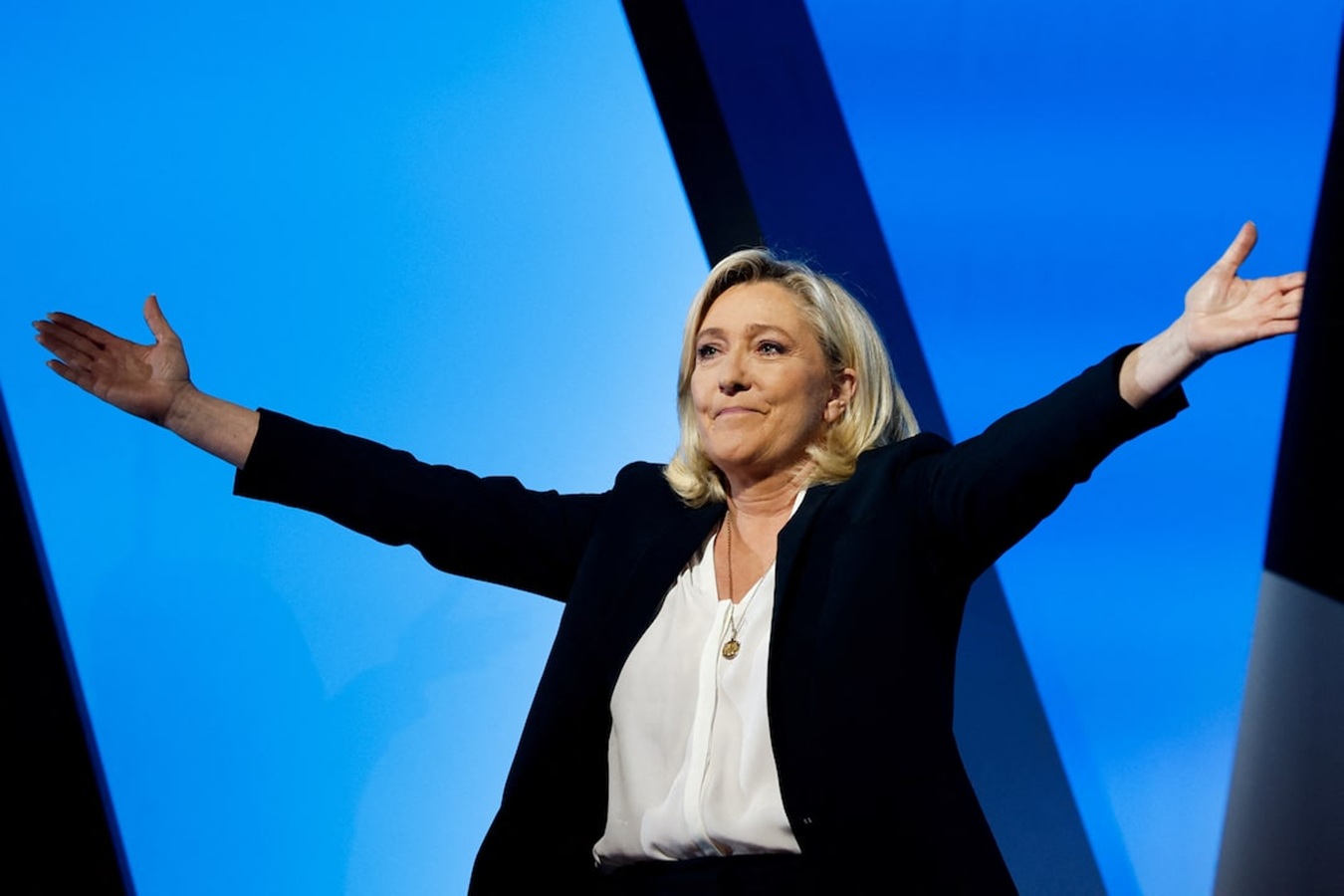
A little more than seven months before the vote, however, an initial hierarchy is emerging with unusual clarity. Marine Le Pen dominates voting intentions. Ipsos bva surveys published in early and mid-September 2026 put her at roughly one-third of the vote, far ahead of every individual rival. In the survey conducted from August 31 to September 2, she received between 34% and 36%, depending on the scenario tested. A much larger survey, conducted from September 3 to 9 among more than 13,000 registered voters, still places her between 33% and 35%. At this stage, no other candidate comes close.
These figures do not predict the outcome of 2027. A poll conducted several months before a presidential election measures the balance of forces at the time it is taken, not the result of the election itself. But when several different configurations produce roughly the same numbers, they reveal something deeper than a weekly fluctuation: the National Rally now possesses the largest and most stable electoral base in French politics.
That is probably the essential change compared with previous elections. In 2017, Marine Le Pen received 21.3% in the first round. In 2022, she rose to 23.2%. The prospect of a result above 30% would therefore represent more than another arithmetic progression. It would mean that the RN is no longer merely a political force capable of reaching the second round because its opponents are fragmented. It is becoming the fixed point around which the other camps must build their strategies.
The loyalty of its electorate reinforces that position. In the early September Ipsos survey, more than 90% of Marine Le Pen's 2022 voters said they intended to vote for her again across the different scenarios tested. Few French political forces currently enjoy that degree of electoral continuity. The RN has also progressively broadened its geographical and sociological reach, transforming what was long treated primarily as a protest vote into a political offer regarded by a growing share of its electorate as a possible government.
That does not mean Marine Le Pen is already the favourite to enter the Élysée Palace. It means something more precise: she is currently the favourite to win the first round.
The distinction is fundamental.
Because behind her, another election is beginning.
The centrist bloc that carried Emmanuel Macron to power in 2017 has not disappeared, but it no longer has an obvious owner. Édouard Philippe currently appears to be its strongest potential candidate. The former prime minister polls between 14.5% and 16.5% when tested alongside Gabriel Attal, but can rise to between 19% and 22.5% when he becomes the only major candidate occupying that political space. That difference almost entirely captures the problem of the post-Macron era.
Macronism succeeded in bringing together voters from different political traditions: social democrats, centrists, liberals, moderate conservatives and part of the educated urban electorate. As long as Emmanuel Macron was the candidate, these constituencies had a strategic reason to remain together. Without him, their differences are returning.
Gabriel Attal can claim part of the presidential legacy. Édouard Philippe is seeking to build a more autonomous political offer capable of recovering part of the moderate right. Bruno Retailleau is attempting to preserve an independent space for Les Républicains. Individually, each strategy has a political logic. Collectively, they can cancel one another out.
This is why the question of a single candidate, or of some mechanism to select one, continues to return in discussions across the centre and right. The problem is not merely ideological. It is mathematical. An electoral space theoretically large enough to produce a second-round candidate can perfectly well be eliminated if it divides itself among several contenders polling at 7%, 10% or 15%. France's two-round presidential system turns fragmentation into an existential risk.
The left faces a comparable difficulty, although in a different form.
Jean-Luc Mélenchon remains its strongest electoral figure. September Ipsos surveys place him at roughly 15% to 17%. He retains significant support among younger voters and within parts of the working-class and urban electorate. His ability to mobilise an established electoral base should therefore not be underestimated.
But that strength is accompanied by an exceptionally high level of rejection. In the early September Ipsos survey, 71% of French respondents said they were “very” concerned about him. The question facing La France Insoumise is therefore no longer simply whether Mélenchon can finish ahead of the other candidates of the left. It is how far his electoral base can expand beyond those already prepared to vote for him.
Raphaël Glucksmann is attempting to occupy precisely that other space. His potential candidacy offers a European, social-democratic and ecological left that is more compatible with part of the centrist electorate. Yet he currently remains behind Mélenchon in the main scenarios tested, generally polling between 11.5% and 14%. Olivier Faure, the Greens and other potential candidacies add further fragmentation.
The French left is therefore confronting an old problem in a new form: it possesses several substantial electorates but, for now, no political figure capable of bringing them together. Mélenchon has the strongest base but also the highest level of rejection. Glucksmann appears better positioned to appeal towards the centre but does not yet possess the same electoral mass. Between them lies precisely the question that could determine qualification for the second round.
The emerging landscape is therefore unusual. The candidate currently most assured of reaching the second round belongs to the RN, while almost all the uncertainty concerns the identity of her opponent.
That is a historic reversal.
For decades, French politics operated around two major governing families, the Socialist left and the Gaullist and later Republican right. The 2017 election destroyed that bipolar structure by installing a dominant third centre. Ten years later, that centre may itself lose its organising function. Yet the old system is not returning. In its place, a configuration is emerging in which the RN holds the largest electoral bloc while several competing forces fight for the ability to constitute the second.
This evolution also changes the meaning of the “republican front”. In 2002, Jean-Marie Le Pen's presence in the second round triggered a massive mobilisation behind Jacques Chirac. In 2017, Emmanuel Macron still won nearly two-thirds of votes cast against Marine Le Pen. By 2022, his margin had narrowed considerably. The mechanism has not disappeared, but its effectiveness has weakened as the RN has become increasingly normalised electorally and voters have become less willing to support a candidate they reject simply to prevent another from taking power.
This is where first-round polling reaches its limits. Marine Le Pen can possess the largest electoral base without necessarily commanding the majority coalition required in the second round. Conversely, her eventual opponent could finish far behind her in the first round and then benefit from transfers of support from several other camps. Everything would depend on who that opponent is. A contest against Édouard Philippe, Jean-Luc Mélenchon or Raphaël Glucksmann would produce radically different patterns of second-round transfers.
The uncertainty remains significant enough that the large Ipsos bva survey published on September 13 did not test second-round voting intentions. At this stage of the campaign, turning those hypothetical match-ups into forecasts would give artificial precision to a situation that remains fluid.
There are still several months during which the economy, purchasing power, public finances, immigration, security, the war in Europe, relations with the European Union or an international crisis could reorder voters' priorities. The field of candidates itself has not yet fully stabilised. French presidential campaigns also have a particular capacity for sudden acceleration: candidates considered inevitable can collapse within weeks, while others can emerge surprisingly late.
But campaigns never begin on a blank page. The 2027 campaign begins with one fact that the other candidates can no longer avoid: the National Rally enters the contest from a position of strength.
The central question therefore becomes less who can defeat Marine Le Pen in the first round than who will still be there to face her in the second.
Édouard Philippe must reunify a centre that no longer has Emmanuel Macron to hold it together. Jean-Luc Mélenchon must transform a solid electorate into a majority coalition despite considerable rejection. Raphaël Glucksmann must demonstrate that a moderate left can expand beyond its current perimeter. Gabriel Attal must decide whether he can become the heir to Macronism without simply reproducing Macronism. The traditional right must choose between preserving its identity and participating in a broader coalition.
Marine Le Pen faces a different problem. Her challenge is no longer simply to reach the second round. Three presidential campaigns and several electoral cycles have largely accomplished that normalisation. Her challenge is now to cross the final frontier: turning a dominant electoral bloc into a presidential majority.
The 2027 presidential election is therefore unlikely to be merely a succession to Emmanuel Macron. It could mark the end of the political cycle opened by his election ten years earlier.
In 2017, the question was whether France's old political system could survive Macron. In 2027, the question is almost the reverse: what remains when Macron disappears from the ballot?
For now, only one political force seems to have found its place in the landscape that is emerging.
The others are still looking for theirs.
Main Sources
Ipsos bva–CESI École d’ingénieurs — “Présidentielle 2027 : le point à 7 mois du scrutin”, survey conducted from September 3 to 9, 2026 among 13,060 registered voters.
Ipsos bva–CESI École d’ingénieurs / Le Parisien — “Présidentielle 2027 : Marine Le Pen conserve une avance nette dans les intentions de vote”, survey conducted from August 31 to September 2, 2026 among 1,500 registered voters.
CEVIPOF — analyses of electoral dynamics and transformations in the French party system.
French Ministry of the Interior — official results of the 2017 and 2022 French presidential elections.
French Constitutional Council — Constitution of the Fifth Republic and provisions governing the presidential term.
Atlas Limits Research Desk
Atlas Limits’ editorial and analytical desk.