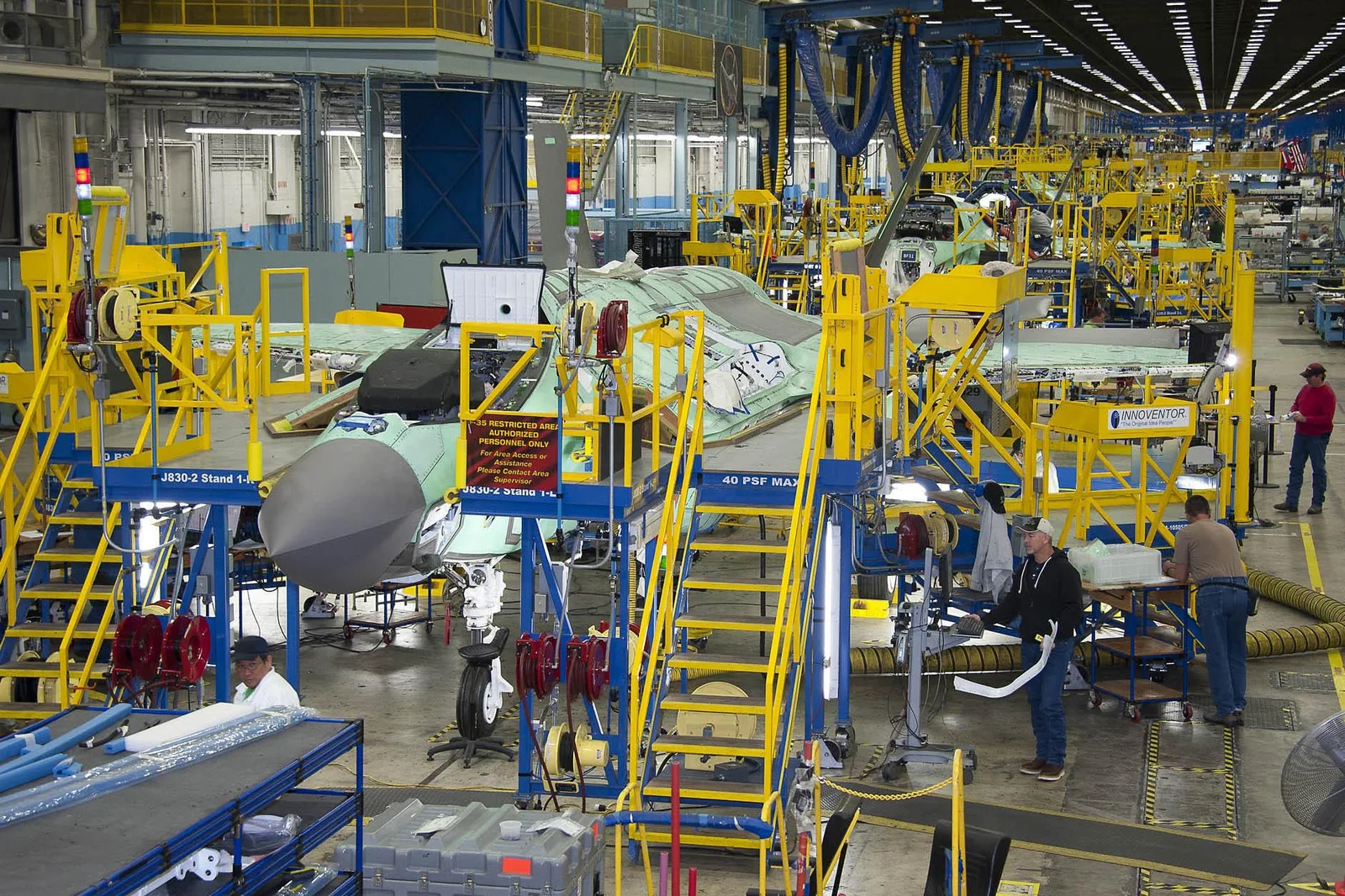
At the assembly plants in Fort Worth, Texas, F-35 production depends on an industrial organisation whose complexity extends far beyond that of a conventional aerospace programme. Thousands of companies contribute to manufacturing the fighter jet, from electronic components and specialised materials to propulsion systems, software and maintenance equipment. Each aircraft is the product of a supply chain spanning several American states and numerous partner countries. Behind the fighter's stealth profile lies an industrial infrastructure whose continuity has become a strategic concern in its own right.
On October 22, 2026, Lockheed Martin and the US Department of Defense announced a framework agreement intended to organise F-35 production and sustainment over ten years. The arrangement envisages at least 850 aircraft for US forces, alongside potential international orders, spare parts, upgrades and maintenance services. In exchange for this exceptional degree of visibility, Lockheed Martin plans to commit at least $7 billion in investments financed from its own resources.
The announcement does not constitute a firm order for 850 aircraft. Definitive contracts, legislative authorisations and congressional appropriations remain necessary. Yet this distinction does not diminish the initiative's significance. Rather, it reveals its underlying logic: Washington is seeking to turn anticipated military demand into immediately mobilisable industrial capacity without bearing the entire burden of financing the necessary investments in advance.
What is emerging, therefore, is not simply another cycle of aircraft production. It is an evolution in the relationship between the American state, its major defence contractors and the supply chains on which its military power depends.
Public Procurement as an Instrument of Industrial Transformation
For decades, the American defence industry has operated under a persistent tension between two different time horizons. The first is that of military planning, subject to budget negotiations, shifting strategic priorities and annual congressional decisions. The second is that of industry, where building a factory, purchasing specialised equipment, qualifying a supplier or recruiting engineers can require several years before delivering tangible results.
This divergence becomes particularly costly in a programme as extensive as the F-35.
Developed by Lockheed Martin, the aircraft serves American forces and a growing number of allied militaries. Its different variants meet the requirements of the US Air Force, US Navy and Marine Corps, while international customers contribute to the expansion of its industrial and operational base. The programme is no longer limited to delivering new aircraft: it now encompasses the maintenance of a substantial fleet, software development, upgrades to onboard systems and the availability of spare parts required for decades of service.
Under these conditions, negotiating successive production lots does not always provide sufficient stability for industrial capacity.
An equipment manufacturer may hesitate to expand a facility when it has only limited visibility over future orders. A producer of critical components may retain insufficient capacity rather than tie up capital in expensive machinery. A lower-tier supplier may struggle to secure bank financing when its future revenues depend on public commitments that remain uncertain.
The announced agreement seeks precisely to reduce this uncertainty.
The Pentagon and Lockheed Martin envisage a ten-year industrial planning framework associated with an overall production rate of 156 aircraft annually. This figure refers to the intended global production rate, not exclusively to deliveries to American forces. It must therefore be distinguished from the minimum of 850 US aircraft included in the framework.
Such visibility could enable Lockheed Martin to plan investments more effectively, negotiate longer-term commitments with suppliers and secure production capacity that would otherwise remain exposed to fluctuations in orders.
The state does not necessarily finance every new machine at the moment of installation. Instead, it seeks to make future demand sufficiently credible for private companies to undertake the investment themselves.
Public authority thus becomes the organiser of an industrial time horizon.
Seven Billion Dollars and a New Distribution of Risk
Lockheed Martin's announced commitment is among the most significant elements of the arrangement. The $7 billion represents a minimum amount of industrial investment the company plans to finance itself. It is neither the purchase price of the 850 aircraft nor the total value of future government contracts, which has not been disclosed.
This distinction is fundamental.
In a traditional military procurement relationship, the state defines its requirements, awards contracts and pays for goods and services under negotiated terms. Defence contractors already finance part of their industrial investment, but the scale of their commitments depends partly on contractual visibility and the allocation of risk.
The proposed F-35 arrangement takes this logic further. Lockheed Martin would commit additional capital to productive capacity in anticipation of sustained demand, while the Pentagon would seek to benefit from a more resilient and responsive industrial base.
The economic calculation is understandable. Stable production can facilitate raw-material procurement, improve facility utilisation, reduce certain unit costs and limit interruptions along assembly lines. Suppliers with more predictable order books may also be able to invest in automation, training and additional capacity.
Yet these potential advantages do not eliminate risk. They redistribute it.
American military appropriations remain subject to congressional decisions. Strategic priorities can change, budgetary constraints can intensify and operational requirements can be revised. If industrial investments precede definitively funded orders, Lockheed Martin may face a mismatch between expenditure already committed and contractually guaranteed revenue.
This tension is not merely theoretical. In its financial communications for the third quarter of 2026, Lockheed Martin reported costs already incurred on F-35 Lot 20 that exceeded contractual authorisations and funding available at that stage. The situation illustrates the difficulty of reconciling industrial continuity, contract negotiations and the availability of public funds.
The decisive question will therefore not simply be whether the company invests the announced $7 billion. It will be how future contracts distribute the risks associated with production volumes, delivery schedules, industrial inflation and underutilised capacity.
Ten years of political visibility do not necessarily provide the same security as a legally enforceable purchase obligation.
Part of the arrangement's financial balance will depend on precisely that difference.
Industrial Integration Without Capital Consolidation
The agreement also has a less visible but potentially more enduring dimension: it could reshape relations between Lockheed Martin and its subcontracting network.
The F-35 industry relies on a deeply interconnected production architecture. Major equipment manufacturers occupy decisive positions in propulsion, avionics, sensors and electronic systems, while numerous specialised companies provide components, materials and manufacturing processes that cannot easily be replaced.
The vulnerability of such a programme does not lie exclusively in its major assembly plants. It may emerge at a supplier possessing rare expertise, limited production capacity or equipment whose duplication would require several years.
A decade-long industrial arrangement could encourage Lockheed Martin to strengthen commitments to these companies, support certain productive investments or coordinate manufacturing schedules and strategic inventories more closely.
This would not necessarily involve acquisitions or mergers.
Economic integration can advance without changes in corporate ownership. Multiyear contracts, capacity commitments, equipment financing and availability obligations can establish industrial relationships almost as consequential as equity-based consolidation.
This form of contractual integration is particularly relevant to strategic industries. It enables a major prime contractor to coordinate a production ecosystem while, in principle, preserving the specialisation and legal independence of its suppliers.
It nevertheless carries a trade-off.
The more a subcontractor's investments become specific to the F-35 programme, the greater its economic dependence on Lockheed Martin may become. Equipment designed for a particular manufacturing process cannot always be easily repurposed for other markets.
The prime contractor may consequently gain not only greater coordination capabilities but also increased bargaining power.
The stability being sought can become a form of organised dependence.
For American authorities, the challenge will be to reconcile secure supply with the preservation of a sufficiently diversified industrial base, preventing a handful of vulnerabilities from compromising the entire programme.
The F-35 as an Infrastructure of American Power
The agreement's implications extend well beyond the United States.
The F-35 occupies a central position in the modernisation of several allied air forces. Adopting the aircraft commits participating countries to a lasting system of training, maintenance, software, spare parts and technological upgrades.
The initial purchase of an aircraft represents only one part of that relationship.
A modern combat aircraft requires regular updates, suitable infrastructure, specialised technical expertise and continuous access to the equipment needed to maintain operational readiness. Decisions affecting American production can therefore influence the availability and operating costs of foreign fleets.
More stable industrial planning could provide partner countries with greater predictability regarding deliveries and sustainment capacity. It could also facilitate national investment planning for air bases, maintenance facilities and personnel training.
But this predictability comes with continued dependence on the programme's industrial and technological architecture.
Countries choosing the F-35 enter a system organised around the United States, where decisions concerning upgrades, export restrictions and certain critical capabilities remain closely connected to American institutions and companies.
Military cooperation thus becomes a long-term industrial relationship.
This reality gives the programme a geopolitical dimension that cannot be reduced to operational performance. The international spread of the F-35 helps structure the equipment, doctrines and support capabilities of numerous allied forces around a common platform.
It can promote military interoperability, but it also concentrates certain technological dependencies.
In this context, strengthening the American production chain does not merely serve the Pentagon's domestic requirements. It contributes to the continuity of an international defence system whose industrial centre remains in the United States.
The Return of the Strategic State
The agreement between Lockheed Martin and the Pentagon forms part of a broader evolution in American industrial policy.
National security no longer depends exclusively on the technological superiority of available equipment. It also rests on the ability to manufacture that equipment, maintain it, replace its components and increase production when circumstances demand.
Geopolitical tensions and disruptions affecting certain supply chains have brought a question back to the forefront, one long overshadowed by the pursuit of economic efficiency: can a military power preserve its strategic autonomy if its productive capacity is too slow, too concentrated or inadequately financed?
The F-35 programme offers a particularly revealing example of this dilemma.
Lockheed Martin estimates that the programme's industrial ecosystem supports 317,000 American jobs and generates approximately $79 billion in annual economic activity. These company estimates are not guaranteed outcomes of the ten-year agreement. They nevertheless indicate the economic scale claimed by the manufacturer and the degree to which military production is intertwined with employment, investment and regional development.
Defence policy consequently becomes an instrument for organising the productive economy.
Such intervention does not necessarily take the form of nationalisation, public equity ownership or direct government management of factories. It operates through demand planning, contractual commitments, availability requirements and the direction of private investment.
The state establishes the horizon. The company mobilises capital. Suppliers adjust their capacity.
This model does not eliminate market mechanisms or commercial negotiations. It places them within an industrial strategy defined by national security objectives.
It may also reinforce established positions.
A ten-year commitment centred on the F-35 could consolidate an industrial ecosystem already dominant in its segment. Accumulated expertise, specialised infrastructure and transition costs can make the emergence of competing solutions more difficult.
Production continuity provides a strategic advantage, but it can also reduce the flexibility of future procurement choices.
The Pentagon will therefore have to balance two imperatives that do not always coincide: stabilising an indispensable industrial capability and preserving enough technological and competitive alternatives for the decades ahead.
Ten Years of Visibility, an Industrial Sovereignty Still to Be Secured
The true significance of the agreement announced on October 22 will become measurable only through its implementation.
Congressional authorisations, contracts actually signed, investments undertaken by Lockheed Martin, changes in production rates and improvements in operational availability will all require close examination.
Shorter delivery times, effective cost control and supplier resilience will be more meaningful indicators than the ten-year ambition alone.
The framework agreement does not automatically resolve the technical, financial or organisational difficulties of a programme this complex. It seeks to establish conditions under which those challenges can be addressed over a period longer than conventional procurement cycles.
That is precisely what makes it important.
For decades, industrial power has often been assessed through corporate technological capabilities, competitiveness and access to markets. The return of strategic constraints is a reminder that such power also depends on the ability to sustain those capabilities over time, even when economic or political conditions become less favourable.
With the F-35, Washington is attempting to convert military planning into an investment architecture. Lockheed Martin, for its part, is prepared to commit part of its capital in anticipation of demand whose fulfilment remains subject to American institutions.
Between them, a new balance is emerging, one in which public authorities do not necessarily own the industrial assets but seek to organise their capabilities over the long term.
The paradox is that this strategy aims to make American defence less vulnerable to industrial disruption while potentially reinforcing its dependence on a limited number of major suppliers.
Power no longer resides solely in the number of aircraft a country can purchase. It also resides in its ability to ensure that the factories, expertise and supplier networks will still exist when they are needed.
And perhaps that is where the essence of industrial sovereignty now lies: not in owning the means of production, but in the state's ability to shape their future.
Main Sources
- Lockheed Martin, official press release, October 22, 2026, New Framework Agreement for Multiyear F-35 Production and Sustainment.
- US Department of Defense, official statement, October 22, 2026, concerning the ten-year F-35 industrial agreement.
- Reuters, October 22, 2026, reporting on the preliminary agreement between Lockheed Martin and the Pentagon covering at least 850 aircraft.
- Lockheed Martin, third-quarter 2026 financial results and communications concerning the F-35 programme.
This analysis distinguishes announced industrial commitments, definitive contractual obligations and potential economic effects. Employment and economic activity figures are based on Lockheed Martin's estimates.
Atlas Limits Research Desk
Atlas Limits’ editorial and analytical desk.