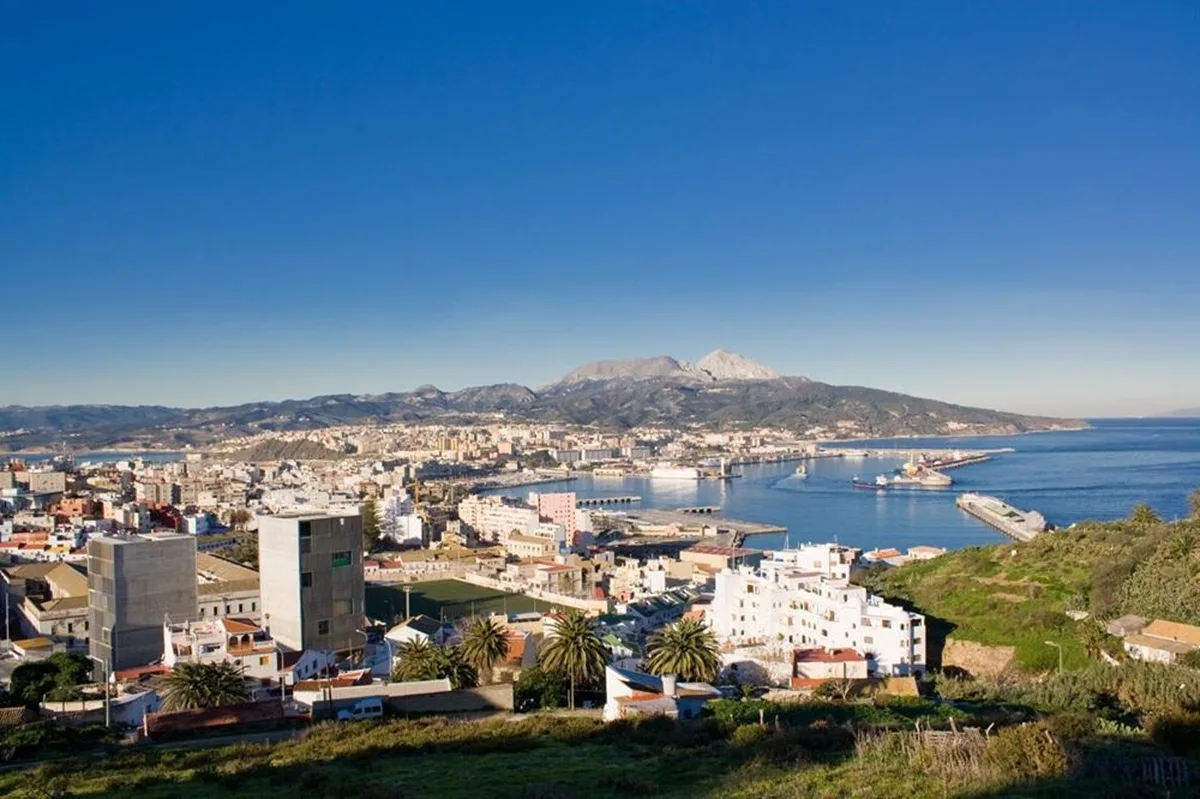
The itinerary comes down to two dates: Ceuta on 13 October, Melilla the following day. Announced on 1 October, Felipe VI and Queen Letizia’s trip will be their first official visit to the two cities since the king’s accession in 2014. The detailed programme has yet to be released, but one fact already establishes the visit’s significance: it was prepared jointly by the Royal Household and the Spanish government. This is not an initiative by the Crown that the executive will have to manage after the event. Madrid is taking responsibility for the visit at the highest level of the state.
In many countries, a head of state visiting two cities governed by the country’s own institutions would be unremarkable. Between Spain and Morocco, that very normality is what remains disputed. For Madrid, Ceuta and Melilla are Spanish, and a royal visit requires no outside permission. For Rabat, which claims both cities, they remain a territorial dispute. The same journey can therefore be presented as routine institutional business on one side of the Strait and received as a political assertion on the other.
This is the contradiction that the rapprochement launched in 2022 had made less visible without resolving. The announced visit brings it back to the centre of the relationship: how far can two states deepen their cooperation when they do not attach the same meaning to the borders separating them?
What Rapprochement Left Unresolved
In April 2022, Pedro Sánchez and Mohammed VI opened a new chapter in bilateral relations. Spain placed Morocco’s autonomy proposal for Western Sahara ahead of other possible foundations for resolving the dispute. Their joint declaration also envisaged renewed migration cooperation, the normalisation of cross-border movement and consultation on matters of common interest, without unilateral action or faits accomplis. It did not, however, explicitly settle the dispute over Ceuta and Melilla.
That distinction is essential. An agreement allowing two countries to work together is not necessarily an agreement on everything that divides them. Madrid and Rabat could rebuild trust in certain areas while retaining their positions in others. Rapprochement thus rested less on the disappearance of contradictions than on the ability to contain them.
The royal visit puts that approach to the test. From Spain’s perspective, there is no conflict between close cooperation with Morocco and the monarch’s presence in Ceuta and Melilla. From Morocco’s perspective, the risk is that normalised bilateral relations could gradually be interpreted as acceptance of the territorial status quo. What Madrid sees as the ordinary exercise of a prerogative may raise questions in Rabat about the political price of accommodation.
It would nevertheless be excessive to portray the visit as a repudiation of the 2022 framework. No established evidence supports the conclusion that Spain intends to call the partnership into question. The more defensible interpretation is narrower: Madrid wants to show that the partnership does not restrict its ability to assert its position on the two cities publicly.
The Border Returns to the Foreground
The migration crisis in late July gives the visit particular resonance. According to EFE, the trip was being considered before those events, making it inaccurate to describe it as a decision taken exclusively in response to the crisis. Yet an earlier plan can acquire a new meaning. On 29 September, speaking in the presence of Emmanuel Macron, Felipe VI described the events in Ceuta as unacceptable and emphasised the European dimension of the border concerned.
Moving from a speech to a visit makes that message more visible. The monarch’s presence can reassure residents and local authorities about their place within the country while demonstrating externally that Madrid does not treat the two cities as places to be kept out of diplomatic view. The timing, immediately after Spain’s national day on 12 October, reinforces that symbolic reading, although it does not establish that the dates were chosen with confrontation in mind.
The emphasis on Europe adds another dimension. By presenting Ceuta as a European border, Spain’s message also seeks to widen the circle of responsibility. Managing migrant arrivals would no longer be merely an issue between two neighbours but a matter of solidarity within the European Union. That formulation does not settle the territorial dispute; it does, however, shift the political ground on which Madrid seeks support.
Two questions that tensions tend to blur must be kept separate here. A border crisis may expose shortcomings in cooperation without, in itself, demonstrating a deliberate intention to undermine it. Attributing the orchestration of events to Rabat would require specific evidence. Analysing the balance of power does not remove that requirement.
The Weight of What Could Be Lost
If both capitals have an interest in containing the dispute, it is not simply for the sake of an abstract good relationship. Their ties have an economic depth that diplomatic crises cannot ignore. In February 2025, Spain’s economy ministry put annual bilateral trade at more than €22.5 billion and reported that over 350 Spanish companies were established in Morocco. It also reiterated Spain’s position as the kingdom’s leading trading partner.
Those figures do not make a rupture impossible. They make its consequences harder to contain. A political deterioration can affect investment, complicate cross-border movement and introduce uncertainty into industrial decisions made years in advance. For businesses and public authorities alike, predictability in the relationship is itself a resource.
The same Spanish statement announced more than €750 million in approved financing for a railway rolling-stock project in Morocco, in preparation for the 2030 World Cup. Behind declarations of partnership lie contracts, infrastructure and financial commitments. Cooperation is not confined to a photograph of national leaders; it is already shaping part of the economic future on both shores.
Interdependence nevertheless produces a more ambiguous effect than simple reassurance. It encourages restraint, but it can also foster the belief that the other side will not risk a rupture. Madrid might calculate that Rabat will prioritise continuity in the partnership. Rabat might conclude that its importance to Spain leaves it room to protest. The danger arises when each overestimates the other’s ability to absorb a politically costly gesture.
What Morocco’s Response Will—and Will Not—Tell Us
The precedent of 2007 weighs on interpretations. Juan Carlos I and Queen Sofía’s visit prompted Morocco to recall its ambassador to Madrid for consultations. Nineteen years later, that episode remains a point of comparison, but it is not an inevitable script.
Citing diplomatic and defence sources, El País reports that the forthcoming visit has received the approval of Mohammed VI and his entourage. The material reviewed contains no accompanying official Moroccan confirmation. The claim must remain attributed to the newspaper, rather than become the foundation for a conclusion about Rabat’s intentions.
Even prior consultations would not resolve every ambiguity. Being informed is not the same as approving; accepting that a crisis should be avoided is not the same as abandoning a claim. Conversely, a public protest would not necessarily mean that cooperation was doomed. States can voice disagreement to preserve their positions while maintaining their exchanges.
Morocco’s response will therefore have to be assessed through its wording, but above all through its effects. A condemnation accompanied by continued diplomatic contact would carry a different significance from suspended meetings or a tangible deterioration in cooperation. And prolonged public silence would not, by itself, distinguish negotiated restraint from a unilateral decision to proceed cautiously.
For Rabat, the difficulty is to prevent preservation of the partnership from being portrayed as a renunciation. For Madrid, it is to assert its position without turning the visit into an exercise in humiliating its neighbour. Each must address its domestic audience while leaving the other room to contain the disagreement. It is often within that narrow space that the strength of a diplomatic relationship is measured.
The events of 13 and 14 October will therefore not establish who has definitively won a longstanding dispute. They will show, instead, whether rapprochement allows the two states to navigate a visible disagreement without jeopardising what they have built. Normalisation does not necessarily erase red lines; it may simply make it possible to live with them.
Ceuta and Melilla thus expose a fundamental limit of the partnership: economies can become more closely connected, commitments can multiply and trust can be rebuilt without reconciling national narratives. The real test will not be whether Felipe VI visits the two cities. It will be what Madrid and Rabat can still do together after he leaves.
Main Sources
— EFE, “Los reyes visitarán Ceuta y Melilla los días 13 y 14 de octubre,” 1 October 2026: announcement, preparations for the visit and royal statements.
— RTVE, “Los reyes visitarán Ceuta y Melilla los próximos 13 y 14 de octubre,” 1 October 2026: coordination between the Royal Household and the Spanish government.
— El País, “Los Reyes visitarán Ceuta y Melilla los días 13 y 14 de octubre,” 1 October 2026: diplomatic context and reporting attributed to anonymous sources concerning possible Moroccan approval.
— Spanish and Moroccan governments, “Nueva etapa del partenariado entre España y Marruecos,” joint declaration of 7 April 2022.
— Spanish Ministry of Economy, Trade and Enterprise, “España y Marruecos refuerzan su cooperación empresarial en el marco del Mundial 2030,” 19 February 2025: bilateral trade, Spanish companies’ presence in Morocco and railway financing.
Atlas Limits Research Desk
Atlas Limits’ editorial and analytical desk.