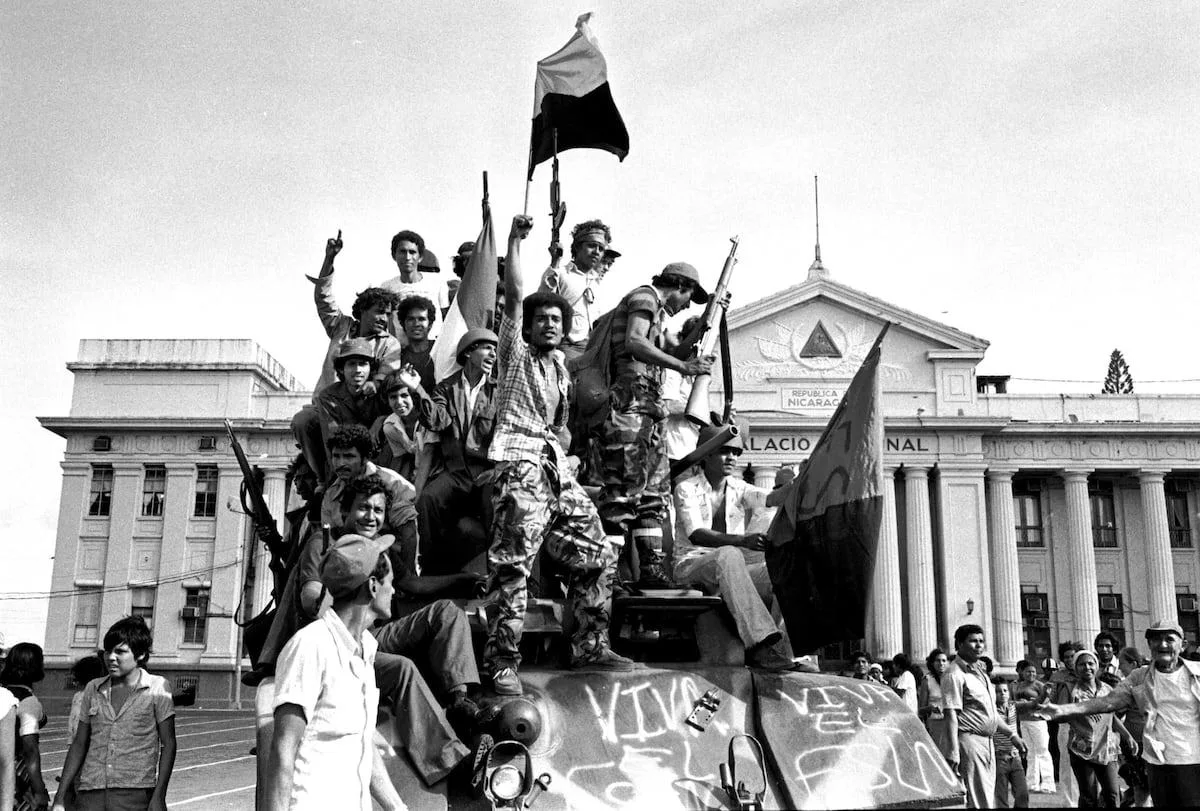
In July 1979, fighters of the Sandinista National Liberation Front entered Managua. The overthrow of Anastasio Somoza Debayle brought an end to several decades of rule by a dynasty that had gradually blurred the distinction between the interests of the state and those of a single family. In the streets of Nicaragua's capital, the revolutionary victory carried a promise extending far beyond the country's borders: the restoration of national sovereignty, the creation of a more equitable society, and the emergence of a political order freed from the domination of traditional elites.
Nearly half a century later, Daniel Ortega, one of the principal leaders of that revolution, still governs Nicaragua. Having returned to the presidency in 2007 after leading the country during the 1980s, he now formally shares power with his wife, Rosario Murillo, who became co-president following a constitutional reform that entered into force in February 2025.
The transformation has been profound. The movement that overthrew a family dictatorship has gradually constructed a political system in which continuity of power rests upon an exceptionally narrow political and familial circle. State institutions have lost much of their autonomy, organized opposition has been marginalized, and thousands of civil society organizations have disappeared from the institutional landscape.
Yet this evolution is not simply a repetition of history. Contemporary Nicaragua has its own distinctive characteristics: a relatively stable economy, continued commercial integration with North America, diversified diplomatic relationships, and a society profoundly reshaped by emigration.
The Nicaraguan paradox lies precisely in this coexistence. As the political system becomes increasingly closed, the economy continues to function and generate growth. While the official discourse emphasizes national sovereignty, a substantial share of household income depends on citizens living abroad.
Understanding this contradiction requires returning to the origins of a revolution whose memory remains central to the government's political legitimacy.
From National Liberation to the Personalization of Power
The political history of contemporary Nicaragua cannot be separated from the influence exercised by the United States over Central America during the twentieth century.
American military intervention, the presence of U.S. Marines until 1933, and Washington's subsequent support for the Somoza dynasty helped shape a political nationalism in which national independence and social transformation appeared inseparable.
Augusto César Sandino, who fought against the American military presence before his assassination in 1934, gradually became the symbol of that resistance. The Sandinista National Liberation Front, founded in 1961, adopted his name and legacy to build a revolutionary movement combining nationalism, socialism, and opposition to dictatorship.
When the Somoza regime collapsed in 1979, Nicaragua entered a period of profound institutional, economic, and social upheaval.
The revolution initiated agrarian reform, developed literacy campaigns, and sought to expand access to public services. But it quickly evolved within a regional environment dominated by the Cold War.
Washington regarded the Sandinista government's Marxist orientation and its relations with Cuba and the Soviet Union as a strategic threat. The Reagan administration supported counterrevolutionary groups known as the Contras, whose operations contributed to prolonging a particularly destructive conflict.
The war militarized society, weakened the economy, and intensified political polarization. Restrictions on civil liberties, military conscription, and worsening material conditions gradually fueled discontent among parts of the population.
In 1990, Daniel Ortega lost the presidential election to Violeta Barrios de Chamorro.
That defeat represented a decisive moment. It demonstrated that political alternation remained possible despite the legacy of civil war. The Sandinista Front retained considerable influence, but it now had to operate within a pluralist political system.
The following years were marked by economic adjustment, privatization, social tensions, and the reconfiguration of political alliances. Ortega began rebuilding his influence through agreements with sections of the economic, religious, and institutional establishment.
His return to the presidency in 2007 was therefore not simply that of a revolutionary leader reclaiming his former office. It resulted from a profound transformation in the mechanisms through which political power was acquired and maintained.
Gradually, revolutionary logic gave way to a strategy of institutional control.
Changes to electoral rules, the weakening of checks and balances, and the concentration of decision-making within the executive reduced the possibilities for political alternation.
The revolution remained omnipresent in official language, but its political function had changed. It no longer served merely to justify a historical break with the previous regime. It had also become an instrument legitimizing the continuity of those in power.
One of the fundamental contradictions of contemporary Nicaragua emerged from this transformation: a revolution designed to end the personalization of the state had gradually produced a new personalization of its institutions.
2018: The Rupture Between Government and Society
The spring of 2018 marked a major fracture in Nicaragua's recent history.
The demonstrations were initially triggered in part by proposed reforms to the social security system, including higher contributions and reductions in certain benefits.
The protests quickly expanded. Students, civil society organizations, business leaders, religious groups, and citizens opposing the concentration of political power joined the mobilization.
The authorities' response transformed a social dispute into a nationwide political crisis.
Security forces and armed groups aligned with the government were accused of participating in violent repression. International human rights organizations documented deaths, arbitrary arrests, and serious violations of fundamental freedoms.
The government portrayed the events as an attempted political destabilization, or even a coup d'état, supported by interests hostile to the Sandinista revolution.
This interpretation remains central to its official narrative. It presents the defense of national sovereignty as a struggle against what the authorities describe as foreign interference.
International investigations, however, have established a substantially different account of state responsibility for the repression.
The 2018 crisis permanently altered the relationship between the government and Nicaraguan society.
Political space contracted, independent organizations faced increasing restrictions, and numerous opponents left the country.
As opportunities for institutional dissent diminished, exile became both a means of protection and an extension of national political life beyond Nicaragua's borders.
The process intensified during the 2021 presidential election.
Several figures capable of challenging Daniel Ortega were arrested or prevented from participating. The electoral contest took place under profoundly unequal conditions.
Ortega secured another term, but the central issue was no longer simply the electoral result. It concerned the very existence of conditions allowing meaningful political alternation.
Nicaragua had entered a phase in which the stability of government depended less on winning an open political competition than on controlling the conditions under which such competition could occur.
This transformation would eventually receive formal constitutional recognition in 2025.
Co-Presidency and the Transformation of Institutions into Instruments of Continuity
The constitutional reform that entered into force on February 18, 2025, represented one of the most significant changes to Nicaragua's institutional architecture since the revolution.
It established a co-presidency exercised by Daniel Ortega and Rosario Murillo, extended the presidential term from five to six years, and placed the principal organs of the state under stronger executive coordination.
Presidential authority no longer merely directs the government. It now occupies a dominant institutional position in relation to legislative, judicial, electoral, and administrative functions.
The reform also enshrined a particular ideological definition of the state, drawing notably upon references to Christianity and socialism.
This combination reflects a remarkable evolution in contemporary Sandinismo. Historically shaped by revolutionary Marxism, the governing movement has progressively incorporated religious and conservative language into its political identity.
Rosario Murillo occupies a central position in this transformation.
Long responsible for government communications and subsequently vice-president, she has become one of the principal figures within the state apparatus. Her accession to the co-presidency formalizes a political reality already apparent for several years: the regime operates through a highly personalized leadership structure.
The reform therefore raises a question extending beyond the constitutional distribution of powers.
In a system where institutions are organized around a narrow leadership circle, the continuity of the state increasingly becomes indistinguishable from the continuity of those exercising authority.
In 2026, this tendency intensified further.
An additional reform, approved in its first legislative reading in September, proposed extending the co-presidential term to seven years and strengthening political restrictions against individuals designated as traitors to the homeland or coup supporters.
The Inter-American Commission on Human Rights condemned an evolution that could eliminate the conditions necessary for democratic alternation.
In early October 2026, international human rights mechanisms also highlighted the continuation of arbitrary detention, enforced disappearances, and repressive measures targeting opponents, including beyond Nicaragua's borders.
The Nicaraguan authorities reject these accusations and present institutional changes as instruments of stability and national sovereignty.
Yet the stability of a political system and its democratic openness are two separate questions.
A state can strengthen its capacity for control while simultaneously reducing the mechanisms through which society participates in determining its future.
Nicaragua illustrates precisely this distinction.
An Economy More Resilient Than Its Political System
Nicaragua's economic performance introduces an essential dimension to the analysis.
Contrary to the assumption that political closure necessarily produces economic collapse, the country's principal macroeconomic indicators reveal significant resilience.
According to World Bank data, gross domestic product expanded by 4.9% in 2025. The institution forecasts growth of 3.6% in 2026 and 3.2% in 2027.
Economic activity has been supported particularly by services, construction, mining, and household consumption.
Inflation remained relatively contained at 2.1% in 2025, while public debt represented approximately 48.1% of GDP at the end of the same year.
The International Monetary Fund also emphasized, in its assessment published in January 2026, the relative strength of international reserves, fiscal prudence, and the resilience of the banking sector.
These results deserve examination without treating them as political justification for the regime or dismissing them because of its authoritarian character.
Macroeconomic stability is a reality distinct from the quality of democratic institutions.
It can result from prudent fiscal policies, favorable commercial conditions, and external financial flows, even when the political environment remains highly restrictive.
Yet the structure of this growth reveals a particularly significant dependency.
In 2024, remittances from workers abroad represented 26.6% of GDP, according to the IMF. More than 84% of these transfers originated in the United States.
In other words, financial resources sent from abroad were equivalent to more than one-quarter of Nicaragua's annual economic output.
This proportion illustrates the economic importance of a diaspora that contributes directly to household purchasing power and indirectly to national economic stability.
It also exposes a political contradiction.
The government claims strategic independence from Washington, yet the incomes of many Nicaraguan households depend heavily on the American labor market.
This relationship does not mean that remittances constitute a political subsidy from the United States. They primarily represent the labor and savings of migrants.
It does, however, demonstrate that a state's declared diplomatic autonomy does not eliminate the economic interdependence of its society.
The same reality is visible in foreign trade.
The United States remains Nicaragua's principal trading partner and absorbs a substantial proportion of its exports.
The Nicaraguan economy remains integrated into North American production chains through manufacturing activities in free-trade zones, while agricultural and mining exports contribute to foreign-exchange earnings.
The country therefore presents an unusual configuration: a political orientation strongly critical of Washington coexists with deep economic integration into the American market.
This contradiction is not necessarily unsustainable in the short term. It nevertheless becomes a vulnerability when American trade or migration policies change.
The IMF has also noted that formal employment remains below its pre-2018 level despite the recovery in economic growth.
Improvement in macroeconomic aggregates therefore does not automatically translate into an equivalent transformation of the labor market.
Growth allows the economic system to function. It does not, by itself, resolve accumulated social and institutional weaknesses.
Exile as a Lasting Transformation of Society
Nicaraguan emigration cannot be understood solely as a consequence of economic hardship.
It also reflects a prolonged deterioration in the political environment and fundamental freedoms.
Since 2018, numerous journalists, academics, activists, religious figures, and political opponents have left Nicaragua.
Costa Rica occupies a particular position within this geography of exile. Its territorial proximity, relatively stable institutions, and historical ties between the two populations have made it an important destination.
The United States represents another major destination, both for economic migrants and for individuals seeking international protection.
The consequences of these departures extend beyond demography.
When a society loses part of its teaching profession, researchers, entrepreneurs, and skilled professionals, it experiences an erosion of human capital whose effects can persist for generations.
The disappearance or closure of independent organizations reinforces this process.
According to Freedom House, more than 5,670 nongovernmental organizations had lost their legal status since 2018, based on official documentation available in 2025.
This transformation affects humanitarian associations, educational institutions, religious organizations, and professional bodies.
It reduces the intermediary spaces between individuals and the state.
Yet these spaces perform a fundamental social function. They facilitate the circulation of ideas, the development of skills, local cooperation, and the expression of collective demands that do not necessarily pass through political parties.
Their disappearance produces more than democratic impoverishment. It can also weaken a country's social and economic capacities.
The paradox becomes particularly pronounced.
Some of the citizens who leave Nicaragua subsequently contribute, from abroad, to financing domestic consumption through their remittances.
Emigration can therefore reinforce a country's short-term economic stability while reducing, over the longer term, the human resources necessary for its development.
This mechanism is not exclusive to Nicaragua. It affects several economies across Central America and the Caribbean.
But here it acquires a distinctive political dimension: a society whose opportunities for domestic political expression have been restricted continues to participate in national economic life from abroad.
The geographical border thus becomes a political boundary without constituting a genuine economic separation.
Asserted Sovereignty and Persistent Dependencies
Nicaragua's foreign policy remains structured around a discourse of national sovereignty and resistance to American influence.
This orientation belongs to a deeply rooted historical tradition, extending from Sandino's struggle to the confrontations of the Cold War.
The government maintains close relations with several states that challenge, to varying degrees, Western predominance in international affairs.
Russia remains an important political and security partner. China has assumed an increasingly significant role since Managua restored diplomatic relations with Beijing in December 2021, severing its official ties with Taiwan.
This rapprochement opens opportunities in infrastructure, trade, and financing.
Yet diplomatic diversification does not necessarily produce a rapid transformation of economic dependencies.
The United States remains a major export market, while international financing and diaspora remittances continue to play essential roles.
China may help Nicaragua diversify its partnerships without automatically replacing the markets, capital flows, and migration networks connecting the country to North America.
The government must therefore manage a permanent tension between its geopolitical orientation and the material constraints of its economy.
This tension is also evident in international sanctions.
Since 2018, the United States, European Union, United Kingdom, and Canada have adopted various restrictive measures targeting officials or certain entities associated with Nicaragua's government.
These sanctions seek, among other objectives, to exert pressure on the authorities over human rights violations and the deterioration of political freedoms.
Their effectiveness, however, remains a complex question.
Targeted sanctions can increase the international costs associated with certain government practices without necessarily transforming the political system.
Broader economic restrictions, meanwhile, risk affecting a population already heavily dependent on external economic relationships.
Nicaragua therefore illustrates the limitations of interpreting authoritarian crises exclusively through diplomacy.
The political isolation of a government does not necessarily imply the economic isolation of its country.
Conversely, continued commercial exchanges do not guarantee improvements in institutional governance.
Between these two realities, international partners possess limited room for maneuver, while ordinary citizens bear a significant share of the consequences of confrontation.
The Question of Succession
Beyond diplomatic tensions and economic performance, Nicaragua's future depends on a fundamental institutional question: political succession.
Daniel Ortega, born in 1945, has achieved exceptional longevity in the contemporary political history of Central America.
His career spans several historical periods: revolutionary struggle, the Cold War, the electoral transition of the 1990s, his return to power in 2007, and the authoritarian consolidation that followed.
Rosario Murillo now occupies an institutional position that gives her a decisive role in the system's continuity.
But the formal establishment of co-presidency does not fully resolve the question of transferring power.
In a regime where institutions operate through highly personalized relationships, succession depends on more than constitutional provisions.
It also involves internal balances within the ruling party, relations with the security forces, economic interests associated with the state, and the leadership circle's ability to maintain cohesion.
The more concentrated political authority becomes, the more structurally important its transfer becomes.
A succession organized around familial continuity might preserve certain balances in the short term. It would not necessarily guarantee their long-term stability.
Conversely, political opening would require the gradual reconstruction of institutions capable of organizing competition, guaranteeing fundamental rights, and allowing divergent social interests to find expression.
Such reconstruction could not be reduced to holding elections alone.
It would also require judicial guarantees, an independent electoral administration, freedom of the press, and the restoration of civil society organizations capable of participating in public life.
The difficulty is that these are precisely the institutions weakened by successive transformations of the political system.
Nicaragua therefore faces a contradiction common to highly personalized regimes: the mechanisms ensuring the immediate continuity of power can diminish the institutional capacities necessary for a future transition.
A Revolution Imprisoned by Its Own Legitimacy
Nicaragua's history cannot be reduced either to the failure of a revolution or to the persistence of dictatorship.
It reveals a more complex transformation in which a political movement gradually turned its historical legacy into a permanent source of legitimacy.
The Sandinista revolution responded to deeply rooted realities: concentrated landownership, social inequality, family domination, and foreign influence.
These conditions explain the strength of its initial support and the importance it continues to occupy in the country's political memory.
Yet revolutionary heritage does not, by itself, constitute a sufficient principle of institutional legitimacy.
A revolution can transform social structures without permanently guaranteeing political pluralism. It can also produce institutions that eventually prioritize their own preservation over the objectives that originally justified their creation.
Contemporary Nicaragua embodies this contradiction.
Its economy continues to grow, its public finances display relative stability, and its commercial relationships remain active. Yet mechanisms of political representation have weakened considerably, while part of society continues its civic existence from exile.
The country therefore faces something more complicated than a simple choice between stability and crisis.
It experiences relative economic and administrative stability within a political system whose closure raises fundamental questions about succession, legitimacy, and the capacity for renewal.
The central issue is not merely how long Daniel Ortega and Rosario Murillo can remain in power.
It is what institutions, social forces, and economic capacities will survive when this political period eventually comes to an end.
In 1979, the Sandinistas overthrew a regime that appeared to have confused its own destiny with that of Nicaragua.
Nearly half a century later, the country confronts a question of troubling familiarity: how can a nation determine its own future when those governing it regard their continued rule as a condition of national sovereignty?
Nicaragua's history thus reminds us that a revolution can seize power by promising to liberate the state, only to eventually regard every possibility of political alternation as a threat to the revolution itself.
And when a government becomes the exclusive guardian of its own history, it is often the country's future that ceases to belong to its people.
Main Sources
World Bank — Nicaragua, Country Overview (2026). Economic growth, inflation, public finances, and medium-term economic projections.
International Monetary Fund — Nicaragua: 2025 Article IV Consultation, January 2026. Macroeconomic stability, remittances, commercial relationships, and structural risks.
Library of Congress — Nicaragua: Latest Reforms to the Constitution Expand Executive Powers, July 2025. Legal analysis of constitutional reforms and the establishment of co-presidency.
Inter-American Commission on Human Rights — Statements issued in 2026 concerning constitutional reforms and the human rights situation in Nicaragua. Institutional assessments of political centralization and restrictions on fundamental freedoms.
United Nations Group of Human Rights Experts on Nicaragua and the Inter-American Commission on Human Rights — Joint statement, October 1, 2026. Assessment of institutional developments and human rights violations.
Freedom House — Freedom in the World 2026: Nicaragua. Political rights, civil liberties, and the institutional environment.
Atlas Limits Research Desk
Atlas Limits’ editorial and analytical desk.