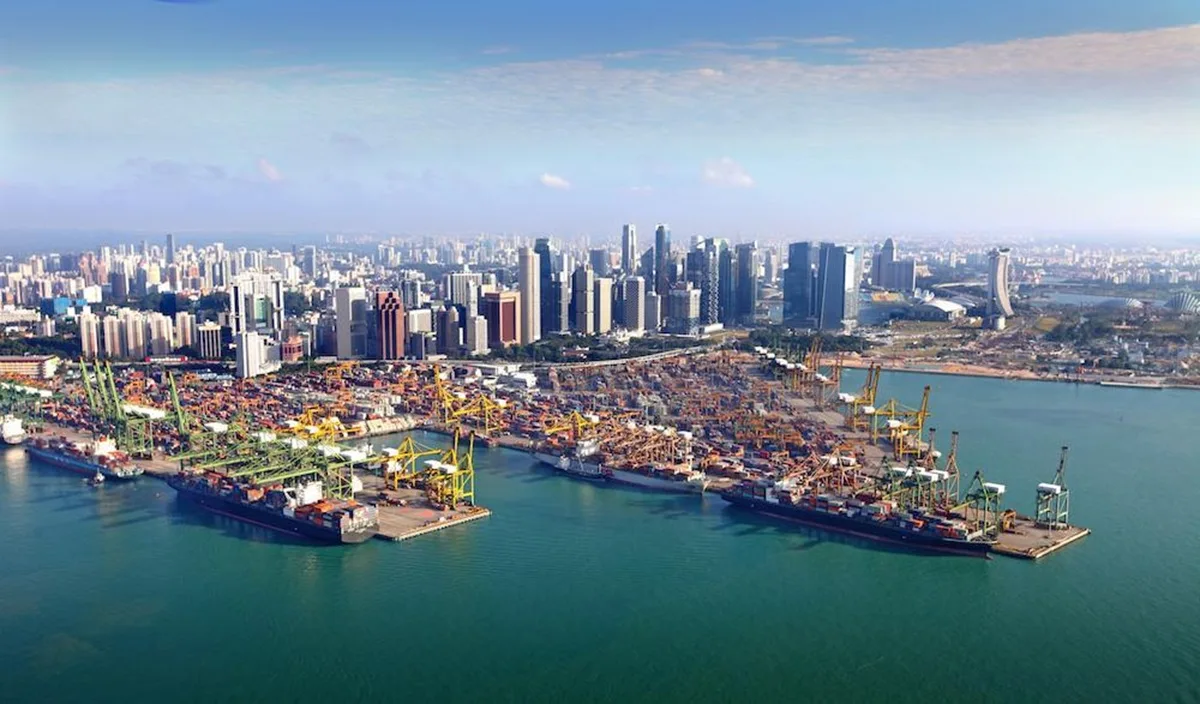
In Singapore, ships never really stop. They arrive, unload, load, refuel and leave again. Capital behaves much the same way. So do goods. Data, aircraft, international executives and an increasing share of the components that sustain the global electronics industry all pass through an island whose economic function seems precisely to be turning movement into value.
The paradox begins with size.
Singapore covers only about 744 square kilometers. Its territory is smaller than many of the world’s metropolitan areas. It possesses virtually no energy resources, little agricultural land and no strategic depth. It depends on the outside world for much of what it consumes and on the global economy for much of what it produces.
On a map of natural resources, Singapore should be marginal.
On a map of global flows, it is difficult to avoid.
In 2025, its merchandise trade reached nearly S$1.4 trillion, including around S$739 billion in exports. Nominal GDP stood at roughly S$790 billion that same year. The value of goods crossing its borders therefore amounted to almost twice the annual output of the economy. A substantial share consists, naturally, of re-exports, which reached approximately S$455 billion in 2025.
This is not a statistical anomaly.
It is the model.
Turning Geography into Infrastructure
Singapore occupies one of those positions that global geography makes disproportionately important: immediately adjacent to the Strait of Malacca, on the great maritime route connecting the Indian Ocean with the South China Sea.
But possessing a favorable geographical position is never enough.
Many territories sit along major trade routes without becoming global centers. Singapore did something else. It built an entire system around its geography designed to reduce the cost, time and risk of passage.
The port is its most visible expression.
In 2025, Singapore handled 44.66 million TEUs, a record and an increase of 8.6% from the previous year. Vessel arrivals represented 3.22 billion gross tons. The country also remained the world’s largest maritime bunkering center, selling 56.77 million tonnes of marine fuel during the year. Its shipping network connects it with more than 600 ports, while more than 200 international shipping groups have established operations there.
Yet Singapore’s real product is not the port.
It is everything surrounding it.
Marine insurance, financing, arbitration, commercial law, brokerage, logistics, ship repair, storage, refining, fleet management, financial services and regional headquarters transform the physical movement of a container into a succession of value-added activities.
A ship therefore brings more than cargo.
It brings a transaction.
And Singapore has spent decades learning how to capture a fraction of the value generated by each transaction without preventing the flow from continuing.
Territory as a Productive Constraint
Land scarcity could have condemned Singaporean industry. Instead, it determined its form.
When territory is expensive, activities that consume large amounts of space while generating little value gradually become difficult to sustain. The economy is pushed toward activities where the value created per hectare, per worker or per unit of infrastructure is high.
Petrochemicals, pharmaceuticals, precision engineering, electronics and semiconductors have consequently acquired a considerable place in an economy that might otherwise be mistaken for an essentially financial one.
Singapore today accounts for roughly 10% of global semiconductor output, around 5% of worldwide wafer fabrication capacity and nearly 20% of global semiconductor equipment production, according to the Economic Development Board.
This positioning reveals a broader logic.
Singapore does not necessarily seek to control an entire industrial chain. It seeks to occupy the segments where its particular combination of legal stability, infrastructure, capital, skills and connectivity becomes difficult to replicate.
The country’s small size then ceases to be purely a weakness.
It also facilitates concentration.
A port, an airport, industrial zones, universities, government agencies, digital infrastructure and a financial center can all be coordinated across a few dozen kilometers. The distance between industrial policy and physical execution becomes exceptionally short.
The territory functions almost as a single platform.
The State Behind the Market
This is where the conventional account of Singapore becomes insufficient.
The country is often presented as one of the purest expressions of global free trade. That is true, but incomplete.
Singapore is profoundly open to markets while retaining a state that is extraordinarily present in the organization of the economy.
The contradiction is only apparent.
Rather than replacing markets, the Singaporean state has sought to construct the conditions within which they operate: infrastructure, land, housing, education, regulation, industrial policy, investment, monetary stability and asset accumulation.
This architecture becomes particularly visible through Temasek.
As of March 31, 2026, the state-owned investment company reported a net portfolio value of S$518 billion, up from S$469 billion a year earlier. It had invested S$51 billion and divested S$31 billion during the financial year.
Beyond Temasek lies a broader structure of public financial strength. Official foreign reserves held by the Monetary Authority of Singapore stood at approximately US$433 billion in August 2026.
Singapore has therefore produced a distinctive form of capitalism: highly favorable to international investment, intensely exposed to global competition, yet supported by a state that is simultaneously owner, investor, planner and strategist.
It is neither classical laissez-faire nor a command economy.
It is a market whose architecture has, to a significant extent, been deliberately designed.
Accumulating What Geography Denies
This strategy responds to an old obsession: vulnerability.
Singapore has no hinterland capable of absorbing a major external shock. Its domestic market is too small to replace global demand. Its territory cannot provide most of the energy it needs. Its food, raw materials and part of its water supply depend on external systems.
Singapore’s response has long been to accumulate elsewhere what geography denies it at home.
Financial reserves, international assets, logistics capacity, diplomatic relationships, infrastructure, strategic stocks, skills and market access all become substitutes for territorial depth.
Capital performs almost the role that natural resources play for other states.
This also explains why Singapore attaches such importance to institutional credibility. For an economy whose prosperity depends heavily on foreign actors being willing to route their goods, capital or regional headquarters through the country, trust is not an abstraction.
It is infrastructure.
Being Useful to Everyone
The same logic runs through Singaporean diplomacy.
Singapore maintains close security ties with the United States while having developed extensive economic relations with China over several decades. It is deeply embedded in ASEAN, yet simultaneously functions as one of the principal gateways for global capital into Southeast Asia.
This position requires more than a policy of balance.
It requires a policy of usefulness.
A small state rarely possesses the means to impose its preferences permanently on great powers. It can, however, increase the cost of bypassing it.
Ports, finance, law, technology, aviation, diplomacy and investment collectively perform that function.
The more useful Singapore becomes to different actors, the more each has something to lose from its destabilization.
This may be one of the most sophisticated forms of power available to a small state.
Not compelling others.
Making its presence preferable to its absence.
The Energy Vulnerability Remains
There is, however, a limit that finance and organization cannot entirely erase: energy.
In 2024, natural gas supplied 94% of Singapore’s electricity generation mix. In 2026, authorities indicated that around 95% of the country’s electricity continued to be generated from imported gas. Supplies arrive through pipelines from Malaysia and Indonesia as well as in the form of LNG purchased on global markets.
The dependence is revealing.
One of the world’s most sophisticated economies, capable of accumulating hundreds of billions in financial assets and becoming a major node in the global electronics industry, remains exposed to the price of a molecule it barely possesses.
The energy tensions of 2026 provided another reminder: higher imported gas costs translated directly into higher domestic electricity tariffs.
Singapore is therefore seeking to diversify its supplies and import more electricity from the surrounding region. But such projects require interconnections, sometimes through submarine cables crossing several jurisdictions, and long-term financial commitments.
The energy transition consequently acquires a geopolitical dimension.
For Singapore, producing lower-carbon electricity also means constructing new dependencies.
When the World Fragments
The most important question, however, lies elsewhere.
Singapore’s model flourished during a historical period particularly favorable to intermediaries.
Globalization fragmented production across countries. Companies internationalized their supply chains. China became the factory of the world. Capital moved more freely. Maritime trade expanded. Asia concentrated an increasing share of global manufacturing.
Whenever a value chain grew longer, Singapore could become one of its nodes.
The world now emerging operates according to a different logic.
The United States is seeking to secure strategic technology chains. China is developing its own capabilities. Industrial policy has returned. Export controls are proliferating. Economic security increasingly shapes investment decisions. Companies speak of resilience, diversification, friend-shoring and sometimes sovereignty.
The flow is not disappearing.
It is becoming political.
For Singapore, this shift is fundamental.
Its historical advantage rests precisely on its ability to provide a space where different systems can meet. If the global economy gradually divides into competing technological, financial and industrial architectures, functional neutrality becomes harder to maintain.
Semiconductors provide perhaps the clearest example.
Deep integration into the industry is an enormous advantage when the value chain is global. It becomes considerably more complicated when every machine, every piece of design software, every fabrication facility and every export destination can enter the strategic calculations of Washington or Beijing.
Singapore must therefore perform a delicate maneuver: remain indispensable without becoming captive.
The Cost of Success
A second tension comes from within.
Singapore’s strategy has been extraordinarily effective at creating value within a constrained space. But that same success increases the price of land, housing, skilled labor and many forms of economic activity.
The more attractive a city becomes to international capital, the more it must ensure that its own success does not erode its capacity to accommodate the people and companies producing that success.
Immigration consequently becomes indispensable to parts of the economy while generating political tensions of its own. Competition for talent intensifies. Demographic ageing gradually alters social balances. Infrastructure must absorb ever greater volumes within a territory that can expand only marginally.
Singapore’s problem is therefore no longer simply how to generate growth.
It is how to preserve the social, physical and political conditions that allow an exceptional concentration of activity to continue functioning.
This is a characteristic difficulty of economies that have traveled very far along their chosen development model.
The scarcity that once forced efficiency eventually makes efficiency itself expensive.
Power Without Territory
Singapore ultimately offers a different way of looking at power.
For a long time, power was measured by territory, population, natural resources, strategic depth and military capability.
None of these factors has disappeared.
But the contemporary economy has created another geography.
Some states control resources. Others control markets. Others still control technologies.
Singapore chose to control interfaces.
The interface between the Indian and Pacific Oceans. Between producers and consumers. Between Western capital and Asian growth. Between industry and finance. Between multinational corporations and regional markets. Between China and a global economic system that China itself is now helping to transform.
This strategy eliminates none of Singapore’s fundamental vulnerabilities.
Singapore remains small. It remains dependent on imports. It remains exposed to global trade. It remains located in a region where several great powers intersect.
But that is precisely what makes its story so revealing.
The country never truly defeated its geography.
It built around it.
Through ports, reserves, factories, investment funds, regulations, cables, airports and trade agreements, it transformed a vulnerable position into a place through which part of the world prefers to continue passing.
Great powers often seek to control flows.
Singapore discovered something different.
Sometimes it is enough to become the place where they meet.
Main Sources
- Singapore Department of Statistics — National Accounts; Merchandise Trade, 2025–2026 data.
- Maritime and Port Authority of Singapore — Singapore Posts Record Port Performance in 2025; maritime and port data, 2025–2026.
- Singapore Economic Development Board — semiconductor industry data.
- Energy Market Authority — Singapore Energy Statistics; electricity mix, natural gas and energy security data.
- Monetary Authority of Singapore — Official Foreign Reserves, August 2026.
- Temasek — Temasek Review 2026, portfolio value and investment data.
Atlas Limits Research Desk
Atlas Limits’ editorial and analytical desk.