For more than a century, the automotive industry has been one of the main engines of global industrialization. It has consumed steel, glass, rubber and oil, employed millions of workers, reshaped cities, stimulated road construction, supported the expansion of consumer credit and produced some of the most powerful industrial groups on the planet.
It has also provided industrial capitalism with several of its most emblematic organizational models. Fordism, mass production, Japanese lean manufacturing, global vehicle platforms, international supplier networks and, today, gigafactories have successively redefined how goods are produced.
But the automotive industry is now undergoing a transformation of a scale rarely seen since the introduction of the moving assembly line.
The internal combustion engine, around which an entire industrial ecosystem was built, is gradually sharing its position with electric and hybrid powertrains. Mechanical engineering is surrendering part of the value chain to software, electronics and batteries. China, once regarded primarily as a market for Western and Japanese manufacturers, has become the world’s largest automotive production center and the core of the electric-vehicle industrial chain. New groups such as BYD are now competing directly with Toyota, Volkswagen, General Motors, Ford, Hyundai-Kia, Stellantis, Mercedes-Benz and BMW.
Behind this industrial competition lies something larger: the geographic redistribution of an industry that remains strategically important to the world’s major economic powers.
From European invention to the American industrial revolution
The automobile was not born from a single invention.
Throughout the nineteenth century, engineers and entrepreneurs experimented with different forms of propulsion. Steam preceded the internal combustion engine. Electricity itself was among the technologies considered during the automobile’s earliest development.
But work carried out in Germany in the late nineteenth century proved decisive. Karl Benz developed a vehicle powered by an internal combustion engine and obtained a patent for his Patent-Motorwagen in 1886. Gottlieb Daimler and Wilhelm Maybach were simultaneously developing their own engines.
A European automotive industry began to emerge.
Peugeot produced its first automobiles at the end of the nineteenth century. Renault was founded in 1899. Fiat appeared in Turin the same year. Mercedes, Opel and other companies gradually helped create an industry that remained largely artisanal.
The United States, however, would transform the automobile far more profoundly than its first inventors had.
Henry Ford invented neither the automobile nor the assembly line. His decisive contribution was to combine standardization, industrial organization and large-scale production.
Introduced in 1908, the Ford Model T became one of the symbols of this revolution. From 1913 onward, Ford’s Highland Park plant generalized the use of the moving assembly line in automobile manufacturing.
Assembly times fell dramatically. Volumes increased. Costs declined.
The automobile could gradually move beyond the luxury market and become accessible to a much larger share of the population.
The automotive industry had discovered one of the defining principles of twentieth-century industrial capitalism: produce on a mass scale in order to sell on a mass scale.
Fordism extends far beyond the automobile
Ford’s influence quickly spread beyond his own industry.
Standardized production, task specialization and larger volumes generated substantial productivity gains. The scientific management principles associated with Frederick Winslow Taylor found an especially favorable environment in large automotive factories.
The model also transformed the relationship between production and consumption.
In 1914, Ford famously introduced a five-dollar daily wage for certain workers who met company requirements, a level far above prevailing industrial standards. Beyond concerns over recruitment and employee turnover, a broader economic logic gradually emerged: mass production required mass consumption.
After the Second World War, this model helped structure much of the Western economic order.
Private car ownership accompanied rising living standards. It facilitated suburban expansion. It altered commercial geography. It stimulated highway construction and transformed urban planning.
In the United States, the automobile became almost inseparable from territorial organization itself.
Its economic influence, however, was even broader.
A car mobilizes an entire economy
The automobile is a highly visible final product. Its production system is much less visible.
Manufacturing tens of millions of vehicles every year requires an enormous industrial infrastructure.
Steel provides structural components. Aluminum helps reduce vehicle weight. Copper carries electricity. Glass forms the windows. Rubber feeds the tire industry. Chemicals supply paints, plastics, foams, adhesives and composite materials.
Then come the components: transmissions, braking systems, suspensions, seats, lighting, air-conditioning systems, electronics, sensors and tires.
Around manufacturers has therefore developed an entire universe of global suppliers: Bosch, Denso, Magna, ZF, Continental, Forvia, Valeo and many others.
This industrial chain is complemented by logistics companies, ports, railways, road hauliers, dealerships, financing companies, insurers, repair shops, spare-parts distributors and energy infrastructure.
For decades, the automotive industry was also one of the main sources of global oil demand.
A car is therefore never just a car.
It is the final product of an economic system connecting raw-material extraction, heavy industry, engineering, finance, energy, trade and infrastructure.
That is precisely what explains its political importance.
When a major automotive plant closes, the consequences do not affect only the manufacturer’s employees. They can spread across dozens or hundreds of suppliers and affect an entire region.
For many governments, preserving a domestic automotive industry therefore means simultaneously defending employment, exports, technological capabilities and part of the national industrial base.
Detroit and the age of American dominance
For much of the twentieth century, the symbolic center of the global automotive industry was Detroit.
General Motors, Ford and Chrysler built an industrial empire that accompanied the rise of the United States as an economic superpower.
The immense American domestic market gave them a considerable advantage. Long distances, suburbanization, historically relatively cheap fuel and rising household incomes created an environment particularly favorable to the automobile.
General Motors also developed a strategy different from Ford’s: multiple brands and product ranges allowed consumers to move through different levels of the same corporate universe as their purchasing power increased.
Chevrolet, Pontiac, Oldsmobile, Buick and Cadillac gradually represented different stages of a social hierarchy expressed through automobile ownership.
The car became both an industrial product and a social marker.
After 1945, American manufacturers dominated a global industry whose European and Japanese markets were still rebuilding.
That dominance, however, would not last forever.
Europe rebuilds its automotive industry
Postwar reconstruction produced a new era of mass motorization in Europe.
Volkswagen manufactured the Beetle by the millions. Renault developed the 4CV and later the Renault 4. Citroën offered the 2CV. Fiat accompanied Italy’s economic miracle with small popular cars that became inseparable from the country’s modernization.
Germany simultaneously built a powerful premium segment around Mercedes-Benz, BMW and later Audi.
France, Germany, Italy and the United Kingdom all developed substantial national automotive industries.
European integration, international competition and consolidation gradually changed that map.
Some brands disappeared. Others changed ownership. Corporate groups merged.
The European industry eventually became organized around a smaller number of major groups: Volkswagen Group, Stellantis, Renault Group, Mercedes-Benz Group and BMW Group, alongside manufacturers now controlled by foreign companies.
The automotive sector nevertheless remains one of Europe’s industrial pillars.
According to the European Automobile Manufacturers’ Association, the automotive ecosystem supports millions of direct and indirect jobs in the European Union and accounts for a major share of private research and development expenditure.
That historical strength is now both an advantage and a vulnerability: Europe possesses extensive industrial capacity linked to a technology—the internal combustion engine—whose role is changing.
Japan changes the rules
From the 1970s and especially the 1980s onward, another major disruption took place.
Japan did not merely produce competitive cars. It transformed manufacturing methods.
Toyota gradually developed what became known as the Toyota Production System.
Lower inventories, continuous improvement, quality control, close supplier relationships, demand-driven production and waste reduction enabled remarkable levels of efficiency.
Lean manufacturing became a global reference.
Toyota, Honda, Nissan, Mazda, Mitsubishi and Subaru expanded across international markets.
The oil shocks of the 1970s also increased the appeal of Japanese vehicles, which were generally smaller and more fuel-efficient than many American models.
Japanese manufacturers subsequently established factories in the United States and Europe, gradually changing their status. They were no longer merely Japanese exporters but global industrial groups.
Toyota ultimately became one of the largest automakers in history.
The automotive industry thereby demonstrated a characteristic that would remain fundamental: each emerging industrial power could use automobile manufacturing as an instrument of economic upgrading.
South Korea follows the same trajectory
A few decades later, South Korea followed a similar path.
Hyundai, and later Kia, gradually moved from producing relatively inexpensive vehicles to competing globally with Japanese, European and American manufacturers.
This rise accompanied South Korea’s broader industrial transformation in steel, shipbuilding, electronics and semiconductors.
The country now occupies a particularly important position in the automotive transition because it combines global automakers, major battery manufacturers and a powerful electronics ecosystem.
History repeated itself, but the center of gravity continued moving toward Asia.
China becomes the center of the automotive world
No geographic shift, however, has matched the scale of China’s rise.
For years, Western and Japanese manufacturers viewed the country primarily as the future great automotive market.
They were right.
What they did not necessarily anticipate were all the consequences of that transformation.
China’s accession to the World Trade Organization in 2001 accelerated its integration into international value chains. Economic growth, urbanization and the emergence of a vast middle class produced an explosion in automotive demand.
Major international manufacturers expanded in the country, often through joint ventures with Chinese partners.
Volkswagen, General Motors, Toyota, Honda, BMW, Mercedes-Benz and many others benefited for years from that expansion.
Meanwhile, Chinese industry was learning.
Geely, SAIC, Changan, Great Wall, Chery and BYD developed their own capabilities. Some acquired foreign assets. Geely, for example, purchased Volvo Cars from Ford in 2010.
Then came the electric transition.
It gave China an opportunity to bypass part of the century-old advantage accumulated by established manufacturers in internal-combustion technology.
The result has been dramatic.
According to the International Organization of Motor Vehicle Manufacturers, China now produces around 30 million vehicles a year and accounts for roughly one-third of global automotive production, depending on the year considered.
It has also become the world’s largest market for electric vehicles.
And it is no longer merely a market.
It exports.
BYD symbolizes the shift
BYD’s history illustrates the new automotive industry particularly well.
The company did not originate in internal combustion engines. Its roots are in batteries.
That difference matters.
While established manufacturers must transform industrial systems built around mechanical engineering, BYD developed in an environment where batteries, electronics and vehicles could be integrated from the outset.
The group manufactures its own batteries and operates with a high degree of vertical integration.
Its Blade Battery, based on lithium-iron-phosphate chemistry, also illustrates the rise of LFP technology, once considered less capable than some nickel-rich chemistries but increasingly competitive for mass-market vehicles because of its cost, durability and safety profile.
In 2022, BYD stopped producing vehicles powered exclusively by internal combustion engines and focused its automotive business on battery-electric and plug-in hybrid vehicles.
Its global expansion symbolizes a historical transformation: Chinese automakers are no longer merely attempting to catch up with the global industry.
They are increasingly helping set its pace.
Electrification redistributes value
The shift from internal combustion to electric propulsion is not simply a change in engine technology.
It profoundly changes the industrial structure of the vehicle.
An internal-combustion powertrain requires engines, pistons, valves, injectors, exhaust systems, complex transmissions, lubrication systems and many mechanical components.
An electric architecture is different.
The battery, electric motor, inverter, power electronics and management software become central.
The consequences for suppliers are considerable.
Some capabilities accumulated over decades gradually become less important, while others become strategic.
The battery is the clearest example.
The battery battle
An automotive battery is itself a global industrial chain.
It begins in mines.
Lithium, nickel, cobalt, manganese, graphite, copper and other materials support different chemistries and components.
But owning mineral resources is not enough.
Materials must be refined. Precursors must be produced. Cathodes and anodes must be manufactured. Cells must be assembled and then integrated into modules or directly into battery packs.
China occupies a dominant position across several of these processing stages.
According to the International Energy Agency, China accounts for a predominant share of global battery-cell manufacturing capacity and also dominates several segments of refining and battery-component production.
CATL and BYD rank among the world’s largest battery manufacturers.
LG Energy Solution, Samsung SDI and SK On give South Korea an important position. Panasonic remains a major Japanese player.
The United States and Europe are simultaneously attempting to develop their own manufacturing capacity.
Gigafactories have therefore become strategic infrastructure.
The automobile of the twenty-first century still depends on raw materials, but they are no longer exactly the same.
For a century, the central question was: who controls oil?
The question is increasingly also: who controls battery materials, chemistry and manufacturing?
Tesla changes the perception of the automobile
The electric transition would probably have happened without Tesla.
But Tesla profoundly accelerated its industrial and financial perception.
When the company developed the Model S in the early 2010s, electric vehicles were still largely associated with small urban cars, limited range or experimental projects.
Tesla reversed that perception.
Electric vehicles became powerful, technological and desirable.
But the company’s contribution went beyond batteries.
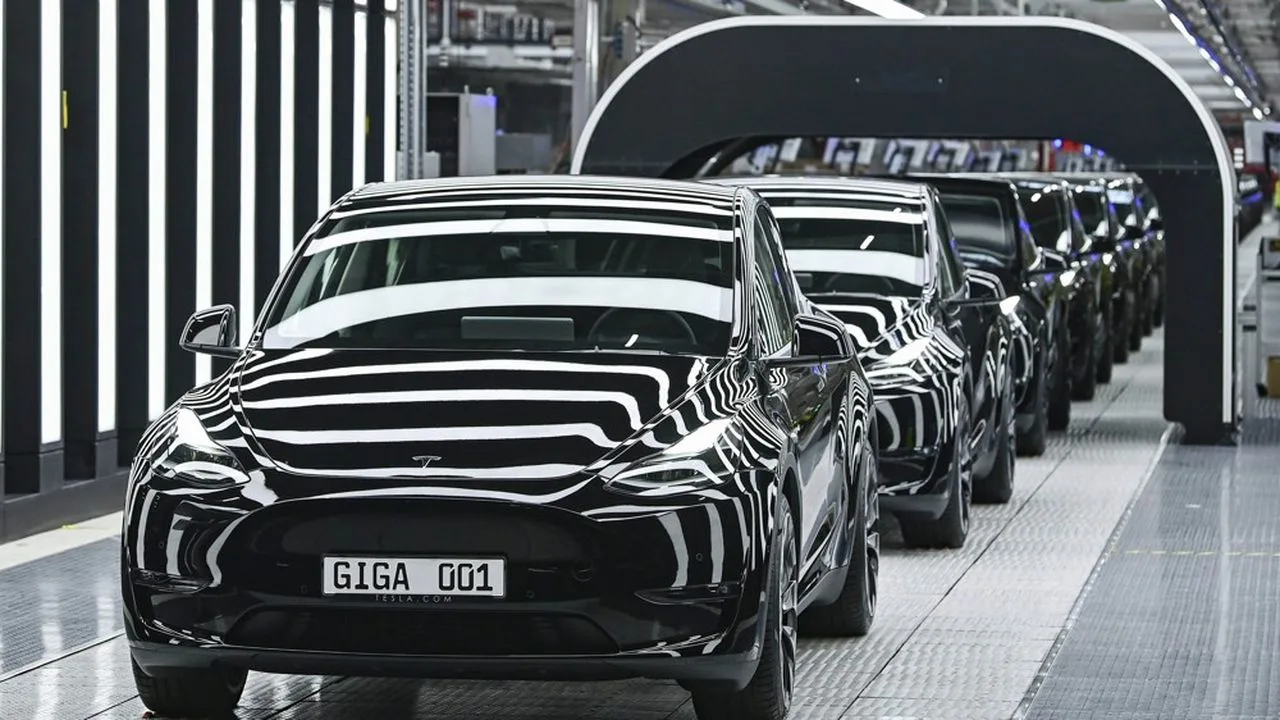
Tesla challenged several established industry conventions: direct sales, over-the-air software updates, more centralized electronic architecture, large touchscreens, massive data collection, vertical integration and gigafactories.
The automobile increasingly began to be conceived as an updatable digital platform.
Established manufacturers had to respond.
The car becomes a computer on wheels
Modern vehicles already contain dozens of control units and millions of lines of code.
That complexity continues to increase.
Engine or battery management, braking, driver assistance, climate control, navigation, entertainment, connectivity and diagnostics increasingly depend on electronics.
The industry is gradually seeking to replace some distributed architectures with more centralized systems.
The software-defined vehicle is becoming one of the structural concepts of the new automotive industry.
The objective is to allow software to determine a growing share of vehicle functions and to enable those functions to evolve after the vehicle has been sold.
This also creates a new economic model.
Functions can be activated remotely. Services can be sold through subscriptions. Vehicle data can support predictive maintenance, insurance, mapping or assisted-driving systems.
The boundary between automotive manufacturing and technology is becoming less clear.
And that evolution introduces new competitors and partners: Nvidia, Qualcomm, Mobileye, Google and numerous specialists in semiconductors, cloud computing, artificial intelligence and mapping.
The allocation of value therefore becomes a strategic question.
If software represents a growing share of the automotive experience, manufacturers must avoid becoming mere hardware assemblers whose digital environment is controlled by other companies.
Semiconductors become strategic
The global semiconductor shortage that emerged during the Covid-19 pandemic revealed this dependence with unusual clarity.
Automotive plants capable of producing hundreds of thousands of vehicles were forced to slow or suspend some production lines because they lacked electronic components whose individual cost could be relatively modest.
The increasing sophistication of vehicles only deepens that exposure.
Electrification, connectivity, radar, cameras, advanced driver-assistance systems and embedded intelligence all increase semiconductor demand.
The automobile has therefore become part of another global industrial struggle: the battle for semiconductors.
Production becomes deeply global
A modern vehicle may be assembled in one country from components sourced from dozens of others.
Manufacturers have progressively organized production around global platforms and major industrial clusters.
Central and Eastern Europe have become deeply integrated into German and broader European automotive production.
Mexico has become a critical manufacturing platform for North America because of its proximity to the United States, its industrial base and regional trade agreements.
Thailand has long been a major automotive hub in Southeast Asia.
India has a substantial industry and a market with enormous remaining potential.
Turkey is deeply integrated into European automotive value chains.
North Africa is also taking an increasingly important role.
Morocco, an automotive platform between Europe and Africa
Over several decades, Morocco has built an automotive ecosystem that now ranks among the leading industrial bases on the African continent.
The opening of Renault’s Tangier plant in 2012 was a decisive milestone.
Its proximity to the Tanger Med port complex allows Moroccan production to be tightly integrated into European and Mediterranean logistics networks.
Stellantis has simultaneously developed its Kenitra plant, inaugurated in 2019 and subsequently expanded through additional investment and capacity increases.
A supplier network has developed around these manufacturers, specializing in wiring harnesses, seats, metal components, plastics and electronics.
The automotive sector has become one of Morocco’s leading industrial export activities.
The strength of the Moroccan model, however, does not rest solely on labor costs.
Geographic proximity to Europe, trade agreements, Tanger Med, industrial zones, vocational training and the progressive development of supplier networks have enabled much deeper integration.
The next challenge is to move further up the value chain.
The electric transition could create new opportunities in batteries, materials, electronics and electric-vehicle components. It could also expose traditional activities to new forms of technological disruption.
Morocco therefore illustrates a broader phenomenon: the new automotive geography no longer simply separates producing countries from consuming countries. It increasingly organizes regional industrial corridors.
India could become the next major shift
With its population, industrialization and rising incomes, India has several characteristics that once made China strategically important to the automotive industry.
Its trajectory, however, will be different.
Maruti Suzuki has historically dominated a large portion of the passenger-car market. Tata Motors and Mahindra also hold major positions. Hyundai and other foreign groups manufacture at scale in the country.
India is simultaneously pursuing policies designed to strengthen its manufacturing base.
Its market remains dominated by relatively small and price-sensitive vehicles, but its long-term growth potential is considerable.
In a world where manufacturers increasingly seek to diversify away from excessive dependence on a single Asian production base, India could also benefit from supply-chain rebalancing.
Global automotive competition may therefore gradually organize itself around three enormous markets—China, the United States and India—alongside the European market.
Europe faces an industrial dilemma
Europe’s position is particularly complex.
The European Union wants to accelerate the decarbonization of transport and has adopted increasingly stringent CO₂ standards for new vehicles.
At the same time, its automotive industry represents hundreds of billions of euros in economic activity, millions of direct and indirect jobs and a significant share of private research spending.
The challenge is that the technological transition is occurring precisely as Chinese competition becomes stronger.
European manufacturers must therefore simultaneously finance their existing internal-combustion businesses, develop electric vehicles, invest in software, secure battery supply and defend market share.
Chinese electric models have begun entering the European market, sometimes with significant cost advantages.
Following an anti-subsidy investigation, the European Union imposed additional countervailing duties in 2024 on imports of battery-electric vehicles produced in China, with differentiated rates depending on manufacturers and their cooperation with the investigation.
The issue goes far beyond trade.
Europe must balance several objectives that are not always perfectly compatible: accelerating electrification, providing affordable vehicles, preserving a European industrial base and complying with international trade rules.
The United States also chooses industrial protection
Washington faces the same challenge but uses different instruments.
The United States sharply increased tariffs on Chinese electric vehicles under the Biden administration in 2024, while successive American policies have sought to strengthen domestic or regional production of batteries, vehicles and strategic components.
The Inflation Reduction Act of 2022 notably used tax credits and origin requirements to encourage the development of a North American supply chain and reduce certain dependencies on China.
Even when instruments change from one administration to another, a deeper trend remains: the automobile has once again become an explicit issue of economic security.
The logic of pure globalization is gradually being supplemented by resilience, localization and dependency management.
The return of industrial policy
For several decades, global automotive production was organized primarily around efficiency.
Producing each component where it was most cost-effective helped lower prices and optimize margins.
That logic has not disappeared.
But it is no longer the only one.
The pandemic, US-China trade tensions, semiconductor shortages, the war in Ukraine and competition over strategic technologies have placed supply-chain security back at the center of decision-making.
Governments want battery plants.
They want secure lithium supplies.
They want semiconductor capacity.
They want to retain automotive manufacturers.
And they want to prevent industrial dependence from becoming geopolitical vulnerability.
The automotive industry has therefore entered a new era of industrial policy.
An industry confronted with the problem of affordability
The technological transformation runs into a simple reality: consumers buy vehicles according to their income.
Cars have become more complex, more heavily equipped and often more expensive.
In many developed markets, manufacturers have increasingly focused on SUVs, premium models and high-margin vehicles.
That strategy may make economic sense in the short term, but it raises a fundamental question: what happens to the affordable mass-market car?
The electric transition can intensify the problem when battery costs make it difficult to produce small vehicles profitably.
This is precisely the area in which Chinese manufacturers may hold a major advantage.
Controlling battery supply, manufacturing at enormous scale and shortening development cycles can allow electric vehicles to be offered at price points that some established groups struggle to match.
The global automotive battle may therefore be decided as much by price as by technology.
The internal combustion engine will not disappear everywhere at the same pace
Electrification is advancing rapidly, but the global automotive market is not homogeneous.
According to the International Energy Agency, global electric-car sales have grown dramatically since the beginning of the 2020s, with China accounting for the largest share of volumes.
But infrastructure, income levels and energy systems differ significantly across regions.
Norway can achieve extremely high shares of electric vehicles in new-car sales.
China can build charging infrastructure at enormous scale.
The transition is slower in many emerging markets where purchase prices, second-hand vehicle availability, grid reliability or access to charging create different constraints.
Internal-combustion vehicles, and especially hybrid technologies, may therefore retain a significant role for a long time.
Toyota has notably defended a multi-technology strategy combining hybrids, plug-in hybrids, battery-electric vehicles and, in some segments, hydrogen.
The future may be less uniform than some projections suggest.
Hydrogen is still searching for its place
Hydrogen has long been presented as another possible path toward automotive decarbonization.
Toyota, Hyundai and several other manufacturers have developed fuel-cell vehicles.
But for passenger cars, battery-electric vehicles currently hold a substantial lead in volumes, infrastructure and industrial ecosystem.
Hydrogen may prove more relevant in certain heavy-duty, industrial or commercial applications where battery weight, range and charging times create different constraints.
Automotive technological history nevertheless encourages caution: the technologies that ultimately dominate are not always those engineers expected decades earlier.
Autonomous driving: delayed revolution, not necessarily abandoned
In the mid-2010s, some forecasts predicted a rapid spread of fully autonomous vehicles.
Reality proved much more complex.
Understanding an open road environment populated by unpredictable human behavior is an enormous technical challenge.
Regulatory, legal and insurance questions add further complexity.
Fully autonomous driving on a general scale therefore remains far more limited than some earlier projections suggested.
Advanced driver-assistance systems, however, continue to progress.
Automatic emergency braking, lane keeping, adaptive cruise control, automated parking and supervised driving systems are becoming increasingly common.
At the same time, some companies are developing robotaxi services in geographically restricted areas.
Autonomy may therefore arrive not as a single dramatic breakthrough, but through the gradual accumulation of capabilities.
The automobile becomes a sovereignty issue
Why do governments devote so much money and political energy to this industry?
Because it concentrates several dimensions of economic power.
It employs at scale.
It exports.
It supports research.
It sustains industrial supplier networks.
It consumes semiconductors, metals, software and energy.
It also generates powerful spillovers into the wider economy.
A strong automotive sector can support metallurgy, chemicals, electronics, robotics, logistics and engineering.
Its decline, by contrast, can destroy skills that are difficult to rebuild.
That is why China, the United States, the European Union, Japan, South Korea, India, Mexico, Turkey and Morocco are all seeking, at different scales, to preserve or expand their position in the automotive value chain.
The automotive geography of the twenty-first century
A new global map is taking shape.
China has scale, the world’s largest automotive market, an extremely competitive electric-vehicle industry and a dominant position across several battery segments.
The United States retains an enormous market, powerful manufacturers, Tesla, an exceptional technology sector and substantial capacity to mobilize public policy.
Europe possesses some of the world’s strongest brands, deep industrial expertise and considerable technological capabilities, but must simultaneously manage regulatory transition, high costs and Asian competition.
Japan remains a major automotive power, led by Toyota and supported by an extremely sophisticated industrial ecosystem.
South Korea combines automakers, batteries, electronics and semiconductors.
India probably represents the largest structural growth opportunity among major markets that remain relatively under-motorized.
Mexico has become an essential extension of the North American automotive system.
Morocco is gradually establishing itself as a Euro-African automotive manufacturing platform.
Southeast Asia is becoming a competitive arena for Japanese, Chinese, Korean and Western groups.
This geography already looks very different from the era in which Detroit, Wolfsburg and Toyota City almost exclusively dominated the global automotive imagination.
Who will capture the value tomorrow?
This is probably the most important question.
During the twentieth century, a large share of automotive value came from mastery of mechanical engineering, engines, industrial manufacturing, branding and distribution networks.
Those capabilities remain important.
But new layers are emerging.
The battery.
Semiconductors.
Software.
Data.
Artificial intelligence.
Autonomous systems.
Digital services.
Charging infrastructure.
A manufacturer that fails to control enough of these technologies risks seeing a growing share of value captured by suppliers.
Conversely, groups capable of integrating vehicle architecture, batteries, electronics and software may acquire a considerable advantage.
The contest between vertical integration and industrial specialization is therefore being reopened.
Two centuries after Benz, a new industry is emerging
The automobile has already experienced several revolutions.
Europe invented the first modern cars.
The United States invented their mass production.
Japan revolutionized their manufacturing.
South Korea demonstrated that a new entrant could join the global leaders within a few decades.
China is now showing that a technological transition can rapidly redistribute the hierarchy of global industry.
The next revolution may be less visually obvious.
An electric car still looks like a car. It has four wheels, seats, a steering wheel and a body.
But its economic architecture is profoundly different.
Mechanical engineering gives more ground to electronics. Oil shares its strategic importance with lithium, graphite and electricity. The garage becomes partly an IT center. The automaker moves closer to the technology company. Engine plants coexist with gigafactories. Data becomes another raw material.
And behind every vehicle now lies a much broader competition.
A competition for minerals, batteries, semiconductors, software, factories, skills and markets.
For more than a century, the automobile has been one of the defining products of the global industrial economy.
It still is.
But the industry that builds the cars of the twenty-first century will probably no longer be quite the same industry that built those of the twentieth.
Main sources
International Organization of Motor Vehicle Manufacturers (OICA) — global automotive production statistics and country-level data.
International Energy Agency (IEA) — Global EV Outlook, data on electric-vehicle sales, batteries, supply chains, industrial capacity and critical minerals.
European Automobile Manufacturers’ Association (ACEA) — vehicle fleet, production, registrations, trade, employment and the economic weight of the European automotive industry.
European Commission — vehicle CO₂ regulation, anti-subsidy investigation and trade measures concerning electric vehicles produced in China.
U.S. Department of Energy — data on automotive technologies, batteries, charging infrastructure and US industrial supply chains.
U.S. Department of the Treasury and other US federal authorities — clean-vehicle incentives, production support mechanisms and evolving eligibility requirements.
World Trade Organization (WTO) — data and analysis related to international trade in vehicles, components and manufacturing value chains.
OECD — analysis of global value chains, industrial production, trade and public policies affecting the automotive sector.
World Bank — macroeconomic, industrial, trade and logistics data used to contextualize the principal automotive-producing regions.
Annual reports and institutional publications from automotive manufacturers and suppliers — Toyota, Volkswagen Group, Hyundai Motor Group, General Motors, Ford, Stellantis, Renault Group, BMW Group, Mercedes-Benz Group, Tesla, BYD, Geely, SAIC, CATL, Bosch and other companies mentioned.
Tanger Med, Morocco’s Ministry of Industry and Trade, Renault Group and Stellantis — data relating to the development of Morocco’s automotive ecosystem, industrial facilities and production capacity.
Atlas Limits Research Desk
Atlas Limits’ editorial and analytical desk.