The United States is no longer simply trying to buy critical minerals. By committing $450 million to Elmet Group while securing up to $2 billion in potential purchases for the national stockpile, Washington is building a tungsten supply chain in which the state finances supply, organizes sourcing and guarantees part of the demand.
Tungsten rarely occupies a prominent place in debates over industrial power. Yet it sits at the heart of a range of military systems and industrial applications where its density, hardness and resistance to extreme temperatures make substitution particularly difficult.
It is precisely this discreet strategic importance that Washington now appears determined to address.
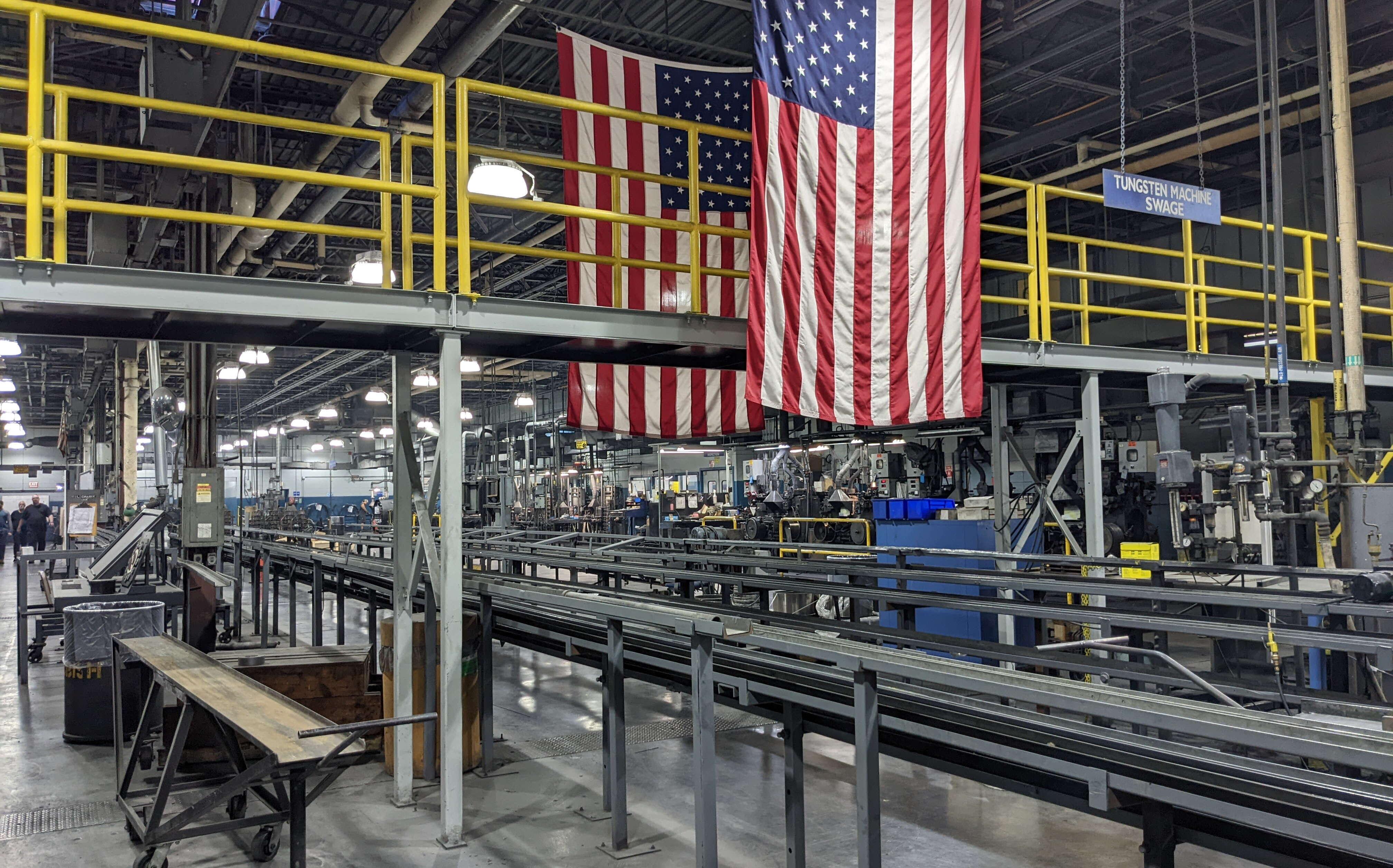
On September 14, 2026, Elmet Group announced a $450 million committed investment from the U.S. Department of War to expand its tungsten mining, conversion and manufacturing capabilities. The transaction, however, bears little resemblance to a conventional industrial subsidy.
An initial $200 million is expected to be funded at closing. In return, the U.S. government is set to receive redeemable preferred shares as well as warrants that could represent up to 19.9% of Elmet’s equity following the transaction. The government will also receive the right to appoint an independent director and a non-voting observer to the company’s board.
In other words, Washington is no longer merely financing a strategic capability. It is acquiring the means to exert influence over the company tasked with building it.
From the mine to the industrial product
The geography of the investment reveals the operation’s broader ambition.
More than $165 million is expected to be invested in Elmet facilities in Maine, Michigan and Ohio. Approximately another $150 million is earmarked for restarting the Springer complex in Nevada, which is intended to restore domestic tungsten mining and conversion capacity.
Under the announced timetable, the Springer mine is expected to restart operations in the fourth quarter of 2027. Its ammonium paratungstate conversion facility — a critical intermediate stage in the tungsten supply chain — is expected to follow in the second half of 2028.
But the architecture extends beyond U.S. borders.
Elmet also plans investments and associated offtake arrangements involving the Mt Carbine mine in Australia and the Barruecopardo mine in Spain. These resources are intended to feed a supply chain in which conversion and an increasing share of manufacturing would be concentrated in the United States.
The emerging model is therefore not one of American mineral autarky. It is closer to the construction of a controllable Western supply chain: resources originating in the United States and allied countries, North American conversion, domestic manufacturing and a secured public-sector customer.
The distinction matters.
In the emerging critical-minerals landscape, sovereignty does not necessarily mean possessing every resource within national borders. Increasingly, it means controlling enough stages of the supply chain to prevent a decision made elsewhere from disrupting the entire system.
The state finances supply and guarantees demand
A second component makes the operation particularly significant.
The Defense Logistics Agency has simultaneously awarded Elmet an indefinite-delivery, indefinite-quantity contract with a ceiling of $2 billion to supply ores, concentrates and sodium tungstate to the U.S. National Defense Stockpile.
The $2 billion figure requires caution. It represents the contract ceiling, not a firm purchase commitment. Only $150 million is currently guaranteed. The initial contract period runs through August 30, 2031, with an option potentially extending it through 2033.
The combination of the two mechanisms nevertheless changes the economics considerably.
For years, one of the principal obstacles to rebuilding Western mining and metallurgical capacity has been less the geological absence of resources than commercial uncertainty. Developing a mine or conversion plant requires heavy investment over several years, after which producers must compete in global markets where prices can fall sharply and Chinese operators occupy dominant positions.
Washington is now intervening on both sides of that equation.
The government provides capital to help create new capacity while simultaneously becoming a customer capable of absorbing part of the resulting production.
Elmet has specified that deliveries to the strategic stockpile are expected to begin only after incremental capacity becomes available. The intention is to prevent public purchases from simply absorbing tungsten already on the market and reducing supplies available to American manufacturers.
The strategic stockpile is therefore becoming something more than a reserve.
It is becoming an instrument of industrial policy.
China behind the equation
This transformation is difficult to understand without considering the current structure of the market.
The United States currently has no operating commercial tungsten mine, while China holds a dominant position in global tungsten mining and processing. Chinese restrictions affecting certain strategic mineral and technology exports have progressively transformed that industrial concentration into an economic-security issue.
Tungsten is particularly sensitive.
Its physical properties make it valuable in high-performance industrial tooling, specialized alloys, electronics and a range of defense applications. Elmet’s U.S. operations provide materials or components associated with programs including Patriot, Phalanx, JDAM and the F-35.
A prolonged supply disruption would therefore affect more than the price of a raw material. It could propagate through multiple industrial chains much further downstream.
That is precisely what Washington is now attempting to prevent.
For several decades, the economics of strategic raw materials largely rested on the assumption that sufficiently open global markets would allow resources to be purchased wherever they could be produced most efficiently. Export restrictions, technological rivalry and the return of industrial policy are progressively altering that logic.
Cost is no longer the only criterion.
Availability under constraint is becoming one as well.
When the state becomes a strategic shareholder
Perhaps the most unusual dimension of the Elmet operation lies elsewhere.
By potentially acquiring up to 19.9% of the company’s equity through the exercise of warrants and obtaining board representation rights, the U.S. government is taking another step in the evolution of American industrial policy.
The boundaries between public procurement, subsidy and direct financial participation are becoming increasingly porous.
This does not necessarily imply a lasting policy of partial nationalization. The preferred shares contemplated in the transaction are redeemable, and the precise investment structure remains subject to a number of conditions. But the principle is becoming visible: when a company controls a link in a supply chain deemed essential to national security, the government may be prepared to enter its capital structure directly to accelerate its development.
The change is institutional as much as industrial.
Washington is no longer merely telling markets which capabilities it wants to see emerge. It is accepting part of the financial risk required to create them.
An architecture, not simply a mine
Springer will not restart tomorrow.
Mining operations are not expected to resume until late 2027, while ammonium paratungstate conversion is scheduled for 2028. Those deadlines remain dependent on permitting, construction, additional financing and Elmet’s ability to contain costs. The volumes that can ultimately be mobilized from Australia and Spain will also need to be confirmed.
Nor should the Defense Logistics Agency’s $2 billion contract be treated as $2 billion in guaranteed revenue. For now, only a fraction of that ceiling represents a firm commitment.
American dependence on foreign tungsten therefore does not disappear with this announcement.
But that is probably not where the most important change lies.
Washington has assembled within a single structure a public financial stake, governance rights, an American mine scheduled for restart, resources sourced from allied countries, domestic conversion and manufacturing capacity, and a government buyer prepared to build strategic inventories over several years.
What is being constructed is not simply a mine.
It is a supply-security architecture.
If it works, the model could prove replicable. Similar obstacles affect other critical minerals: high upfront investment, uncertain demand, dominant foreign suppliers and the difficulty of keeping new Western capacity competitive during its early years.
The Elmet model offers one answer: allow the state to absorb part of the risk that the market is unwilling to bear while leaving industrial operations in private hands.
That may ultimately be the deeper shift. Faced with China’s concentration of strategic mineral supply chains, Washington is no longer merely seeking to diversify its suppliers.
It is beginning to organize the market it believes it needs.
Main sources: Elmet Group, September 14, 2026 announcement and investment documentation; Defense Logistics Agency, National Defense Stockpile contract; U.S. Department of War; Reuters, September 14, 2026.
Atlas Limits Research Desk
Atlas Limits’ editorial and analytical desk.