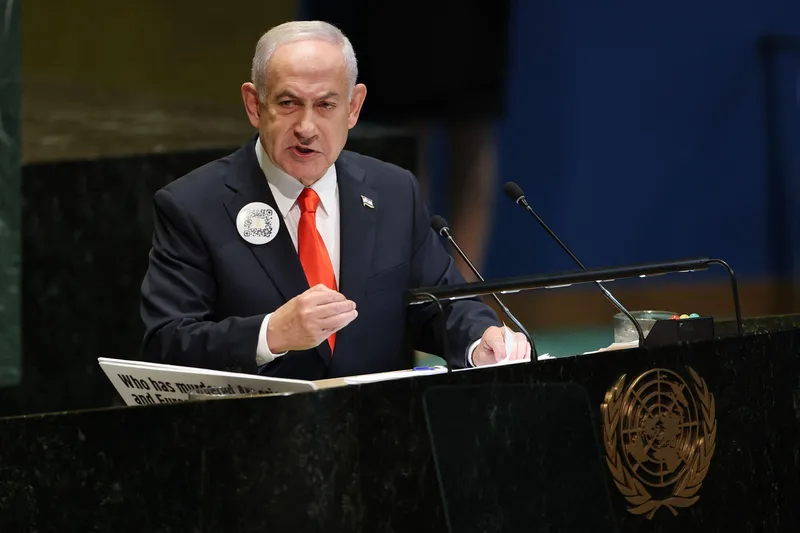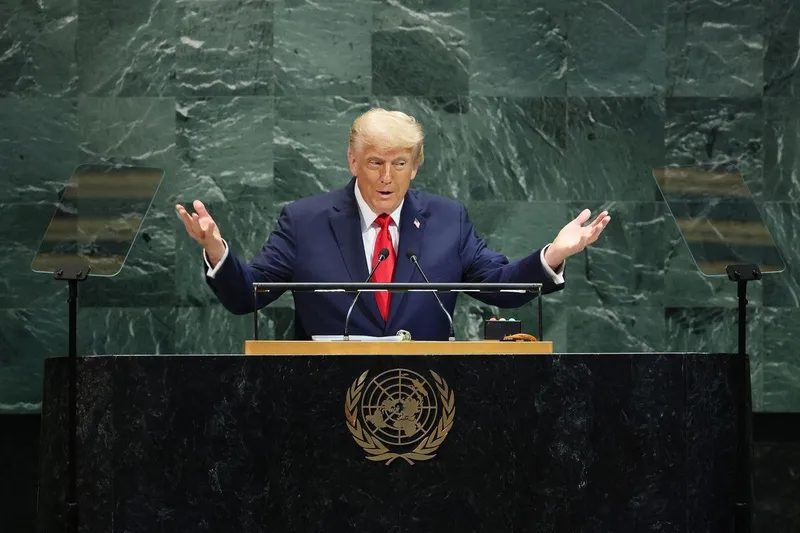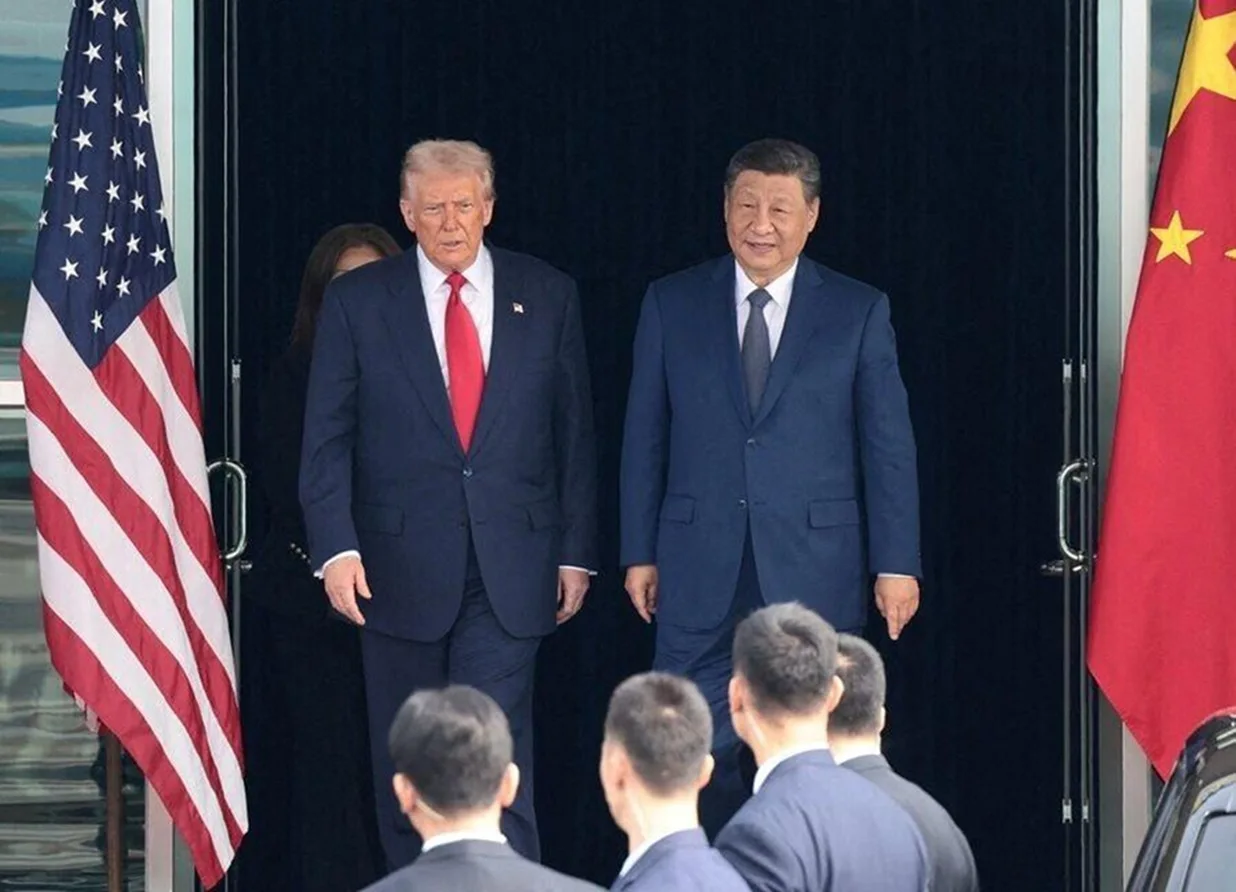
For three days, Washington rediscovered the choreography of a major state visit. Donald Trump went to welcome Xi Jinping upon his arrival. The red carpet was rolled out, military honors were rendered, and a state dinner was held at the White House. On the final day, the two presidents appeared together again before America’s founding documents at the National Archives. In the images, after years of tariffs, technological restrictions and mutual accusations, the world’s two leading powers seemed almost to have returned to normal.
They had not.
When Xi Jinping left Washington on September 25, none of the fundamental contradictions in the US-China relationship had disappeared. Taiwan remains a fault line. American technology restrictions remain in place. China retains a dominant position across several critical-mineral supply chains. Washington and Beijing continue to compete over semiconductors, artificial intelligence, industrial capacity and strategic influence across much of the world.
But measuring the summit by what it failed to resolve may obscure what it began to build.
In Washington, the United States and China did not organize their reconciliation. They moved further toward organizing their rivalry.
The Return of Small Agreements
The economic results are modest when compared with the scale of the disputes, but they are not insignificant. The two governments operationalized economic mechanisms initiated several months earlier: a Board of Trade and a Board of Investment are intended to provide permanent channels for negotiation between the two economies.
On trade, the two sides advanced recommendations for more favorable tariff treatment covering $30 billion in goods considered non-sensitive in each direction. The American categories concerned include certain agricultural products, seafood, timber, cosmetics and medical devices. Beijing also committed to purchasing at least 10 million metric tons of US coal in 2027 and the same amount in 2028.
This is not a return to the economic relationship of the 2000s, when interdependence was still widely treated as an objective in itself. Since then, both countries have learned to map their vulnerabilities, protect their technologies and distinguish ordinary commerce from sectors they now regard as strategic.
The language used in Washington reveals almost as much as the amounts announced: the concessions primarily concern “non-sensitive” goods.
Cooperation is returning where it does not directly threaten competition.
Where Dependence Begins
Rare earths immediately reveal the limits of this approach.
China still occupies a central position in their extraction and, above all, their processing. These materials are used in electric vehicles, electronics, energy infrastructure and numerous military systems. Chinese restrictions have reminded Washington that industrial dependence can become an instrument of power when political relations deteriorate.
Xi’s visit did not resolve the problem.
The US account of the talks states that the two governments will continue working on shortages involving rare earths and other critical minerals in an effort to restore shipments to levels considered appropriate. Behind that diplomatic language lies one of the defining characteristics of the current balance of power.
Washington still possesses considerable leverage over certain advanced technologies. Beijing possesses leverage over several of the materials required to manufacture them.
The technological rivalry now extends all the way down to raw materials.
It also explains why complete decoupling, repeatedly discussed over the past several years, remains much easier to announce than to achieve. Both powers are trying to reduce dependencies they consider dangerous without absorbing the economic cost of a general rupture.
It is less spectacular than a trade war. It is also far more structural.
AI Changes Category
The newest part of the relationship may lie elsewhere.
The United States and China are now pursuing a government-level dialogue on risks associated with artificial intelligence. Another session is expected to continue discussions already underway between the two countries, while the possibility of a communication channel that could be used in the event of a serious AI-related incident has become part of the mechanisms under consideration between Washington and Beijing. Preparatory discussions have included uncontrolled agents, cyberattacks and risks originating from non-state actors.
Taken in isolation, the arrangement may appear technical. Its significance is considerably greater.
For several years, artificial intelligence was treated primarily within the US-China relationship as a technology to be controlled: computing power, semiconductors, data centers, models, investment and export controls. It is now beginning to appear in another form — as a source of risk potentially serious enough to require direct communication between the two states.
AI is gradually moving from industrial policy into the realm of strategic stability.
Comparisons with the communication mechanisms developed during the Cold War should be handled carefully. The United States and China of 2026 are not the United States and the Soviet Union. Their economies remain deeply connected, their companies still share numerous value chains, and their confrontation does not rest on two hermetically sealed economic blocs.
But the underlying principle is familiar: when two powers simultaneously develop capabilities capable of generating rapid, difficult-to-interpret and potentially serious incidents, the ability to communicate becomes an instrument of security in its own right.
For the first time, that logic is beginning to encompass artificial intelligence.
Stabilizing Without Moving Closer
This evolution helps explain an expression that is increasingly present in exchanges between Washington and Beijing: the search for a form of strategic stability.
The term can be misleading. Stability does not mean that the two countries are beginning to see the world in the same way. Beijing continues to place sovereignty and territorial integrity at the center of its relationship with Washington. Taiwan therefore remains unavoidable. The United States, for its part, announced no general retreat from its Indo-Pacific policy or from the technological instruments developed over recent years.
The change lies elsewhere.
Washington and Beijing appear increasingly willing to accept that a relationship can be simultaneously adversarial and organized.
They can negotiate on trade while protecting themselves in semiconductors. They can seek to secure critical-mineral flows while investing to reduce their respective dependencies. They can accelerate their artificial-intelligence programs while discussing what protocol should be used on the day a system causes an incident serious enough to alarm both capitals.
The contradiction is only apparent.
The deeper the rivalry becomes, the more it requires mechanisms capable of preventing it from becoming uncontrollable.
A Compartmentalized Relationship
This may be Washington’s most important lesson.
The era in which the US-China relationship could be described simply in terms of engagement or confrontation is disappearing. In its place, a more fragmented architecture is emerging.
In some sectors, trade continues. In others, the two economies are seeking greater separation. Some dependencies are tolerated; others become matters of national security. Investments are screened, technologies filtered and supply chains reorganized. Above this entire structure, the two presidents maintain a direct political relationship intended to preserve the possibility of arbitration.
The ceremony in Washington therefore takes on a different meaning.
Xi Jinping’s visit was not important because the images suggested reconciliation. It was important precisely because they accompanied a relationship that is not reconciling.
Only a few months after Trump’s visit to Beijing, Xi was received in Washington. The frequency of summit-level encounters is gradually becoming part of the mechanism itself: disagreements are now numerous enough to require almost permanent political management.
Summits no longer necessarily come to resolve the crisis.
They are becoming one of the ways of living with it.
The Managed Rivalry
For years, one question has dominated analysis of the US-China relationship: how far will the confrontation go?
Washington tightened technological controls. Beijing developed its own instruments of pressure. Companies relocated parts of their supply chains. Governments spoke of resilience, de-risking and industrial sovereignty. Each new restriction seemed to announce the next stage of a gradual separation.
The Washington visit suggests that another dynamic is developing alongside it.
The United States and China appear to be preparing for a relationship in which rivalry could endure for a very long time without necessarily producing a rupture.
That requires knowing where to trade and where to protect, where to negotiate and where to refuse, where to reduce a dependency and where to accept that one will remain. It also requires channels capable of functioning when political relations deteriorate, precisely because that is when they become necessary.
None of this guarantees stability. Taiwan can still produce a crisis. Technology controls can be tightened further. Critical minerals can again become instruments of coercion. Artificial intelligence itself introduces risks whose implications both powers are only beginning to understand.
But Washington and Beijing appear to have identified a shared reality: neither can easily exit the relationship.
For three days, Washington therefore rolled out the red carpet without removing a single one of the major fault lines between the two powers.
At the end, the semiconductors were still there. Taiwan was still there. So were the rare earths.
The carpet had already been rolled back up.
Main Sources
— The White House — “President Donald J. Trump Advances a Fair and Reciprocal Relationship with China While Hosting Historic State Visit”, September 25, 2026. Official US account of the visit, including trade and investment mechanisms, critical-mineral discussions, Chinese purchasing commitments and strategic dialogue. https://www.whitehouse.gov/fact-sheets/2026/09/fact-sheet-president-donald-j-trump-advances-a-fair-and-reciprocal-relationship-with-china-while-hosting-historic-state-visit/
— Ministry of Foreign Affairs of the People’s Republic of China — Official accounts of Xi Jinping’s state visit to the United States and his talks with Donald Trump, September 2026. Chinese position on the bilateral relationship, strategic stability, sovereignty and the political outcomes of the visit. https://www.fmprc.gov.cn/mfa_eng/
— State Council of the People’s Republic of China — Accounts of the Xi–Trump discussions and statements by Wang Yi, September 25–27, 2026. Chinese presentation of strategic stability, core interests and the evolution of US-China relations. https://english.www.gov.cn/
— Reuters — “Rare earths force Trump to be less hostile before Xi summit”, September 21, 2026. Context and data on China’s position in rare-earth supply chains and their role in US-China negotiations. https://www.reuters.com/world/china/rare-earths-force-trump-be-less-hostile-before-xi-summit-2026-09-21/
— Reuters — “US, China to meet again on AI safety in two months in Shenzhen, Bessent says”, September 21, 2026. US-China discussions on artificial-intelligence risks, autonomous agents, cyberattacks and possible communication mechanisms for serious incidents. https://www.reuters.com/world/asia-pacific/us-china-meet-again-ai-safety-two-months-shenzhen-bessent-says-2026-09-21/
— Reuters — “China’s Xi expected to press Trump to halt Taiwan arms sales under 1982 agreement”, September 22, 2026. Background on Taiwan and Beijing’s position regarding US arms sales. https://www.reuters.com/world/china/chinas-xi-expected-press-trump-halt-taiwan-arms-sales-under-1982-agreement-2026-09-22/
— The Economist — Post-summit analysis of Xi Jinping’s state visit to Washington, September 2026. Assessment of the limited agreements reached during the visit against the persistence of the major strategic disputes. https://www.economist.com/
Atlas Limits Research Desk
Atlas Limits’ editorial and analytical desk.