
At Quantico on September 30, 2026, three men found themselves around the same table. Elon Musk, whose rockets already carry American military payloads. Palmer Luckey, whose company Anduril builds drones, autonomous systems and command software. And Newt Gingrich, the former Speaker of the House, a political figure from another generation. Yet their mission is not to examine a particular weapons program. The Pentagon is asking them something much broader: to think about what American warfare will look like tomorrow.
Secretary of Defense Pete Hegseth has named the initiative Project Meridian. Operating under the authority of the department's Chief Technology Officer, Emil Michael, it is intended to identify emerging domains of conflict and the capabilities U.S. forces will need to maintain an advantage within them. Musk, Luckey and Gingrich will jointly lead the effort. Its first report is expected within 120 days.
Elon Musk's appointment naturally generates the headlines. But it obscures the more important development. On the same day, Hegseth unveiled several reforms placing autonomous systems, drones, artificial intelligence and emerging technologies at the center of the transformation of the U.S. military. Project Meridian is therefore not an isolated commission. It is the prospective component of a much deeper reorganization.
What is changing is not merely the technology of weapons. It is the way the United States is beginning to organize the production of military power itself.
From the weapons factory to the software factory
For decades, the American military-industrial complex rested on a relatively identifiable architecture. The Pentagon defined its requirements, Congress approved the budgets, and a handful of prime contractors — Lockheed Martin, Boeing, Northrop Grumman, RTX and General Dynamics — developed platforms whose industrial life cycles could extend over several decades.
A fighter jet, bomber, aircraft carrier or strategic missile remained an industrial object before it was a computing system. That boundary is gradually disappearing.
A modern drone is simultaneously an aircraft, a network of sensors, a communications system and a software platform. A satellite constellation can provide military communications without having originally been conceived as conventional military infrastructure. A command system can fuse information from satellites, radars, drones and ground sensors within seconds before proposing a target or response.
Military value is therefore shifting, at least in part, from the platform toward the network connecting the platforms together.
This evolution helps explain the growing importance of companies that historically did not belong to the first circle of the defense industry. SpaceX provides the U.S. government with launch services and space capabilities. Anduril has built its expansion around autonomous systems and Lattice, its command-and-control software platform. Only days before Meridian was announced, the U.S. Navy established a center in Virginia dedicated to integrating robotic and autonomous systems into future operations. During a U.S. Northern Command exercise in September, Lattice was used as the digital architecture integrating different commercial counter-drone capabilities.
The movement therefore did not begin with Musk and Luckey.
Their appointment instead shows how far it has already progressed.
Meridian looks beyond the next weapon
Project Meridian is supposed to look years, perhaps decades, ahead. According to the Pentagon's presentation, it will explore emerging domains of warfare and determine which technologies will be required to master them. This approach addresses a fundamental weakness in military acquisition systems. 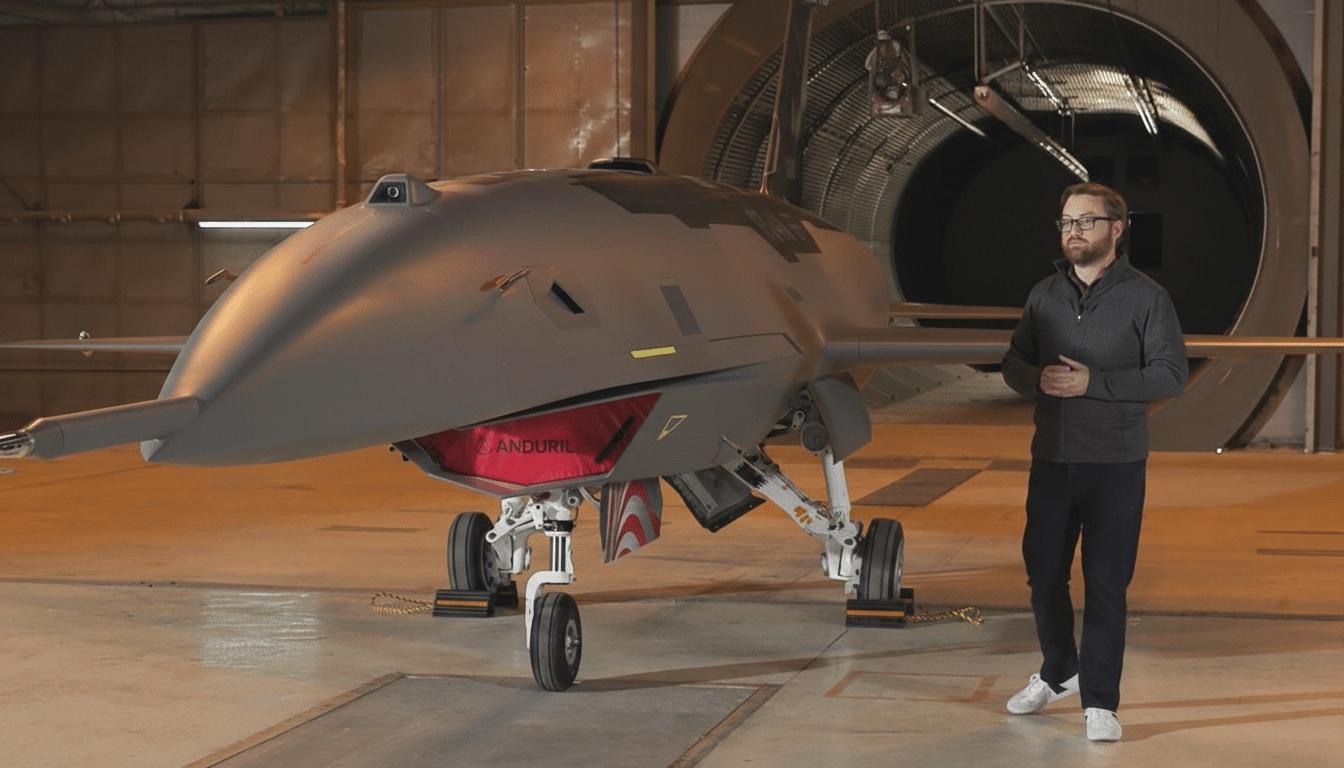 Major platforms can require years of design, testing, budget authorization and production. Software evolves within months. Artificial intelligence models can change within weeks. Commercial drones can be modified directly on the battlefield. A military architecture designed around industrial programs lasting twenty or thirty years must now absorb technologies whose individual generations can become obsolete before a single budget cycle has even ended.
Ukraine has made this contradiction particularly visible. Drones, electronic warfare, satellite communications, targeting software and the rapid adaptation of equipment have transformed the pace of military innovation. The ability to modify a system quickly can become as important as its original performance.
The Pentagon is therefore attempting to reduce the distance between innovation, acquisition and the battlefield. This is where Meridian begins to make sense.
Musk and Luckey are not simply entrepreneurs capable of imagining new technologies. They lead industrial organizations built around development cycles considerably shorter than those traditionally associated with major military programs.
The Pentagon is therefore importing not only two men, but their industrial method.
The command of autonomous warfare
A second announcement made at Quantico reveals the scale of the shift.
Hegseth announced the creation of an Autonomous Warfare Command, or AUTOWARCOM, intended to coordinate and accelerate the integration of autonomous systems across U.S. forces. The initiative is designed to bring greater coherence to efforts currently dispersed among different services and programs.
The two decisions fit together. Meridian is intended to think about the future forms of warfare. AUTOWARCOM is intended to help turn some of those technologies into operational capabilities.
That connection matters because America's problem is no longer simply producing prototypes. The United States possesses an enormous technological ecosystem. The greater difficulty is converting commercial or experimental innovation rapidly into equipment that can be deployed at scale across military units.
Autonomous warfare intensifies that problem. A military increasingly dependent on thousands of relatively inexpensive, distributed and regularly replaced systems cannot be administered in exactly the same way as one built around a few hundred extremely sophisticated and expensive platforms.
It requires different supply chains, different command systems, different procurement procedures and probably a different defense economy.
Quantity begins to matter as much as sophistication
Behind autonomy lies an economic transformation.
For several decades, part of American military superiority has rested on extraordinarily capable but also extraordinarily expensive platforms. That logic remains indispensable for nuclear submarines, strategic bombers, advanced satellites and certain combat aircraft. But it encounters a limit when the battlefield fills with expendable machines.
Destroying a drone costing a few thousand or tens of thousands of dollars with an interceptor worth hundreds of thousands, or even several million dollars, creates an economic asymmetry. Producing a small number of exceptional systems is no longer necessarily sufficient when an adversary can manufacture thousands of adequate ones.
The military equation becomes industrial again. How many units can be produced? How quickly? Using which components? At what cost? How many can be lost and replaced?
This is precisely where the new generation of defense companies is seeking to challenge established contractors: greater reliance on commercial components, more software, shorter development cycles and systems designed from the outset to operate as part of a network.
Autonomy is therefore not merely a tactical revolution. It could become a revolution in cost.
The adviser is also the supplier
The composition of Meridian nevertheless introduces an obvious tension.
SpaceX and Anduril are not outside observers of the defense industry. They are companies with substantial commercial relationships with the U.S. government. That inevitably creates a governance question.
When an industrial executive advises the state about which technologies it should consider strategically important while his own company develops some of those technologies, the boundary between expertise and economic interest becomes sensitive. But this proximity also exposes the Pentagon's dilemma.
The technologies it increasingly regards as decisive — artificial intelligence, reusable launch vehicles, satellite constellations, robotics, autonomy and large-scale data processing — are developed extensively within the private sector. Excluding their leading industrial actors from strategic deliberations would mean excluding part of the expertise transforming those very sectors.
Including them means accepting that those helping to imagine certain capabilities may also become candidates to build them. Meridian concentrates that contradiction in a single room.
The Anthropic case reveals the other side of the system
The contrast with Anthropic is particularly revealing. The recent confrontation between the company and the Pentagon concerned precisely the ability of a private artificial intelligence supplier to impose restrictions on the military uses of its technology. A U.S. federal appeals court has now upheld, in the litigation concerned, the department's ability to treat certain privately imposed restrictions as a supply-chain risk.
Within the space of only a few days, two dimensions of the same problem have therefore emerged. On one side, the American state is becoming increasingly dependent on technologies developed by private companies.
On the other, it is seeking to prevent that dependence from giving those companies an operational veto over how the capabilities they provide can be used.
Meridian demonstrates how far the Pentagon is prepared to open strategic thinking to technology entrepreneurs. The Anthropic case simultaneously demonstrates how determined it is to preserve its sovereignty once a technology becomes militarily essential.
These are not two separate stories. They describe the negotiation of a new contract between the state and Silicon Valley.
The military-industrial complex is not disappearing
It would nevertheless be misleading to conclude that Lockheed Martin, Northrop Grumman or the other traditional defense groups are about to be replaced.
Building a nuclear submarine, a stealth bomber or a missile-defense system remains an industrial undertaking of extraordinary complexity. The infrastructure, expertise, certifications and supply chains accumulated over decades are difficult to reproduce.
The transformation is taking place elsewhere. A new industrial layer is being superimposed on the old one.
The missile remains important, but the network telling it where to strike becomes essential. The satellite remains indispensable, but the constellation and software distributing its information acquire increasing value. The aircraft remains central, but autonomous drones accompanying it can alter its role. The soldier remains on the battlefield, but increasingly operates among machines capable of observing, communicating and sometimes acting with reduced human intervention.
The defense giants of the future may therefore not necessarily build the largest machines. They may build the systems that allow all the other machines to work together.
The industrial battle behind the military battle
Project Meridian will deliver its conclusions within months. Some recommendations may remain theoretical. Others will encounter Congress, acquisition procedures, inter-service rivalries or simply budgetary and industrial constraints. A prospective commission alone cannot transform an institution as vast as the American military apparatus. But Meridian's significance already lies elsewhere.
To think about warfare over the coming decades, Washington has not simply convened generals, academics or executives from the traditional defense establishment. It has called Elon Musk and Palmer Luckey.
That choice says something about how the United States increasingly understands its own power. The boundary between technology company, civilian infrastructure and military capability is becoming more porous. Commercial space becomes strategic infrastructure. Software becomes a potential weapon. Artificial intelligence becomes a component of command. Drones become industrial consumables.
And the technology entrepreneur is entering a function once largely reserved for military officers, public officials and defense manufacturers: participating in the definition of future warfare itself.
For almost a century, American military power has been built around the capacity to produce the world's most advanced machines.
The next competition may be different. Aircraft, ships and missiles will still have to be built. But millions of sensors may also have to be produced, thousands of machines connected, algorithms trained, constellations launched, destroyed systems rapidly replaced and software updated at the pace of combat.
Silicon Valley is therefore not simply entering the Pentagon. The Pentagon is beginning to learn how to operate like Silicon Valley.
Main sources
- U.S. Department of Defense — official announcement of the initiatives presented by Pete Hegseth at Quantico, September 30, 2026.
- Air & Space Forces Magazine — creation of the Autonomous Warfare Command and the transformation of U.S. autonomous capabilities, September 30, 2026.
- Axios — composition of Project Meridian, the roles of Musk, Luckey and Gingrich, and the companies' relationships with the Pentagon, September 30, 2026.
- DefenseScoop — creation of the U.S. Navy's Robotic and Autonomous Systems Warfighting Development Center, September 25, 2026.
- DefenseScoop — Falcon Peak 26.2 exercise and the use of Anduril's Lattice as an integration architecture, September 23, 2026.
Atlas Limits Research Desk
Atlas Limits’ editorial and analytical desk.