Central Africa occupies a paradoxical position in the global economy. It possesses some of the mineral resources most sought after by modern industries, contains the world's second-largest tropical rainforest, has considerable hydroelectric potential and controls territories situated at the intersection of several African economic regions. Yet this exceptional concentration of wealth has not produced the emergence of a regional economic power of comparable magnitude. Raw materials frequently leave the territories where they are extracted before undergoing the processing stages that generate much of their industrial value. Infrastructure remains inadequate, economies continue to be exposed to fluctuations in international commodity prices, and a substantial share of the population still lives in poverty.
This contradiction is one of the defining characteristics of contemporary Central Africa. The region is indispensable to several global supply chains without exercising equivalent control over their organization. Its minerals contribute to transport electrification, digital technologies and the manufacture of industrial equipment. Its forests help regulate the climate and preserve biodiversity. Its hydrocarbons supply international markets, while its water resources could support electricity generation on an exceptional scale. But the economic value of these assets is largely determined by markets, technologies, financing arrangements and decisions located outside the region.
Central Africa is therefore not simply a territory rich in natural resources. It is a region where the question of converting natural wealth into economic sovereignty arises with particular intensity.
Defining this geographical space requires an initial distinction.
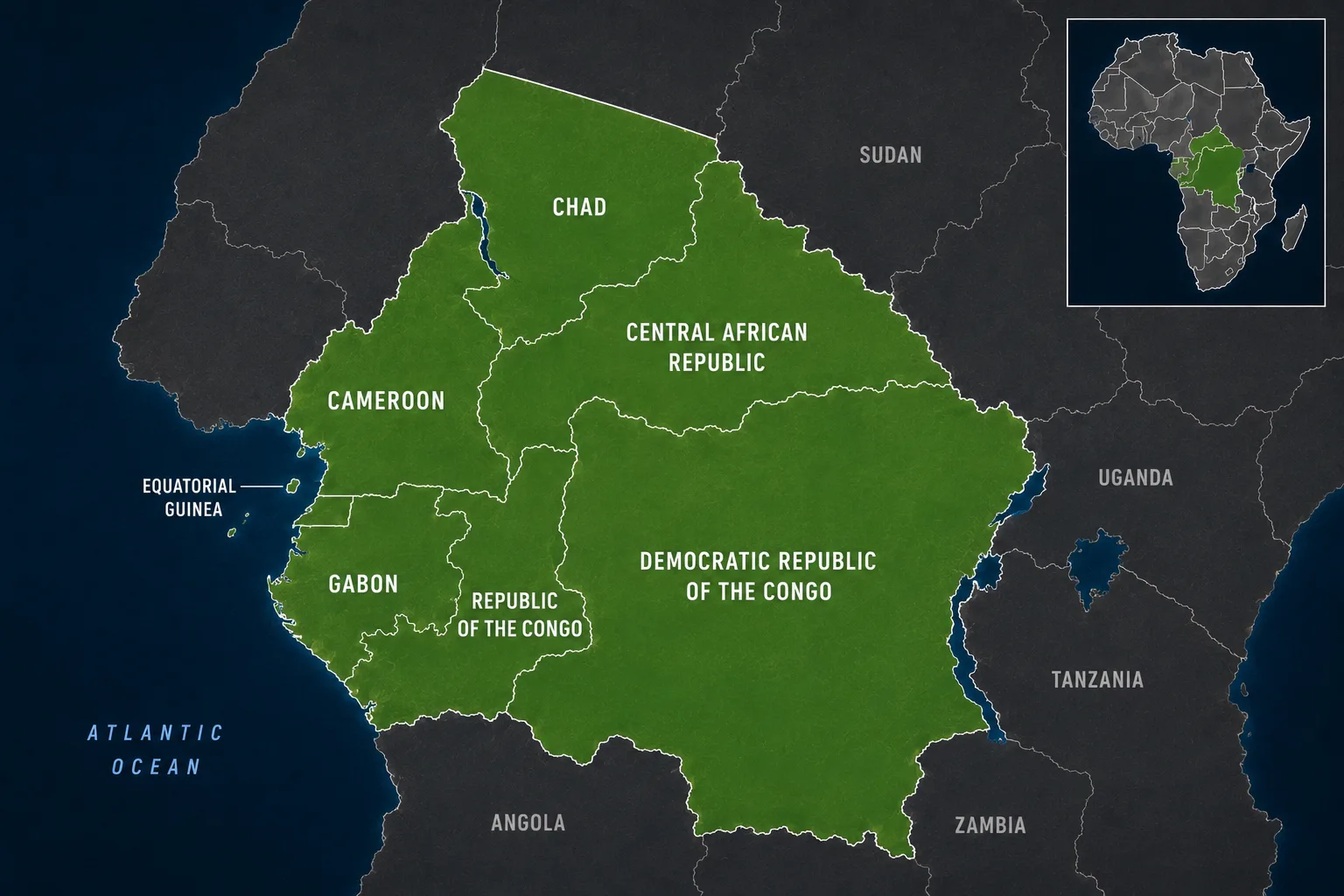
In its commonly understood geographical sense, Central Africa includes the Democratic Republic of the Congo, the Republic of the Congo, Cameroon, Gabon, Chad, the Central African Republic, Equatorial Guinea and São Tomé and Príncipe, among others. Angola is also classified as part of Middle Africa under the United Nations statistical system, although it simultaneously participates in the economic dynamics of Southern Africa.
The institutional boundaries are different. The Economic Community of Central African States and the Central African Economic and Monetary Community do not have exactly the same membership.
This diversity of classifications is not merely a statistical difficulty. It reveals an economic reality: Central Africa simultaneously belongs to several regional systems.
The Democratic Republic of the Congo maintains important commercial and political relationships with Southern and Eastern Africa. Cameroon constitutes a logistical gateway for several landlocked countries. Chad lies at the intersection of the Sahara, the Sahel and the Congo Basin. Angola connects inland mining economies to the Atlantic Ocean. The Gulf of Guinea states participate in global energy markets.
This geography could encourage the emergence of a vast trading area.
But it also contributes to the fragmentation of economic policies.
Trade corridors are frequently oriented toward ports and external markets rather than the construction of regional production chains. Integration institutions overlap without always possessing the capabilities necessary to harmonize regulations, facilitate transport or coordinate investment.
The region therefore possesses geographical centrality that has not yet been transformed into economic integration.
This distinction is fundamental.
A territory can occupy a central position on a map while remaining peripheral to the organization of trade.
Central Africa illustrates this contradiction through the structure of its economies.
The Democratic Republic of the Congo constitutes the region's principal demographic and mining center. Cameroon possesses a relatively diversified economy combining agriculture, services, manufacturing activities and hydrocarbons. Gabon, the Republic of the Congo, Equatorial Guinea and Chad depend to varying degrees on petroleum revenues. The Central African Republic continues to face profound institutional and security constraints, while São Tomé and Príncipe has a small island economy.
These differences create distinct economic needs.
But they do not prevent the existence of common constraints.
Dependence on primary exports, infrastructure costs, weaknesses in certain industrial capabilities and financing difficulties limit productive transformation.
Demographic growth simultaneously increases opportunities and pressures.
The Democratic Republic of the Congo now has a population exceeding 100 million and represents one of the continent's principal demographic markets. Several neighboring countries are also experiencing rapid population growth.
This evolution could support the expansion of domestic markets, consumption and the labor force.
But it also increases demand for employment, housing, education, healthcare, transport and electricity.
Demographic growth becomes an economic advantage only when productive capabilities expand sufficiently to absorb a growing working-age population.
Yet extractive sectors, which occupy a central position in several regional economies, are frequently capital-intensive.
They can generate considerable revenues without creating employment proportional to the value produced.
This characteristic explains part of the gap between the economic importance of natural resources and the living conditions of populations.
The central question is therefore not simply gross domestic product growth.
It concerns the structure of that growth and its ability to transform the economy sustainably.
This problem is particularly acute in the mining sector.
The Democratic Republic of the Congo occupies an exceptional position in global cobalt and copper supply chains.
Cobalt is used in certain battery chemistries, superalloys and several specialized industrial applications.
Copper is a fundamental resource for electricity networks, motors, energy infrastructure and industrial equipment.
The DRC also possesses resources of tin, tantalum, gold, diamonds and other minerals.
Several of these materials are considered strategic by major industrial economies.
Their importance reflects the geographical concentration of production, the difficulty of substituting certain materials and their role in complex manufacturing chains.
But the concept of a critical mineral must be interpreted precisely.
A resource is not critical simply because it is scarce or sought after.
It may be critical because its supply is concentrated, because refining capacity is limited or because industries using it have few alternatives in the short term.
The DRC occupies a major position in cobalt extraction.
But this position does not mean that it controls the entire battery value chain.
Between the extracted ore and the final industrial product lie several operations: concentration, refining, production of active materials, cell manufacturing, battery assembly and integration into equipment.
These activities require different technologies, investments, energy infrastructure and skills.
An economy can dominate the extraction of a raw material without controlling the stages where the most advanced industrial capabilities are concentrated.
This distinction lies at the heart of the Congolese problem.
The strategic value of a mineral depends on its usefulness to global industry.
But the economic value retained by the producing country depends on its position within the processing chain.
Mining revenues can support public finances, exports and investment.
They can also finance infrastructure and services.
But their contribution to development remains limited when connections with other economic sectors are insufficient.
Mining companies may import a large proportion of their equipment, technologies and specialized services.
They may export relatively lightly processed products.
The most profitable industrial activities may then develop in other countries.
The local economy retains part of the value created but does not necessarily control the decisive segments of the chain.
This situation does not mean that local processing is always the best economic solution.
Building a refinery or battery-manufacturing facility requires specific industrial conditions.
Electricity must be available at a competitive cost. Logistics infrastructure must support the supply of inputs and the export of products. Technical skills must be accessible. Production volumes must justify investment.
Proximity to a mineral deposit constitutes an advantage, but it is not sufficient to guarantee competitiveness.
An effective industrial policy must therefore identify the processing stages in which regional economies can progressively acquire lasting capabilities.
It must also avoid confusing the announcement of an industrial project with its actual completion.
The ambition to develop a regional battery industry around Congolese and Zambian resources illustrates this problem.
Complementarity between mineral resources, industrial markets and transport infrastructure could encourage the emergence of new activities.
But their development requires coordination between several states, substantial energy investment and a training strategy.
Industrial integration cannot simply be decreed.
It must be built on actual production conditions.
This requirement also concerns minerals extracted in eastern DRC.
Tin, tantalum, tungsten and gold participate in complex international supply chains.
Their extraction may be formal, artisanal or informal, depending on the territories and operators concerned.
In some conflict-affected areas, mineral extraction and trade can finance armed networks, predatory practices and cross-border trafficking.
But it would be incorrect to reduce the entire Congolese mining sector to this conflict economy.
Large industrial operations, particularly in the south of the country, function through different economic and contractual structures.
Distinguishing between territories, minerals and extraction methods is essential to understanding governance challenges.
Traceability, certification and due-diligence mechanisms seek to reduce risks associated with supply chains.
They can help improve transparency.
But their effectiveness depends on administrative capabilities, inspections and cooperation between states.
They can also produce unintended consequences when compliance costs exclude artisanal producers without providing viable economic alternatives.
Regulation must therefore reconcile supply security, population protection and the preservation of legitimate economic activities.
This question reveals a broader difficulty.
Mineral resources can strengthen economic sovereignty when they generate transparent revenues and support productive diversification.
They can instead weaken institutions when their control becomes a source of armed rivalry or political capture.
The importance of resources does not automatically determine institutional quality.
But it increases the stakes associated with their governance.
The same logic appears in Central Africa's oil-producing economies.
Gabon, the Republic of the Congo, Equatorial Guinea and Chad possess petroleum sectors that occupy an important place in their exports and public finances.
Hydrocarbons can generate substantial revenues relative to the size of some of these economies.
They make it possible to finance infrastructure, public administration and government programs.
But they also expose national budgets to fluctuations in international prices.
When prices rise, revenues can increase rapidly.
When prices fall, governments may be forced to reduce expenditure, borrow more or postpone investment.
This volatility complicates economic planning.
It can also intensify imbalances when periods of high revenues are not used to diversify sources of income.
Petroleum dependence has another consequence.
Hydrocarbon exports generate foreign currency, but extraction activities do not necessarily create substantial connections with the rest of the economy.
Some equipment and specialized services may be imported.
Local companies may remain largely absent from the most technically complex segments.
The contribution to employment may remain limited relative to the revenues generated.
The central question therefore becomes how those revenues are used.
States can devote part of their income to immediate public consumption.
They can also finance infrastructure, develop skills and support economic diversification.
These choices are not mutually exclusive.
But the balance between them determines economies' ability to progressively reduce their dependence on hydrocarbons.
Transforming petroleum revenues into lasting productive assets is therefore a major challenge.
This transformation also depends on fiscal institutions.
Stabilization mechanisms, debt-management rules, contractual transparency and the quality of public investment can reduce certain vulnerabilities.
But they require administrative capabilities and policy continuity.
Petroleum wealth does not replace these conditions.
It can even make their absence more costly.
This contradiction also appears in the energy sector.
Central Africa possesses considerable hydrocarbon and hydroelectric resources.
Yet access to reliable electricity remains insufficient in several countries, particularly across many rural territories.
This situation constitutes one of the principal obstacles to industrialization.
Manufacturing activities require a regular electricity supply.
Agrifood businesses need energy for processing, preservation and storage.
Digital networks, hospitals, transport and public services also depend on functioning electricity systems.
The availability of an energy resource therefore does not guarantee the existence of an effective electricity system.
Power plants, transmission lines, distribution networks and financing mechanisms must be built.
Maintenance must also be ensured, tariffs organized and operators kept financially viable.
The Congo Basin possesses exceptional hydroelectric potential.
The Congo River, through its flow and geographical configuration, constitutes one of the world's major river systems.
The Inga site, in the Democratic Republic of the Congo, represents an opportunity for energy development on a considerable scale.
Projects associated with Grand Inga have repeatedly been presented as capable of transforming electricity supply across part of the continent.
But theoretical potential must be distinguished from actual installed capacity and electricity effectively delivered to consumers.
A major hydroelectric project requires very substantial investment, high-voltage transmission networks and long-term commercial commitments.
It also raises environmental, social and institutional questions.
Building a power plant does not guarantee that electricity will become accessible to nearby households and businesses.
Infrastructure may be designed to supply distant industrial centers or export markets.
Such an orientation may have an economic justification.
But it raises the question of how benefits are distributed.
A regional energy strategy must therefore balance several objectives: supporting extractive industries, developing manufacturing, improving household access and enabling cross-border trade.
These objectives can be complementary.
They can also compete when financial resources are limited.
Integrating electricity networks could improve the allocation of available capacity.
But it requires technical and regulatory coordination.
Investment must be accompanied by reliable payment mechanisms and sustainable contracts.
An interconnection does not resolve the structural difficulties of an electricity system if generation capacity, networks and institutions remain inadequate.
Central Africa's energy challenge is therefore not limited to exploiting its natural potential.
It consists of transforming that potential into accessible and sustainable economic infrastructure.
This question connects to transport.
Central Africa possesses particularly complex geography.
Tropical forests, major rivers, long distances and climatic constraints make infrastructure construction and maintenance expensive.
Several territories remain difficult to access.
Road networks are incomplete or inadequately maintained.
Rail connections are limited and frequently organized around specialized routes.
River transport plays an important role, but its development depends on navigational conditions, port facilities and overland connections.
This situation increases the cost of moving goods.
It limits trade between production centers and markets.
It also complicates the provision of public services.
A region may possess fertile agricultural land and substantial urban markets without being able to connect them efficiently.
Transport costs can then reduce the competitiveness of local production.
They can also favor imports when foreign products reach coastal cities more easily than goods produced in the continental interior.
This contradiction constitutes a major obstacle to economic diversification.
Cameroon occupies a particular place in this organization.
Its port infrastructure, notably around Douala and Kribi, constitutes an important gateway for national and regional trade.
The corridors connecting Cameroon to Chad and the Central African Republic play an essential role in supplying these landlocked economies.
Their efficiency influences prices, delivery times and the availability of goods.
Logistics infrastructure therefore possesses a strategic dimension extending beyond its immediate commercial profitability.
It determines how several economies function.
But its development must be coordinated.
Building a port is insufficient when roads, railways, border crossings and logistics platforms cannot move goods efficiently.
The quality of a corridor depends on all its components.
The Democratic Republic of the Congo faces difficulties on another scale.
The extent of its territory, the concentration of certain mining activities and inadequate internal connections complicate the integration of its national market.
Several economic regions are more closely connected to neighboring countries than to other parts of Congolese territory.
This configuration reflects geography, infrastructure history and commercial patterns.
It creates opportunities for regional cooperation.
But it can also intensify the country's economic fragmentation.
Developing corridors toward the Atlantic Ocean, the Indian Ocean and Southern Africa could improve transport conditions.
The Lobito Corridor, connecting inland mining regions to the Angolan port, illustrates this possibility.
But its contribution to development will depend on the nature of the activities it supports.
A corridor primarily intended for mineral exports can reduce logistics costs without profoundly transforming local economies.
A corridor associated with industrial zones, technical services, agricultural infrastructure and regional markets could produce broader effects.
The distinction between export infrastructure and development infrastructure therefore constitutes a fundamental issue.
This question also appears in agriculture.
Central Africa possesses substantial land and water resources.
Agroecological conditions allow a diversity of crops, including cassava, maize, bananas, cocoa, coffee, palm oil and several food crops.
Agriculture constitutes a major source of employment and income for a substantial share of the population.
But productivity remains limited in many territories.
Difficulties accessing equipment, inputs, financing and storage infrastructure reduce yields and incomes.
Transport costs complicate market access.
Post-harvest losses can be significant.
Producers sometimes have limited bargaining power against intermediaries.
Agrifood processing could help improve this situation.
Developing packaging, preservation and processing activities would allow more value to be retained in local economies.
It could also create employment and strengthen relationships between rural territories and urban centers.
But this transformation requires electricity, logistics infrastructure, skills and financing.
It therefore depends on the same structural conditions as mining-related industrialization.
Central Africa does not merely lack agricultural investment.
In several territories, it lacks the economic systems necessary to make that investment productive.
This difficulty is particularly important in a context of rapid demographic growth.
Population growth increases food requirements.
It can support regional agricultural markets.
But it can also intensify dependence on imports when local production does not expand sufficiently.
Food security therefore depends on productivity, infrastructure, incomes and the stability of trade.
It cannot be reduced to the mere availability of cultivable land.
Ecosystem preservation constitutes another essential constraint.
The Congo Basin represents the world's second-largest tropical rainforest system after the Amazon.
It contains exceptional biodiversity and plays an important role in water cycles, climate balances and carbon storage.
Its forests also constitute living and productive environments for millions of people.
Local populations depend on these ecosystems for food, materials, income and several traditional activities.
The value of the Congo Basin therefore cannot be assessed solely through its global climate functions.
It also constitutes an economic, social and territorial system.
This distinction is essential in conservation policies.
Major industrial economies recognize the importance of preserving tropical forests to limit emissions and protect biodiversity.
But Central African states must simultaneously respond to their populations' development needs.
Infrastructure, agriculture, energy and economic activities require land and investment.
Forest protection can come into conflict with certain extractive or agricultural projects.
This tension does not mean that development and conservation are necessarily incompatible.
It requires defining the conditions under which economic activities can expand without causing irreversible ecosystem degradation.
The central question becomes financing.
Preserving a forest generates benefits extending far beyond the borders of the country concerned.
But the costs of monitoring, management and restricting certain economic activities are primarily borne locally.
This asymmetry creates a distribution problem.
Countries preserving environmental assets of global importance do not necessarily receive compensation proportional to the benefits they provide.
Climate-finance mechanisms seek to reduce this gap.
They include concessional financing, conservation programs and certain carbon-related instruments.
But their effectiveness depends on the quality of measurement methods, transaction transparency and the ability to ensure equitable revenue distribution.
Carbon markets raise particularly important questions.
The value of a credit depends on the credibility of the emissions reduction or removal it represents.
Risks of double counting, methodological uncertainty and verification difficulties can undermine the environmental integrity of certain arrangements.
Mechanisms must also account for land rights and the interests of local communities.
A conservation policy that excludes populations from decision-making can weaken its legitimacy and effectiveness.
Protecting the Congo Basin therefore requires institutions capable of reconciling climate objectives, economic development and residents' rights.
This requirement takes on particular significance in the peatlands of the central Congo Basin.
These ecosystems store substantial quantities of carbon accumulated over long periods.
Their degradation could release significant emissions and affect hydrological balances.
But their conservation depends on scientific knowledge, monitoring mechanisms and appropriate territorial policies.
The question is not simply protecting a carbon stock.
It is preserving an ecological system whose functions extend beyond national borders.
This situation gives Central Africa a global environmental responsibility.
But this responsibility must be accompanied by a genuine capacity to finance conservation and development.
The Congo Basin cannot sustainably become a global climate asset if the economies that contain it lack the means necessary to improve their populations' living conditions.
This contradiction reveals a new form of dependence.
Central African countries possess natural resources whose strategic value is increasing with global environmental and industrial priorities.
But international recognition of this value does not automatically translate into public revenues, investment or improved infrastructure.
Ecological value must be distinguished from the capacity to convert it into financing.
This question connects to institutions.
Central Africa presents very different political trajectories.
Some states possess relatively structured administrations and extensive experience in resource management.
Others face profound institutional difficulties, political tensions or armed conflicts.
Political transitions, governance problems and fiscal constraints directly influence investment conditions.
But it would be reductive to regard instability as a uniform characteristic of the region.
Situations differ considerably between countries and territories.
The Democratic Republic of the Congo constitutes one of the most complex examples.
Prolonged conflicts in the country's east involve armed groups, territorial rivalries, economic interests and regional tensions.
They cause population displacement, disrupt economic activities and weaken local institutions.
Control over resources can be one of the stakes in these conflicts.
But it is insufficient to explain all their political and security dynamics.
Questions of citizenship, land, political representation, security and relations between neighboring states also play important roles.
Reducing these conflicts to simple competition for minerals would neglect these dimensions.
It could also produce policies inadequate to address the causes of violence.
Lasting stabilization requires security, justice, governance and regional cooperation mechanisms.
It also requires economic prospects for populations.
Extractive activities cannot sustainably support development when territories remain subject to recurring violence.
But security cannot be achieved solely by protecting mining sites.
It depends on institutions' ability to perform fundamental public functions.
The Central African Republic also experiences prolonged security and institutional difficulties.
Conflicts have affected economic activity, infrastructure and living conditions.
They have also encouraged the involvement of external partners in military and security affairs.
These partnerships may respond to immediate needs for protection and support to national authorities.
But they raise questions concerning sovereignty, agreement transparency and the conditions under which resources are managed.
The presence of foreign actors is not in itself a guarantee of lasting stabilization.
Its effectiveness depends on the objectives pursued, institutional oversight and the ability to rebuild functioning public administrations.
Chad occupies a different position, at the intersection of the Sahel and Central Africa.
Its security challenges are influenced by regional dynamics, borders and conflicts in neighboring countries.
This situation demonstrates that security problems do not always correspond to traditional geographical divisions.
Crises can connect several African regions and generate economic effects over considerable distances.
They affect trade routes, population movements and public expenditure.
Security thus becomes a condition for markets to function.
But it cannot be separated from economic and social policies.
A region with fragile infrastructure and limited productive opportunities remains particularly vulnerable to the effects of conflict.
This relationship explains the importance of regional organizations.
The Economic Community of Central African States seeks to support political, economic and security cooperation.
The Central African Economic and Monetary Community organizes monetary and economic integration among six states: Cameroon, Gabon, Chad, the Central African Republic, the Republic of the Congo and Equatorial Guinea.
These countries share the Central African CFA franc, issued by the Bank of Central African States.
A common currency can reduce certain transaction costs and facilitate trade.
But it does not guarantee productive integration.
Member economies remain heavily dependent on primary exports and possess different economic structures.
Their investment requirements, fiscal positions and industrial capabilities are not identical.
A monetary union can contribute to nominal stability without automatically producing economic convergence.
Industrial diversification requires complementary policies.
It also presupposes improvements in infrastructure and intraregional trade.
Institutional cooperation must therefore extend beyond monetary arrangements.
It must encourage the movement of goods, investment, services and business development.
But results depend on the effective implementation of commitments.
Administrative obstacles, border controls and regulatory differences can maintain high costs.
Economic integration does not result solely from the existence of common organizations.
It depends on their ability to change production and trading conditions in practice.
This difficulty becomes particularly important amid international competition for strategic resources.
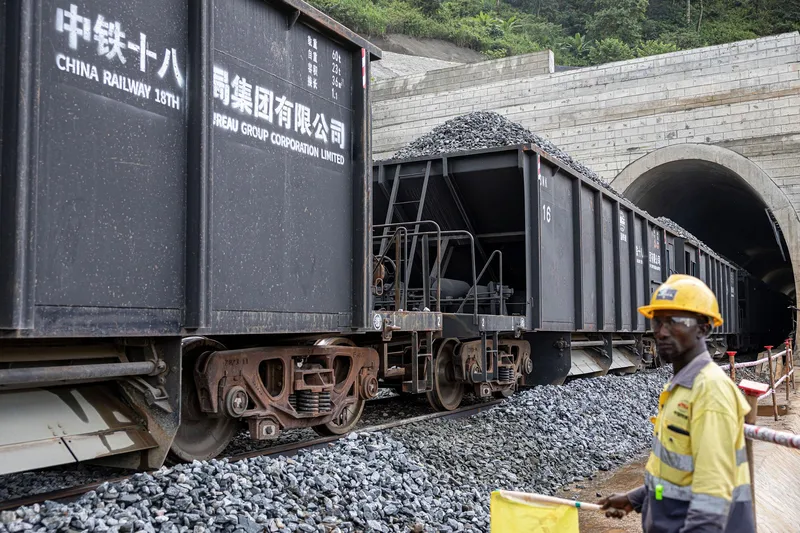
China occupies a major position in several Central African mining and infrastructure sectors.
Its companies participate in extraction, the processing of certain minerals, infrastructure construction and equipment supply.
Economic relationships with the region form part of international supply chains in which refining and manufacturing capabilities play an essential role.
The United States is also seeking to strengthen the security of its critical-mineral supplies.
The European Union is developing policies to diversify value chains and secure resources needed by its industries.
India, Turkey, Gulf states and other partners are strengthening their commercial, financial or diplomatic relationships.
This multiplication of actors can expand governments' negotiating options.
It may allow them to diversify financing, suppliers and export markets.
But it does not guarantee greater economic autonomy.
Competition between external powers can also intensify pressure on strategic resources and infrastructure.
Investment agreements must therefore be evaluated beyond their announced amounts.
Financing conditions, contractual obligations, public revenues, associated infrastructure and effects on local businesses must all be examined.
An investment can increase exports without sufficiently improving national productive capabilities.
It can also develop useful infrastructure while creating substantial financial commitments.
The central question is the economic value retained.
Governments must determine how to use international competition to obtain more local processing, skills development and participation by national businesses.
But this strategy requires negotiating and oversight capabilities.
It presupposes administrations able to evaluate complex projects and monitor their implementation.
Economic sovereignty therefore also depends on the quality of public institutions.
This dimension is particularly important in mining contracts.
Project revenues depend on international prices, operating costs, investment, fiscal mechanisms and marketing arrangements.
Companies may belong to international groups whose activities are distributed across several jurisdictions.
Transfer pricing, financing charges, intragroup services and supply contracts can influence the allocation of taxable profits.
These mechanisms are not necessarily irregular.
But they require tax administrations with the expertise necessary to verify transactions and enforce rules.
A resource-development policy therefore cannot be limited to royalty rates.
It must incorporate taxation, contractual transparency, accounting rules and enforcement capabilities.
It must also account for corruption risks and revenue capture.
Payment-disclosure and extractive-transparency mechanisms can contribute to improved public accountability.
But their effectiveness depends on how institutions, parliaments and civil societies use the information.
Transparency is an instrument of governance.
It does not replace the capacity to make and implement decisions.
This question connects to development financing.
Central African states must simultaneously respond to considerable needs for infrastructure, public services and security.
Extractive revenues can help finance these expenditures.
But their volatility complicates long-term commitments.
Borrowing requirements may increase when investment exceeds available fiscal resources.
Foreign-currency debt exposes public finances to exchange-rate fluctuations and international financing conditions.
States must therefore balance several objectives.
They must preserve fiscal sustainability while financing the investment necessary for economic transformation.
Excessive reductions in capital expenditure can perpetuate structural constraints.
Poorly managed borrowing can compromise future stability.
Project quality therefore becomes decisive.
Investments must be evaluated according to their costs, benefits and contribution to productive capabilities.
Infrastructure may be politically visible without representing the best use of public resources.
Conversely, less spectacular investments in electricity networks, secondary roads, water or administrative services can generate substantial economic benefits.
Structural transformation often depends on these fundamental capabilities.
This reality explains why natural-resource abundance is insufficient.
Minerals, hydrocarbons and forests constitute assets.
But their contribution to development depends on the institutions governing them, the infrastructure connecting them to markets and the companies capable of creating value from them.
Central Africa possesses a combination of advantages that could support major economic transformation.
Its minerals occupy an important place in several global industrial supply chains.
Its energy potential could help reduce electricity deficits.
Its agricultural resources could support greater food and agrifood production.
Its forests constitute an environmental asset of global importance.
Its expanding population represents a considerable potential market.
But these advantages do not yet function as a sufficiently integrated productive system.
Mineral resources are often exported before the most advanced processing stages.
Energy infrastructure remains inadequate.
Logistics corridors sometimes connect extractive sites to external markets more effectively than they connect regional economies to one another.
Conflicts weaken several territories.
Economic institutions face coordination difficulties.
Resource revenues do not always produce sufficient diversification.
The region thus remains indispensable to the global economy without possessing equivalent productive autonomy.
This contradiction could intensify with the industrial and environmental transformations now underway.
The energy transition is increasing the importance of certain minerals.
Climate policies are drawing greater attention to the Congo Basin.
Geopolitical rivalries are encouraging major powers to diversify their supplies.
Demographic growth is expanding regional markets.
But these developments do not guarantee that Central African economies will capture a growing share of the value created.
They may instead reinforce an economic structure in which natural resources are exploited locally while industrial activities, financing and strategic decisions remain concentrated elsewhere.
The risk is therefore not merely persistent dependence.
It is renewed dependence built around resources that have become more strategic.
Minerals required for low-carbon technologies could reproduce some historical structures of the extractive economy.
Climate financing could place a value on forests without sufficiently transforming populations' living conditions.
New corridors could improve exports without developing regional trade.
Energy investments could supply specialized activities without guaranteeing broader access to electricity.
These outcomes are not inevitable.
They depend on public policies and negotiating conditions.
Central Africa could use its strategic position to develop industrial capabilities, strengthen infrastructure and diversify partnerships.
But this transformation requires a vision extending beyond resource extraction alone.
It presupposes treating minerals, energy, agriculture, transport and services as components of a single economic system.
It also requires more operational regional cooperation.
Resources and markets are distributed across several states.
The infrastructure needed to develop them frequently crosses national borders.
Energy investments can benefit several economies.
Trade corridors can connect industrial and agricultural centers.
Conservation mechanisms for the Congo Basin require cross-border coordination.
Conflicts also demand diplomatic and institutional responses extending beyond the territories directly affected.
Regional integration is therefore an important condition of economic transformation.
But it must produce concrete results.
The multiplication of organizations and declarations is insufficient.
Transport costs must be reduced, the movement of goods improved, investment coordinated and predictable commercial rules developed.
Administrations capable of negotiating and overseeing international contracts must also be strengthened.
This institutional capacity could become one of the principal determinants of regional power.
Central Africa does not lack resources sought by the world.
In several sectors, it lacks the means to convert their strategic value into autonomous economic capabilities.
Developing local businesses, improving technical skills, strengthening infrastructure and diversifying activities constitute the principal conditions of this transformation.
But the challenge extends beyond economics.
Natural wealth can become a source of stability when it finances effective institutions, public services and economic opportunities.
It can also fuel rivalries when it is concentrated, opaque or insufficiently redistributed.
Resource management is therefore a fundamental political question.
It concerns states' ability to represent their populations' interests and organize the distribution of benefits.
It also concerns their ability to preserve ecosystems on which part of the world's environmental balance depends.
Central Africa thus stands at the intersection of three requirements.
It must develop its economies to meet the needs of a growing population.
It must preserve natural resources whose importance extends beyond its borders.
It must strengthen its autonomy amid intensifying international competition.
These objectives are not necessarily incompatible.
But reconciling them requires strong institutions, appropriate financing and long-term policies.
Central Africa's power cannot be measured solely by the volumes of cobalt, copper, oil or timber exported.
It must be assessed through the added value retained, industrial capabilities developed, employment created and the quality of infrastructure and public services.
It also depends on the ability to preserve the ecological functions of the Congo Basin while improving the living conditions of the populations residing there.
This approach leads to an essential distinction.
Possessing a strategic resource does not mean controlling the economic strategy that gives it value.
Being indispensable to a supply chain does not mean controlling its decisions.
Holding an environmental asset of global importance does not guarantee receiving the financing necessary to preserve it.
Central Africa embodies all three contradictions.
Its mineral wealth is indispensable to several global industries. Its forests are essential to ecological balances extending beyond the continent. Its energy resources could transform production conditions across numerous African economies.
But its ability to convert these advantages into power remains constrained by infrastructure, institutions, conflicts and the structure of trade.
Central Africa possesses natural wealth whose global importance continues to increase. Yet this strategic centrality does not constitute economic sovereignty. The region supplies resources indispensable to the world's industries, energy systems and environmental balances, but it controls only part of the mechanisms that determine their value. Its challenge is not to become indispensable: it already is. It is to transform this global necessity into productive capability, institutional stability and shared development. As long as its resources remain more deeply integrated into external value chains than into the economies that contain them, Central Africa's power will remain largely captive.
Bureau de recherche Atlas Limits
Bureau éditorial et analytique d’Atlas Limits.