A decade after the final years of Abdelaziz Bouteflika's presidency, Algeria's trajectory cannot be reduced to either immobility or the break proclaimed by its leaders. Officeholders have changed, reforms have been introduced and non-hydrocarbon activities have expanded. Yet the questions shaping the assessment remain connected: how can political legitimacy be renewed, social commitments financed and production broadened with less dependence on energy revenue?
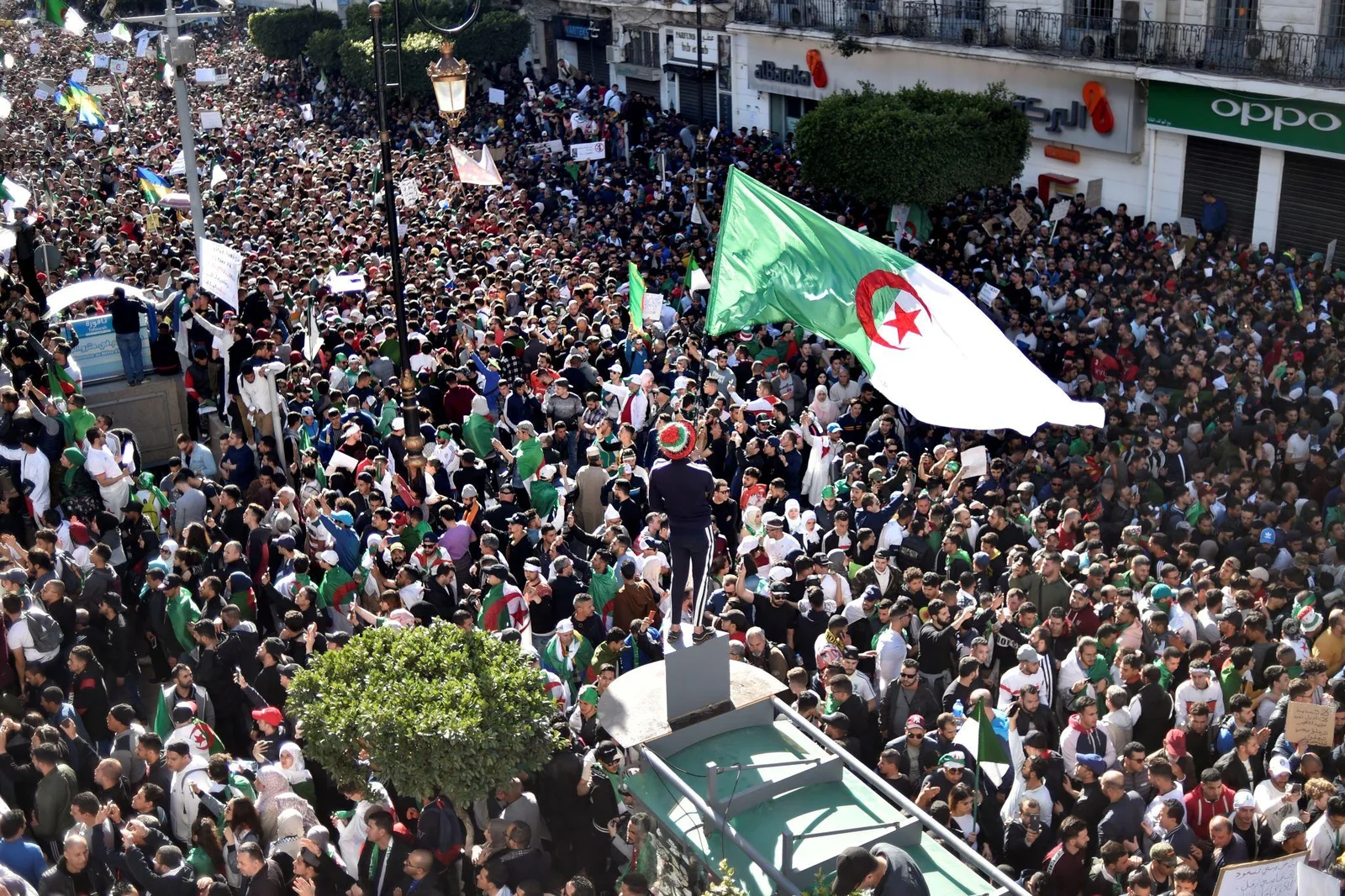
The events of 2019 form the essential turning point. The Hirak protest movement began on 22 February; Bouteflika resigned on 2 April, according to the Algerian Foreign Ministry's chronology. [1] His departure addressed a presidential crisis, but changing a leader does not by itself establish a new relationship between institutions and society. The question is how demands for representation, oversight and renewal become part of the state's everyday operation.
Abdelmadjid Tebboune's re-election in September 2024 confirmed institutional continuity. The Constitutional Court's final proclamation awarded him 84.30% of valid votes and set turnout at 46.10%. [2] These are the definitive figures, distinct from initial announcements. They do not reveal individual abstainers' motives or, alone, measure confidence in the system. The legal basis of a mandate and the quality of political pluralism are different questions.
On the latter issue, Human Rights Watch's World Report 2026, covering events in 2025, describes continuing restrictions on expression, association and public mobilisation. [3] These findings must be attributed to the organisation and their period specified. They nevertheless support a precise question: do institutions provide sufficiently open ways to challenge policies and hold officials accountable? Changes to legal texts or officeholders cannot settle that question if peaceful dissent remains constrained.
Diversification is also a financing question
Economic assessment requires the same distinction between real change and persistent constraints. The IMF's consultation published on 21 September 2026 recognises diversification efforts and robust growth while highlighting eroded fiscal and external buffers and financing pressures. [4] Selecting only one side would distort the assessment. Non-hydrocarbon production can expand while the conditions financing expenditure and imports remain vulnerable.
The 2025 report provides a historical benchmark: hydrocarbons accounted for 84% of goods and services exports in 2023 and 91% of merchandise exports alone. [5] These are not observations for 2026. They explain why diversifying production is different from diversifying external earnings. Domestic activity can grow through public orders financed by energy revenue without immediately creating new export markets.
The mechanism is circular. Oil and gas receipts finance public spending, which supports incomes, investment and companies' sales. If those companies remain dependent on public orders, weaker energy receipts eventually affect them too. Reducing dependence therefore requires activities able to retain customers, fund expansion and generate external earnings beyond the fiscal cycle.
The state retains an essential role in infrastructure, training and social protection. The issue is not simply its size. It concerns predictable rules, access to finance and whether firms can enter markets without discretionary treatment. Public investment can prepare a more autonomous productive base; it can also increase commitments without generating the income needed to maintain them. Asset utilisation and productivity are therefore central to assessing results.
Foreign policy also needs to be evaluated dossier by dossier rather than through sweeping claims of isolation or power. Energy relationships, regional disagreements and participation in international institutions serve different purposes. A protest states a position; its effectiveness depends on outcomes and costs. Maintaining dialogue does not necessarily mean surrendering national interests. Serious assessment compares objectives, instruments and results without assigning every regional impasse to one state.
These dimensions meet in the capacity to adapt. More diversified revenue would provide fiscal room; predictable procedures would reduce investment uncertainty; more open debate could identify policy costs earlier. None automatically delivers the others. Their complementarity nevertheless helps explain why individual sectoral announcements sometimes achieve less than expected.
The decade's balance is mixed. Presidential succession was organised and economic capabilities developed without resolving every tension between institutional continuity, political participation and financial dependence. The coming years can be assessed through observable outcomes: revenue diversification, investment efficiency, business autonomy and the conditions for exercising civil liberties. This approach evaluates Algerian policy without confusing declared ambitions with delivery, or persistent difficulties with an absence of progress.
Sources
[1] Algerian Foreign Ministry, History of Algeria.
[2] Constitutional Court, final September 2024 proclamation reproduced by Algeria's diplomatic service.
[3] Human Rights Watch, World Report 2026: Algeria, events of 2025.
[4] IMF, 2026 Article IV consultation, 21 September 2026.
[5] IMF, 2025 report, including 2023 export data. Unattributed mechanisms and assessments are Atlas Limits analysis.
Atlas Limits Research Desk
Atlas Limits’ editorial and analytical desk.