The return of the South Korean container ship PanStar Acro to Busan, following an experimental commercial voyage through the Arctic, illustrates a potential transformation in the geography of global trade. Between shorter distances, geopolitical rivalries, economic constraints and Russian sovereignty, the Northern Sea Route could become a new instrument for diversifying trade between Asia and Europe. But its development raises a fundamental question: is a shorter route necessarily safer, more profitable and more independent?
The geography of global trade enters a new phase
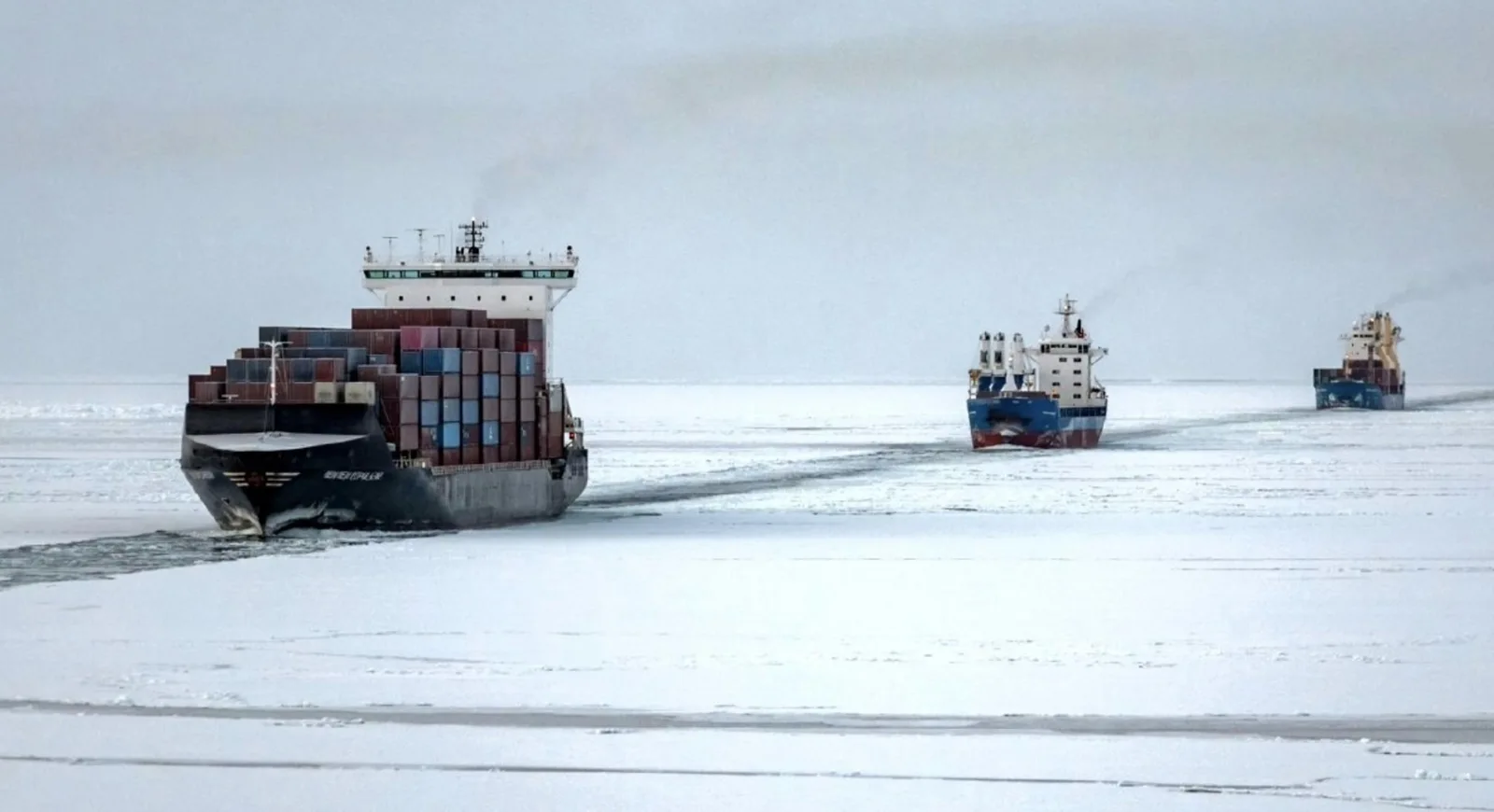
On October 11, 2026, the South Korean container ship PanStar Acro returned to the port of Busan after completing a fifty-day round-trip commercial voyage. Having departed on August 22, the vessel sailed along the Northern Sea Route, which follows Russia's Arctic coastline, before calling at several European ports, including Felixstowe in the United Kingdom, Rotterdam in the Netherlands and Gdańsk in Poland.
The event goes beyond the technical achievement of a polar crossing. It represents a commercial experiment that could help clarify the future of maritime relations between two of the world's principal manufacturing and consumer regions.
For centuries, the movement of goods between Asia and Europe has depended on a limited number of strategic passages. The Strait of Malacca, the Indian Ocean, Bab el-Mandeb, the Red Sea and the Suez Canal form one of the principal corridors of intercontinental trade. When this route becomes dangerous or economically unattractive, vessels can sail around Africa via the Cape of Good Hope, at the cost of substantially longer distances.
The Arctic route introduces a third possibility. By connecting the North Pacific to the Atlantic through the seas bordering Siberia, it allows certain voyages to bypass the Indian Ocean and the Suez Canal entirely.
South Korean authorities estimate that this corridor could reduce sailing times between East Asia and Europe by approximately one-third. That estimate, however, depends on departure and destination ports, ice conditions, permitted speeds and the availability of maritime services.
The Arctic is therefore becoming more than an additional maritime space. It is emerging as a region where the relationship between distance, cost, power and supply-chain security could be fundamentally reconsidered.
Suez, Africa and the Arctic: three competing geographies
Since its opening in 1869, the Suez Canal has occupied a central position in the organization of trade between Europe and Asia. It transformed maritime distances by eliminating the need to circumnavigate Africa to reach the Mediterranean from the Indian Ocean.
This centrality has also created structural dependence.
The blockage caused by the grounding of the Ever Given in March 2021 demonstrated how a localized incident could disrupt international supply chains. Attacks against commercial shipping in the Red Sea beginning in late 2023 subsequently exposed a more persistent vulnerability, this time associated with regional security conditions.
For many shipping companies, diverting vessels around Africa became a means of reducing exposure to military risks. But that relative security comes at a price: additional sailing days, higher fuel consumption, longer crew deployments and more capital tied up in ships and cargo.
The Arctic offers a different response. Rather than simply avoiding a conflict zone, it changes the architecture of the journey itself.
For certain connections between Northeast Asia and Northern Europe, theoretical distances can be considerably shorter than those of routes passing through Suez. The advantage is particularly relevant to ports in northern Europe, including Rotterdam, Hamburg and Gdańsk.
Yet the three routes are not perfectly interchangeable.
Suez serves a mature commercial network connecting the Mediterranean, the Middle East, East Africa and major Asian ports. The Cape of Good Hope provides relatively predictable open-ocean navigation despite longer distances and meteorological constraints. The Arctic, by contrast, offers a geographical shortcut whose commercial exploitation remains conditioned by seasons, infrastructure and regulations.
Competition will therefore concern more than nautical miles. It will involve logistical systems with fundamentally different costs, flexibility and risk profiles.
South Korea seeks to turn an experiment into an industrial strategy
South Korea's decision to test the Northern Sea Route forms part of a broader reassessment of its economic security.
The country is an industrial power deeply integrated into international trade. Its major corporations export semiconductors, vehicles, electronic equipment, chemicals and industrial goods to markets around the world.
This integration underpins national prosperity, but it also exposes the economy to disruptions in maritime transportation.
Seoul is therefore seeking to diversify available routes without abandoning traditional corridors.
The government of President Lee Jae-myung aims to develop regular commercial services through the Arctic by 2030. The PanStar Acro voyage can be understood as an initial step toward evaluating that ambition.
The strategy also has an industrial dimension.
South Korea possesses one of the world's most advanced shipbuilding industries, with companies such as HD Hyundai, Hanwha Ocean and Samsung Heavy Industries. Polar navigation could generate additional demand for specialized vessels, adapted propulsion systems, navigation technologies and maritime monitoring solutions.
The issue therefore extends beyond transporting cargo. It also concerns the capacity of South Korean industry to position itself in the equipment and technologies required for a possible expansion of Arctic shipping.
Busan could, in this context, strengthen its role as a logistical platform connecting Asian production networks with European markets.
However, a maritime strategy cannot be evaluated solely through the successful completion of an inaugural voyage. It must demonstrate the ability to attract cargo consistently, maintain commercial schedules and generate savings sufficient to justify investment.
The PanStar Acro exposes the limits of the economic model
The first lesson of the South Korean expedition concerns cargo utilization.
According to information reported about the operation, the shipping company initially sought approximately 1,300 twenty-foot equivalent units, or TEUs, of cargo. The vessel ultimately departed with 737 loaded TEUs, alongside empty containers.
Loaded cargo therefore represented approximately 57% of the initial commercial target. This figure should not be confused with the vessel's physical capacity utilization rate, which would require information about its nominal capacity and total container load.
Nevertheless, it reveals an essential difficulty: a maritime route acquires economic value only when shippers are willing to use it.
For shipping companies, savings in distance and fuel consumption must be weighed against several categories of expenditure.
Polar navigation may require vessels with specialized technical characteristics, additional safety equipment, adapted crew training and, depending on conditions, icebreaking assistance.
Insurance premiums may also reflect specific risks associated with remote rescue infrastructure, severe weather and difficulties conducting emergency operations.
These costs are compounded by transit fees and services that may be charged under Russian regulations.
A reduction in sailing distance does not therefore guarantee a proportional reduction in operating costs.
Another difficulty concerns regularity.
Container shipping depends heavily on scheduled services whose departures and arrivals must be sufficiently predictable to support the organization of supply chains.
Major shipping companies do not simply sell transportation between two ports. They sell capacity, frequency and reliability.
A corridor accessible during only part of the year, and potentially subject to significant delays when ice conditions deteriorate, does not possess the same characteristics as a maritime route available year-round.
The economic question consequently becomes more complex: can the Arctic support competitive scheduled services, or will it remain primarily a seasonal solution for particular categories of cargo?
The PanStar Acro voyage provides an initial operational experience. It does not yet settle that question.
Russia controls a decisive part of the equation
The principal geopolitical contradiction of the Northern Sea Route lies in its location.
The corridor follows Russia's northern coastline, crosses several Arctic seas and depends, for certain services, on Russian infrastructure and assistance capabilities.
Moscow has long considered the development of this route a strategic priority. It regards the corridor as an instrument for developing its northern territories, expanding energy exports and consolidating its presence in the Arctic.
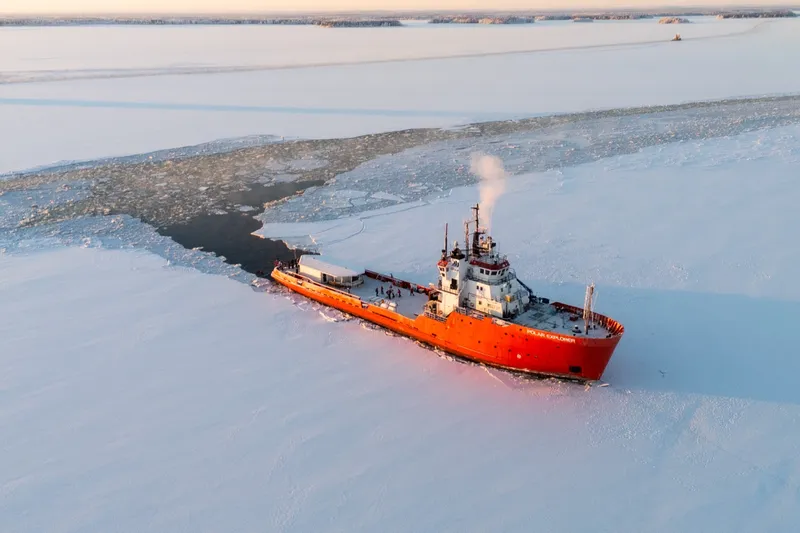
Russia also possesses a substantial fleet of nuclear-powered icebreakers, providing an operational advantage in difficult ice conditions.
For foreign shipping companies, using the route may require permits, information exchanges and coordination with the competent authorities, subject to the applicable framework of maritime law.
Seoul reportedly had to consult Moscow regarding the conditions of the PanStar Acro voyage, particularly the availability of assistance should the vessel encounter difficulties in the ice.
This operational necessity raises a political problem.
South Korea maintains a strategic alliance with the United States and participates in several economic restrictions targeting Russia following its full-scale invasion of Ukraine in 2022.
Yet developing a commercial route dependent on Russian services could create new economic and regulatory interactions with Moscow.
This is not necessarily a legal contradiction. Not every maritime activity involving Russia is automatically prohibited. Applicable restrictions depend on the companies involved, the services provided, financial transactions and relevant sanctions regimes.
The contradiction is primarily strategic.
A route designed to reduce the vulnerability of trade to crises in the Middle East could increase its exposure to relations between Russia and Western powers.
Geographical efficiency does not necessarily translate into greater geopolitical autonomy.
China sees another opportunity
South Korea is not the only Asian power interested in the commercial possibilities of the Arctic.
China has spent years developing an Arctic policy encompassing scientific research, infrastructure, energy and transportation.
In 2018, Beijing formally introduced the concept of a "Polar Silk Road," integrating Arctic corridors into its broader vision of international economic connectivity.
China's interest is multidimensional.
First, route diversification could reduce dependence on Southeast Asian and Middle Eastern maritime passages for certain categories of cargo.
Second, industrial regions in northern and eastern China could benefit from more direct connections to northern European ports.
Third, cooperation with Russia could provide Beijing with access to Arctic infrastructure while strengthening energy and logistical complementarities between the two countries.
Nevertheless, this prospect has limitations of its own.
China remains deeply dependent on traditional maritime corridors. Its exports are not exclusively destined for Northern Europe, and its commercial networks rely on numerous intermediate ports.
The Suez Canal therefore remains a major component of its logistical architecture.
The Arctic represents an additional option rather than an immediate replacement.
Competition between China and South Korea could nevertheless accelerate investment in polar technologies and specialized maritime capabilities.
Russia would then occupy a distinctive position: that of a territorial and infrastructure power capable of benefiting from growing interest among several Asian economies.
But this position could also deepen Moscow's dependence on partners capable of financing the vessels, equipment and commercial flows necessary to develop the corridor.
Europe confronts a reorganization of maritime access
For Europe, the emergence of an Arctic commercial route raises questions extending well beyond transportation.
European port geography has developed around several complementary maritime regions: the Mediterranean, the Atlantic, the English Channel, the North Sea and the Baltic.
The Suez Canal historically facilitates connections between Asia, the Mediterranean and the major ports of Northern Europe. Diversions around Africa change relative transit times and costs without eliminating the role of established logistical platforms.
A more active Arctic corridor could strengthen the appeal of northern ports for certain direct connections with Northeast Asia.
Rotterdam, Germany's North Sea ports and Poland's Baltic infrastructure could seek to capture part of these flows.
The actual effect would nevertheless depend on transported volumes, service frequency and integration into existing networks.
Europe is not a homogeneous maritime market. Goods destined for Italy, Spain or southern France would not necessarily enjoy the same advantages as cargo delivered to the Netherlands, Germany or Poland.
The issue also intersects with European policy toward Russia.
Developing a corridor dependent on Russian infrastructure would occur against a background of sanctions, commercial restrictions and persistent security tensions.
European authorities would consequently have to balance the potential economic benefits of new maritime connections against foreign-policy requirements.
The Arctic could thus become another arena in which the European Union's commercial, industrial, environmental and security policies intersect.
Suez and African ports will not disappear from the equation
The possible expansion of Arctic navigation could be interpreted as a threat to the Suez Canal. Such an interpretation would nevertheless be premature.
The Egyptian canal is not merely a shortcut between Asia and Europe. It belongs to a commercial system that also serves Gulf economies, East Africa, the Mediterranean and several Asian regions.
Energy flows, containerized goods and regional exchanges follow different economic patterns.
A polar corridor could therefore not replace all the functions performed by Suez.
However, if a portion of trade between Northeast Asia and Northern Europe were permanently redirected toward the Arctic, Egypt could face competitive pressure on certain categories of traffic.
Canal transit revenues depend on vessel numbers, ship characteristics, cargo types and tariff policies.
Diversification could eventually modify the bargaining relationship between shipping companies and the authorities managing strategic maritime passages.
Africa possesses another advantage: the Cape of Good Hope.
Although longer, this route is not subject to the same ice conditions or specific authorization requirements associated with the Northern Sea Route.
It therefore retains an important alternative function when the Red Sea becomes dangerous.
African ports along the Atlantic and southern maritime façades may also benefit, depending on shipping services and port calls, from traffic reorganizations caused by maritime crises.
For Mediterranean platforms, particularly Tanger Med in Morocco, the challenge would be different. Their competitiveness depends on their position within transshipment networks, their maritime and inland connections, operational performance and capacity to serve multiple markets.
The emergence of the Arctic does not imply their automatic decline. It could nevertheless gradually alter the distribution of certain cargo flows between European and Mediterranean port systems.
The geography of world trade is never reorganized around a single route. It results from decisions made by shippers, shipping companies, ports, insurers and governments.
Climate change opens a route without making it predictable
The development of Arctic navigation is taking place within a major environmental transformation.
The Arctic is warming faster than the global average, contributing to long-term reductions in sea-ice extent and thickness. This evolution can extend the seasonal windows during which certain waters become navigable.
But an overall decline in sea ice does not eliminate navigational risks.
Conditions can vary significantly from one year to another, between different seas and even over relatively short periods. Drifting ice, fog, storms and rapidly changing weather can complicate operations.
Polar navigation also imposes particular requirements concerning equipment, communications, hydrographic information and rescue capabilities.
The International Maritime Organization addresses these risks through the International Code for Ships Operating in Polar Waters, commonly known as the Polar Code.
The framework establishes requirements relating to vessel design and equipment, operations, training and environmental protection, according to ship categories and applicable regulations.
The ecological dimension remains particularly sensitive.
A maritime accident in the Arctic could have severe consequences because of fragile ecosystems, difficult cleanup conditions and the remoteness of emergency response resources.
Marine fuel combustion also generates emissions, including carbon dioxide and, depending on the technologies used, particles that contribute to black carbon deposition on snow and ice.
A shorter route may reduce fuel consumption under certain conditions, but those savings must be evaluated across the entire voyage, accounting for speed, vessel characteristics, possible assistance and navigational conditions.
The paradox is considerable: climate change is gradually making maritime spaces more accessible, while their additional exploitation can itself create new environmental pressures.
The private profitability of a route does not necessarily reflect its collective cost.
The real issue: supply-chain reliability
Comparing Suez, the Cape of Good Hope and the Arctic cannot be reduced to nautical miles or sailing days.
Modern supply chains are organized around industrial schedules, inventories, commercial contracts and delivery commitments.
A company importing electronic components, automotive parts or industrial equipment does not necessarily seek the shortest journey. It often seeks the best balance between cost, transit time and predictability.
Saving several days may lose much of its value if accompanied by a high probability of delays or insufficient service frequency.
Conversely, a seasonal route can become attractive for cargo whose delivery schedules are sufficiently flexible.
This distinction could encourage gradual specialization along the Arctic corridor.
Certain industrial goods, energy products and logistical operations may be better suited to its constraints than global container services operating on weekly rotations.
The development of regular services will also depend on the ability to organize economically viable return voyages.
A vessel carrying substantial cargo in one direction but insufficient freight in the other incurs costs that must be recovered across the entire rotation.
The question raised by the PanStar Acro's 737 loaded TEUs is therefore essential. Completing a voyage does not establish the existence of a sustainable market.
To transform an experiment into a commercial corridor, operators will have to demonstrate that they can assemble sufficient volumes in both directions, over a sufficiently long period and at competitive costs.
2030: an industrial deadline rather than a commercial certainty
South Korea's objective of developing regular services by 2030 provides a political timetable, but it does not guarantee the emergence of a viable business model.
Four years is a relatively short period in which to transform a major maritime commercial system.
Vessels must be available, assistance services organized, regulatory conditions stabilized and commercial contracts negotiated.
Shippers must also be willing to change their logistical practices.
Established maritime corridors benefit from considerable network effects. The more vessels, ports, services and cargo they concentrate, the more attractive they become to operators.
A new corridor must overcome this inertia.
The Arctic possesses a genuine geographical advantage for certain connections. But it does not yet have the logistical density of traditional routes.
Its development could therefore be gradual, beginning with specialized or seasonal services before any possible broader expansion.
The decisive question will not be whether a ship can cross the Arctic. That possibility has already been demonstrated.
It will be how many vessels can do so regularly, at what cost, under what guarantees and carrying which categories of cargo.
Diversification that shifts dependencies
The PanStar Acro's return to Busan illustrates a deeper evolution in international trade.
For several decades, maritime globalization developed around a logic of optimization: concentration of cargo flows, larger vessels, economies of scale and the continuous pursuit of lower costs.
Geopolitical, health and logistical crises have progressively exposed the limitations of a system excessively dependent on a small number of strategic passages.
Companies and governments now attach greater importance to supply-chain resilience.
In this context, the Arctic represents an opportunity for diversification.
But diversification does not automatically mean independence.
A vessel avoiding Bab el-Mandeb may reduce its exposure to conflict in the Red Sea while increasing its dependence on Russian infrastructure, polar conditions and specialized technical services.
A shorter route can be more expensive. A route less exposed to one conflict may be more vulnerable to another. A seasonally accessible corridor may remain incompatible with the requirements of certain industrial supply chains.
The real transformation therefore lies not in replacing Suez with the Arctic, but in the possibility of a more fragmented commercial geography, where multiple corridors coexist according to cargo characteristics, seasons and geopolitical relationships.
The Suez Canal would retain its centrality for a large share of international trade. The Cape of Good Hope would remain a major alternative. The Arctic could become a complementary corridor, particularly attractive for certain connections between Northeast Asia and Northern Europe.
Such an evolution would increase the strategic importance of states capable of controlling maritime infrastructure, technologies and access conditions.
The PanStar Acro has not demonstrated that the Arctic will become the new highway of global commerce. It has helped demonstrate that another organization of trade can be contemplated.
And that is precisely where the significance of this voyage lies.
As commercial routes diversify, globalization does not free itself from geopolitics. It multiplies the spaces in which geopolitics determines the conditions of trade.
The Arctic may shorten the distance between Asia and Europe. It will not necessarily narrow the distance between their strategic interests.
Main Sources
- Reuters, October 11, 2026 — Reporting on the PanStar Acro's return to Busan, its itinerary, cargo volumes and South Korea's commercial ambitions.
- International Maritime Organization (IMO) — International Code for Ships Operating in Polar Waters (Polar Code), international safety and environmental requirements for polar navigation.
- Arctic Council, Protection of the Arctic Marine Environment (PAME) — Arctic Shipping Status Reports, data and analysis concerning the evolution of Arctic maritime traffic.
- UNCTAD — Review of Maritime Transport, analysis of maritime trade routes, shipping disruptions and logistical costs.
- State Council of the People's Republic of China, January 2018 — China's Arctic Policy, reference document on China's Arctic strategy and the Polar Silk Road.
- National Snow and Ice Data Center (NSIDC) — Sea Ice Index, long-term observational data on Arctic sea-ice conditions.
Atlas Limits Research Desk
Atlas Limits’ editorial and analytical desk.