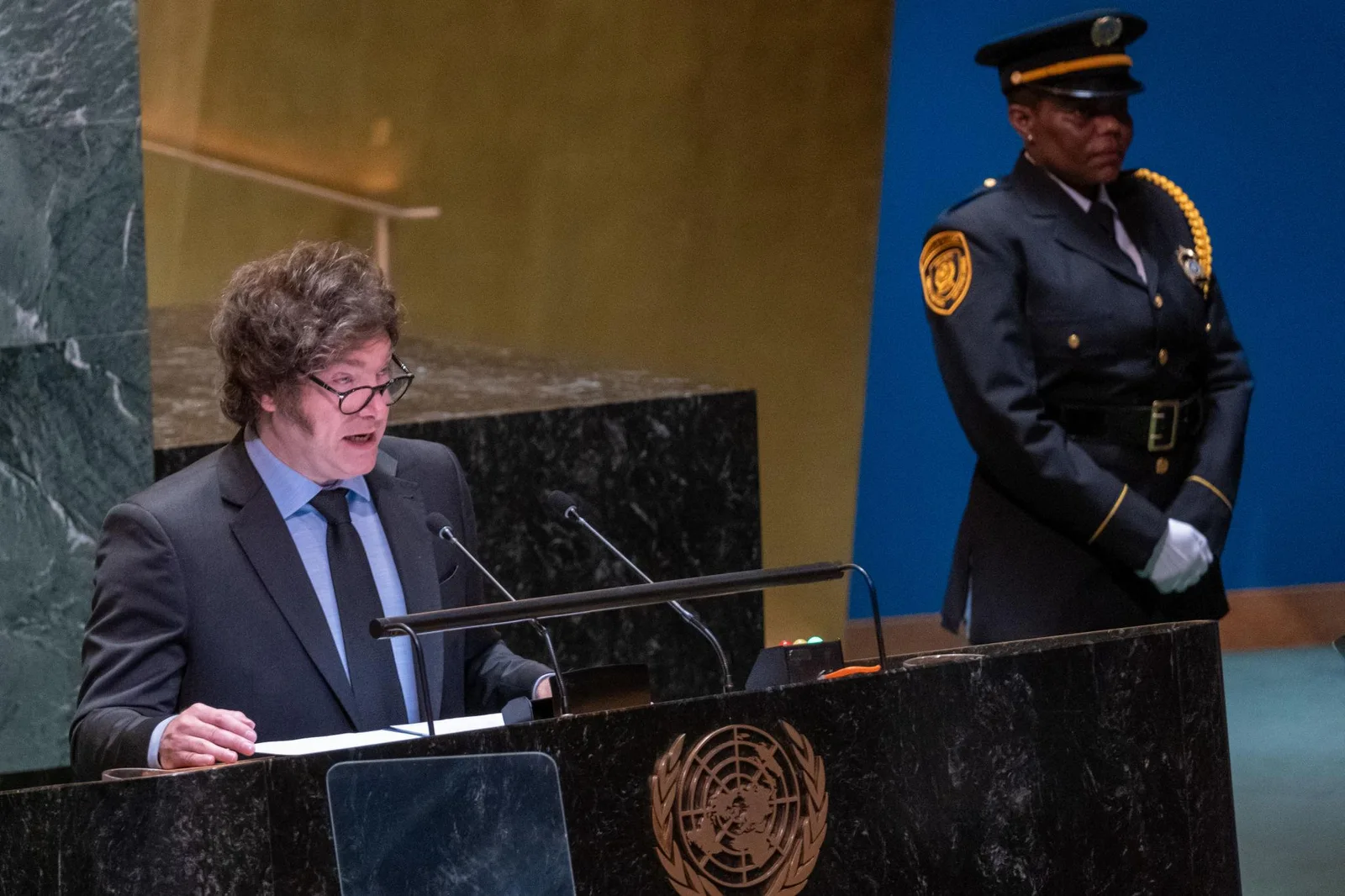
At the United Nations, Javier Milei did not change his register. On September 23, 2026, standing before an organization whose trajectory he was explicitly challenging, Argentina’s president denounced what he sees as an institution that has become bureaucratic, intrusive and increasingly incapable of fulfilling the functions for which it was created. He accused the UN of having “looked the other way” on the Falkland Islands/Malvinas question, reaffirmed Argentina’s sovereignty claim over the islands, rejected excessive international governance of artificial intelligence and defended a conception of the international order built around sovereignty, economic freedom and limits on institutional power.
The speech could easily be read as another expression of the Milei style: confrontational to his opponents, consistent to his supporters, designed to turn a diplomatic podium into an ideological stage. But it also revealed something deeper. Nearly three years after entering the Casa Rosada, Javier Milei is no longer merely denouncing a system. He is governing one. Argentina has become the laboratory in which his ideas are encountering what every doctrine eventually confronts when it reaches power: institutions, entrenched interests, economic constraints and society itself.
That is what now makes Milei more interesting than the chainsaw-wielding figure who burst into Argentine politics.
Behind the spectacle lies a political and economic experiment sufficiently advanced for its contradictions to become visible. Inflation has fallen dramatically. Public finances have been repaired. Regulations have disappeared. Part of the system of currency controls has been dismantled. The economy has returned to growth after the initial shock. Poverty, after rising sharply, has declined. Yet external reserves remain fragile, investment is uneven, employment is not advancing everywhere at the same pace, and parts of the real economy continue to bear the costs of an adjustment whose macroeconomic benefits are increasingly visible without yet being evenly distributed.
Milei promised a rupture.
The rupture happened.
The more difficult question is beginning now: can it become a durable system?
THE MAN BEFORE THE PRESIDENT
Almost nothing in Javier Milei’s institutional trajectory resembled that of a conventional Argentine president.
An economist by training, long removed from the country’s major political structures, he worked as a consultant, lecturer and corporate economist before becoming a public figure through the media. Television built the character before politics built the movement: unruly hair, explosive rhetoric, attacks on the “caste,” an impassioned defence of markets and an almost obsessive denunciation of inflation as the consequence of monetary disorder created by the state.
His celebrity therefore preceded his political machinery.
When he entered Congress in 2021, Milei did not arrive after a long territorial or party career. He arrived with an audience. Two years later, that audience became an electoral coalition and, in December 2023, presidential power.
The speed of that ascent is essential to understanding what followed. Milei was not gradually socialized by the state apparatus before taking control of it. He reached the top carrying a doctrine constructed largely against that apparatus.
He identifies with libertarianism and, more specifically at the intellectual level, anarcho-capitalism. In this conception, the state is not automatically regarded as the instrument capable of correcting market failures. It is itself a potential source of distortions, rents, constraints and political capture.
Applied to Argentina, this framework acquires particular force.
For decades, the country accumulated fiscal deficits, inflation, capital controls, subsidies, multiple exchange rates, debt restructurings and government interventions intended to correct the consequences of previous interventions. The Argentine state was no longer simply a provider of public services or a redistributor of income. It had become a central actor in price formation, access to foreign currency, energy, transportation, imports, credit and a considerable share of everyday economic decisions.
For Milei, these crises were not a succession of accidents.
They formed a system.
That is probably the key to understanding his actions since 2023. Where his predecessors generally sought to stabilize the economy while preserving the broad architecture of the Argentine state, Milei regards that architecture as part of the problem.
THE DEFICIT FIRST
When he entered the Casa Rosada on December 10, 2023, Argentina was approaching another macroeconomic breakdown. Annual inflation exceeded 200 percent, reserves were extremely weak, the fiscal deficit remained substantial and confidence in the peso had been profoundly damaged.
Milei chose a strategy whose severity was deliberate: he would not first attempt to restore growth and then repair the public finances. He reversed the sequence.
The deficit had to disappear.
The government cut expenditure, suspended much federally financed public works, reduced transfers and subsidies, restructured the administration and allowed relative prices that had been artificially compressed for years to adjust abruptly. The peso was sharply devalued at the beginning of the administration. Consumption fell. Economic activity contracted.
Argentina’s economy shrank by 1.3 percent in 2024.
But something unusual happened at the same time: the public accounts moved into surplus. The national public sector recorded a primary surplus equivalent to 1.8 percent of GDP that year and an overall financial surplus of roughly 0.3 percent. In 2025, the primary surplus still stood at 1.4 percent of GDP and the financial surplus at 0.2 percent.
Two consecutive years of overall fiscal surplus represented a striking break for an economy in which deficits had long appeared to have become a permanent feature of the political system.
This priority reveals the core of Milei’s doctrine.
Fiscal balance is not treated simply as an accounting objective. It is presented as the condition necessary to eliminate monetary financing of the Treasury and therefore to break one of Argentina’s historical mechanisms for generating inflation.
The reasoning is circular, but in the opposite direction from the cycle that had prevailed for decades: if the state no longer persistently spends more than it collects, it no longer needs to turn the central bank into a permanent financing mechanism. If money creation ceases to finance fiscal deficits, the currency can gradually recover its anchoring function. If inflation declines, economic decisions can once again extend beyond a horizon of a few weeks.
This is where the chainsaw ceases to be merely an electoral symbol.
It becomes an indirect monetary policy.
THE BATTLE AGAINST INFLATION
The most visible result appeared in prices.
At the end of 2023, Argentina was moving along a trajectory in which inflation threatened to become uncontrollable. In December 2023 alone, consumer prices increased by 25.5 percent.
By August 2026, INDEC measured monthly inflation at 1.7 percent.
The contrast is enormous.
It does not mean Argentina’s inflation problem has disappeared. Monthly inflation close to 2 percent would remain extremely high by the standards of most advanced economies, and the IMF was still projecting annual inflation of around 25 percent by the end of 2026. But the order of magnitude has changed. The immediate danger of the hyperinflationary dynamic that overshadowed the beginning of Milei’s presidency has receded.
This disinflation is probably the administration’s most consequential macroeconomic achievement because it strikes at the heart of Argentina’s dysfunction.
Inflation was never merely a high statistic. It distorted the entire economy. Prices became progressively less reliable as signals. Contracts shortened. Savings fled into dollars. Companies devoted part of their resources to managing exchange-rate risk rather than investing. Households learned to spend rapidly a currency whose value was constantly eroding.
Reducing inflation therefore restores something more fundamental than an indicator.
It restores the possibility of economic time.
But stabilization came at a cost.
The 2024 shock hit incomes, consumption and economic activity. Poverty increased sharply during the first phase of the program. For millions of Argentines, macroeconomic stabilization did not initially appear as a falling line on a chart. It appeared as a loss of purchasing power.
That is precisely what makes the subsequent trajectory important.
THE RECOVERY AFTER THE SHOCK
As inflation slowed and the economy emerged from recession, part of the initial social deterioration began to reverse.
According to INDEC, 28.2 percent of the population in Argentina’s 31 largest urban areas lived below the poverty line in the second half of 2025. Extreme poverty affected 6.3 percent of the population covered by the survey.
Those figures remain substantial.
But they are far below the levels reached during the most severe phase of the initial adjustment.
The economy itself rebounded. After contracting in 2024, real GDP expanded by 4.4 percent in 2025. By the spring of 2026, the IMF expected growth of approximately 3.5 percent for the year.
Argentina is therefore no longer merely experiencing a contraction intended to correct macroeconomic imbalances. A second stage has begun: the stage in which stabilization must generate investment, productivity and ultimately a lasting improvement in incomes.
And this is precisely where the experiment becomes more uncertain.
Because the recovery is deeply asymmetric.
Energy, mining and agriculture occupy an important place in growth and exports. Vaca Muerta is gradually turning Argentina’s historical energy constraint into an external advantage. Lithium and other mineral resources are attracting capital. Agriculture retains its long-standing ability to generate foreign currency.
But labour-intensive sectors are not necessarily advancing at the same pace. The IMF noted in the spring that construction and manufacturing remained weaker than primary and financial activities. Unemployment had reached around 7.5 percent by the end of 2025, while informality increased and real wage growth slowed.
This is one of the essential limits of the recovery narrative.
An economy can be stabilized before it is transformed.
The two processes should not be confused.
THE DEREGULATION LABORATORY
The second dimension of the Milei experiment is less immediately visible than inflation, but potentially more consequential over the long term.
The government is not merely trying to eliminate the deficit. It wants to alter the relationship between the state and the economy.
Since December 2023, the administration has pursued an extensive process of deregulation: simplifying procedures, eliminating or modifying regulations, progressively liberalizing trade, reforming individual markets and reducing administrative structures.
The doctrinal objective is clear: reduce the number of economic decisions requiring political or administrative authorization.
This strategy rests on a fundamental hypothesis. Argentina’s problem is not simply that the state spends too much, but that it organizes too much. The accumulation of regulation has gradually transformed the economy into a system of permissions, creating rents for those able to navigate the rules while raising costs for new entrants.
Deregulation therefore seeks to move the centre of economic decision-making.
From the administration to the company.
From the minister to the price.
From authorization to contract.
The true measure of this policy’s success, however, will not be the number of regulations eliminated. It will be the amount of productive capital Argentina can attract and retain.
The country possesses considerable assets: energy, agriculture, minerals, human capital, cultural proximity to the West and significant potential in digital technologies. But it also carries a long history of changing rules, capital controls, defaults, nationalizations, restructurings and political reversals.
An investor therefore does not evaluate only Argentina’s rules in 2026.
The investor tries to anticipate Argentina’s rules in 2030.
And this is where the Milei experiment encounters its deepest problem.
TRUST CANNOT BE DECREED
A government can balance a budget in a matter of months. It can eliminate a regulation in a matter of days. It can change an exchange-rate regime.
Building institutional credibility takes much longer.
Argentina continues to face significant external vulnerability. The IMF was still warning in May 2026 that the country’s external position remained fragile and that reserve coverage was inadequate. Despite foreign-currency purchases by the central bank since the beginning of the year, net international reserves remained negative at that point.
This matters profoundly.
Argentina has experienced periods of growth before. It has implemented stabilization programs before. It has seen capital return before.
Its historical problem has not merely been producing improvement.
It has been making improvement irreversible.
Every crisis leaves a memory behind.
Argentines hold dollars because they remember devaluations. Investors demand a premium because they remember defaults. Companies anticipate regulatory reversals because they have already experienced them.
Distrust therefore becomes an informal institution of its own.
And no chainsaw can eliminate it.
THE CENTRAL BANK PARADOX
That may be why Milei’s recent evolution is particularly revealing.
The candidate of 2023 made closing the Central Bank of the Argentine Republic one of the symbols of his campaign. Dollarization was presented as the ultimate mechanism for preventing political power from destroying the currency.
Three years later, the central bank still exists.
More interestingly, Milei is now seeking to strengthen some of the institutional protections surrounding it.
In July 2026, he presented a reform of its charter intended, among other things, to prohibit direct or indirect financing of the Treasury and modify the conditions governing the appointment and removal of its leadership in order to reduce political influence over the institution.
The paradox is striking.
The man who came to power promising to abolish an institution is now trying to construct rules designed to prevent his successors from abusing it.
It would be easy to describe this simply as an ideological contradiction.
It can also be understood as something deeper.
Governing is forcing Milei to move from a doctrine of abolishing institutions toward a doctrine of limiting institutions.
The distinction is considerable.
A minimal state remains a state. A stable currency requires rules. Markets function through contracts whose enforcement depends on institutions. Long-term investment assumes that certain decisions cannot simply be overturned arbitrarily.
The Argentine experiment may therefore be pushing Milei toward a destination he might not have imagined when he was appearing on television studios years ago: not simply reducing the state, but determining which institutions must survive and what constraints must be imposed on them so they cannot again become instruments of the political cycle.
The chainsaw begins to build locks.
And those locks may ultimately matter more than the chainsaw itself.
POWER TRANSFORMS DOCTRINE
This evolution does not mean Milei has become a conventional president.
His language remains extraordinarily confrontational. His relationship with political opponents, the media, some international organizations and parts of the intellectual establishment continues to be structured around conflict. His international alignment, particularly with the United States, is considerably more explicit than the caution traditionally favoured by some Latin American governments.
His September 23 speech in New York demonstrated that once again.
But something has changed since 2023.
At the time, Milei could measure the coherence of a proposal against a doctrine.
In 2026, he must also measure its consequences.
Reality has already imposed several compromises. Dollarization has not occurred. The central bank has not disappeared. The Argentine state still exists. Social programs have not been abolished. The government negotiates with the IMF, Congress, provincial governors, investors and trading partners.
That does not necessarily mean the project has been abandoned.
It means the project has moved from theory into power.
And that is usually where political experiments become genuinely interesting.
A radical program can follow two paths. It can gradually normalize itself until it becomes another variant of the system it sought to replace. Or it can transform institutions sufficiently to shift the system’s centre of gravity on a lasting basis.
It is still too early to know which fate awaits Mileísmo.
AFTER MILEI
The decisive test of Javier Milei will probably not be Argentina’s inflation rate in September 2026.
It will not even be this year’s fiscal balance.
It will be what remains when Milei is no longer president.
If fiscal balance depends exclusively on his personal determination, it can disappear with him. If deregulation depends exclusively on executive decrees, it can be reversed. If monetary stability rests only on confidence in one economic team, it will remain vulnerable to the next political transition.
Structural transformation begins precisely when rules cease to depend on the people who created them.
That is why the attempt to protect the central bank more effectively from political financing of fiscal deficits is more revealing than its technical details might suggest. The same applies to embedding financial balance in the 2026 budget, fiscal reforms, changes to the labour market and the effort to rebuild Argentina’s access to capital.
Milei must now resolve the paradox confronting every radical reformer: using enough power to place lasting limits on power.
Argentina is an especially difficult terrain for that experiment precisely because its economic history is filled with rules replaced by other rules, stabilizations followed by crises and promises of rupture gradually absorbed by the constraints of the system.
THE ARGENTINE LABORATORY
This also explains why the experiment now matters beyond Argentina’s borders.
Milei is watched internationally not only because his personality fascinates or irritates, but because he is attempting something that has become relatively unusual among contemporary democracies: implementing, on a large scale, a program explicitly constructed around reducing the economic perimeter of the state.
His results will therefore be interpreted far beyond Buenos Aires.
His supporters will point to falling inflation, fiscal surpluses and renewed growth as evidence that shock therapy can extract an economy from a dysfunctional equilibrium.
His opponents will emphasize the initial cost of adjustment, persistent difficulties in some sectors, employment insecurity, dependence on commodities, external vulnerabilities and the social consequences of a smaller state.
Both interpretations can find facts to sustain them.
Neither is sufficient yet.
Because the experiment is unfinished.
Milei has already demonstrated that an Argentine government can rapidly reduce its fiscal deficit and dramatically slow an inflationary dynamic that had come to appear almost structural.
He has not yet demonstrated that such an adjustment can produce a decade of investment, productivity growth, sustained real wage increases and monetary stability.
That is the frontier separating successful stabilization from a change in economic regime.
It cannot be crossed in three years.
THE LIMITS
In New York, before the United Nations General Assembly, Milei ultimately reproduced at the international level the argument that brought him to power in Argentina.
An institution is created to perform a function. Then it grows. It accumulates responsibilities, procedures, interests and bureaucracies. Eventually, it may begin to regard its own permanence as an objective in itself. And when it is no longer constrained by the limits that justified its existence, it risks becoming a source of the very dysfunction it was intended to address.
That is how Milei describes the United Nations.
It is also how he has described the Argentine state for years.
The intellectual continuity is real.
But governing has forced him to discover the other half of the problem.
Not every limit is created by abolishing something.
Some limits have to be built.
A fiscal rule is a limit. Central-bank independence is a limit. A contract that the next government cannot easily overturn is a limit. An administration that cannot indefinitely finance expenditure through monetary creation is a limit.
The Milei experiment is therefore entering a different phase.
The first was about stopping a machine.
The second is about preventing it from starting again.
And perhaps only now is the most difficult part of his revolution beginning.
Main Sources
- International Monetary Fund — Argentina: 2026 Article IV Consultation and Second Review under the Extended Fund Facility
- International Monetary Fund — Second Review of Argentina’s Extended Fund Facility and 2026 Article IV Consultation
- INDEC — Consumer Price Index
- INDEC — Poverty and Extreme Poverty
- World Bank — Argentina Economic Overview
- Reuters — Argentina’s Milei unveils bill to shield central bank from political pressure
- Reuters — Milei addresses UN amid tensions over Falkland Islands/Malvinas
Atlas Limits Research Desk
Atlas Limits’ editorial and analytical desk.