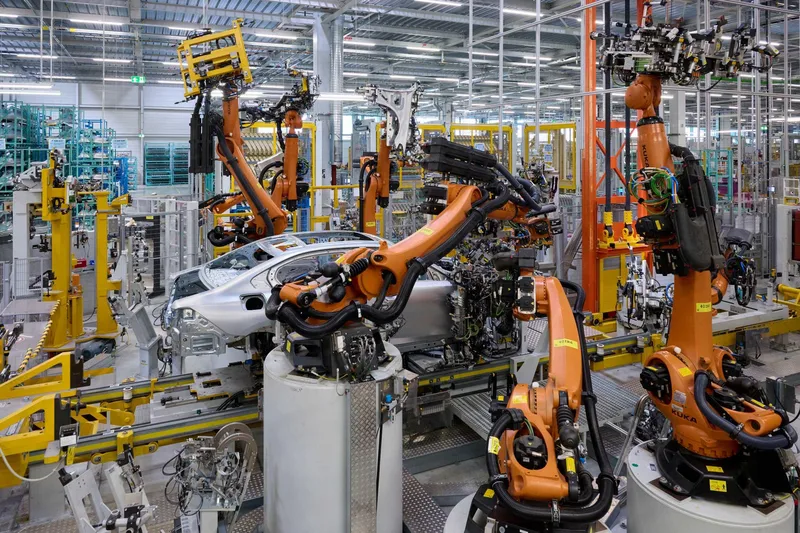
By announcing its first US factory, Audi is preparing to transform its production network. Behind the investment lies an increasingly consequential choice for multinational companies: manufacture closer to customers to protect market access while preserving the skills and jobs at their established industrial locations.
Audi wants to give its American ambitions an industrial foundation. On October 25, 2026, the German carmaker announced plans to invest approximately $4 billion in its first US manufacturing plant, in Georgia. The project envisages annual capacity of up to 200,000 vehicles and approximately 4,500 jobs. Production would focus on premium SUVs tailored to North American customers.
The announcement marks a strategic milestone, but it does not conclude the decision-making process. Volkswagen says the project must still follow its internal procedures and be submitted to the relevant corporate bodies. That distinction is essential: an industrial ambition has been made public, but implementation remains subject to the necessary approvals.
Beyond its financial scale, the investment raises a question that extends well beyond Audi: how should companies allocate productive capital when access to markets becomes less predictable? The proposed answer in Georgia is to bring manufacturing closer to consumption. That strategy can strengthen a company’s competitiveness while redistributing jobs, supplier contracts and growth prospects across the territories in which it operates.
The timetable underscores the scale of the commitment. Audi refers to construction beginning in 2027 and production starting in the early 2030s. Georgia’s government provides a more detailed sequence: site preparation in 2027, factory construction from 2028 and full production expected in 2031. These remain the projected milestones of an announced project.
Several years will therefore separate the initial decision from its commercial effects. During that period, automotive demand, powertrain preferences, financing costs and trade rules could all change. Building a factory means committing capital to a long-term market assumption that extends well beyond the conditions that helped bring the project about.
Audi’s stated objective is to establish North America as a third major pillar of its manufacturing network, alongside Europe and China. The company presents the investment as a way to increase sales, improve competitiveness and reduce exposure to trade and currency risks.
This logic changes the economic role of the factory. It remains a manufacturing asset, but it also becomes a partial safeguard against disruptions to international trade. Proximity to the final market can shorten logistics lead times, facilitate product adaptation and bring a portion of costs into the same currency as sales.
That protection comes at a price. A new manufacturing location requires construction expenditure, equipment, recruitment, training and a production ramp-up. It may also duplicate functions already performed elsewhere within the group. The decision therefore depends on the full cost of a US manufacturing presence compared with supplying the market from abroad under different trade scenarios.
Tariffs make this calculation particularly sensitive. According to Reuters, reporting Audi’s figures, US trade measures cost the carmaker approximately €1.2 billion in 2025. Donald Trump presented the project as a result of his trade policies at a rally in Perry on October 24.
The existence of a tariff burden, however, does not by itself establish the future factory’s profitability. It would be misleading to compare that annual cost directly with the investment amount and infer a payback period. The vehicles involved, the volumes actually localized, imported components and the rules in force when production begins will determine the savings that can realistically be achieved.
Assembling a vehicle in the United States does not guarantee that its entire value chain will escape trade tensions. A factory may rely on parts, machinery or materials sourced from several countries. The depth of the local supplier network will therefore matter as much as the location of final assembly.
Georgia emphasizes precisely this combination of industrial conditions: site readiness, logistics infrastructure, supplier access and training programs. The state’s Georgia Quick Start program is expected to help prepare the workforce. The location’s appeal thus rests on its ability to make the investment operational, beyond the financial announcement itself.
The economic details of the agreement nevertheless remain incomplete. The statements reviewed do not disclose the financing breakdown or the full range of any public assistance and incentives. Those details will be necessary to assess the company’s net investment cost and the commitments made by public authorities.
For US policymakers, evaluation will need to extend beyond the announced number of jobs. It should account for whether those jobs materialize, their wages, contracts awarded to local suppliers, infrastructure spending and expected tax receipts. A foreign investment can generate substantial activity without concentrating all its economic benefits in the host region.
From Germany’s perspective, the question is different: how much of the American expansion will support European activity, and how much could replace it?
The union response reflects that tension. IG Metall considers a stronger US position necessary for Audi, while demanding firm prospects for German workers and criticizing Audi’s chief executive for participating in Trump’s rally. Lower Saxony has also called for American expansion to preserve employment and value creation in Germany.
These concerns do not establish that a US factory would automatically lead to job losses in Europe. Overseas expansion can support engineering, research, industrial equipment and some component manufacturing in the home country. It can also enable a company to capture sales that would otherwise have gone to competitors.
But the opposite effect is possible if local production gradually replaces vehicles previously exported. In that scenario, volumes leaving European factories would decline, affecting capacity utilization and profitability. The outcome will depend on model allocation, actual sales growth and the division of activities among the group’s locations.
The central issue then becomes the allocation of future investment. A factory retains its position within a group when it secures new models, modernization spending and the capabilities needed for subsequent product generations. Capital allocation can therefore determine an industrial site’s future before any change in employment is announced.
Volkswagen will also have to assess the project across its global portfolio. Resources committed to Georgia must be weighed against the group’s other requirements. The decision carries an opportunity cost: investing here leaves fewer resources for other projects unless financing or available cash flow increases.
The announced capacity of 200,000 vehicles should therefore not be confused with guaranteed sales. Profitability will depend on factory utilization, margins per vehicle and cost control. A large facility can deliver economies of scale when sufficiently utilized; it can also become a burden when demand falls short of expectations.
Ultimately, the significance of the project extends beyond a simple comparison between American and European manufacturing. It illustrates a possible regionalization of industrial globalization: companies remain international, but increasingly seek to organize production around the major markets they serve.
This shift can make some supply arrangements more resilient. It can also increase the expenditure required to maintain several production networks and reduce the efficiencies achieved by concentrating manufacturing globally. Industrial resilience and economic efficiency do not always align; their balance must be designed and financed.
Audi’s project does not yet justify conclusions about a large-scale transfer of value out of Europe or a definitive economic victory for US trade policy. It does, however, provide a concrete case through which to examine how these decisions take shape.
Final approval, financing terms, component sourcing and model allocation will reveal its actual significance. The decisive question is whether Volkswagen is adding a new source of growth to its global network or, under pressure from trade barriers, reorganizing the geography of its existing production.
Atlas Limits Research Desk
Atlas Limits’ editorial and analytical desk.