He sleeps in the street, is chased away by policemen, loses his jobs, knows hunger, prison and humiliation. His clothes are either too large or too small, his shoes are worn out, and his fortune sometimes amounts to a handful of coins. Yet when he puts his bowler hat back on, straightens his cane and resumes his peculiar walk, something remains intact. The world can take almost everything from the Tramp. It never quite manages to diminish him.
This may be where Charlie Chaplin’s true power lies. Behind the slapstick, the falls and the extraordinarily precise mechanics of the gag, his cinema spent several decades asking the same question: what remains of an individual when economic, social and political structures become powerful enough to determine his place?
Chaplin’s answer is neither theoretical nor truly ideological. It resides in a body. The body of a tiny man who stubbornly refuses to become as small as society would like him to be. 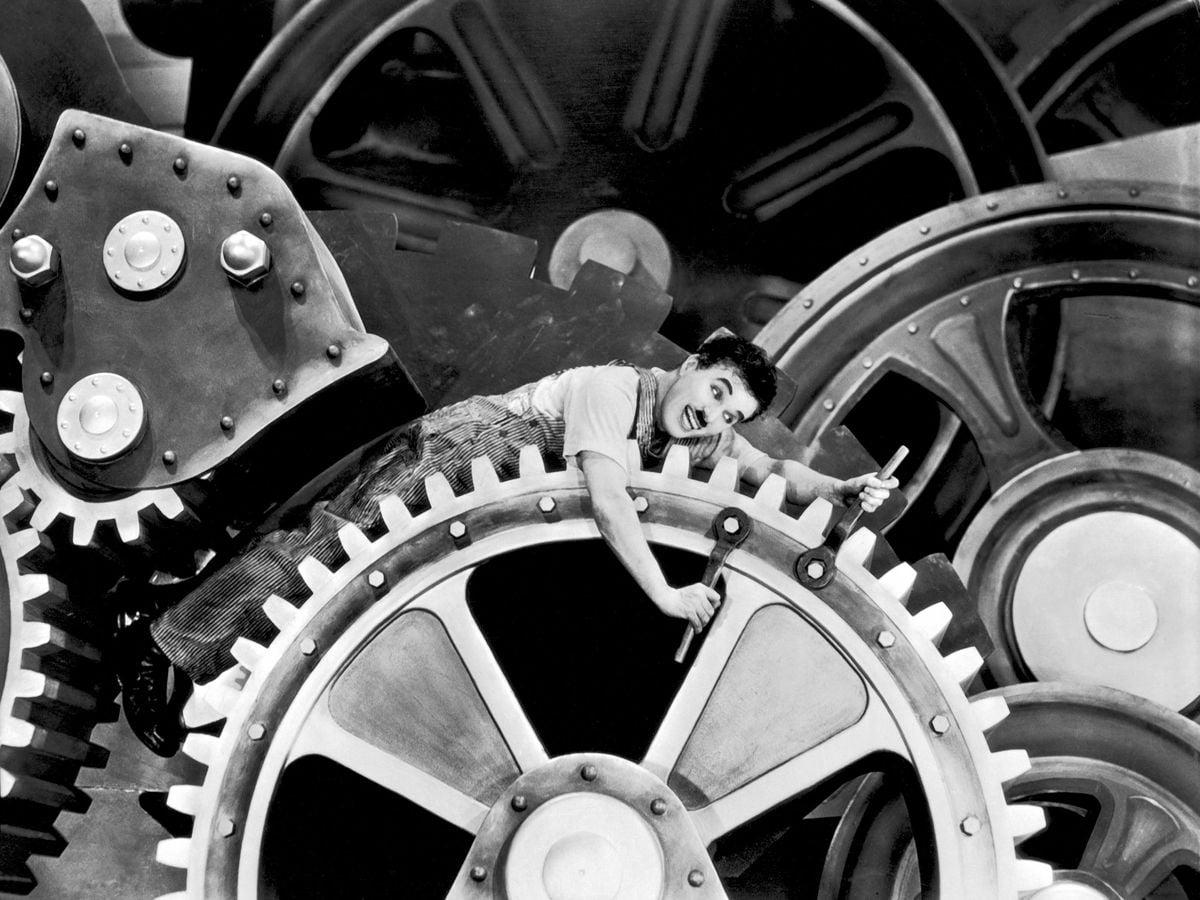 A Man Without a Place
When The Kid was released in 1921, the Tramp had already existed for several years. But the film gave him a new depth. The vagabond takes in an abandoned child and raises him in poverty. When institutions intervene, they do not repair their precarious existence. They separate them.
Poverty, in Chaplin’s work, is therefore not a picturesque backdrop. It structures human relationships. Housing, food, the police, social services, work: everything reminds the Tramp that he inhabits a world whose rules were written by others.
But Chaplin immediately reverses the hierarchy. The man who owns nothing can still protect someone. The man with no status can create a family. The person society considers marginal can prove more humane than the institutions entrusted with defining what is normal.
This inversion would become one of the constants of Chaplin’s work. The powerful possess money, authority and buildings. The Tramp retains something far more difficult to administer: the ability to decide what deserves his attention.
Seeing the Person No One Sees
Ten years later, City Lights pushes this logic much further.
The film begins almost like a manifesto. Dignitaries unveil a monument dedicated to peace and prosperity. When the covering is removed, the Tramp is discovered sleeping on the statue. Official prosperity has literally uncovered the poor man it was supposed to have made disappear.
Then the Tramp meets a blind flower seller. Because she hears a car door slam, she assumes he is wealthy. He could correct her mistake. He does not. What follows is one of cinema’s most beautiful reversals of social appearance: a man without money sets out to become, for someone else, the man she believes she has met.
He works, boxes, endures humiliation and eventually obtains the money that allows the young woman to regain her sight. He is then accused of theft and imprisoned. By the time he leaves prison, she can see. He is more destitute than before. She recognises her benefactor only when she touches his hand.
The whole of City Lights ultimately rests on this paradox: the young woman has to recover her sight in order to discover that appearances had deceived her.
The rich man was not rich.
The vagabond was not insignificant.
And blindness may not have belonged only to the flower seller.
Chaplin had long been working with this idea, but he had now given it its purest form: dignity does not coincide with social position.
When the Machine Becomes the World
With Modern Times in 1936, the setting changes abruptly. The Tramp is no longer confronted only with wealthy men, policemen or institutions. He encounters something larger: the industrial system.
The film’s first visual comparison is explicit. A flock of sheep is followed by crowds of workers entering a factory. The Tramp then appears on an assembly line, forced to repeat the same movement continuously. An experimental machine soon attempts to feed him without interrupting his work. The objective is no longer simply to produce more: even the lunch break has become a problem of efficiency.
The gag works brilliantly because the machine malfunctions. But behind that malfunction lies a far more serious intuition. The individual is progressively treated as a variable within the production process. His body must adapt to the pace; his movements belong to the organisation; his time itself becomes a resource to be optimised.
Chaplin was not a detached observer of this transformation. After a long journey around the world in the early 1930s, he became increasingly interested in the consequences of the Great Depression, unemployment, mechanisation and the political upheavals accompanying the crisis. These concerns directly shaped the conception of Modern Times.
But he chose to turn those anxieties into comedy.
That is precisely what makes Modern Times more enduring than a political treatise. Chaplin does not argue that machines are inherently bad. He shows what happens when an organisation ceases to be built around human beings and instead asks human beings to rebuild themselves around it.
The Tramp literally ends up caught inside the gears.
The image is funny because it is impossible. It became iconic because the metaphor was not.
When Laughter Changes Its Target
There is, however, a progression throughout Chaplin’s work.
In The Kid, the individual confronts poverty and institutions.
In City Lights, he confronts social hierarchy.
In Modern Times, he confronts industrial organisation.
In 1940, in The Great Dictator, he finally confronts political power when it seeks to absorb the individual entirely.
The transition is considerable. Chaplin simultaneously plays a persecuted Jewish barber and Adenoid Hynkel, a transparent caricature of Adolf Hitler. Above all, speech now truly assumes power. The filmmaker who had long resisted talking pictures finally uses the human voice against a politics built precisely upon the amplified voice, radio, mass rallies and propaganda.
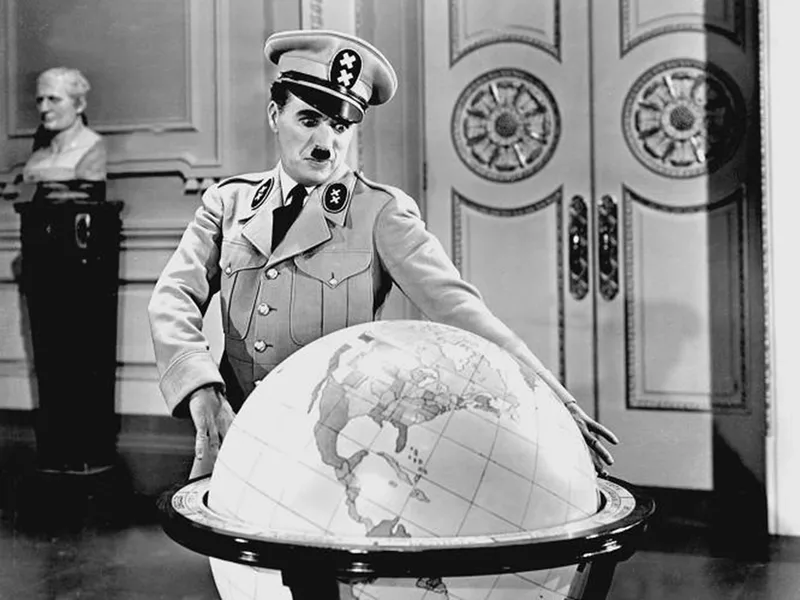
The famous scene in which Hynkel plays with an inflatable globe encapsulates the distance travelled since the Tramp. The vagabond needed to find a few coins to eat. The dictator wants to possess the world.
Yet Chaplin connects the two characters through their bodies, their moustaches and his own face. One possesses almost nothing and preserves his humanity; the other claims everything and ultimately reduces human beings to categories.
The question of individual dignity therefore becomes explicitly political.
At the end of the film, the barber, mistaken for the dictator, speaks. The character gradually seems to disappear behind his creator. The comedian no longer merely makes power ridiculous: he states what he believes about how power should be exercised.
It was an artistic risk. It was also a political threshold whose consequences Chaplin would experience in post-war America.
When Chaplin Stops Consoling
After the war, his cinema becomes darker.
Monsieur Verdoux, released in 1947, does not feature the Tramp at all. Henri Verdoux is a former bank employee who, after losing his job, marries and murders wealthy women in order to obtain their money. The film developed from an idea initially proposed by Orson Welles and was loosely inspired by the Landru case.
The shift is essential.
For decades, Chaplin had asked audiences to look at the weak. Now he forces them to examine the systems that determine what society is prepared to recognise as violence.
Verdoux is a murderer. Chaplin does not attempt to erase that reality. Instead, he constructs a deliberately provocative comparison: why does individual murder provoke absolute revulsion while modern societies are capable of organising destruction on an industrial scale and integrating it into their institutions, economies and wars?
Chaplin’s laughter has almost completely turned around.
In the earlier films, it allowed the poor man to survive humiliation.
In Monsieur Verdoux, it becomes uncomfortable. It no longer protects the spectator. It almost accuses the audience of being perfectly capable of recognising crime when it is committed by an individual, yet far less capable of recognising it when it changes scale and acquires the attributes of respectability.
The Tramp had disappeared because Chaplin perhaps no longer needed him.
The Weak Against the System
This evolution also explains why Chaplin’s significance extends far beyond the history of slapstick cinema.
He never developed a coherent theory of industrial society. His political positions were sometimes idealistic, sometimes controversial, and their reception was profoundly shaped by the ideological tensions of his time. From the 1940s onward, his political interventions and conflicts with the American authorities themselves became part of his public history.
In 1952, as he left the United States for London for the premiere of Limelight, the American authorities challenged his right to re-enter the country. Chaplin ultimately chose not to return and settled in Switzerland. British records released decades later showed that British intelligence services, approached amid American suspicions surrounding Chaplin, had not established that he represented a security threat.
But reducing his work to these political confrontations would miss what is deepest within it.
Chaplin is less interested in doctrines than in asymmetry.
A man against a factory.
A child against an administration.
A flower seller against poverty.
A worker against unemployment.
A barber against a dictator.
In each of these situations, the forces are disproportionate. The Chaplinesque character cannot truly win according to the rules of the world around him. He controls neither capital, nor the state, nor the police, nor the machine. He does not always even have a roof over his head.
One final sovereignty therefore remains: his conduct.
This is where the cane, the bowler hat and the walk cease to be mere comic accessories. The Tramp continually transforms material weakness into symbolic independence. He is poor but sometimes behaves like a gentleman. He is rejected but tips his hat. He is hungry but shares. He falls, adjusts his clothes, and starts walking again.
That tiny gesture may contain Chaplin’s entire philosophy.
The world can impose a condition.
It cannot entirely impose an attitude.
What Chaplin Had Seen
More than a century after The Kid and ninety years after Modern Times, the machines have changed.
Mechanical assembly lines have been joined by software, algorithms, platforms and digital automation. Contemporary societies are incomparably wealthier than the world in which the Tramp searched for a few coins. Social protections, working conditions and institutions have also changed profoundly, albeit unevenly across countries.
It would therefore be easy, and wrong, to turn Chaplin into a prophet of our age.
Yet his intuition remains remarkably modern: material progress and human progress are not necessarily the same thing.
A society can produce more without necessarily giving individuals greater control over their lives. An organisation can become more efficient while becoming more impersonal. A technology can free a person from one task while simultaneously making his economic position more uncertain. An institution can follow its procedures perfectly and completely fail to see the human being standing before it.
Chaplin understood this fundamental ambiguity of modernity.
He also understood something more difficult to measure: human beings do not easily accept being treated solely as functions.
Worker. Unemployed. Poor. Foreigner. Prisoner. Consumer. Soldier.
The Tramp passes through all kinds of categories without ever allowing himself to be contained by any of them.
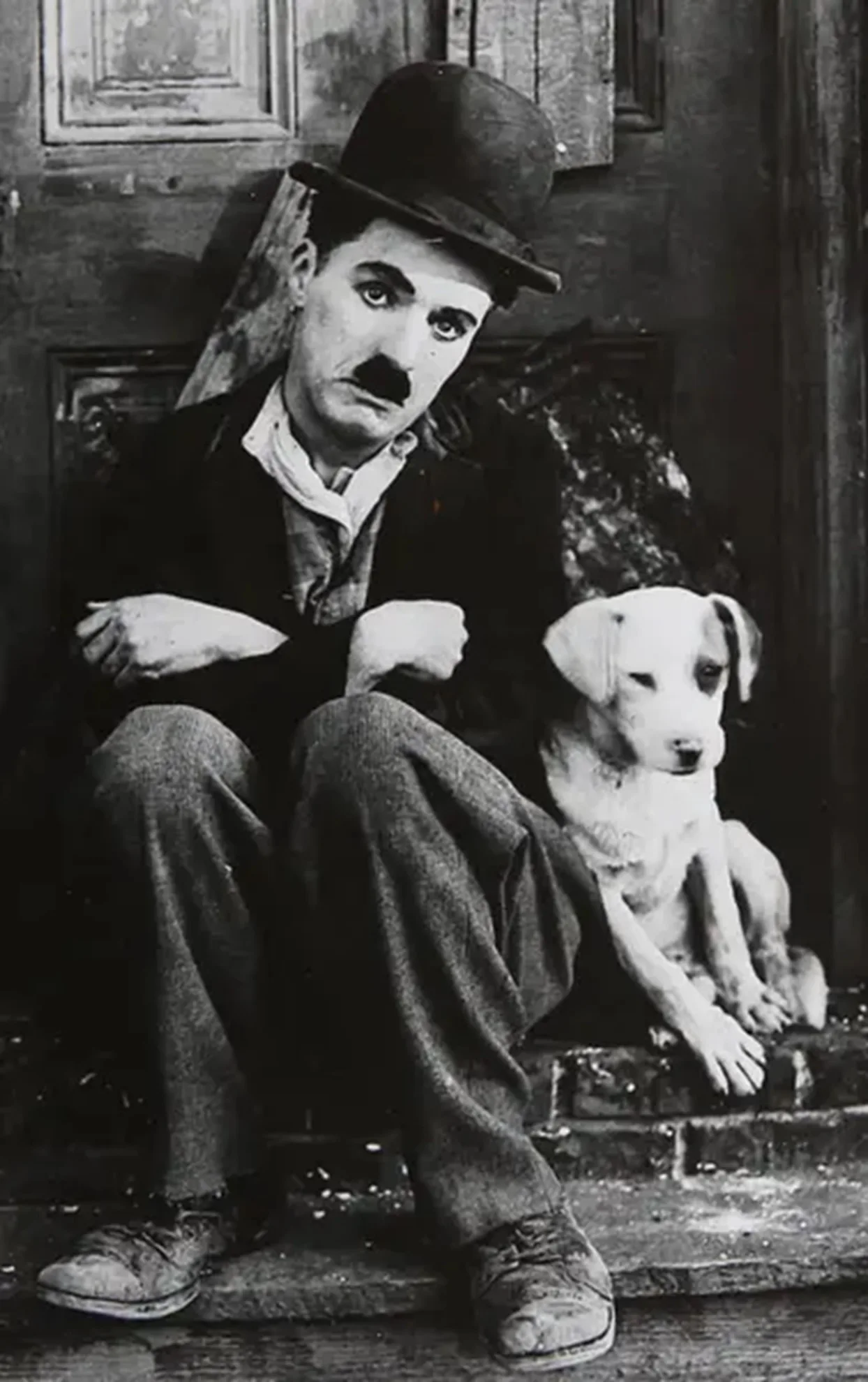
That is why the photograph of a small man sitting on a doorstep beside a dog can still contain something more than nostalgia for silent cinema. His shoes are worn. His trousers do not fit. He clearly has nowhere to go.
And yet he seems to belong to no one.
Chaplin spent his career telling the story of this strange victory: that of a man who loses almost everything except what still allows him to say that he is a man.
The powerful figures in his films possess factories, banks, monuments, uniforms and sometimes entire countries.
The Tramp has his cane.
And Chaplin made sure that, for a few seconds, it weighed more than all the rest. 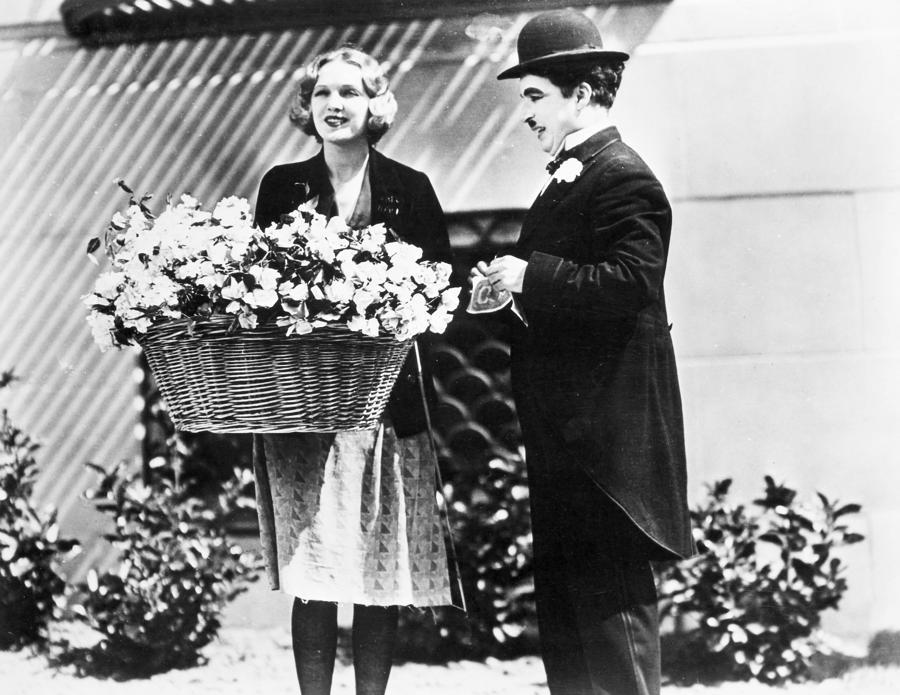 Main Sources
Charlie Chaplin Official Website — archives and documentation on The Kid, City Lights, Modern Times, The Great Dictator and Monsieur Verdoux.
Charlie Chaplin Official Website — Charlie Chaplin biography and documentation on the origins and economic and social context of Modern Times.
The National Archives, United Kingdom — historical records concerning British investigations into Charlie Chaplin and requests made to British intelligence services in the context of American suspicions surrounding him.
Atlas Limits Research Desk
Atlas Limits’ editorial and analytical desk.