Nearly thirty years after performing before John Paul II, Bob Dylan has been received by Pope Leo XIV at the Vatican. Behind this encounter between a pontiff and a legend of American music lies a deeper history: that of an artist whose work has been shaped by faith, dissent and the nuclear threat, and whose questions continue to resonate in a world that once seemed to have left them behind.
On November 4, 2026, Bob Dylan entered the Vatican's Apostolic Palace wearing a black hooded sweatshirt. Waiting to receive him was Leo XIV, the first American pope in history. The meeting was brief. A few words, a rosary presented by the pontiff, a copy of Chronicles: Volume One offered by the musician. Nothing, at first glance, that resembled a major event. Yet behind this almost ordinary scene lay two histories that have intersected for decades: that of an artist who has never stopped questioning the certainties of his time, and that of a religious institution seeking to preserve its voice in a world whose cultural references it no longer controls.
At 85, Dylan continues to tour, with a performance scheduled in Rome the day after the audience. He had not come to announce a conversion, champion a cause or present a new work. No detailed account of his conversation with the pope has been made public. But the encounter carries a significance beyond whatever intentions might be attributed to its participants. It comes only months after Leo XIV chose to quote an anti-nuclear text written by Dylan in 1963 to warn against the renewed global arms race.
The man who once sang about the anxieties of the Cold War thus finds himself, more than sixty years later, at the heart of a papal reflection on the dangers of the present. Between those two periods, the powers have changed, technologies have evolved and international balances have been profoundly reshaped. The fear of destruction brought about by humanity itself, however, has not disappeared.
The First Encounter
The story began long before Leo XIV.
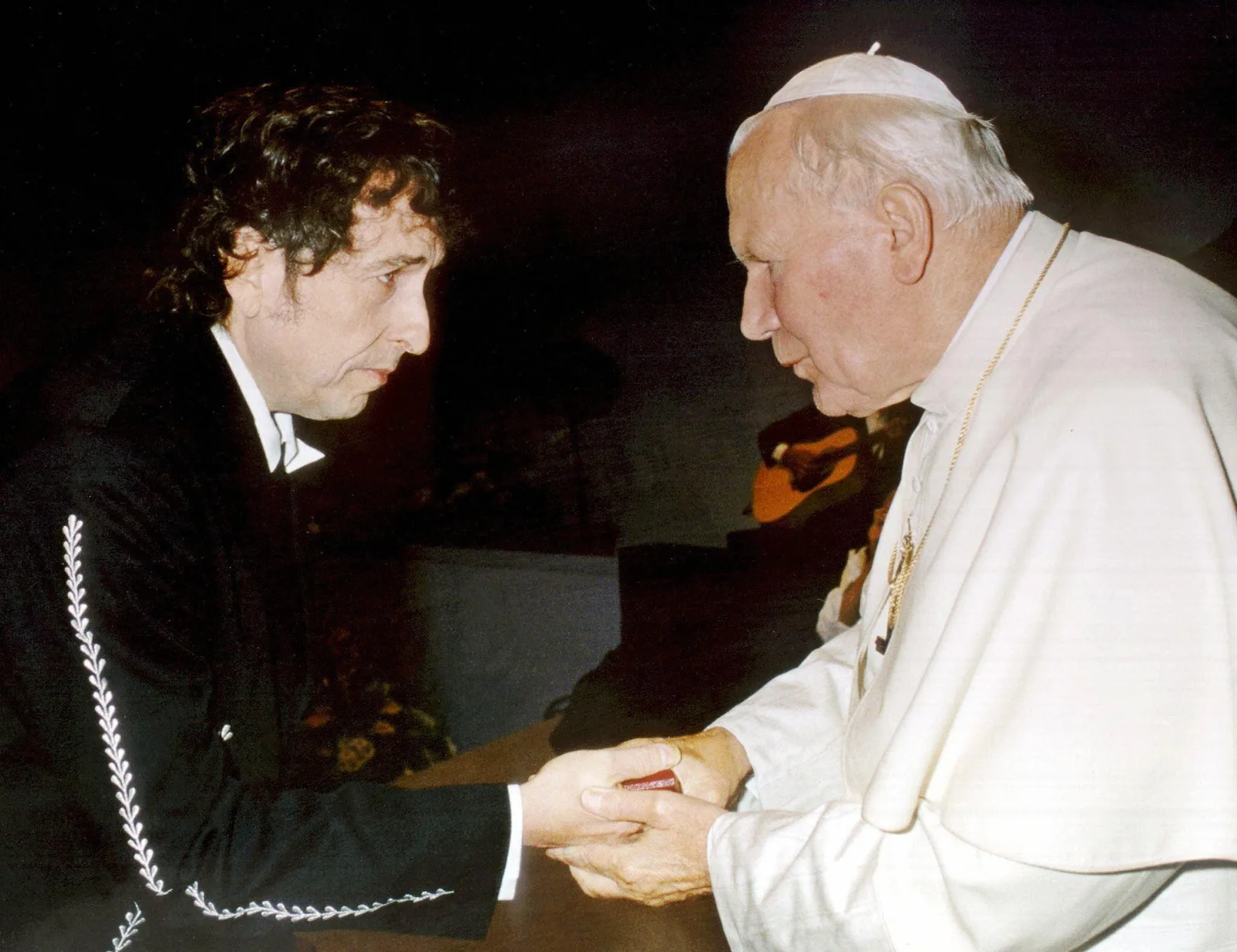
On September 27, 1997, Bob Dylan performed in Bologna during Italy's National Eucharistic Congress, before John Paul II and an enormous gathering of young people. The invitation was unexpected. Dylan had long been associated with the protest movements of the 1960s, the struggle for civil rights and a musical culture that had largely developed outside traditional institutions.
John Paul II, meanwhile, had undertaken to renew the Catholic Church's relationship with younger generations. Large gatherings, apostolic journeys and an openness to certain expressions of popular culture formed part of that approach. Inviting Dylan was not simply a matter of welcoming a celebrity. It amounted to acknowledging that some of the spiritual questions of contemporary society were now being expressed beyond the traditional spaces of religion.
The singer performed three songs, including Knockin' on Heaven's Door, A Hard Rain's A-Gonna Fall and Forever Young. He then removed his cowboy hat and went to greet the pope.
John Paul II had chosen to respond to a question made famous by Blowin' in the Wind: how many roads must a man walk down before he can be called a man? For the pontiff, the answer lay in a single road, the path of Jesus Christ.
The exchange revealed a fundamental difference. Dylan posed open-ended questions, to which his songs often refused to provide definitive conclusions. John Paul II offered an answer grounded in theological conviction. One turned uncertainty into poetic material; the other sought to give it spiritual direction.
That difference did not prevent the encounter. On the contrary, it gave the meeting its significance.
It would nevertheless be excessive to interpret the occasion as evidence of unanimous ecclesiastical approval of Dylan. Joseph Ratzinger, the future Benedict XVI, would later express reservations about the singer's presence at the event. The encounter between popular culture and religious tradition was therefore not an entirely consensual celebration. It also reflected differing sensibilities within Catholicism itself.
Nearly three decades later, Dylan returns to the Vatican in a profoundly different context. He is no longer merely the supposed spokesman of a protest generation. He has become a towering figure of world culture, recognized with the Nobel Prize in Literature in 2016, while retaining a remarkably distant relationship with the ceremonies that usually accompany such recognition.
A Spiritual Journey That Defies Classification
Bob Dylan's relationship with religion cannot be reduced to his encounters with two popes.
Born Robert Zimmerman in 1941 into a Jewish family in Minnesota, he grew up surrounded by a religious tradition whose images, narratives and references would continue to permeate his writing. From his earliest major compositions, biblical figures appeared alongside characters from contemporary America. Prophets, judgment, catastrophe and promises of deliverance became elements of an artistic language capable of addressing both the human condition and political conflict.
In the late 1970s, Dylan underwent a period of explicitly Christian conversion. Slow Train Coming, released in 1979, followed by Saved in 1980 and Shot of Love in 1981, reflected this transformation. Evangelical references were no longer simply literary images; they occupied the center of his artistic discourse.
The shift unsettled part of his audience. The man who had come to embody, however reluctantly, a certain freedom from established authorities now appeared to be defending explicit religious convictions. Yet treating this period as an absolute rupture would overlook the underlying continuity of his work.
From the beginning, Dylan had explored guilt, justice, salvation, responsibility and the limits of human power. His Christian period gave those questions a more clearly doctrinal expression, but it did not invent them. They were already present in the songs that had established his reputation.
In subsequent years, the musician moved away from his most emphatic religious declarations without abandoning the spiritual dimension of his artistic universe. Biblical references remained, metaphysical questions persisted, and Dylan generally avoided offering any definitive description of his beliefs.
This resistance to classification helps explain his singularity. Dylan has successively been described as a protest singer, a generational poet, a countercultural figure, a Christian musician, an heir to American musical traditions and a Nobel laureate in literature. Each description contains an element of truth. None is sufficient to define him.
His work seems to have been constructed precisely against the possibility of being permanently assigned a single identity.
The Return of the Bomb
It is perhaps in the choice of an almost forgotten text that the encounter with Leo XIV acquires its greatest significance.
In July 2026, in the preface to a book devoted to disarmament and peace, the pope quoted Go Away You Bomb, a composition written by Dylan in 1963, at the height of the Cold War. The text addresses the atomic bomb directly and denounces its entirely human character: conceived, possessed and operated by human beings.
The song was never officially recorded or included on an album. Its manuscript, long unpublished, resurfaced in 2013. Its use by Leo XIV is therefore remarkable. The pope did not select one of the musician's universally recognized anthems, but a marginal work directly concerned with human responsibility for the creation of instruments of destruction.
That choice establishes a bridge between two historical moments.
In 1963, the Cuban Missile Crisis had just demonstrated how close a confrontation between nuclear powers could bring the world to catastrophe. Peace movements were expanding, while Western societies lived under the permanent threat of a conflict capable of annihilating entire populations.
In 2026, the strategic environment is different, but the fundamental question remains. The modernization of nuclear arsenals, the weakening of arms-control mechanisms and the intensification of rivalries among major powers have returned deterrence to the center of international security concerns.
Technological progress has not eliminated the moral questions that accompanied the first generations of nuclear weapons. It has made the systems more sophisticated, the means of destruction more varied and decision-making mechanisms more complex. But ultimate responsibility for their use remains human.
By invoking Dylan, Leo XIV is not turning a song into diplomatic doctrine. He is drawing on artistic expression to remind the world that debates about international security cannot be left entirely to the language of military strategy.
Where states reason in terms of capabilities, credibility and balances of power, poetry reintroduces a more elementary question: what does it mean to build instruments whose very purpose rests on the possibility of mass destruction?
That question belongs as much to moral philosophy as to international politics. It explains why a text written by a young American musician in the early 1960s can still find a place in the words of a pope more than six decades later.
Two Americas, Two Forms of Authority
The November 4 encounter also carries an American dimension.
Bob Dylan and Leo XIV emerged from the American Midwest, a region that has produced cultural, religious and political traditions often far removed from the most visible representations of national power. Dylan was born in Duluth, Minnesota; Robert Francis Prevost, who became Leo XIV, in Chicago, Illinois.
Their trajectories could hardly be more different. One moved through musical stages, cultural movements and the transformations of the entertainment industry. The other devoted his life to the Church, notably through his missionary and pastoral experience in Peru, before ascending to the papacy.
Yet they embody two forms of authority that do not primarily depend on economic or political power.
Dylan acquired his influence through words, melodies and his ability to express the contradictions of society. Leo XIV exercises institutional religious authority, rooted in a historical continuity that extends far beyond his own person.
One officially represents no one beyond himself and his work. The other leads a global institution and carries doctrinal and pastoral responsibilities. This asymmetry is essential. Their meeting implies neither complete agreement between their convictions nor equivalence between their roles.
Rather, it demonstrates that cultural and religious authority can meet around shared concerns without becoming indistinguishable.
In a world where public speech is often measured by its immediate audience, this distinction deserves attention. The longevity of a work is not the same as its popularity at a particular moment. A song can outlive its original context, acquire new meanings and be reinterpreted by generations that never experienced the circumstances of its creation.
The Vatican, an institution particularly attentive to historical continuity, appears to recognize this ability of certain works to cross the boundaries of time.
What Songs Preserve
There is a quiet irony in this history.
Bob Dylan has spent much of his career escaping the expectations of those who wanted to turn him into a spokesman. As early as the 1960s, he resisted being confined to the role of political conscience for an entire generation. He changed styles, sounds and repertoires, sometimes to the considerable frustration of those who expected him to remain faithful to his earliest songs.
And yet his lyrics continue to be invoked to express collective concerns.
Blowin' in the Wind provided John Paul II, in 1997, with the starting point for a reflection on humanity's spiritual journey. Go Away You Bomb allowed Leo XIV, in 2026, to recall the dangers of nuclear armament.
Between these two references, an interesting evolution emerges. The first encounter was dominated by questions of faith and youth. The second belongs more directly to a reflection on peace, responsibility and collective survival.
This shift does not mean that the Church has abandoned spiritual concerns in favor of geopolitical questions. Rather, it illustrates how its discourse seeks to connect religious convictions with the anxieties of the contemporary world.
As for Dylan, nothing establishes that this audience represents a new stage in his religious journey. The content of his conversation with Leo XIV has not been disclosed. Attributing precise spiritual or political intentions to him would turn a documented encounter into a speculative narrative.
What is established is sufficient to invite reflection: two popes, nearly thirty years apart, have found in his work a way to articulate questions extending far beyond music.
The Roads That Remain
It would be tempting to conclude this story with an image of reconciliation: the protest singer welcomed by a religious institution, youthful rebellion transformed into cultural heritage, old divisions eventually absorbed by time.
But such an interpretation would be too convenient.
Bob Dylan was never merely a rebel, just as the Vatican has never been an entirely immobile institution. Their respective histories have been shaped by transformations, contradictions and attempts to respond to changing worlds.
The deeper continuity lies elsewhere.
In 1997, John Paul II responded to a question posed by Dylan about the roads a person must travel. In 2026, Leo XIV returned to the words of another Dylan, the young songwriter who denounced the atomic bomb at a moment when humanity was discovering the very real possibility of its own destruction.
Between those two moments, generations have changed, political boundaries have shifted and the certainties of the Cold War have given way to new uncertainties. Yet the fundamental questions remain strikingly familiar: what direction should human existence take, what should societies do with the power they possess, and how far can a civilization go when it mistakes technological capability for wisdom?
Bob Dylan has never claimed to provide definitive answers to all these questions. Perhaps that is precisely why his songs continue to travel between worlds that would otherwise have little reason to meet.
On November 4, 2026, at the Apostolic Palace, a pope offered a rosary to a musician, and a musician offered his autobiography to a pope. Two modest objects, two different ways of telling the story of a life and searching for meaning beyond it.
More than sixty years after his earliest songs, Dylan has still not told us how many roads must be traveled.
And the world, evidently, has not finished asking.
Principal Sources
- Vatican News, Salvatore Cernuzio, November 4, 2026. Official confirmation of the papal audience, the reference to Go Away You Bomb, and the historical encounter in 1997.
- Associated Press, Nicole Winfield, November 4, 2026. Reporting on the audience and the exchange of gifts.
- Euronews, Stefania De Michele, November 4, 2026. Context of the meeting and Dylan's spiritual journey.
- United Press International, September 27, 1997. Contemporary reporting on the Bologna concert.
- America Magazine, November 4, 2026. Historical perspective on Dylan's relationship with the papacy, including the reservations later expressed by Joseph Ratzinger.
Documented events, historical references and artistic works are distinguished from the cultural, religious and geopolitical interpretations developed in this article.
Atlas Limits Research Desk
Atlas Limits’ editorial and analytical desk.