He had the face of anger, the gestures of impatience, and an extraordinary ability to turn the slightest inconvenience into a national emergency. An employee disobeyed, a subordinate resisted, a wife took an initiative, and an entire social order suddenly seemed under threat. Louis de Funès could make a whole audience laugh simply by rolling his eyes. Yet behind this comic machinery of exceptional precision lay something deeper: a portrait of a France obsessed with status, authority, money, and appearances.
For nearly four decades, he worked his way through French cinema before becoming one of its most beloved figures. His legacy, however, cannot be reduced to the facial expressions and explosive outbursts that made him famous. His films also form an unintended chronicle of French society, from the postwar years to the final stages of the extraordinary economic expansion known as the Trente Glorieuses.
For Louis de Funès possessed a rare talent: he could make power look ridiculous without ever needing to overthrow it. 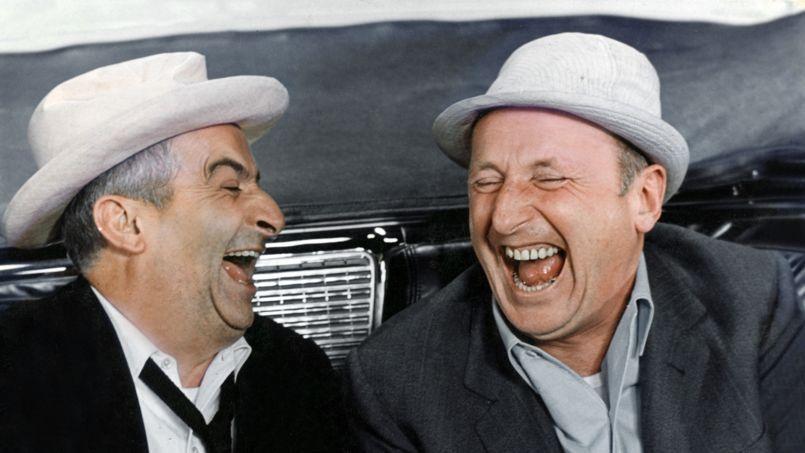
The Late Triumph of an Impatient Man
Born on July 31, 1914, in Courbevoie, near Paris, into a family of Spanish origin, Louis de Funès was not among those actors whose careers began with immediate success. Before becoming a star, he experienced modest jobs, cabaret performances, piano playing, and minor film roles that offered more opportunities for survival than for glory.
His musical training played an essential part in shaping his craft. As a jazz pianist, he developed an instinctive understanding of rhythm, silence, acceleration, and sudden changes of tempo. That discipline would become central to his acting. A Louis de Funès scene sometimes resembles a musical score: the body sets the rhythm, the face introduces variations, and the voice erupts like an instrument that has suddenly escaped control.
Recognition came relatively late. After numerous supporting appearances, the 1960s finally brought the leading roles that transformed his career. Pouic-Pouic in 1963, followed by Le Gendarme de Saint-Tropez and Fantômas in 1964, established a screen personality that audiences could recognize instantly.
He was approaching fifty.
The contrast between his long apprenticeship and his sudden fame may explain part of his originality. De Funès did not encounter success with the carefree confidence of a young newcomer. He reached the summit after years of observing human behavior, its contradictions, weaknesses, and absurdities.
His comedy seemed to have been built through the patient study of other people.
A France That Commands and Obeys
The characters portrayed by Louis de Funès share one defining characteristic: they almost always want to control something.
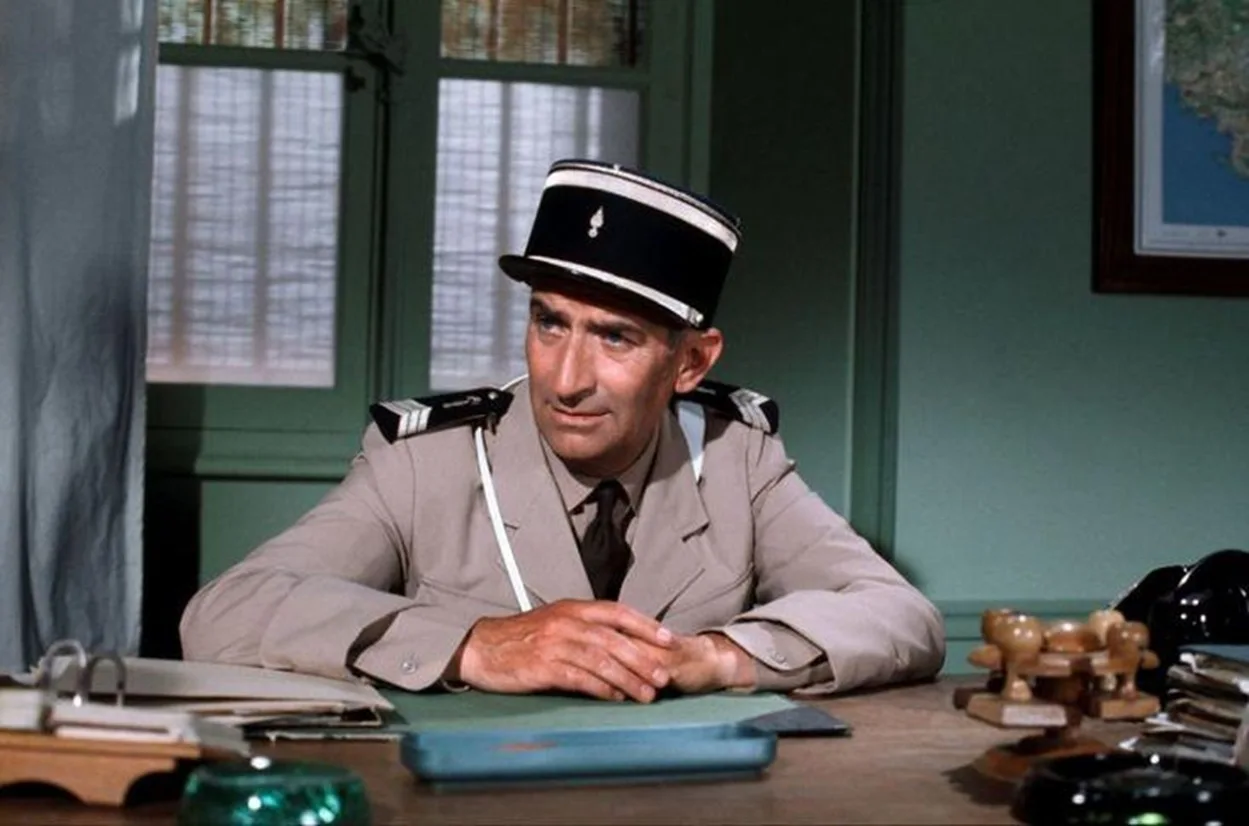
Gendarme Ludovic Cruchot seeks to impose discipline. The industrialist or businessman guards his interests. The bourgeois protects his social standing. The employer demands obedience. The wealthy property owner fears losing his money, influence, or reputation.
All are driven by the same anxiety: the possibility that the world might escape their authority.
In Le Gendarme de Saint-Tropez, this obsession takes the form of an administrative hierarchy pushed to the point of absurdity. Cruchot commands those beneath him while displaying extraordinary submission toward his superiors. His conception of order changes according to his position within the chain of command.
The caricature works because it rests on a perfectly recognizable social behavior: severity toward the weak and deference toward the powerful.
This mechanism extends far beyond the police force. It can be found in businesses, families, institutions, and relationships between social classes.
De Funès thus embodies a particular kind of petty authority: the individual who does not necessarily possess real power but clings desperately to whatever fragments of it have been entrusted to him.
He is not the representative of any specific political system. His characters are more universal. They belong to that part of humanity which readily confuses respect with submission, responsibility with domination, and dignity with prestige.
Audiences recognize the overbearing manager, the authoritarian neighbor, the tyrannical employer, or the father incapable of accepting disagreement.
Sometimes, they also recognize something of themselves.
Money, Another French Obsession
Money occupies a remarkable place in the cinematic universe of Louis de Funès.
In La Folie des grandeurs, directed by Gérard Oury in 1971, Don Salluste embodies a greed that knows no limits. His wealth and social position are never sufficient to satisfy his desire for accumulation. Money ceases to be an instrument and becomes an obsession governing his entire existence.
The character belongs to a much older tradition, that of classical comedy and the satire of the powerful. He extends, in his own way, the familiar figures of the miser, the courtier, and the pretentious bourgeois.
This connection becomes explicit in 1980, when Louis de Funès brings Molière's The Miser to the screen, co-directing the adaptation with Jean Girault. Harpagon seems to join naturally the gallery of characters he had portrayed over the previous two decades.
The continuity is striking.
For Molière as for de Funès, miserliness is not merely an individual weakness. It reveals a relationship with the world in which human beings become secondary to possessions.
In Le Tatoué (The Tattoo), released in 1968, the art dealer Félicien Mézeray takes this logic to an extreme by attempting to acquire a work of art tattooed onto another man's body. Market value collides with personal dignity, and the comedy emerges from the impossibility of transforming everything into property.
These films accompanied a France that was growing wealthier, consuming more, and discovering new forms of social distinction during the postwar economic boom.
De Funès' cinema does not systematically condemn wealth. Instead, it exposes the absurdities that arise when money becomes the sole organizing principle of human existence.
The Body Against Social Conventions
An essential part of Louis de Funès' genius lies in his physical language.
His eyes, eyebrows, shoulders, hands, and movements sometimes seem to lead independent lives. His face can shift from flattery to fury, from satisfaction to panic, without a single word being spoken.
This physical comedy belongs to a tradition connecting boulevard theatre, pantomime, silent slapstick, and situational comedy.
But de Funès introduces a distinctive element: his characters' bodies constantly betray their intentions.
When they try to appear dignified, they become grotesque. When they claim to control events, their gestures reveal panic. When they attempt to inspire respect, their agitation destroys every trace of authority.
At the heart of this comedy lies a fundamental contradiction between the social image they wish to project and their inner reality.
Laughter emerges from that rupture.
His experience as a musician allowed him to organize these explosions with almost choreographic precision. An outburst might begin with silence, continue through a glance, and then erupt into a succession of gestures and words whose acceleration appears uncontrollable.
Yet it never truly is.
The visible excess rests upon invisible discipline. 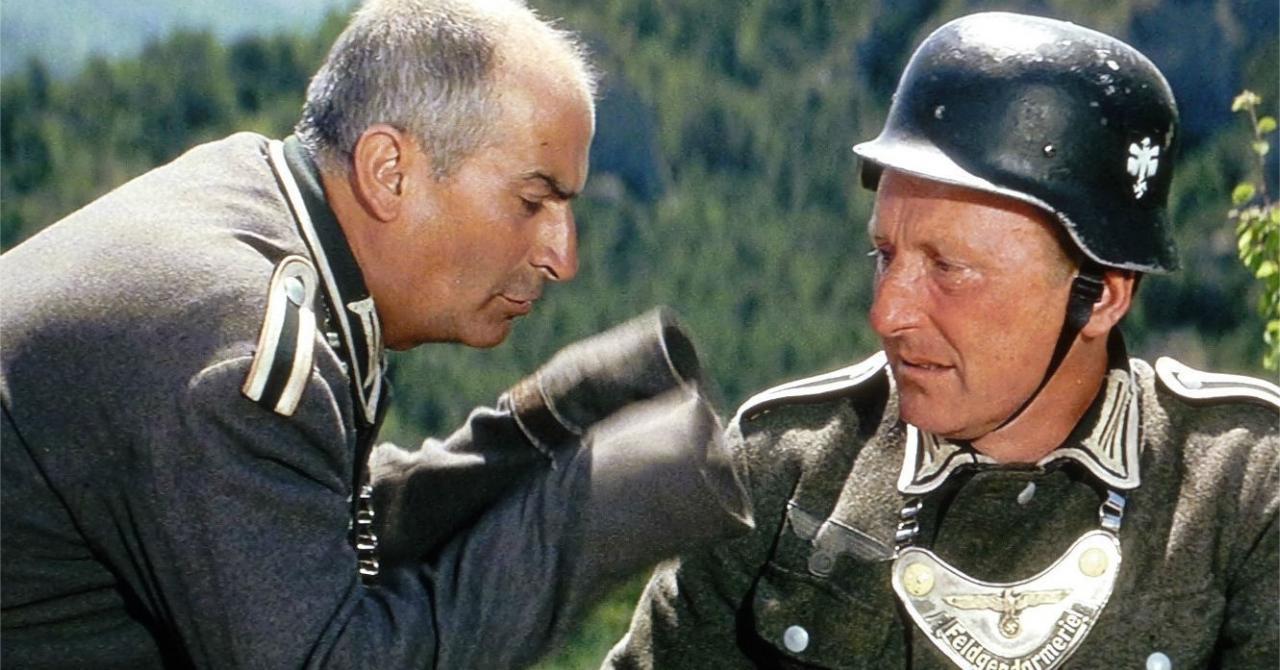
Popular Cinema as Collective Memory
The cultural importance of Louis de Funès cannot be explained solely by the quality of his performances. It also rests on the extraordinary scale of their circulation.
According to the Musée Louis de Funès, the actor appeared in more than 140 films and accumulated over 270 million cinema admissions. These figures reflect a presence extending far beyond individual success.
La Grande Vadrouille, released in 1966, attracted more than 17 million spectators in France alone. It became a national phenomenon and remained a benchmark of popular box-office success for decades.
Alongside Bourvil, Louis de Funès formed a comic partnership built on the opposition of two temperaments. One was nervous, authoritarian, and suspicious; the other appeared more accommodating, spontaneous, and almost disarmingly ordinary.
Their encounter transformed differences of character into a shared cultural language.
But La Grande Vadrouille also possesses a historical dimension. By placing comedy in German-occupied France, Gérard Oury constructed a narrative in which ordinary French citizens become involved in an adventure far beyond their control.
The war becomes the setting for a comic reconciliation, without the film attempting to capture the full complexity of the Occupation.
The success of the partnership reveals the ability of popular cinema to shape collective representations of the past.
Through these characters, spectators were not merely watching a story. They were rediscovering a particular image of their country, its contradictions, and its capacity to laugh at itself.
Rabbi Jacob, or Laughter Against Prejudice
In 1973, Les Aventures de Rabbi Jacob (The Mad Adventures of Rabbi Jacob) marked a distinctive moment in Louis de Funès' career.
Gérard Oury cast him as Victor Pivert, an authoritarian French industrialist, racist and deeply entrenched in his prejudices. Through a succession of increasingly absurd circumstances, the character is forced to assume an identity that overturns his certainties.
The comic device is familiar: placing a character in a situation that directly contradicts his convictions.
But the subject goes beyond the mechanics of disguise.
In a France increasingly confronted with debates over immigration, religious identities, and relations between communities, the film uses laughter to expose the absurdity of prejudice.
Victor Pivert does not suddenly become an enlightened man. He begins as a bourgeois imprisoned by his reflexes, unable to understand a world that does not correspond to his habits.
His transformation comes through the experience of disorder.
The film is not a philosophical treatise on tolerance, and some of its representations inevitably reflect the conventions of their time. Nevertheless, it reveals an unusual ambition: to turn popular comedy into a space where established assumptions about identity can be challenged.
Louis de Funès demonstrates that his familiar screen persona, so often associated with authority and social conservatism, can also become an instrument for criticizing those very attitudes.
A Popularity Without Real Equivalent
The immense popularity of Louis de Funès was not immediately accompanied by the same critical recognition granted to major figures of auteur cinema.
The contrast reveals a cultural hierarchy long present in France, where commercial success and artistic legitimacy have not always been regarded as compatible.
Comic actors are readily celebrated for their ability to entertain, but less frequently examined for their contribution to understanding an era.
De Funès occupies precisely this ambiguous space.
His films attracted millions of spectators, his characters became familiar to successive generations, yet his performances were sometimes reduced to a succession of grimaces and temper tantrums.
Such a reading overlooks the technical sophistication of an actor capable of transforming ordinary human behavior into instantly recognizable archetypes.
In 1980, he received an honorary César Award for his career. Four decades later, the Cinémathèque française devoted a major exhibition to him, held between 2020 and 2021, acknowledging his place in cinema history.
This belated recognition reminds us that popular culture is not necessarily a lesser form of culture.
It may constitute one of the most faithful archives of collective sensibilities.
What Remains When the Laughter Fades
Louis de Funès died on January 27, 1983, at the age of sixty-eight.
The France he had so often portrayed was already changing. The postwar economic boom had ended, traditional hierarchies were being challenged, and the economy was entering a period of profound transformation.
Yet his characters retain a remarkable familiarity.
Technologies have evolved, corporations have expanded, and forms of authority have changed. But the behaviors he caricatured have not disappeared.
The manager who confuses authority with competence, the wealthy man who mistakes fortune for superiority, the bureaucrat devoted to his regulations, the bourgeois terrified of losing social status: all continue to inhabit contemporary societies in different forms.
Perhaps this is where the true longevity of his work lies.
Louis de Funès did not merely invent a comic persona. He gave a face, a rhythm, and a voice to some of the enduring contradictions of social life.
His cinema was not always subtle in its situations, but it could be extraordinarily subtle in its observation of human nature.
He understood that a society sometimes reveals itself more clearly through its absurdities than through its grand speeches.
And that, to expose the ridiculous nature of power, one need only let it lose its temper.
Main Sources
- Cinémathèque française — Louis de Funès, exhibition, July 15, 2020 – May 31, 2021. https://www.cinematheque.fr/exposition/louis-de-funes.html
- Centre national du cinéma et de l'image animée (CNC) — L'image de la semaine : les 105 ans de la naissance de Louis de Funès, August 2, 2019. https://www.cnc.fr/cinema/actualites/limage-de-la-semaine--les-105-ans-de-la-naissance-de-louis-de-funes_1028873
- Musée Louis de Funès — Louis de Funès en chiffres. https://museedefunes.fr/carriere/
- Encyclopédie Larousse — Louis de Funès, biographical entry. https://www.larousse.fr/encyclopedie/personnage/Louis_de_Fun%C3%A8s/120556
- Films examined: Le Gendarme de Saint-Tropez (1964), La Grande Vadrouille (1966), Le Tatoué (1968), La Folie des grandeurs (1971), Les Aventures de Rabbi Jacob (1973), L'Avare (1980).
Atlas Limits Research Desk
Atlas Limits’ editorial and analytical desk.