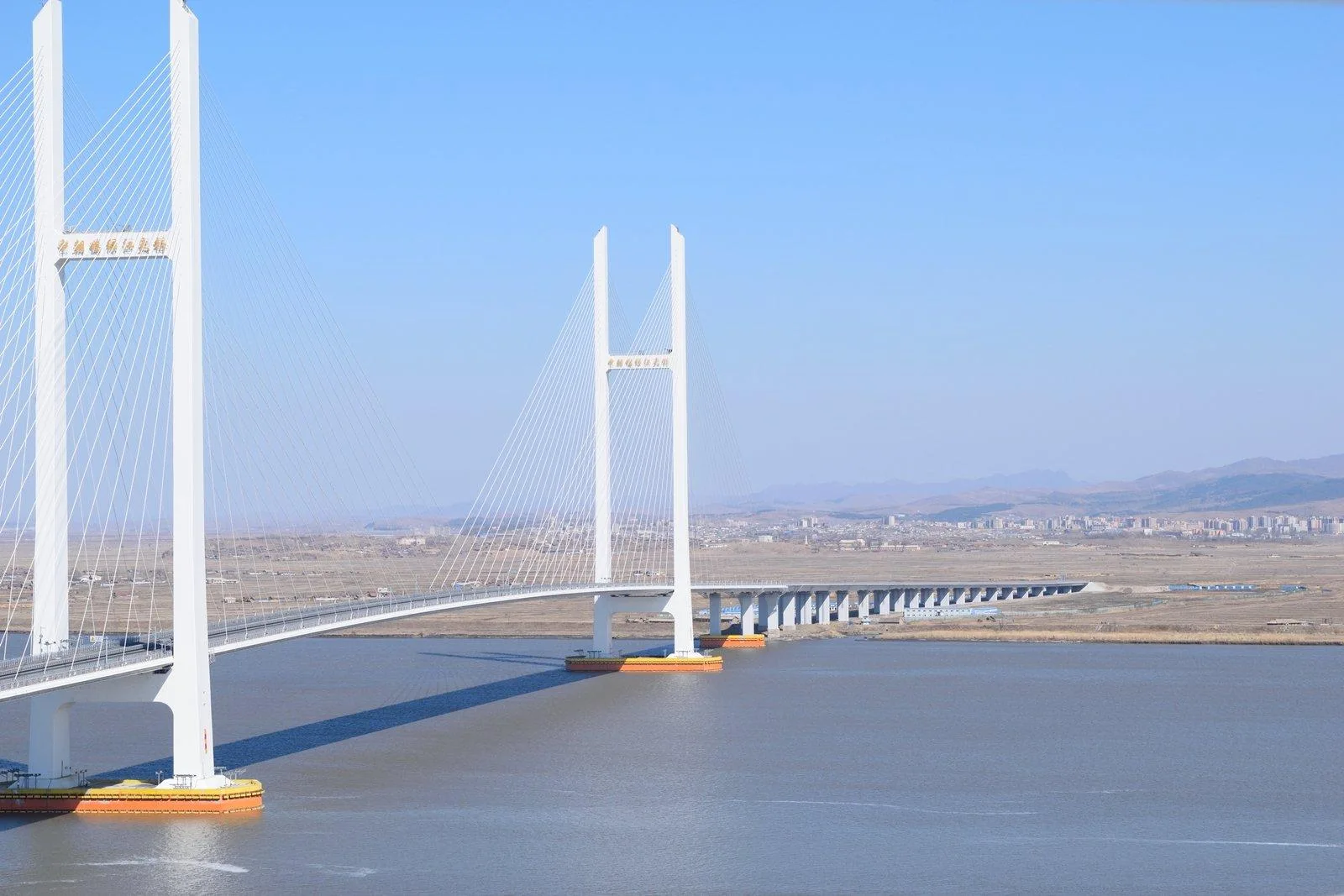
In Dandong, on the banks of the Yalu River, a bridge stretching more than three kilometres had waited twelve years to fulfil its purpose. Built to connect China and North Korea and completed in 2014, it had become a symbol of a border where infrastructure could advance faster than political decisions. Its opening on October 15, 2026, marks a new stage in economic relations between Beijing and Pyongyang. Behind this long-dormant road connection lies a deeper transformation: North Korea is seeking to expand its external trade while retaining strict control over the terms of its regional integration.
The New Yalu River Bridge connects Dandong, in China's Liaoning province, with Sinuiju, one of North Korea's principal economic gateways. Approximately 3,026 metres long and carrying four traffic lanes, the structure was designed to accommodate part of the commercial traffic traditionally concentrated on the older Sino-Korean Friendship Bridge. Built during Japan's colonial rule over the Korean Peninsula, that crossing has served as a vital artery of bilateral trade for decades, although its technical limitations constrain the movement of goods.
Construction of the new bridge was largely financed by Beijing, which sought to modernise transport links with its neighbour and support economic development in northeastern China. Yet despite completion of the main structure in 2014, regular traffic never materialised. Customs facilities and connecting roads on the North Korean side remained unfinished for years, while diplomatic tensions, international sanctions and pandemic-related restrictions further delayed the prospect of opening.
For more than a decade, the infrastructure embodied the contradictions of the Sino-North Korean relationship. China possessed the financial and industrial resources needed to expand cross-border commerce, but North Korea retained control over the pace at which it was prepared to strengthen its connections with the outside world.
A Border at the Centre of North Korea's Economy
The border between China and North Korea extends approximately 1,400 kilometres, largely following the Yalu and Tumen rivers. It represents the country's principal commercial gateway, far exceeding the importance of its other land borders. Since the 1990s, the North Korean economy has depended heavily on China for manufactured goods, industrial equipment, agricultural products and essential inputs for its infrastructure.
That dependence deepened as international sanctions restricted trade with other partners. Successive United Nations Security Council resolutions, adopted in response to North Korea's nuclear and ballistic missile programmes, have limited exports of coal, minerals, textiles and numerous other products. They have also imposed restrictions on certain equipment imports and financial transactions.
China nevertheless remains Pyongyang's dominant trading partner. According to Chinese customs figures reported for 2025, exports to North Korea reached approximately $2.3 billion, an increase of 25% from the previous year. This recovery reflects the restoration of commercial flows following the severe disruptions caused by North Korea's near-total border closure during the pandemic.
The bridge therefore opens at a time when Pyongyang's economic requirements are becoming increasingly apparent. Industrial equipment replacement, domestic market supplies and infrastructure development all require logistical capacity that existing crossings cannot always provide efficiently.
Additional road capacity could shorten delivery times, facilitate heavy-goods transport and improve customs operations. It does not, however, guarantee a sustained expansion of bilateral trade. Actual volumes will depend on North Korean authorisations, the composition of transported goods and the continued application of international restrictions.
China and North Korea's Growing Partnership with Russia
The inauguration also takes place against a changing diplomatic background. Since 2023, relations between North Korea and Russia have strengthened considerably, particularly in the military, industrial and strategic spheres. The signing of a comprehensive strategic partnership treaty in June 2024 gave this rapprochement a formal institutional foundation.
For Pyongyang, Moscow offers an additional source of diplomatic, technological and economic support. The relationship provides opportunities to reduce its political dependence on Beijing, although Russia's economic capacity and logistical constraints make it difficult to replace China's central commercial role.
Russia and North Korea have also pursued initiatives to reinforce railway, road and logistical connections. Infrastructure development around the Tumen River, near their short shared border, forms part of this broader reorganisation of regional transport networks.
Against this background, the opening of the Dandong–Sinuiju bridge carries strategic significance for Beijing. China retains an overwhelmingly dominant economic position in North Korea, but that position does not guarantee exclusive political influence. Stronger relations between Moscow and Pyongyang introduce another major partner into North Korea's strategic calculations.
The opening cannot be presented as a demonstrable direct response to the Russian–North Korean rapprochement. The project predates the latest phase of their relationship by more than a decade. Nevertheless, its entry into service acquires additional significance in the current geopolitical environment, reinforcing an economic connection through which Beijing maintains substantial influence while Pyongyang retains operational control.
China's interests extend beyond bilateral trade. Stability in North Korea reduces the risks of disruption along its northeastern frontier, while commercial exchanges support economic activity in Liaoning, a province historically shaped by the restructuring of heavy industry. Beijing also has an interest in preventing changes in regional partnerships from diminishing its ability to influence developments on the Korean Peninsula.
Economic Connectivity Without Political Liberalisation
A defining feature of the North Korean economic model is its ability to develop selected commercial relationships without undertaking a broader liberalisation of its economy. Trade with China does not operate through a fully open border market. It remains embedded in a system where authorised enterprises, state institutions and security authorities play decisive roles.
Modern infrastructure therefore does not necessarily change the institutional character of the border. A four-lane bridge can increase physical transport capacity while remaining subject to quotas, administrative authorisations and strict inspection procedures.
This distinction is essential when assessing the significance of the opening. The bridge's theoretical capacity should not be confused with the volume of trade that will actually cross it. The relevant indicators will be the frequency of vehicle movements, the composition of cargo, the development of customs operations and the integration of the new corridor into North Korea's domestic distribution networks.
International sanctions remain equally important. United Nations Security Council resolutions continue to regulate trade with North Korea, even as disagreements among major powers have complicated their enforcement. Opening a new road connection does not suspend those obligations. It creates additional logistical capacity whose use must still comply with restrictions affecting specific goods, companies and financial transactions.
The distinction between connectivity and economic integration is fundamental. Connectivity depends on the availability of infrastructure. Integration requires commercial rules, financial mechanisms and political decisions that allow goods to circulate in practice.
Dandong and the Economics of a Continental Gateway
For Dandong, the new bridge could also transform the organisation of local commercial activity. Located in eastern Liaoning, the city has long occupied a distinctive position in economic relations between China and North Korea. Its transport companies, warehouses, trading intermediaries and customs facilities form an important part of the border economy.
A modern road connection could support the development of logistics services, improve the separation of freight and other traffic, and strengthen the attractiveness of commercial facilities near the crossing.
These opportunities nevertheless depend on actual traffic growth. Investment in warehouses, distribution platforms and transport services becomes economically sustainable only when commercial volumes are sufficiently regular to justify operating costs.
The experience of the previous twelve years demonstrates the limits of an infrastructure-led approach. China had built a modern bridge, but it could not unilaterally determine when the crossing would become operational. The timetable depended on a partner whose political and security priorities did not always align with Chinese economic objectives.
That asymmetry persists. Beijing possesses investment capacity and industrial resources vastly exceeding those of Pyongyang, yet North Korea exercises decisive authority over access to its territory.
The relationship is therefore not simply one of economic dominance. It also involves a smaller state using control over its borders to preserve a degree of autonomy in its dealings with a much larger neighbour.
A Changing Geography of Dependence
Across Northeast Asia, the new bridge forms part of a gradual transformation of continental transport corridors. China seeks to preserve its connections with the Korean Peninsula, Russia is expanding its relationships across the Asian Far East, and North Korea is attempting to make greater use of its geographical position between the two powers.
This configuration does not yet constitute an integrated economic region. Sanctions, contrasting political systems, uneven infrastructure and restrictions on cross-border movement substantially limit its development. Nevertheless, it illustrates the strategic importance of overland connections in regional economic relationships.
For North Korea, maintaining several partners and transport corridors offers advantages beyond reducing freight costs. Diversification can increase its negotiating flexibility, secure certain supplies and limit the consequences of disruptions at individual border crossings.
It does not eliminate structural dependence. China's industrial proximity, market depth and extensive logistics networks give it advantages that Russia cannot easily reproduce. Expanding transport connections may therefore alter the management of North Korea's external dependence without fundamentally transforming its underlying structure.
The Dandong bridge illustrates this tension. Conceived as an instrument of commercial development, it has also become part of a regional political geography in which roads, customs posts and freight capacity influence relations between states.
For twelve years, the structure stood between two territories without performing the function for which it had been built. Its opening ends that physical anomaly, but it does not resolve the contradictions that produced it. North Korea is accepting an additional connection with its principal economic partner without abandoning the mechanisms of control that define its relationship with the outside world.
The significance of the new corridor will ultimately be measured less by the length of its roadway than by the regularity of the trade it carries. Between Dandong and Sinuiju, construction was completed in 2014. It took another twelve years for the infrastructure to become a commercial route. In this part of the world, the distance between two economies is measured not only in kilometres, but also in the political time required to bring them closer together.
Main Sources
- Reuters, October 15, 2026 — Reporting on the opening of the new China–North Korea bridge and the recovery of cross-border trade.
- Yonhap News Agency, October 15, 2026 — Coverage of the Dandong–Sinuiju crossing entering service.
- 38 North, September 2026 — Signs of Life at New Sinuiju–Dandong Crossing, monitoring developments at the border crossing.
- General Administration of Customs of China — Bilateral trade statistics between China and North Korea.
- United Nations Security Council — Resolutions governing sanctions on the Democratic People's Republic of Korea.
- Russian Ministry of Foreign Affairs — Comprehensive Strategic Partnership Treaty between Russia and North Korea, June 2024.
Atlas Limits Research Desk
Atlas Limits’ editorial and analytical desk.