The technological competition between China and the United States is increasingly being fought not only through industrial infrastructure but also through the financial mechanisms that enable its development. Long associated with public subsidies, industrial planning and investment in manufacturing capacity, China's pursuit of technological sovereignty is increasingly drawing on capital markets. The trading session of November 27, 2026, offers a particularly striking illustration of this transformation.
Following a State Council meeting chaired by Premier Li Qiang, Beijing announced stronger measures to stabilize financial markets, triggering a spectacular rally across Chinese equity indices. The Shanghai Composite gained 3.73%, the Shenzhen Component rose 7.24% and the ChiNext advanced 11.61%, while the STAR 50, which tracks fifty leading companies listed on Shanghai's technology-focused market, surged 15.07%. Combined trading turnover in Shanghai and Shenzhen approached RMB 2 trillion, an increase of nearly 52% compared with the previous session.
Beyond the magnitude of the rally, its sectoral composition reveals the expectations increasingly shaping the allocation of Chinese capital. Data observed through Atlas Markets show a remarkable concentration of Asia's strongest equity gains in semiconductors, manufacturing equipment and computing infrastructure. Investors were not merely repricing technology companies. They were simultaneously reassessing several segments of an industrial value chain whose development has become one of Beijing's foremost strategic priorities. 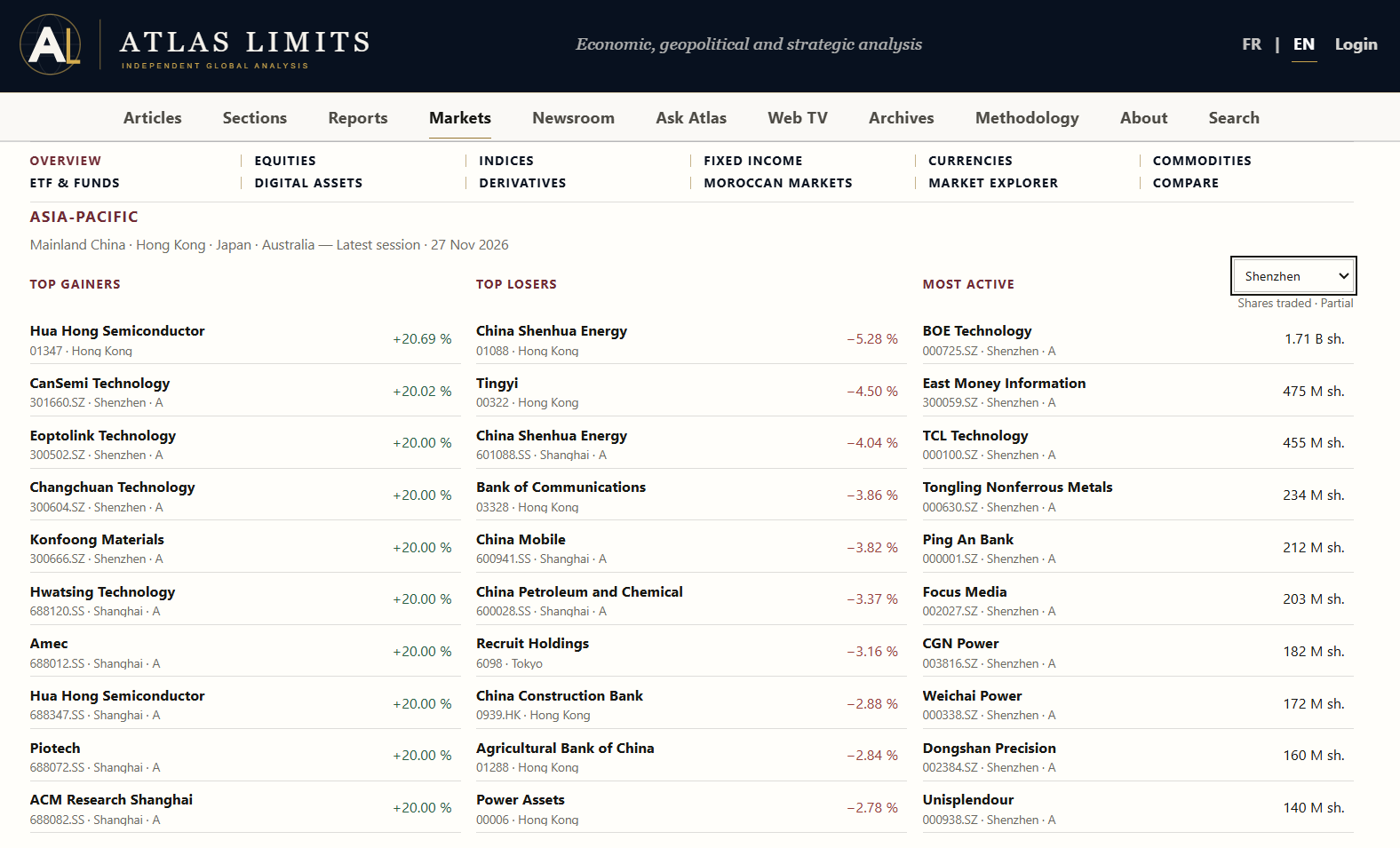
Mobilizing Capital Markets
The Chinese government's intervention comes against a backdrop of prolonged pressure on equity valuations, driven by trade uncertainties, US technology restrictions and questions surrounding the profitability of artificial intelligence investments.
The State Council intends to strengthen the role of Central Huijin Investment, a subsidiary of the sovereign wealth fund China Investment Corporation, in stabilizing financial markets. The institution occupies a central position within China's so-called national team, a group of state-backed financial entities capable of intervening in equity markets, notably through purchases of shares and exchange-traded funds.
The authorities also seek to encourage share buybacks and dividend distributions while facilitating long-term investment by insurance companies, corporate pension schemes and social security funds.
According to figures reported by the Chinese government, net subscriptions to equity ETFs since the beginning of October approached RMB 800 billion, while share repurchases and increases in shareholdings by listed companies and their shareholders amounted to nearly RMB 60 billion.
These figures do not represent exclusively public financing or investment in technology companies. They nevertheless illustrate the growing importance of financial stability within China's broader economic strategy.
Preserving equity valuations is not simply a matter of protecting investor wealth. It also contributes to maintaining financing conditions compatible with the country's industrial ambitions, particularly in sectors characterized by substantial capital requirements and extended investment horizons.
The Repricing of an Industrial Value Chain
The composition of the November 27 rally is particularly revealing. Companies recording some of the strongest gains included Hua Hong Semiconductor, Eoptolink Technology, Piotech, Hwatsing Technology and ACM Research Shanghai.
Hua Hong operates in semiconductor manufacturing, while Piotech develops equipment used to deposit thin films onto silicon wafers. Hwatsing Technology specializes in chemical mechanical planarization, a critical process in integrated circuit manufacturing, and ACM Research Shanghai produces wafer processing and cleaning equipment. Eoptolink, meanwhile, operates in high-speed optical transmission technologies used across digital infrastructure.
Other companies, including SMIC, AMEC, Changchuan Technology and Konfoong Materials, illustrate the breadth of industrial capabilities China is seeking to develop, from materials and manufacturing equipment to semiconductor fabrication and testing.
This diversity is essential to understanding the nature of China's technological ambitions. Technological autonomy cannot be reduced to the ability to design a processor capable of competing with American products. It also requires access to the equipment, materials, software and expertise necessary to manufacture such processors under economically sustainable conditions.
Dependence on a foreign supplier for even a single critical process can undermine the competitiveness of an entire value chain. Control over manufacturing equipment therefore becomes as strategically important as control over the components it enables companies to produce.
The numerous gains approaching 20% recorded during the session must, however, be interpreted in light of Chinese market regulations. Daily price movements on Shanghai's STAR Market and Shenzhen's ChiNext are generally capped at 20%. When several stocks simultaneously reach this limit, observed prices can no longer fully capture the extent of buying pressure beyond the regulatory threshold.
The phenomenon indicates substantial demand for these securities without necessarily establishing the underlying economic value of the companies concerned.
From Public Financing to the Mobilization of National Capital
China's semiconductor financing strategy reached a decisive milestone in 2014 with the establishment of the China Integrated Circuit Industry Investment Fund, commonly known as the Big Fund.
Its first phase had registered capital of RMB 138.7 billion. The second phase, launched in 2019, increased this figure to RMB 204.2 billion. In May 2024, the establishment of a third phase with registered capital of RMB 344 billion, equivalent to approximately $47.5 billion at the time of its launch, confirmed the growing scale of the initiative.
Together, the three phases represent more than RMB 686 billion in registered capital. Although this figure should not be confused with capital actually deployed, it provides a measure of the financial resources mobilized to support the industry.
Six major Chinese state-owned banks announced combined commitments of RMB 114 billion to the third fund, accounting for nearly one-third of its registered capital. The participation of the banking system alongside public investment institutions demonstrates how semiconductor development has become embedded within the capital allocation strategies of China's largest financial institutions.
The qualitative evolution of the initiative is as important as the increase in committed resources. While earlier interventions helped expand domestic manufacturing capacity, priorities have progressively broadened to include industrial equipment, materials, memory technologies and other capabilities required to reduce external dependencies.
China is no longer simply seeking to finance factories. It is attempting to establish a financial environment capable of supporting the long-term development of an entire domestic technology ecosystem.
Technological Sovereignty as a Financial Asset
The financialization of technological sovereignty emerges from the convergence of public investment instruments and the valuation mechanisms of capital markets.
When a company is identified as a potential domestic supplier of technologies previously imported from abroad, its valuation may incorporate not only its current financial performance but also the growth prospects associated with industrial substitution, future orders and government support.
Control over a strategic technology consequently acquires a financial value extending beyond the revenue immediately generated by its commercial exploitation.
This mechanism has significant implications for companies. A higher market capitalization can facilitate equity issuance, reduce the relative dilution of existing shareholders when raising new capital, support share-based acquisitions and strengthen the ability to attract and retain scientific and engineering talent.
An increase in share prices does not, in itself, constitute an injection of capital into a company. Secondary-market transactions primarily involve transfers of ownership between investors. However, when valuations remain elevated and liquidity is sufficient, they can improve the conditions under which companies subsequently access new financial resources.
This distinction is fundamental. Secondary markets do not directly finance a new factory every time share prices rise, but they help shape the financial environment in which such investments can be undertaken.
The establishment of the STAR Market in 2019 reflected precisely this ambition to develop a capital market better suited to science and technology companies, whose financing requirements and profitability profiles differ substantially from those of traditional industries.
For Beijing, the objective is to establish a system in which public investment funds, banks, institutional investors, private equity and stock markets participate at different stages of industrial development, from research to large-scale commercialization. 
US Restrictions and the Value of Technological Substitution
Since October 2022, the United States has progressively tightened restrictions on China's access to advanced computing technologies and the equipment required to manufacture next-generation semiconductors.
In December 2024, the US Department of Commerce's Bureau of Industry and Security extended its export controls to 24 categories of semiconductor manufacturing equipment, three categories of software tools and certain high-bandwidth memory products.
These measures are intended to restrict China's access to technologies that Washington considers capable of contributing to the modernization of its military and strategic capabilities. They also alter the economic environment in which Chinese technology suppliers operate.
When access to a foreign technology becomes uncertain, the existence of a technically viable domestic alternative creates a potential growth opportunity for local companies. Restrictions can therefore accelerate substitution efforts, encourage the industrial qualification of new suppliers and strengthen growth expectations across certain segments of the value chain.
Technological competition consequently introduces a geopolitical dimension into the valuation of industrial assets.
A Chinese equipment manufacturer is no longer assessed solely on the basis of its current competitiveness. Its valuation may also reflect its potential ability to replace a foreign technology that has become increasingly difficult to access. The economic value of this opportunity nevertheless depends on actual scientific progress, equipment performance and adoption by industrial customers.
A protected domestic market can facilitate the emergence of new companies. It guarantees neither their international competitiveness nor their ability to match the technological standards established by leading global suppliers.
Artificial Intelligence as an Investment Accelerator
The development of artificial intelligence is amplifying the capital requirements of China's technology industry. Training and deploying AI models requires processors, memory, transmission infrastructure, storage capacity, cooling systems and electricity networks capable of accommodating growing demand.
This transformation extends well beyond the market for computing accelerators. It is reshaping the entire industrial ecosystem responsible for their production, interconnection and operation.
The strong performance of companies specializing in manufacturing equipment and optical communications illustrates how the economic value generated by artificial intelligence is spreading towards activities that have historically received less attention than processor design.
For China, developing these capabilities serves a dual purpose. It must support the expansion of the domestic digital economy while reducing the vulnerability of national infrastructure to foreign regulatory decisions.
Capital mobilization is therefore becoming a component of technological security. It must sustain research programs and industrial investments characterized by high costs, uncertain outcomes and development timelines that may be incompatible with demands for immediate profitability.
Two Financial Architectures of Technological Power
The competition between China and the United States also reflects differences between two financial architectures for supporting innovation.
In the United States, venture capital, equity markets, major institutional investors and the internal financing capacity of multinational technology companies play a decisive role in selecting and developing technologies. The government nevertheless remains a substantial participant through publicly funded research, defense procurement, tax incentives and industrial policy.
In China, the authorities possess a more direct capacity to coordinate public financing, the banking system and national industrial objectives. Capital markets complement this architecture by mobilizing domestic savings and enabling companies to benefit from valuations reflecting their anticipated growth.
The distinction between the two systems is therefore not an absolute opposition between markets and the state. Rather, it concerns the mechanisms through which capital is coordinated, investments are selected and risks are distributed between public and private actors.
The American model benefits from the depth of its financial markets, the ability of its companies to attract international capital and the competitiveness of its innovation ecosystem.
The Chinese model relies more heavily on its capacity to mobilize substantial resources around long-term industrial objectives, including in circumstances where commercial returns remain uncertain.
In both cases, technological power ultimately depends on the ability to transform financial resources into scientific expertise, productive infrastructure and industrial assets capable of sustaining long-term competitiveness.
The Limits of Financialization
The November 27 trading session should not obscure the difficulties that continue to confront Chinese financial markets. Despite the magnitude of the rally, the ChiNext remained down nearly 24% since the beginning of the year, while the Hang Seng Tech Index was still recording a decline of approximately 34%.
These figures serve as a reminder that public capital mobilization alone cannot resolve uncertainties surrounding corporate growth, profitability or the strength of domestic demand.
The financialization of technological sovereignty also carries risks of its own. When investors anticipate sustained government support, valuations may become disconnected from economic fundamentals. Companies benefiting from a strategic positioning may attract capital disproportionate to their actual capabilities, while the proliferation of industrial projects can generate excess capacity and deteriorating investment returns.
The earlier phases of the Big Fund have themselves exposed the difficulties associated with allocating substantial financial resources in an environment characterized by considerable technological uncertainty. Project selection, governance quality and financial discipline remain decisive, regardless of the strategic importance of the industries concerned.
Capital can finance infrastructure, extend research programs and support the recruitment of skilled professionals. It cannot, by itself, guarantee a scientific breakthrough, mastery of a complex manufacturing process or the establishment of a sustainable competitive advantage.
China's challenge is therefore to mobilize sufficient capital to accelerate technological development without weakening the economic mechanisms that distinguish productive investments from commercially unviable projects.
Capital as an Infrastructure of Sovereignty
The transformation underway in China reveals a broader evolution in international competition. Technological sovereignty no longer depends exclusively on scientific knowledge, access to natural resources or control over industrial capacity. It also requires a financial architecture capable of sustaining these assets over time.
In an industry where successive generations of technology emerge rapidly, investments must often be renewed before previous ones have reached their full economic potential. The ability to absorb failures, finance research and redeploy resources becomes an essential condition of competitiveness.
China is seeking to integrate this financial dimension into the foundations of its sovereignty strategy. By combining state instruments with capital market mechanisms, Beijing is attempting to construct an environment in which industrial ambitions can be sustained beyond economic and financial cycles.
The November 27 trading session does not mark the culmination of this strategy. It nevertheless reveals the extent to which financial expectations have become intertwined with the country's technological development prospects.
In the competition between major powers, control over critical technologies will depend as much on the ability to invent and manufacture them as on the capacity to finance their continuous renewal. Capital, in this respect, is becoming an infrastructure of sovereignty in its own right.
Atlas Limits Research Desk
Atlas Limits’ editorial and analytical desk.