Space exploration was long the preserve of governments, major public programmes and industrial conglomerates. The emergence of commercial constellations, the expanding military applications of low Earth orbit and the industrialisation of satellite manufacturing are now transforming the sector’s ownership structures. Private equity is no longer merely financing emerging space companies. It is acquiring the industrial infrastructure that determines their production capabilities.
On 24 November 2026, Cerberus Capital Management announced an agreement to acquire the US satellite manufacturing operations of Airbus U.S. Space & Defense. The transaction is expected to close before the end of the year, subject to customary closing conditions. Financial terms have not been disclosed.
Behind this divestiture lies a deeper transformation in the political economy of space. The nationality of capital, control over supply chains and the ability to finance industrial infrastructure are becoming instruments of sovereignty in their own right, alongside the technologies themselves.
Industrial Infrastructure at the Heart of the Orbital Economy
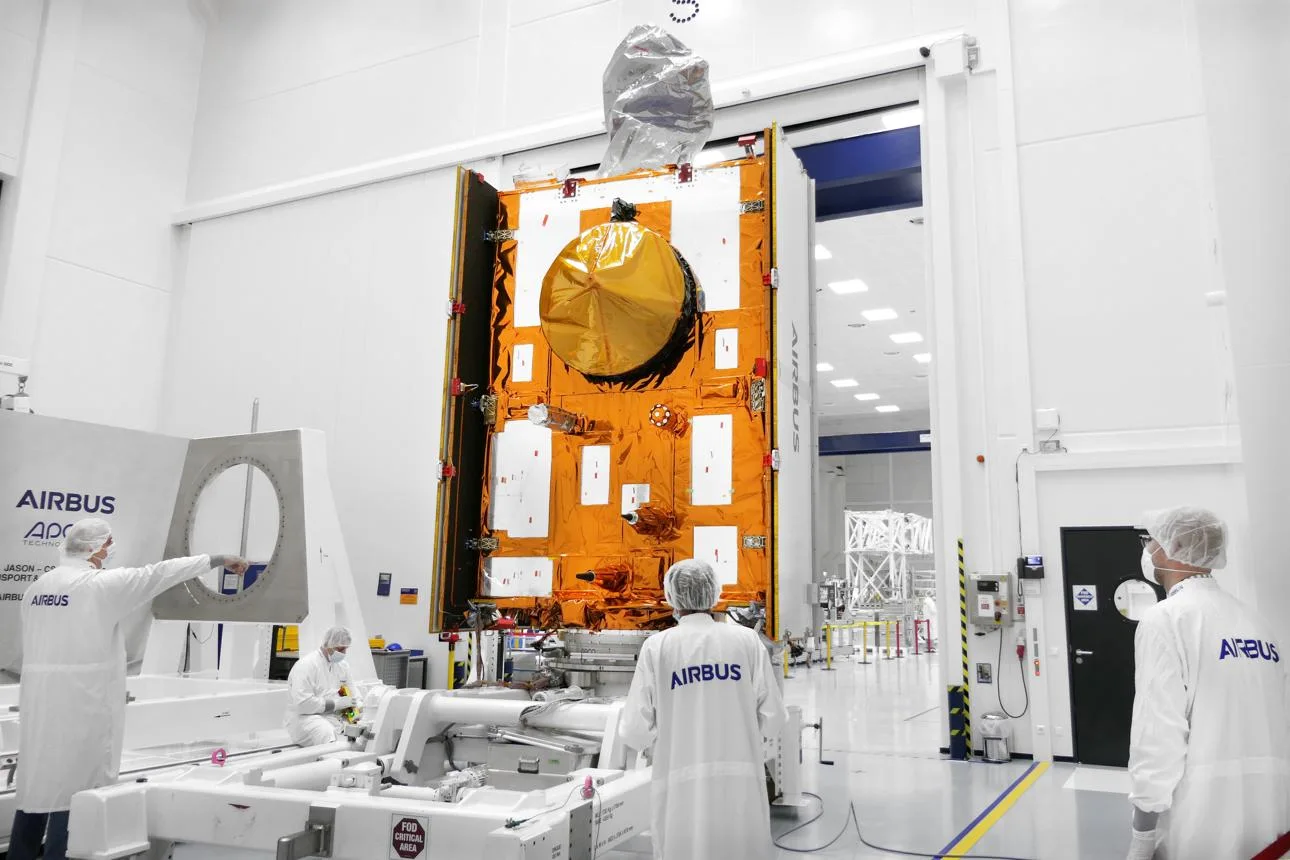
Located in Merritt Island, Florida, near the Kennedy Space Center, the business being acquired operates a manufacturing facility covering approximately 18,600 square metres and has contributed to the production of more than 650 satellites. Its origins lie in the joint venture established in 2016 between Airbus and OneWeb to industrialise satellite manufacturing for low Earth orbit constellations.
The initiative marked a departure from traditional space industry practices. Whereas individual satellites had historically been complex, expensive and largely bespoke systems, constellations required standardisation, reproducibility and serial production.
The Florida facility achieved a production rate of two satellites per day for OneWeb’s first-generation constellation. The space industry was beginning to adopt manufacturing methods associated with the automotive and mass-market electronics sectors, while retaining the stringent reliability requirements of orbital equipment.
Airbus consolidated its control over the facility in January 2024 by acquiring the 50% stake held by Eutelsat OneWeb. Its annual report recorded a €51 million remeasurement gain on its existing interest and final goodwill of €83 million, reflecting the anticipated economic synergies of the integration.
Less than three years later, the European group has decided to divest the business.
This succession of transactions illustrates how rapidly the strategic value of space assets can evolve. An industrial facility may retain its expertise, equipment and technological potential while becoming less relevant to its owner’s broader portfolio.
Airbus and the Geography of Consolidation
Airbus’s decision does not represent a general withdrawal from the space sector. On the contrary, it comes amid a broader restructuring of its operations, marked by the proposed combination of its satellite activities with those of Thales and Leonardo.
The historical fragmentation of European industry, long organised around national champions and separate institutional programmes, is becoming increasingly difficult to reconcile with the economies of scale pursued by emerging American competitors.
Airbus is simultaneously continuing the manufacture of next-generation satellites for Eutelsat OneWeb at its facilities in Toulouse. The shift of orders towards France alters the economic prospects of the American facility, whose original business model relied heavily on demand from the OneWeb constellation.
Airbus’s US subsidiary now intends to concentrate its resources on aviation and the development of autonomous systems capabilities, while the group pursues its broader European space consolidation strategy.
This reallocation of capital reflects growing geographical specialisation. European operations are consolidating around the need to achieve critical industrial mass, while sensitive American assets are moving towards ownership structures more firmly embedded in the domestic defence ecosystem.
The internationalisation of production chains has not disappeared. It is increasingly being reshaped by the strategic segmentation of industrial activities and their ownership.
Cerberus and the Financialisation of Industrial Sovereignty
With approximately $74 billion in assets under management at the time of the announcement, Cerberus possesses investment capabilities extending well beyond those of a fund specialising exclusively in space technology.
Its strategy combines private equity, credit and real estate investments with targeted investments in sectors considered essential to American economic and industrial resilience.
Established in 2022, its Cerberus Supply Chain platform has completed more than twenty investments across industries including aerospace, defence, semiconductors, critical minerals, energy, telecommunications and manufacturing.
The acquisition of Airbus’s satellite manufacturing operations fits within this broader strategy. Cerberus is not simply seeking financial exposure to the growth of the space market. The firm intends to develop an independent manufacturer capable of serving multiple civilian and military customers without being directly owned by one of the sector’s major prime contractors.
Such industrial independence may constitute a commercial advantage. Major defence groups can simultaneously be customers, suppliers and potential competitors. A satellite platform manufacturer possessing a degree of commercial neutrality may expand its addressable market and establish an intermediary position across several value chains.
Cerberus has already established positions within this ecosystem, notably through Stratolaunch, aerospace engineering company Vivace and an investment in Star Catcher, which is developing orbital power distribution solutions.
These investments span distinct but complementary segments of the aerospace and space economy. Their significance lies as much in the technological capabilities acquired as in their potential to address the emerging requirements of American strategic infrastructure.
The Pentagon as an Architect of Demand
The evolution of military doctrine is one of the principal drivers of this transformation.
Military space architectures traditionally relied on a limited number of highly sophisticated and expensive satellites. The vulnerability of these assets has encouraged the development of distributed constellations comprising larger numbers of satellites, designed to maintain operational continuity despite the potential loss of individual components.
This evolution is fundamentally altering industrial requirements. Value no longer resides exclusively in the sophistication of individual systems, but increasingly in the ability to manufacture, replenish and deploy platforms at scale.
Airbus’s US satellite manufacturing business has already contributed to this transition by supplying 42 satellite platforms to Northrop Grumman for a Space Development Agency programme. It has also developed a commercial customer base, including Loft Orbital.
For investors, this diversification of end markets is essential. Institutional contracts can provide multiyear revenue visibility, while commercial applications can expand production volumes and improve the absorption of fixed costs.
Military demand, however, guarantees neither profitability nor revenue stability. Budget cycles, procurement procedures, regulatory requirements and changing operational priorities remain significant sources of risk.
The business model therefore depends on a delicate balance between the depth of public-sector demand and the company’s ability to develop a sufficiently independent commercial operation.
When the Nationality of Capital Becomes Strategic
The transaction carries another dimension. Cerberus has explicitly emphasised the transition of this industrial infrastructure to American ownership.
In conventional industries, the nationality of a shareholder is primarily a matter of corporate governance, taxation or financial regulation. In the space and defence sectors, it can influence access to certain markets, classified information, controlled technologies and institutional programmes.
American technology transfer restrictions, particularly those arising from the International Traffic in Arms Regulations (ITAR), together with the frameworks governing foreign participation in sensitive activities, already shape much of this environment.
European companies can participate in American programmes through subsidiaries operating under specific governance and security arrangements. A transition to American ownership may nevertheless reduce certain constraints associated with foreign control, without eliminating regulatory obligations or qualification requirements.
The leadership of Cerberus Supply Chain also illustrates the growing proximity between financial, industrial and military communities.
General John W. Raymond, the former Chief of Space Operations of the US Space Force, holds a leadership position within the platform. Steve Feinberg, co-founder of Cerberus, relinquished his responsibilities at the firm in 2025 to become US Deputy Secretary of Defense.
These career trajectories reflect the circulation of expertise between public institutions and private investors. They do not, in themselves, constitute evidence of preferential treatment, but they raise legitimate questions concerning procurement transparency, the prevention of conflicts of interest and the governance of strategic industries.
American industrial sovereignty is increasingly built around the interaction of private financing, military expertise, federal regulation and public procurement.
The Financial Economics of Space Assets
The entry of private equity into satellite manufacturing is also changing the criteria by which industrial infrastructure is valued.
A satellite manufacturing facility cannot be valued solely on the basis of its physical equipment. Its economic potential depends on its industrial qualifications, record of successful missions, engineering workforce, intellectual property, contractual relationships and ability to replenish its order book.
Control over these intangible assets can represent a considerable barrier to entry. A new market participant may be able to finance a modern manufacturing facility without immediately possessing the technical credentials and commercial track record required to access the most demanding programmes.
Acquiring an established platform can shorten this process. It provides the investor with access to an operational industrial base whose future value may be enhanced through higher production volumes, customer diversification, productivity improvements or complementary acquisitions.
Financial mechanisms nevertheless remain subject to the sector’s underlying constraints. Industrial-scale satellite manufacturing requires research expenditure, recurring capital investment, inventories of specialised components and substantial working capital.
A highly leveraged acquisition could, under certain circumstances, constrain investment capacity and create tensions between financial returns and the preservation of industrial expertise. Conversely, a shareholder with sufficient resources may accelerate infrastructure modernisation and finance growth that the previous owner no longer considered a priority.
In the absence of information concerning the purchase price, acquisition financing and intended capital structure, it would be premature to assess the expected profitability or financial risk of the Cerberus-Airbus transaction.
The decisive question remains the future allocation of capital. Value creation can only be sustainable if it is accompanied by the development of genuine industrial capabilities.
Competition Between Ownership Models
The global space industry is increasingly characterised by the coexistence of several organisational models.
SpaceX embodies an advanced form of vertical integration, combining launch capabilities, satellite manufacturing, constellation operations and communications infrastructure. Its model relies on the interdependence of these activities and their ability to generate economies of scale.
Traditional industrial groups, both American and European, retain significant positions in institutional programmes, complex satellite manufacturing and defence systems. Their advantages stem notably from accumulated experience, systems integration capabilities and established relationships with sovereign customers.
Private equity introduces a third model, based on the development of specialised industrial platforms operating independently of major systems integrators and capable of serving multiple competing ecosystems.
These models are not necessarily mutually exclusive. They may complement one another, particularly when major operators seek independent suppliers to diversify procurement and reduce their dependence on individual industrial partners.
China is simultaneously developing its own space ecosystem, in which state-owned enterprises, commercial operators and publicly supported financing mechanisms contribute to a national strategy for the development of orbital infrastructure.
Space is thus becoming an arena of competition between different forms of capital ownership, industrial organisation and public power.
Sovereignty and the Financial Time Horizon
Cerberus’s announced acquisition ultimately raises a question extending well beyond the space industry: whether private capital’s investment horizons are compatible with the long-term requirements of strategic infrastructure.
Industrial expertise is accumulated over decades. Space programmes require years of development and qualification. Private equity funds, meanwhile, operate within investment horizons and return objectives determined by their financial structures.
These different time horizons are not inherently incompatible. They become so when the pursuit of liquidity, dividend distributions or preparations for an exit take precedence over the renewal of productive capabilities.
For governments, the fundamental challenge is therefore to mobilise private capital without relinquishing control over industrial continuity. This requires contractual, regulatory and financial mechanisms capable of preserving expertise, investment and infrastructure availability beyond changes in ownership.
The transaction between Airbus and Cerberus illustrates this evolution. It does not constitute the privatisation of a public constellation or the transfer of ownership of satellites already in orbit. It concerns an asset situated upstream of the orbital economy: the capacity to manufacture the equipment upon which that economy depends.
As modern societies become increasingly reliant on satellite communications, navigation, Earth observation and military space infrastructure, ownership of the means of production acquires a new significance.
Space power is no longer measured solely by the number of satellites placed in orbit. It also depends on who owns the factories, finances their renewal and determines their development. Sovereignty begins long before launch.
Atlas Limits Research Desk
Atlas Limits’ editorial and analytical desk.