The rapprochement between Ottawa and Brussels is no longer merely about trade diversification. It is beginning to look like a strategic reorganisation.
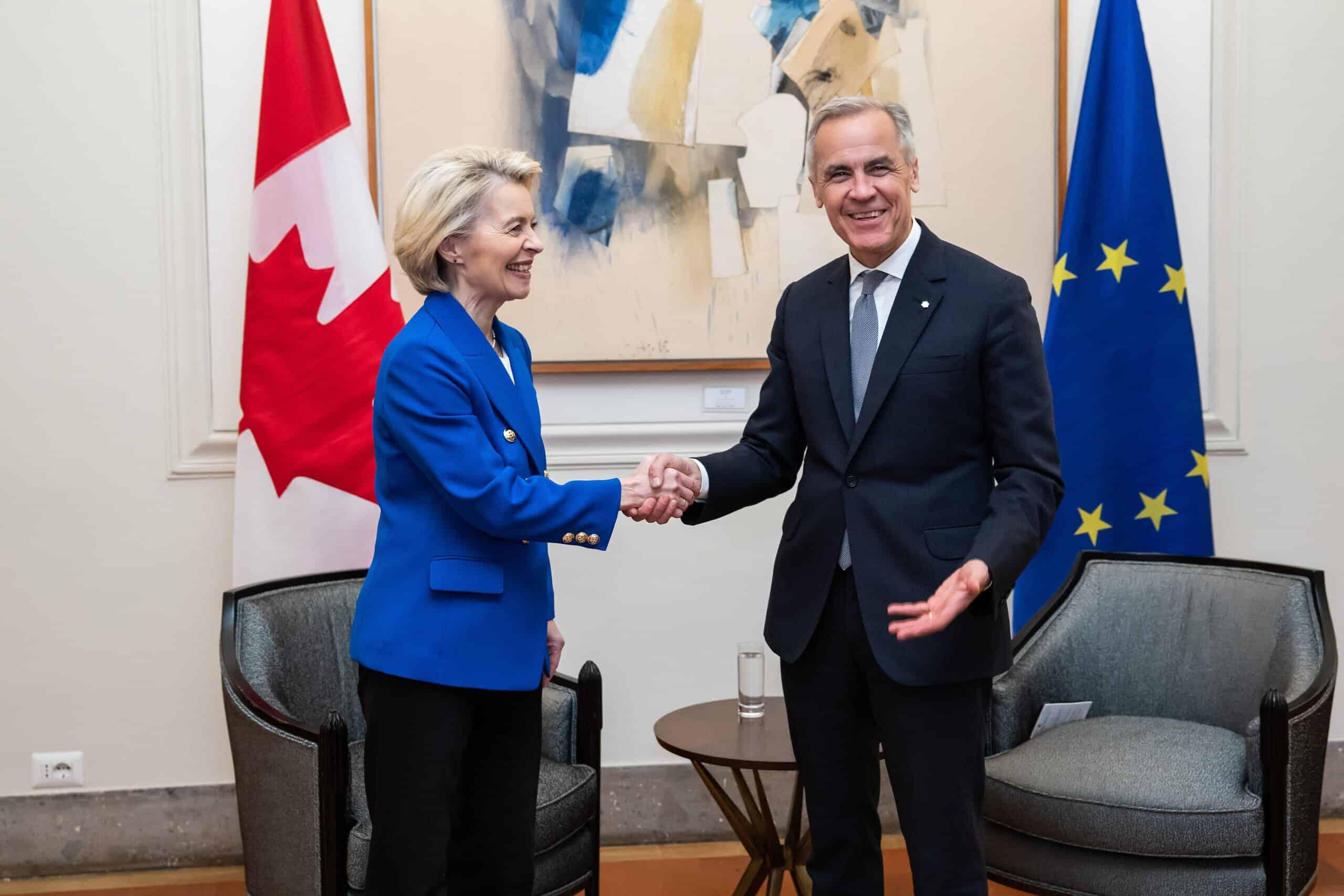
On September 16, Ursula von der Leyen proposed making Canada the European Union’s first “associate member” — a category that does not currently exist as a formal status under the EU treaties or as a conventional stage on the path toward membership.
The idea therefore remains legally undefined. Politically, however, it is already significant. The European Union is exploring the possibility of building a circle of partners far more deeply integrated than ordinary trading partners without necessarily offering them full membership.
Canada may be the most logical country with which to test such a model.
Ottawa already has an advanced free-trade framework with the European Union through CETA. Bilateral trade has expanded substantially since the agreement began to be implemented. But the relationship now being discussed goes considerably further: defence, energy, critical minerals, artificial intelligence, technology, research, financial services, the Arctic and strategic supply chains.
Canadian Prime Minister Mark Carney reinforced that direction on September 17 in an address to the European Parliament in Strasbourg. He called for an “alliance for the future” between Canada and Europe and argued for greater collective capacity to preserve economic and political sovereignty.
Canada is not asking to join the European Union.
It is looking for something different: strategic depth.
That distinction matters.
For decades, the geography of the Canadian economy has rested on an obvious reality: the United States is its natural market. Energy infrastructure, industrial supply chains, agricultural flows and manufacturing networks have all been constructed around continental integration. Roughly 72% of Canadian merchandise exports still go to the United States.
But dependence of that magnitude becomes more difficult to manage when the political relationship itself becomes unpredictable.
Trade tensions with the Trump administration, tariff threats and repeated negotiating disputes have accelerated a debate that predates the current crisis: Canada wants to preserve access to the American market, but it can no longer organise its entire economic strategy around the assumption that such access will always remain politically guaranteed.
Europe offers a particular kind of alternative.
Not because it can replace the United States — geography makes that implausible — but because it can provide Canada with a second economic and strategic space.
That is the logic behind Ottawa’s approach.
Canada is not attempting to leave North America and enter Europe. It is attempting to reduce the potential cost of excessive dependence on a single partner.
Donald Trump’s reaction illustrates why the issue has already moved beyond trade.
Following the European proposal, the US president said that Canada becoming an associate member of the EU could amount to a “hostile act” against the United States. He also raised the prospect of additional tariffs on Europe and restrictions on trade if the project were directed against American interests.
The statement transformed what remains a highly abstract institutional proposal into a concrete geopolitical dispute.
Washington appears to regard deeper Canadian economic and strategic integration with Europe not simply as a sovereign decision by Ottawa, but as something capable of altering the internal balance of the North American system.
Carney responded by stressing that Canada would decide for itself which international partnerships it pursued. He also argued that a more diversified Canada could remain a stronger partner for the United States rather than becoming an adversary.
That may be where the real issue lies.
For much of the postwar period, the Western architecture operated according to a relatively straightforward logic. The United States provided the overwhelming share of military and financial power. Canada belonged to the North American core of that system. Europe formed its principal transatlantic extension.
That architecture is becoming more horizontal.
The European Union is seeking greater industrial and military autonomy. Canada wants to diversify its dependencies. The United Kingdom is still defining its relationship with Europe after Brexit. Norway already participates in many European structures without belonging to the Union. In defence, new partnerships are emerging among countries that share strategic interests without necessarily sharing the same institutional status.
The concept of “associate membership” could eventually become the political expression of that evolution.
For Brussels, such a model offers several advantages. The Union could expand its economic and strategic environment without immediately reopening the politically difficult question of conventional enlargement. It could develop advanced relationships with industrial democracies able to provide natural resources, technology, military capacity or geographic depth.
Canada possesses almost all of those characteristics.
It is a major producer of uranium, potash, nickel and other resources increasingly important to Western industry. It holds vast energy reserves. Its territory provides access to the Arctic, whose economic and military significance continues to grow. Its aerospace, nuclear and mining industries complement several European vulnerabilities.
Europe, in return, offers Canada something it lacks: a market of nearly 450 million consumers, a diversified industrial base, substantial financial and regulatory capacity and, above all, a second architecture of international cooperation capable of reducing dependence on the United States.
Defence may be the first area in which this relationship becomes materially significant.
Canada is already participating in European efforts to strengthen defence-industrial cooperation and is seeking deeper integration into common military supply chains. The European Union, as its defence expenditure rises, increasingly needs partners with compatible industries, raw materials and production capacity.
Energy and critical minerals form a second axis.
Europe has spent years attempting to reduce its dependence on Russia for energy and on China for several strategic materials. Canada possesses enormous reserves, but much of its export infrastructure remains oriented toward the United States.
A deeper European relationship could therefore generate something far more tangible than diplomatic declarations: new ports, energy terminals, mining projects, processing capacity and transport infrastructure.
The Arctic provides a third dimension.
Retreating sea ice is gradually opening new shipping routes and increasing the strategic value of northern territories. Russia already maintains a substantial military presence in the region. China has sought a larger economic role. Canada controls one of the largest Arctic territories in the world.
A privileged relationship with Ottawa would therefore increase Europe’s ability to influence a region whose importance is likely to grow.
Yet the proposal also has substantial limitations.
“Associate membership” currently has no precise institutional content. Brussels and Ottawa would have to determine whether Canada could participate in specific European programmes, gain broader access to parts of the single market, contribute financially to common policies or enter dedicated defence and investment mechanisms.
They would also have to determine where integration stops.
Greater Canadian participation in the European market could require regulatory convergence with Brussels. Yet Canada’s economy remains deeply embedded in American standards and production systems. The more Ottawa aligns with European rules, the more some Canadian companies could face difficult choices between two economic systems.
That creates a potential contradiction.
Canada wants to reduce its dependence on the United States without jeopardising access to the American market. But integration with Europe that becomes too deep could itself generate additional friction with Washington.
The eventual architecture of the relationship will therefore matter more than the label attached to it.
Canada will not become European. The European Union will not become North American. But the two are beginning to construct mechanisms capable of linking their economies, defence industries and strategic resources more deeply than before.
The implications may extend well beyond Ottawa and Brussels.
If the model works, it could interest other advanced economies located outside the EU’s institutional boundary. The United Kingdom, Norway or even selected partners in Asia could eventually seek hybrid arrangements combining economic access, security cooperation and participation in European programmes without full membership.
The European Union would then gradually evolve away from a system defined primarily by a binary legal frontier — member or non-member — toward an architecture composed of several circles of integration.
At its centre would remain the member states.
Around them could emerge a second circle of deeply integrated partners.
Beyond that, a broader group of economic and strategic partners.
Seen from this perspective, the Canadian experiment could eventually matter far more than its administrative title.
For decades, the Western order was organised around an American centre surrounded by allies.
What is beginning to emerge is subtly different: a network of allied powers that still want close cooperation with Washington, but are simultaneously building relationships among themselves strong enough to reduce their dependence on it.
Canada is not turning its back on the United States. It is simply beginning to build a second door.
Main sources: European Commission, European Parliament and Mark Carney’s public statements, alongside Reuters and Associated Press reporting. The legal and institutional content of any “associate member” status remains undefined; the discussion of concentric circles of European integration is therefore structural analysis rather than a description of an already agreed framework.
Atlas Limits Research Desk
Atlas Limits’ editorial and analytical desk.