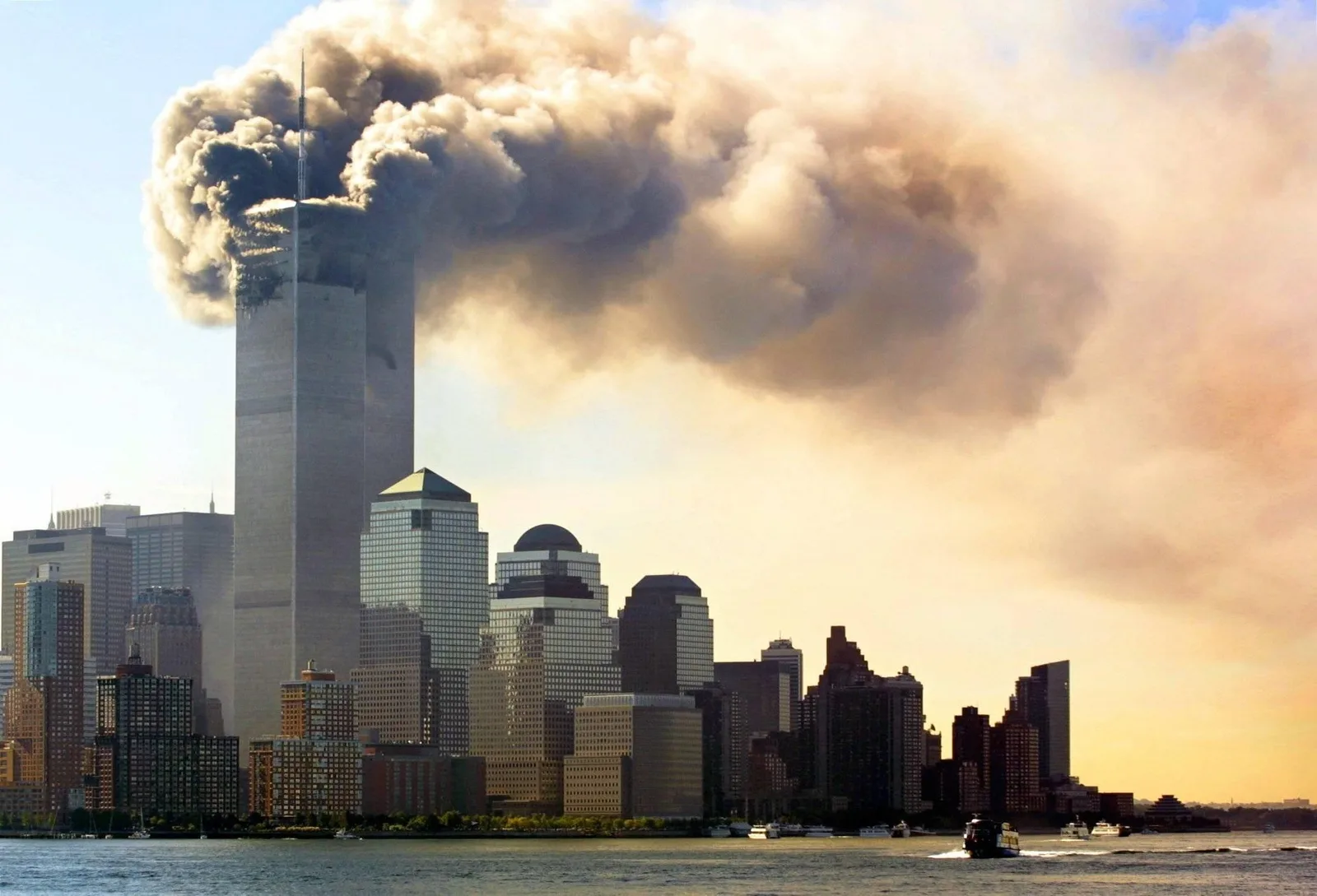
On September 11, 2001, nineteen men hijacked four passenger aircraft in the United States. Two struck the towers of the World Trade Center in New York, a third hit the Pentagon, and the fourth crashed in Pennsylvania after passengers fought back. The attacks, organized by Al-Qaeda, killed 2,977 people, excluding the nineteen hijackers. Twenty-five years later, the victims’ names are still read aloud in Manhattan and ceremonies are held at the Pentagon. But the world that September 11 helped create is much harder to commemorate. It is everywhere, embedded in institutions, wars and political reflexes that have long since ceased to be directly associated with that morning in 2001.
To understand the scale of the rupture, it is necessary to remember what America looked like on the eve of the attacks. The Soviet Union had disappeared a decade earlier. The United States no longer faced a strategic rival of comparable stature. Globalization seemed capable of progressively extending the market economy, liberal democracy and an international order largely organized around American power. Washington possessed unmatched military superiority, yet scarcely imagined that a transnational network operating from Afghanistan could simultaneously strike the financial heart of New York and the headquarters of American military power.
Within hours, the American perception of security changed. An invisible frontier had been crossed: geographical distance no longer necessarily protected the territory of the United States. The oceans had not disappeared, but they had lost part of their strategic function. A non-state group with a few dozen operatives, a clandestine organization and the ability to exploit the civilian infrastructure of an open society had inflicted a spectacular attack on the world's leading power on its own territory.
The response matched the scale of the trauma. George W. Bush's administration did not treat September 11 merely as a terrorist crime requiring the destruction of Al-Qaeda. It placed the attacks within a broader “war on terror” whose geographical, temporal and sometimes legal boundaries would prove far more difficult to define. The United States intervened in Afghanistan in the autumn of 2001 to overthrow the Taliban regime that had sheltered Al-Qaeda. Less than two years later, it invaded Iraq.
The two wars eventually became intertwined in American political memory even though they followed different logics. Afghanistan was a direct consequence of the attacks. Iraq was not responsible for them. Yet the strategic atmosphere created by September 11 made possible a much more ambitious doctrine: it was no longer enough to respond to attacks; threats had to be prevented from emerging, including through preventive military action.
This is perhaps where the real history of the world that followed begins.
American power, almost unrivalled at the beginning of the century, embarked on operations in which military superiority could win battles far more easily than it could produce the desired political order. Kabul fell quickly. So did Baghdad. What followed was considerably more complicated. Rebuilding states, containing insurgencies, arbitrating communal divisions and establishing institutions capable of surviving the withdrawal of foreign forces required something other than control of the skies and precision weapons.
Iraq became the most brutal laboratory of this contradiction. The fall of Saddam Hussein removed a dictatorship, but the collapse of the Iraqi state opened space for insurgencies, sectarian violence and jihadist organizations. Al-Qaeda in Iraq emerged from this chaos before its successors later contributed to the formation of the Islamic State. A war launched in the political climate created by the struggle against terrorism thus helped create some of the conditions in which a new generation of jihadism could prosper.
Afghanistan followed a different trajectory but ended in an equally striking paradox. For twenty years, the United States and its allies fought the Taliban, built institutions, trained security forces and financed an Afghan state heavily dependent on external support. In August 2021, as American forces completed their withdrawal, the Taliban retook Kabul. The movement overthrown only weeks after September 11 returned to power only weeks before the twentieth anniversary of the attacks.
None of this means that two decades of counterterrorism produced no results. Al-Qaeda lost its original Afghan sanctuary, its central organization was severely weakened and Osama bin Laden was killed in Pakistan in 2011. Western intelligence capabilities, financial surveillance and counterterrorism cooperation expanded considerably. No externally organized terrorist attack comparable to September 11 struck the United States again on the same scale.
But the cost of this transformation extends far beyond the military campaigns themselves. Brown University's Costs of War project estimates that the United States had spent or incurred obligations exceeding $8 trillion on the wars and related measures of the post-9/11 era through fiscal year 2022, including future obligations toward veterans. It also estimates that between 905,000 and 940,000 people had been directly killed by war violence across the principal theaters studied by 2023, while indirect deaths resulting from the destruction of health, economic and social systems bring the estimated toll in those areas to at least 4.5 to 4.7 million. These figures encompass several conflicts with distinct causal histories and should therefore not be interpreted as a death toll directly attributable to the September 11 attacks themselves. They nevertheless convey the historical scale of the strategic era that followed.
There is another legacy that is less visible precisely because it has become ordinary.
After 2001, security moved deeply into everyday life. The United States created the Department of Homeland Security in 2003 in the largest reorganization of the federal government since the Second World War. Airport security changed, watchlists multiplied, information sharing between government agencies intensified and electronic surveillance capabilities expanded dramatically. Financial intelligence became a central component of the effort to disrupt terrorist networks. Practices initially conceived as exceptional responses to an exceptional threat gradually became integrated into the normal functioning of states.
September 11 also transformed the relationship between liberty and security. Guantánamo, extraterritorial detention, coercive interrogation, surveillance programs revealed over subsequent decades and the expansion of executive authority opened debates that have never entirely closed. The question posed in 2001 remains familiar in 2026: how far can a democracy alter its own rules to protect itself without transforming precisely what it claims to defend?
Yet one of the most striking developments visible on the twenty-fifth anniversary lies elsewhere. Terrorism has not disappeared, but it no longer organizes the American view of the world by itself.
China now occupies the center of long-term American strategic planning. Russia has returned high-intensity conventional warfare to the center of European security concerns. Hypersonic missiles, drones, semiconductors, artificial intelligence, space infrastructure, supply chains and control over critical technologies have become instruments of power as important to contemporary strategy as terrorist networks were to the strategic imagination of the early 2000s. Following the withdrawal from Afghanistan, the Pentagon and much of the American strategic establishment increasingly shifted their attention toward great-power competition, particularly with China and Russia.
That shift reveals something deeper. September 11 imposed the idea that the principal threat could come from relatively weak actors capable of exploiting the vulnerabilities of much stronger societies. The world of 2026 has reintroduced an older logic: states, territory, industry, arsenals, alliances, resources and balances of power. History has not returned exactly to its starting point. It has simply placed two eras on top of one another.
The architecture created after 2001 did not disappear with the return of interstate rivalry. Drones refined during counterterrorism campaigns are now ubiquitous in conventional warfare. Surveillance technologies developed in the name of national security have become routine instruments of state power. Financial sanctions, the tracing of monetary flows, mass exploitation of data and the integration of intelligence with technology have changed targets without losing their usefulness. Even as the vocabulary of September 11 fades, some of its infrastructure remains.
The legacy is political as well. An entire American generation grew up with wars whose endings were difficult to define. The belief that foreign intervention could durably reconstruct another society lost some of the confidence it possessed at the turn of the century. Afghanistan, and above all Iraq, helped foster distrust of prolonged military commitments and of the institutional claims used to justify them. This fatigue did not produce absolute isolationism. It changed the question asked in Washington: no longer simply “can we intervene?”, but increasingly “what will intervention actually achieve?”
The Middle East itself still bears the marks of this period, but it no longer resembles the region of 2001. Iranian influence expanded after the disappearance of Saddam Hussein's regime before encountering new regional realignments. The Gulf monarchies acquired greater diplomatic, financial and technological autonomy. Turkey pursues its own strategy. Israel remains at the center of a deeply conflictual regional system. Asian powers, led by China, have become major economic actors across the region. The United States remains an essential military power there, but it is no longer the only actor shaping its horizon.
It would therefore be too simple to ask whether the war on terror was “won” or “lost.” The question assumes that the conflict possessed clearly defined borders and an identifiable endpoint. Its historical characteristic was precisely that it blurred both. Jihadist terrorism has not disappeared. Al-Qaeda survived in fragmented forms, the Islamic State demonstrated that an organization emerging from this broader matrix could temporarily conquer substantial territory, and various branches continue to operate across Africa, the Middle East and Asia. Yet none achieved the strategic ambition implicit in September 11: bringing about the collapse of American power.
The United States, however, devoted an immense quantity of resources, political attention and strategic capital to responding to the threat. This may be where the assessment becomes most uncomfortable. A great power can destroy the organization that attacked it and still discover, twenty-five years later, that its response to the attack transformed its own system almost as profoundly as it transformed its enemy.
On September 11, 2026, the commemorations therefore return to the places where everything began. In New York, families read the names. For the twenty-fifth anniversary, the National September 11 Memorial & Museum also marks a moment of silence for those who have died in the years since from illnesses and injuries associated with the attacks. The institution notes that roughly one-third of the American population is now too young to possess a personal memory of September 11. The event is entering a new phase: the moment when lived memory slowly begins to become history.
That may provide the distance necessary to understand what actually happened.
September 11 did not create the contemporary world by itself. It did not create China's rise, Russia's return, the digital revolution or the fractures of the Middle East. But for two decades it profoundly influenced how the world's leading power perceived threats, employed force and defined security. It triggered wars, accelerated the construction of a global counterterrorism and surveillance apparatus, redirected enormous resources and altered the relationship between the state, technology and the individual.
Twenty-five years later, the towers are gone. Al-Qaeda is no longer the adversary around which Washington organizes its entire strategy. Afghanistan is once again governed by the Taliban. Great-power competition now dominates an increasing share of the international agenda.
And yet the world of September 11 never completely disappeared.
It simply became part of ours.
Main Sources
National September 11 Memorial & Museum — historical information on the September 11, 2001 attacks and the twenty-fifth anniversary commemoration, September 2026.
Brown University, Watson School of International and Public Affairs, Costs of War — research on the human, fiscal and institutional costs of the post-9/11 wars.
U.S. Department of Homeland Security — institutional history and the creation of the department following the September 11 attacks.
The 9/11 Commission Report — National Commission on Terrorist Attacks Upon the United States, 2004.
Atlas Limits Research Desk
Atlas Limits’ editorial and analytical desk.