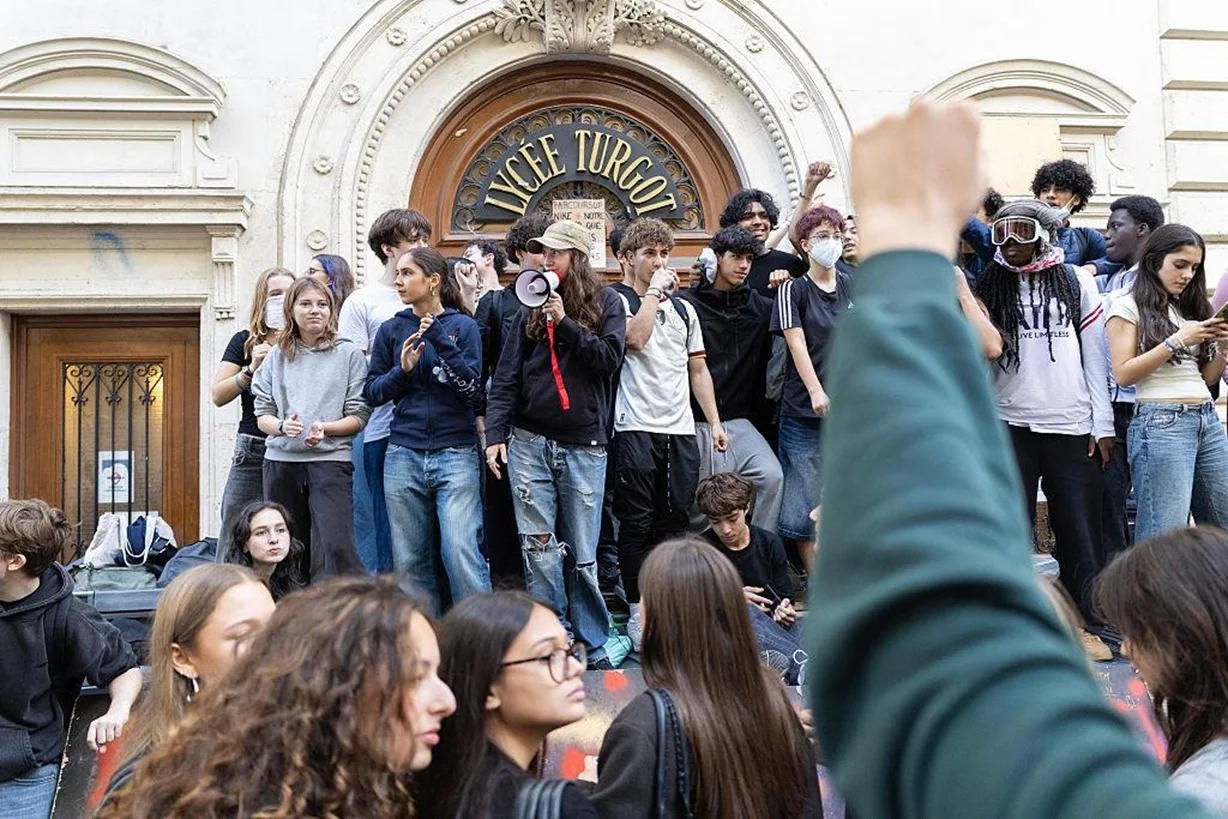
Outside the gates of French high schools, the protest began with ordinary things. A missing teacher. An overcrowded classroom. A school nurse who is difficult to find. An ageing building. Lost teaching hours. Then came concerns about Parcoursup, access to higher education and, behind them, a much larger question: what place is actually waiting for this generation in the France to come?
Within a few weeks, the answer moved beyond the classroom.
On October 6, 2026, 266,000 people demonstrated across France according to the Interior Ministry, including 56,000 in Paris. High school and university student organisations put the figure at 450,000 nationwide, including 100,000 in the capital. This third major day of mobilisation marked a change of scale: what had begun around individual schools had become a national movement joined by university students, teachers, parents, trade unionists and other demonstrators.
The numbers matter. But they do not explain the event.
What distinguishes this mobilisation may be less its size than the age of those who started it. Part of France's youth is taking to the streets before it has truly entered the labour market, paid its first taxes or experienced unemployment for any significant period. The protests begin with school, but they already speak to selection, inequality, public services, future purchasing power and a society whose constraints this generation can perceive before it has fully experienced its institutions. That shift deserves attention.
School as the First Encounter With the State
For a teenager, school is probably the most tangible public institution there is.
The state does not appear there as an abstract budget or central administration. It takes the form of a teacher who is present or absent, a classroom of twenty-five or thirty-five pupils, an available guidance counsellor, a psychologist, a nurse, a functioning computer, a maintained building.
The mobilisation began precisely with this material reality.
Since September 21, demands reported across schools have concerned teacher numbers, overcrowded classes, the condition of some buildings and shortages of school health personnel. Initially concentrated in the Paris region, the movement rapidly spread to Lille, Lyon, Marseille, Nice, Nantes, Rennes, Bordeaux, Tours and many other cities. By September 29, 410 actions had already been recorded in high schools. A few days later, more than a thousand schools had been affected to varying degrees by the mobilisation.
These difficulties do not mean that France has stopped funding education. That is precisely what makes the situation more interesting.
In 2025, France's domestic expenditure on education reached €199.2 billion, equivalent to 6.7% of GDP. The central government financed around 55% of it and local authorities 23%. Average expenditure reached €11,780 per secondary-school pupil. The French education system employs around 1.22 million people, including more than 850,000 teachers.
There is therefore an apparent contradiction: one of Europe's largest educational systems mobilises considerable resources while some of its users describe a daily experience of scarcity. That contradiction is probably at the heart of the problem.
The question is no longer simply how much France spends on education. It is how public expenditure is transformed into a service that pupils can actually perceive.
Two Hundred Billion Euros and the Missing Teacher
Public systems are often measured through their budgets. Citizens judge them through their operation.
Between the two lies the entire complexity of a national education system: salaries, pensions, administration, property, local government responsibilities, geographical distribution of teachers, replacement of absences, educational options, disability support, guidance and school healthcare.
Around 72% of education expenditure is absorbed by salaries, social contributions and pensions. Investment accounts for only about 8.5%. These proportions are not in themselves anomalous — education is necessarily labour-intensive — but they help explain why an increase in aggregate expenditure does not automatically produce an improvement that is immediately visible in every school.
Demography adds another paradox. France is losing pupils. The Education Ministry estimates that the school system will have lost around one million pupils between 2019 and 2029. For the 2026 school year alone, public primary schools are expected to receive almost 150,000 fewer pupils. Yet the 2026 budget provided for almost 5,900 additional jobs compared with 2025.
In theory, the mechanics should create breathing room. They have not been sufficient to eliminate the perception of saturation.
In general and technological high schools, the average class contained 30.2 pupils in 2025, compared with 27.7 in 2010. Vocational high schools present a different picture, with the average falling to 18.4 pupils. National statistics therefore reveal less a uniform shortage than a deeply heterogeneous system.
And it is precisely this heterogeneity that turns a budgetary question into a territorial one.
The Geography of Opportunity
Not every French high school offers the same experience of the Republic.
Territory, pupils' social backgrounds, a school's attractiveness, its ability to retain teachers, the subjects it offers, and its proximity to a large city or university can considerably alter the way the same national policy is experienced.
The mobilisation has made this geography visible. It developed notably in schools serving working-class areas before gradually reaching other categories of high school. Pupils from some highly privileged schools have also joined demonstrations, in some cases explicitly in solidarity with students studying under less favourable conditions. This shift matters.
When pupils protest solely about their own school, the issue can remain local: a vacant position, a building, a timetable. When they begin comparing educational conditions between schools, the debate changes.
It becomes a question of substantive equality. The French Republic has historically built part of its legitimacy around the idea that education should reduce the importance of birthplace and social origin. It has obviously never fully achieved that promise. But when differences between schools become sufficiently visible to enter the language of pupils themselves, it is no longer only the operation of the education system that is being questioned. It is its social function.
Parcoursup and the Discovery of Scarcity
Then comes Parcoursup.
The platform is often described as a technological or administrative problem. More fundamentally, it is the moment when hundreds of thousands of young people encounter an elementary economic reality: not every aspiration corresponds to an available place.
Until then, school primarily organises a pathway. At the end of high school, it begins allocating possibilities.
Preferred course. University. Preparatory class. Technical degree. Specialist school. City. Mobility. Housing. Cost of living.
Orientation suddenly becomes an allocation of scarce resources. That is probably one reason Parcoursup concentrates such a significant share of the anxieties expressed in the current movement.
The issue extends beyond the platform itself. Behind the algorithm lies a demographic and economic transition: a generation that society asks to achieve high levels of qualification while simultaneously observing uncertainty in some career paths, increasingly expensive housing in major cities, the rapid transformation of occupations through artificial intelligence and the difficulty of anticipating the future value of a degree that will only be obtained several years from now.
For previous generations, professional uncertainty often arrived after education. It is now entering the high school classroom.
A Generation That Anticipates
This may be the movement's most significant characteristic.
The teenagers demonstrating in 2026 are not protesting only against their present circumstances. They are anticipating their future ones.
This generation has grown up in an unusual environment. It experienced the pandemic during its schooling. For years, it has watched the return of war to Europe, geopolitical tensions, inflation, housing pressures, climate disruption and now the extraordinary acceleration of artificial intelligence.
At sixteen or seventeen, a student can watch machines perform some of the intellectual tasks that are simultaneously presented as justification for spending many more years in education.
That does not mean AI will eliminate the jobs these young people hope to enter. Such a conclusion would be premature. But it is already changing their perception of the future.
School asks them to prepare for tomorrow precisely when tomorrow appears less predictable.
The implicit contract consequently becomes harder to read: work, study, obtain a degree, enter the labour market, become independent.
Every stage remains possible. It is their sequence that appears less automatic.
Downward Mobility Before Social Position
Fear of downward mobility traditionally has a particular characteristic: it concerns people who already have something to lose.
The current movement suggests a different form of anxiety. Part of the younger generation appears to fear downward mobility before it has even acquired a social position from which to fall.
What is anticipated is not necessarily poverty. It is the widening gap between the effort demanded and the reward expected.
Study longer to find housing with greater difficulty. Accumulate more qualifications to enter a more uncertain labour market. Accept more intense academic competition in exchange for later economic independence.
This perception does not always correspond precisely to economic data. It varies enormously according to social background, geography and education.
But politically, perceptions can become almost as consequential as statistics once they become collective.
And a connected generation compares constantly. A high school pupil can now observe conditions in another school, rents in a city where they might study, salaries in an occupation they are considering, the difficulties encountered by a graduate, career trajectories abroad or the transformations produced by a new technology.
Comparison no longer begins after entering the labour market. It accompanies adolescence.
When the Street Transforms the Demand
The transition from a school movement to a national movement inevitably changes its nature.
The demonstrations of recent weeks have been accompanied by violent incidents, property damage and confrontations. Police officers have been injured. Demonstrators have been injured as well. Several investigations have been opened into police interventions.
By October 2, more than 5,000 people had been arrested since the beginning of the movement, according to Interior Ministry figures reported by Amnesty International; the organisation said 85% were minors and denounced what it described as disproportionate uses of force. It simultaneously acknowledged violence by some demonstrators while stressing that state use of force must remain necessary and proportionate.
On October 5, in Lens, a fifteen-year-old lost a hand after the explosion of a police dispersal grenade; an investigation by the IGPN police inspectorate was opened. Other serious injuries among demonstrators have been documented, while members of the security forces have also suffered assaults.
At that point, a familiar mechanism of social movements begins to appear. The mobilisation is no longer concerned only with its original demands. It also becomes concerned with the way the state responds to the mobilisation itself.
Every confrontation produces images. Every image circulates immediately. Every intervention can become another argument for taking to the streets.
Public-order policing therefore ceases to be peripheral to the movement. It can become one of its potential drivers.
Politics Comes Looking for the Movement
A mobilisation of this scale never remains outside politics for long.
With the 2027 presidential election approaching, the government, opposition parties, trade unions and activist organisations inevitably seek to impose their own interpretation of the events.
The government has accused political groups of attempting to exploit the demonstrations and has emphasised violence surrounding some blockades. Its opponents, by contrast, have criticised what they describe as an excessively security-focused response to social and educational demands.
This political battle must be distinguished from the movement itself. A movement involving hundreds of thousands of people has neither a single motivation nor a homogeneous ideology. Some are demonstrating for additional resources. Others because of Parcoursup. Some against police violence. Others are expressing much broader anxieties about their future.
That dispersion is precisely what makes the mobilisation politically difficult to address.
A demand can be negotiated. Anxiety is much harder to negotiate.
The Government Opens a Door
After several weeks of tension, the executive is now attempting to move the confrontation towards dialogue.
From October 7, all high schools are expected to devote half a day to a “temps lycéen”, presented by the Education Ministry as an internal democratic forum allowing pupils to express their difficulties and expectations. A national consultation is simultaneously open until October 23 through the Agora platform.
The response is politically significant. It implicitly recognises that the problem can no longer be treated solely as a succession of blockades to be managed school by school. But it also creates an expectation.
Because asking students to speak eventually requires deciding what will be done with what they say.
High school and university student organisations are now demanding emergency measures and several billion euros in additional resources. The government, meanwhile, must operate within a much broader national fiscal constraint. This is where the school protest intersects with France's central question.
The Generational Allocation
France faces a difficult fiscal equation.
It must simultaneously finance pensions, healthcare, the energy transition, defence, debt servicing, local government, infrastructure and education.
Every expenditure has its justification. But all compete for the same public resources.
In an ageing society, this budgetary competition inevitably has a generational dimension, even when nobody explicitly formulates it that way.
A school demanding more teachers indirectly competes with a hospital demanding more healthcare workers. A university asking for additional places participates in the same allocation process as a rising defence budget or a pension system confronting demographic ageing.
The high school students demonstrating do not, of course, frame the issue in these terms.
Yet behind their demands lies precisely this question: what share of its resources is an ageing society prepared to invest in those who do not yet produce economically and, in some cases, are not even old enough to vote?
The question extends far beyond France.
But France is a particularly revealing laboratory because it combines a powerful welfare state, high taxation, substantial public expenditure and a political culture in which the state remains directly accountable for the quality of collective services.
When those services appear inadequate, frustration therefore rises in proportion to the promise.
What France Spends, What Young People See
This may be the real divide exposed by the movement.
The state thinks in billions.
A high school student thinks in teaching hours.
The state counts budgetary positions.
A pupil counts the teachers who actually arrive.
The state measures the education effort as a percentage of GDP.
A family measures how long it takes to obtain an appointment with support staff, the distance to an available course or the cost of student housing.
Both measurements are legitimate.
They simply do not describe the same reality.
France can spend close to €200 billion a year on education while simultaneously producing, in some schools, the perception that essential resources are missing.
This distance between resources mobilised and services perceived is one of the most difficult problems confronting large contemporary welfare states.
It cannot necessarily be solved simply by spending more money.
It also requires understanding where the money goes, how staff are distributed, why some positions become difficult to fill, how buildings are maintained, how responsibilities are divided between central and local government, and why territorial inequalities survive decades of corrective policies.
In other words, the high school movement raises a question about resources.
But it may raise an even more important question about state effectiveness.
A Generation Enters the National Conversation
It is too early to know what will become of this mobilisation.
It may continue, fragment, radicalise or fade. Budgetary responses may calm it. Violence may instead change its trajectory. Political parties and trade unions may become more involved, or high school students may preserve a more decentralised form of organisation. But something has already happened.
A generation that had largely appeared in public debate as the object of education policies has become a political and social actor.
It is no longer asking only what it is expected to learn. It is asking under what conditions it will learn, what that education will allow it to become and what place society is prepared to reserve for it.
That is why the demonstrations of autumn 2026 should probably not be understood solely as a crisis of France's education system.
They reveal something deeper: the growing difficulty experienced by developed societies in maintaining a simple promise that structured several generations — the idea that education provides the safest path towards a better life.
That promise has not disappeared. But it must now be demonstrated.
And when a generation begins demanding proof before it has even left high school, the problem is no longer merely educational. It has become national.
Main Sources
French Ministry of National Education — DEPP, L’Éducation nationale en chiffres, édition 2026; En 2025, 199,2 milliards d’euros consacrés à l’éducation, soit 6,7 % du PIB; data on student numbers, class sizes and education financing.
French Ministry of National Education — Temps lycéens : un temps de dialogue pour exprimer ses difficultés et ses attentes, October 6, 2026.
Le Monde — coverage of the high school movement, October 1–7, 2026; mobilisation figures, accounts from schools, violence and government responses.
Amnesty International France — documentation concerning the high school movement, arrests and controversies surrounding public-order policing, October 2026.
French Ministry of the Interior — participation and arrest figures as reported by the sources above.
Atlas Limits Research Desk
Atlas Limits’ editorial and analytical desk.