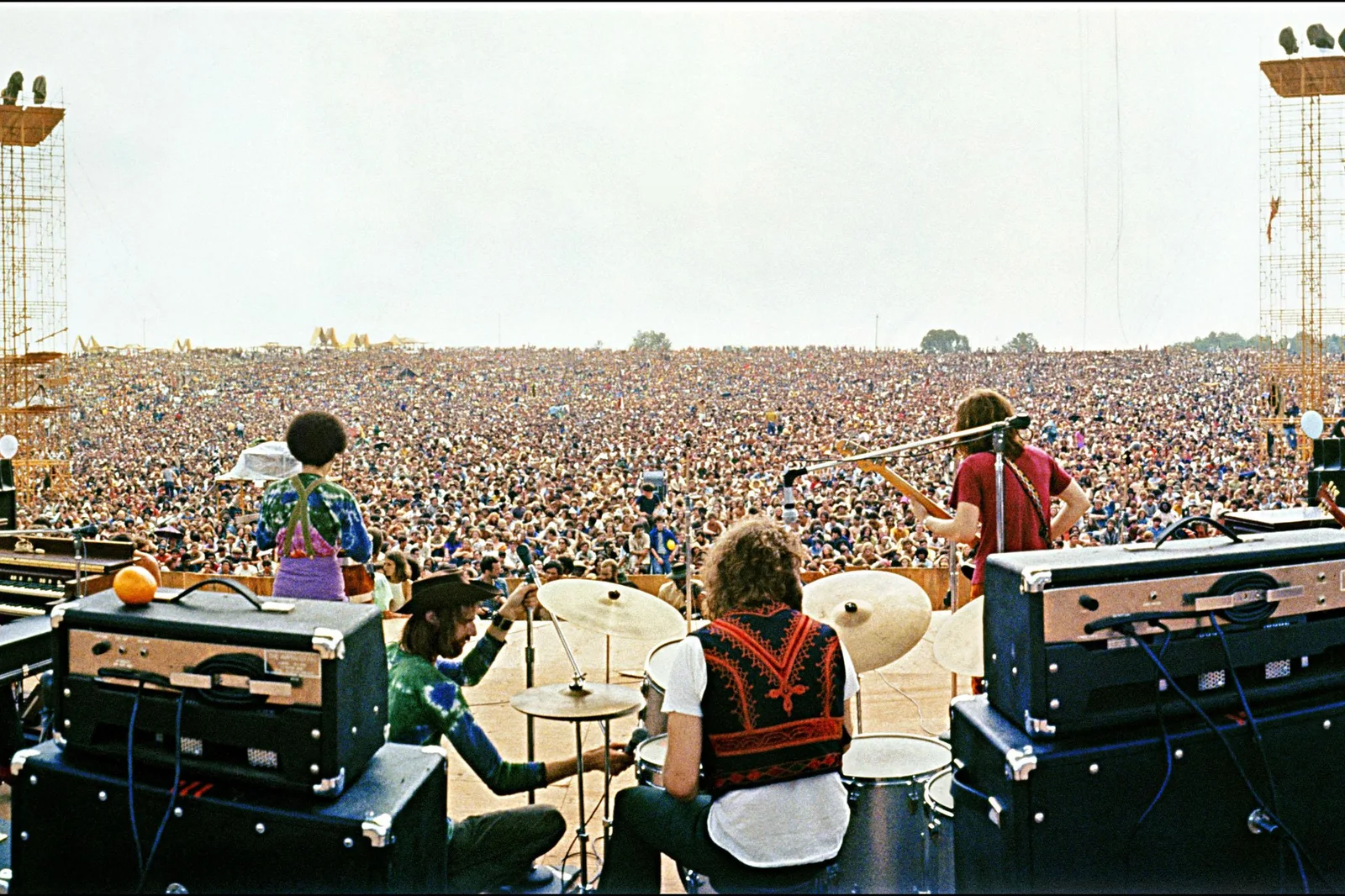
In August 1969, a farm in upstate New York became, for a few days, the center of a world that no longer wanted to resemble the one inherited from its parents. Around 400,000 people converged on Woodstock. They came for the music, but the image that endured quickly grew beyond the concerts: long hair, liberated bodies, drugs, pacifism, communal life, rejection of authority, and the conviction — characteristic of great generational ruptures — that society could be changed simply by refusing to follow its codes.
A few weeks earlier, another rupture had taken place in New York City. On the night of June 27–28, a police raid on the Stonewall Inn triggered several days of confrontation. One year later, on June 28, 1970, between 3,000 and 5,000 people took part in the first Christopher Street Liberation Day march. Documents preserved by the Library of Congress make clear what it represented at the time: a political demonstration against discriminatory laws, violence, discrimination in employment and housing, and, more broadly, against a society in which homosexuality was still largely pushed into invisibility.
Woodstock and Stonewall do not tell the same story. One was a music festival that became a generational myth; the other, an uprising that became a landmark in the struggle for civil rights. Treating them as equivalent would be historically inaccurate. But looking at them together reveals something larger: by the end of the 1960s, part of the political transformation of Western societies was taking place through culture, the body and the occupation of public space.
Protest was no longer asking only for new laws.
It was inventing new ways of being visible.
The Body Becomes Political
The counterculture of the 1960s challenged the ordinary symbols of social order. Hair length, clothing, music, sexuality, consumption, family, food and even ways of living became arenas of confrontation. The Smithsonian notes that countercultural movements of the period experimented with communes, cooperatives, organic food and alternative forms of collective life precisely because they were attempting to move away from the patterns of consumption and social organization associated with the establishment.
Woodstock condensed that aspiration into an almost perfect image.
Hundreds of thousands of young people gathered in a field, the organizers overwhelmed, fences rendered meaningless and what had been conceived as a ticketed festival effectively transformed into a largely open gathering. The scene appeared to demonstrate that a parallel society could emerge spontaneously if enough people agreed to share its codes.
The first Pride march followed a different logic, but it too used visibility as an instrument of transformation. To walk openly through New York in 1970 was not simply to celebrate an identity. It was to make publicly visible a population that institutions, social conventions and, in some cases, the law had long pushed toward invisibility.
In both cases, public space became a stage.
And the stage became political.
Then the Market Arrived
There is, however, a retrospective temptation: to imagine Woodstock as something entirely pure, existing outside capitalism, and contrast it with contemporary mass gatherings filled with sponsors, brands and institutional communication.
History is less comfortable than that.
Woodstock was a commercial venture. Its organizers sold tickets and intended to make a profit. Circumstances and the sheer number of people arriving at the site eventually made admission controls impossible. More importantly, Woodstock's transformation into a product began almost immediately. The National Museum of American History notes that Woodstock-branded fabric was already being sold by a major American retailer less than a year after the festival. The documentary, records, clothing and countless other products extended that process.
Counterculture was discovering a remarkable property of consumer societies: they could commercialize their own opposition.
Rebellious rock became an industry. Jeans became a global uniform. Long hair stopped provoking outrage. Punk entered shop windows. Tattoos moved out of the margins. Streetwear became luxury. Symbols originally designed to distinguish those rejecting the norm eventually came to be reproduced by the millions.
The market does not necessarily destroy counterculture.
It can do something far more effective: absorb it.
From the Street to the Institution
The history of Pride allows us to observe the same mechanism, but on a much deeper political scale.
The first New York march in 1970 commemorated a confrontation with the police and explicitly denounced government hostility and discrimination. Half a century later, Pride events can receive support from municipalities, universities, public institutions and major corporations. In the United States, Pride Month itself has progressively acquired presidential and institutional recognition.
That shift is partly the outcome sought by the movements that came before it. Conduct once criminalized has been decriminalized. Forms of discrimination have been prohibited. Same-sex marriage has been legalized. Openly gay people now occupy political, economic, media and cultural positions that would have been difficult to reach only a few decades ago.
The margin therefore moved the norm.
But when a counterculture succeeds, it encounters a paradox: the institutions it once challenged begin speaking its language.
Corporate logos adopt Pride colors. Communications departments publish supportive messages. Brands develop dedicated collections. What was once a risky act of visibility also becomes a marketing category.
And some of the most skeptical observers are now found within the community itself.
A Pew Research Center survey published in 2025 found that 68% of LGBTQ adults in the United States believed that all or most companies promoting Pride did so because they thought it would benefit their business. Only 16% believed that all or most of those companies were motivated by a genuine desire to celebrate LGBTQ people.
Criticism of commercialization is therefore no longer simply an argument made by outsiders.
It has become part of the internal debate.
When Transgression Becomes a Common Language
This is perhaps where the distance between 1969 and the present becomes most visible.
Classical counterculture operated against a relatively identifiable boundary. There was a center and a periphery, a dominant culture and cultures attempting to escape it. Transgression was immediately recognizable because the norm itself was recognizable.
That boundary has become far more unstable.
Contemporary cultural industries have learned to transform the margins into trends at extraordinary speed. An aesthetic born within a small community can appear on social media, spread globally, be adopted by a brand and enter mainstream culture within months.
Rebellion now has its own supply chain.
That does not mean cultural conflict has disappeared. On the contrary. It has moved.
In the United States, after two decades of generally rising acceptance of LGBTQ rights, some indicators have recently stabilized or declined. In 2026, Gallup measured support for same-sex marriage at 65% — still a clear majority, but six percentage points below the peak recorded in 2022 and 2023. The share of Americans considering gay or lesbian relations morally acceptable had fallen to 62%, its lowest level since 2016.
Institutional integration has therefore not eliminated cultural conflict.
It has changed its geography.
Counterculture Has Not Disappeared
It would be tempting, then, to conclude that everything is eventually appropriated: music, identities, clothing, revolts and, finally, their symbols.
That would be too simple.
The commercialization of a movement does not necessarily erase what it has produced. Woodstock could simultaneously be a commercial project, a vast musical event and the symbol of a generational rupture. The Smithsonian notes that its commercialization was interpreted in two different ways even at the time: for some, it betrayed the counterculture; for others, it demonstrated that countercultural values were gradually penetrating American society.
Pride carries the same ambiguity.
A bank can place a rainbow on its communications while, elsewhere, people continue demonstrating for rights they do not possess. A Pride event can simultaneously be a celebration, a tourist attraction, a commercial event, an assertion of identity and a political demonstration. Even within Western societies, levels of acceptance remain markedly different depending on whether the subject is homosexuality, bisexuality, transgender identity or nonbinary identity. Pew Research Center data show precisely how uneven those perceptions of social acceptance remain.
What has changed since Woodstock, then, is not the disappearance of protest.
It is protest's relationship with the system it challenges.
In 1969, much of Western counterculture was still attempting to construct an outside: another kind of music, another sexuality, another form of consumption, another community, sometimes another society. More than half a century later, those boundaries have become porous. The margins influence the center; the center absorbs their codes; the market turns their symbols into products; institutions adopt their vocabulary; and then new margins emerge to challenge the resulting order.
Woodstock wanted to show that another world could exist in a field.
Stonewall sought to make visible a population that the social order had kept at its margins.
Contemporary Pride shows how far that visibility has penetrated the center of Western societies — into their laws, corporations and institutions.
That may ultimately be what most clearly separates 1969 from 2026.
Counterculture did not win because it replaced mainstream culture. It won some of its battles by gradually becoming part of that culture.
And when transgression enters institutions, shop windows and advertising, a new question is already beginning to emerge:
Where is the margin now?
Main Sources
- Smithsonian Institution — National Museum of American History, Remembering Woodstock — history of the 1969 festival, its roughly 400,000 attendees, countercultural significance, original commercial model and subsequent commercialization. Smithsonian — Remembering Woodstock
- Smithsonian Institution — National Museum of American History, Countercultures — the counterculture movement, communes, cooperatives, alternative lifestyles and rejection of mainstream patterns of consumption and social organization. Smithsonian — Countercultures
- Library of Congress, The Stonewall Era: 1966–1969 — historical context surrounding the Stonewall uprising and the emergence of the modern LGBTQ rights movement in the United States. Library of Congress — The Stonewall Era
- Library of Congress, LGBTQ+ Pride Month: History and Overview — development of Pride from the early liberation marches to broader political and institutional recognition in the United States. Library of Congress — Pride History and Overview
- Pew Research Center, About two-thirds of LGBTQ adults have participated in Pride Month events, May 29, 2025 — participation in Pride events and LGBTQ adults’ perceptions of corporate involvement, including attitudes toward companies’ commercial motivations. Pew Research Center — LGBTQ Adults and Pride Month
- Pew Research Center, The Experiences of LGBTQ Americans Today, May 29, 2025 — perceptions of social acceptance and differences in experiences among gay, lesbian, bisexual, transgender and nonbinary Americans. Pew Research Center — The Experiences of LGBTQ Americans Today
- Gallup, U.S. Support for LGBTQ+ Issues Remains Down From Peak, June 3, 2026 — recent U.S. public-opinion trends, including 65% support for same-sex marriage and 62% saying gay or lesbian relations are morally acceptable. Gallup — U.S. Support for LGBTQ+ Issues
Atlas Limits Research Desk
Atlas Limits’ editorial and analytical desk.