Israel's reported authorization of an initial deployment of 250 foreign troops to Gaza comes as the country faces a major political transition. Following the October 27 elections, Gadi Eisenkot has been tasked with forming a government that could replace Benjamin Netanyahu's administration. These two developments, military and institutional, point toward a new phase of the conflict. The question is no longer simply how to bring hostilities to an end, but who will exercise security and political authority over Gaza, under what rules, and with what accountability.
A War Entering a Different Framework
On November 9, Israeli media reported that Benjamin Netanyahu's government had authorized the entry of approximately 250 foreign military personnel into the Gaza Strip. The initial contingent would operate within the International Stabilization Force (ISF), established under the framework supported by Washington and authorized by the United Nations Security Council in November 2025.
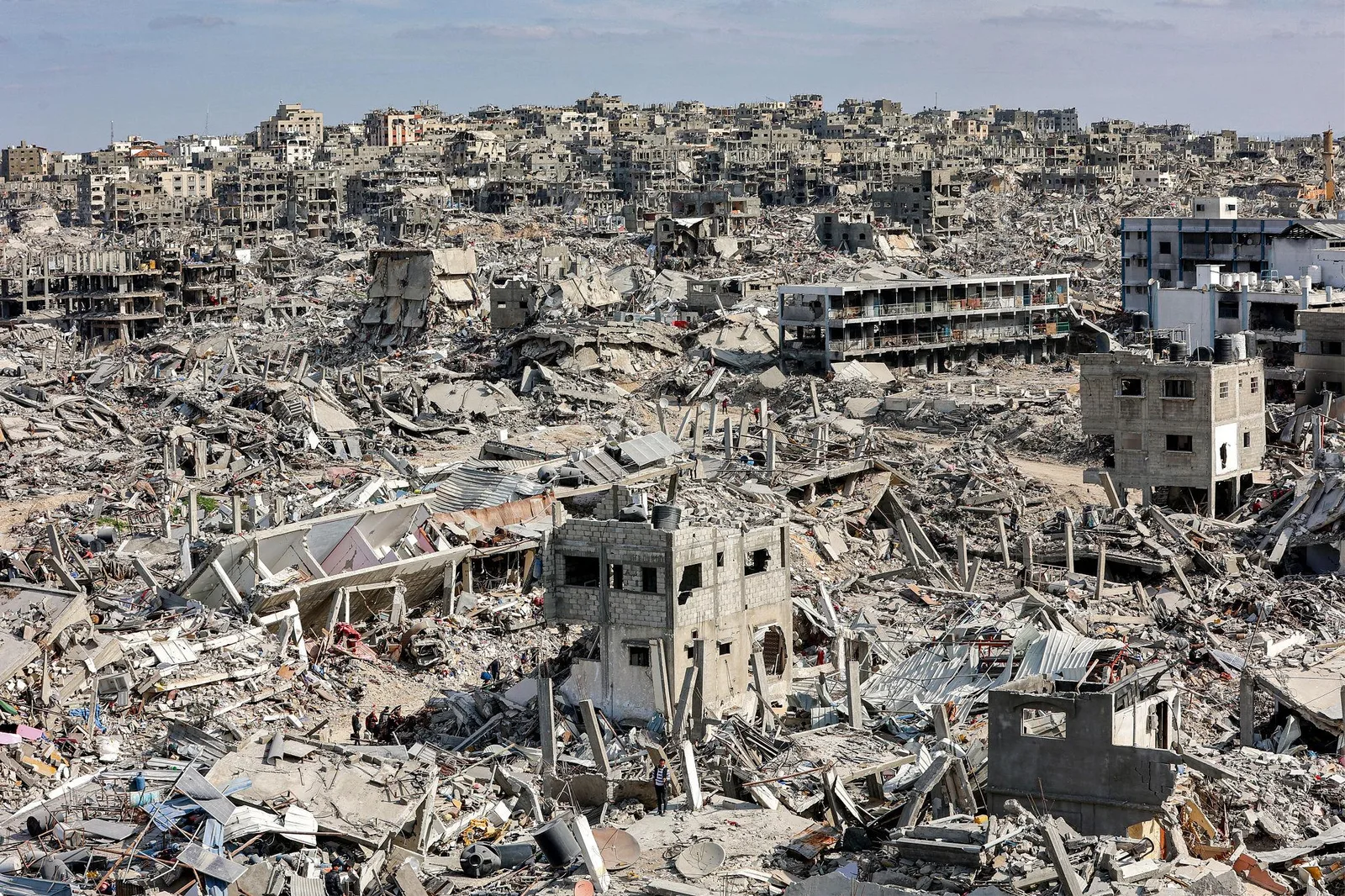
The number remains modest relative to the territory's size, the destruction of its infrastructure, and the scale of its security requirements. Nevertheless, it represents an important political signal. For the first time, the international mechanism envisaged since the ceasefire could begin to translate into an organized foreign military presence inside Gaza, with operational responsibilities distinct from those of the Israeli military.
The transition from planning to actual deployment has yet to be established. The reported authorization concerns an initial phase, while the precise arrangements governing the contingents' entry, areas of operation, and deployment schedule remain unresolved.
The significance extends beyond military considerations. Since October 2023, the conduct of the war and the security architecture of Gaza have largely been shaped by Israeli military power, confronting Hamas and other Palestinian armed organizations. The introduction of a multinational force would gradually alter that arrangement. It would create an additional actor responsible for contributing to security, civilian protection, and administrative transition.
This development would not mean the disappearance of Israeli influence or the end of the conflict. Instead, it could inaugurate a period in which several authorities coexist, with responsibilities and interests that do not necessarily align.
The Internationalization of Security
UN Security Council Resolution 2803 provides for a temporary stabilization force operating under unified command, in cooperation with Israel and Egypt. Its responsibilities include securing designated areas, supporting a reorganized Palestinian police force, protecting humanitarian operations, and facilitating demilitarization.
The framework is based on a phased process. As the international force establishes conditions considered sufficiently secure, Israeli forces would progressively withdraw according to arrangements linked to the disarmament of armed groups. An Israeli security presence along the perimeter could nevertheless remain under the envisaged framework.
This architecture introduces a fundamental distinction between territorial withdrawal and the relinquishment of strategic control. Israel could reduce its direct military presence in parts of Gaza while retaining decisive influence over security conditions, access arrangements, and the pace of transition.
For Washington, the objective is to transform a fragile ceasefire into a durable institutional mechanism without assuming direct American occupation of the territory. For participating states, the mission offers an opportunity to contribute to stabilization but also entails considerable political and military risks.
An international force perceived as an extension of Israeli security requirements rather than an instrument of protection and transition could face sustained local opposition. Conversely, a force lacking sufficient capabilities or credible rules of engagement could become another vulnerable actor in an already fragmented security environment.
The decisive issue will therefore be less the number of troops initially deployed than the nature of the authority they can effectively exercise.
Israel Between Two Governments
These developments coincide with an exceptional moment in Israeli politics. The October 27 legislative elections opened the possibility of a transfer of power after years of Benjamin Netanyahu's political dominance.
On November 8, President Isaac Herzog formally entrusted Gadi Eisenkot, a former military chief of staff and leader of the Yashar party, with the task of forming the next government. Presidential consultations had produced recommendations from 67 members of the Knesset in Eisenkot's favor, compared with 46 for Netanyahu, while seven lawmakers declined to recommend either candidate.
This parliamentary balance provides Eisenkot with a significant institutional advantage but does not yet guarantee the formation of a governing coalition. He must convert the support expressed during consultations into a parliamentary majority capable of operating despite differences among its constituent parties.
In the meantime, Netanyahu remains at the head of the outgoing government. The authorization of the initial international contingent therefore comes during a period in which security decisions continue to be taken by the incumbent administration, even as the prospect of its replacement becomes increasingly concrete.
The timing matters. The Gaza stabilization framework could be initiated under one government and implemented, expanded, or renegotiated by its successor.
Israel's political transition does not suspend its foreign or security policy. It does, however, introduce uncertainty regarding the continuity of its methods, priorities, and decision-making mechanisms.
Eisenkot and the Continuity of Israeli Security Doctrine
The possible arrival of Gadi Eisenkot in power should not automatically be interpreted as a fundamental break with Israel's established security doctrine.
As a former chief of staff, Eisenkot himself comes from the country's military establishment. His political trajectory is rooted in a strategic culture that places considerable emphasis on deterrence, intelligence, operational superiority, and the prevention of security threats.
The potential difference with Netanyahu may therefore lie less in the definition of Israel's security interests than in the methods used to pursue them.
An Eisenkot government might seek more structured coordination with Washington, place greater emphasis on multilateral arrangements, and view Gaza's stabilization as a means of reducing Israel's direct military exposure. These possibilities remain hypotheses, however, until the composition of the coalition, its governing program, and its principal officeholders become clear.
Domestic political constraints would also be substantial. Israeli society remains deeply affected by the October 7, 2023 attacks, the subsequent war, the human losses, and the controversies surrounding the state's institutional responsibilities.
A new administration would face simultaneous expectations: restoring confidence in public institutions, guaranteeing security, preserving relations with the United States, and defining a strategy for Gaza that does not indefinitely reproduce the conditions of conflict.
The challenge would be to move from a framework dominated by continuous military operations toward a political and security doctrine capable of managing the postwar environment.
A Broader Institutional Transformation
The political transition extends beyond Gaza. It also concerns the organization of Israeli state power, relations between the government and the judiciary, and mechanisms of political accountability.
The political forces opposing Netanyahu have expressed their intention to revisit institutional changes pursued under his administration and establish responsibility for the failures preceding the October 2023 attacks.
A change in government could therefore alter relations among the executive, judiciary, parliament, and security institutions. It would not, however, automatically constitute a change of regime in the constitutional sense. Israel would remain a parliamentary democracy whose fundamental institutions would not be replaced simply because a new coalition assumed office.
This distinction is essential to understanding the regional consequences of the transition.
A different government could restore certain institutional checks, change decision-making practices, and redefine relations with international partners without abandoning the state's principal strategic priorities.
In Gaza, such an evolution might encourage a clearer separation between Israeli security objectives and civilian responsibilities assigned to a Palestinian administration. Yet that separation would depend on concrete decisions concerning borders, freedom of movement, resources, and the local administration's ability to exercise genuine authority.
The question is therefore not merely whether Netanyahu leaves office, but whether the institutional and strategic practices associated with his governments can be substantially revised.
The Unresolved Question of Palestinian Authority
An international stabilization force cannot, by itself, provide a political settlement.
The Washington-backed framework envisages a Palestinian technocratic administration responsible for public services and civilian functions under the transitional supervision of the Board of Peace. Reconstruction and military withdrawal are linked to security commitments, including the disarmament of armed organizations.
This arrangement presents a structural difficulty: it seeks to establish administrative authority before the conditions for clearly defined political sovereignty have been secured.
The risk is the emergence of fragmented governance, in which a Palestinian administration manages everyday needs, foreign forces provide part of the security, and Israel retains the capacity to intervene or control essential parameters.
Such an arrangement could reduce violence in the short term without resolving the underlying question of political legitimacy.
Rebuilding Gaza requires investment, infrastructure, and security guarantees. It also requires residents to be able to identify an authority accountable to them, capable of making decisions and implementing them.
Without a credible political horizon, stabilization could become an extended system of transitional administration rather than a step toward a durable settlement.
The distinction between administering a territory and establishing legitimate government will be central to the success or failure of the international initiative.
Washington as the Architect of Transition
The American role represents another major transformation.
The United States is no longer acting solely as Israel's military supporter or as a diplomatic mediator. It is increasingly involved in designing a framework combining multinational military command, transitional civilian administration, regional coordination, and reconstruction financing.
This evolution gives Washington more direct responsibility for the outcome of the process.
The American administration must reconcile objectives that may prove difficult to achieve simultaneously: securing the progressive withdrawal of Israeli forces, preventing Hamas from rebuilding its military capabilities, mobilizing contributing states, and supporting the emergence of a Palestinian administration sufficiently credible to function.
Israel's governmental transition could facilitate some negotiations if the next administration adopts a more cooperative approach. It could also expose disagreements over withdrawal conditions, the international force's operational authority, and the role of Palestinian institutions.
The initial deployment would therefore constitute a test of American influence. It would help determine whether Washington can translate a diplomatic agreement into an effective security structure, including when the priorities of local actors diverge.
The broader implication is that the United States would assume a more direct role in managing the political consequences of the conflict, even without deploying a conventional occupation force.
An Uncertain Transition Beyond the War
The authorization of 250 foreign military personnel does not mark the end of the Gaza war. Rather, it indicates that the actors involved are attempting to construct a mechanism intended to prevent a large-scale resumption of hostilities and organize the transition toward a different form of governance.
The significance of this development will depend on several unresolved conditions: the actual entry of foreign contingents, their ability to secure designated areas, the corresponding withdrawal of Israeli forces, the position of Palestinian armed organizations, and the establishment of a civilian administration with genuine operational capabilities.
Israel's elections add a decisive political dimension to this process. The government that may succeed Netanyahu will inherit a framework already set in motion, but one whose political balance remains largely undefined.
The central question will therefore not simply be whether Israel changes its prime minister. It will be whether that transition can alter how the state approaches security, institutional accountability, and its relationship with the Palestinians.
In Gaza, direct warfare could gradually give way to an international architecture of stabilization. But transferring military responsibilities does not yet amount to a political settlement.
Between the withdrawal of forces, the reconstruction of the territory, and the formation of a new Israeli government, a different regional configuration is beginning to emerge. Its institutions, boundaries of authority, and political horizon remain unsettled.
The war may be entering a new framework. Whether that framework can produce a different political outcome remains the defining question.
Principal Sources
United Nations Security Council — Resolution 2803 (2025), establishing the framework for the International Stabilization Force and transitional arrangements for Gaza.
United Nations — Board of Peace reporting, including document S/2026/418, concerning the implementation of the stabilization framework.
Office of the President of Israel — November 8, 2026 announcement concerning the mandate given to Gadi Eisenkot to form a government.
Associated Press — November 2026 reporting on the Israeli electoral transition, coalition negotiations, and Eisenkot's institutional agenda.
Israeli media reporting, including Walla, November 9, 2026 — Reported authorization of the initial multinational military contingent for Gaza.
Atlas Limits Research Desk
Atlas Limits’ editorial and analytical desk.