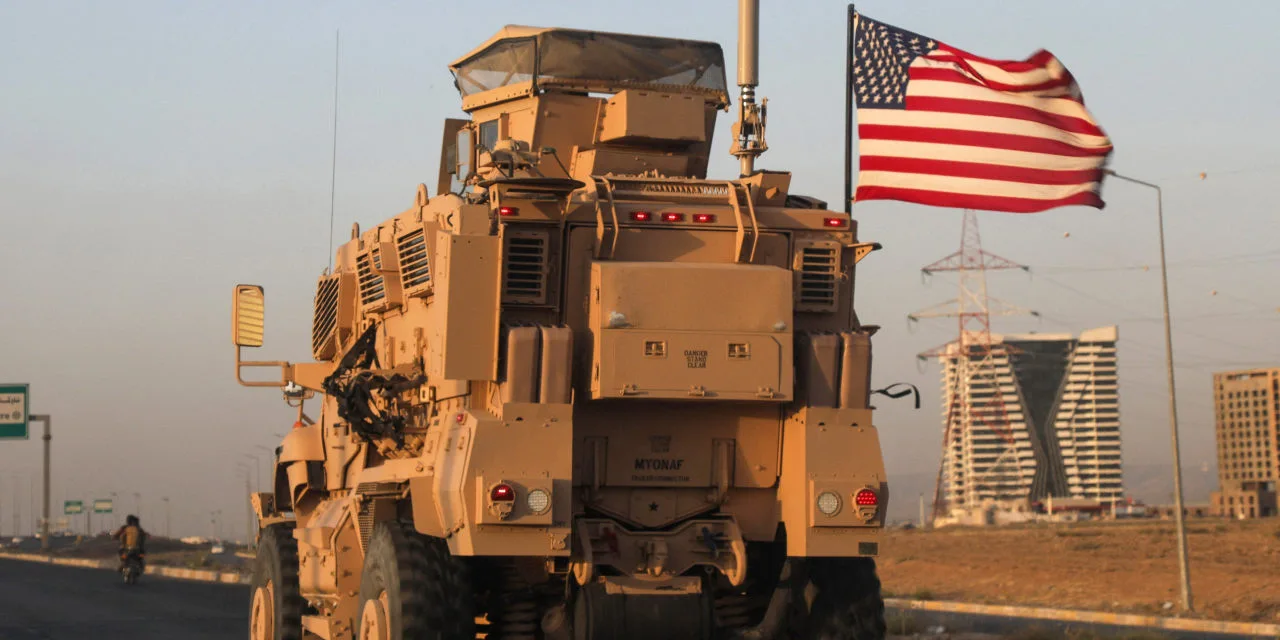
Twenty-three years after the first American troops entered Baghdad, the last ones are leaving Iraq. The movement is infinitely quieter than it was in 2003. There are no armored columns converging on the capital, no statues falling before the cameras of the world. A few hundred soldiers, military equipment, air-defense systems and infrastructure being gradually dismantled are now enough to close one of the longest chapters of American military involvement in the early twenty-first century.
The last U.S. forces stationed on Iraqi bases are due to leave the country by September 30, 2026. The final movement was still underway on the eve of that deadline. It represents the second stage of the agreement reached between Washington and Baghdad in September 2024: the international coalition’s military mission in federal Iraq had already ended in September 2025, while a residual presence was maintained primarily in the Kurdistan Region to support operations against the Islamic State in Syria.
That presence is now disappearing as well.
At its peak in 2007, the American deployment in Iraq exceeded 170,000 troops. Around 2,500 remained when the withdrawal timetable was announced in 2024. More than 4,500 U.S. service members have been killed in the country since the March 2003 invasion.
But the numbers only partially explain what is disappearing today. The American footprint had become relatively small. Its strategic function remained considerable.
A Small Deployment at the Center of a Larger Balance
Contemporary Iraq occupies an unusual position in the Middle East. It maintains a military partnership with the United States while preserving deep political, economic and security ties with Iran. Within its own security system coexist forces directly subordinate to the Iraqi state and armed groups with historical, ideological or operational links to Tehran.
For years, Baghdad has lived with this contradiction.
The American presence did not eliminate Iranian influence. Nor did it prevent Tehran-aligned militias from existing, participating in political life or retaining their own military capabilities. But it introduced an external counterweight into the Iraqi system, significant enough to prevent any single regional axis from completely dominating the country’s security environment.
That counterweight is disappearing just as relations between Washington and Tehran have crossed another threshold of confrontation.
The paradox is striking. The United States is reducing its ground exposure in Iraq precisely when Iraqi territory has regained major strategic importance in the regional confrontation with Iran. According to Reuters, seven of the eighteen U.S. military personnel killed since the beginning of the current conflict with Tehran have died in Iraq. An American sergeant was among those killed in July during an operation to neutralize a drone near Erbil.
Leaving Iraq therefore reduces the number of American targets directly accessible to hostile armed groups. But it also reduces Washington’s ability to observe, influence and, when necessary, intervene rapidly in one of the Middle East’s most sensitive strategic spaces.
Vulnerability decreases. So does strategic depth.
Sovereignty and Its Paradox
For Baghdad, the American departure carries a different meaning.
For years, the presence of foreign troops has been a politically sensitive issue. The Iraqi government can now present the September 30 deadline as the culmination of a normalization process: the Islamic State no longer controls significant territory in Iraq, national security forces are incomparably stronger than they were in 2014, and a permanent foreign military presence cannot indefinitely be justified by circumstances that emerged more than two decades ago.
Seen from this perspective, the withdrawal represents a restoration of sovereignty.
But sovereignty is not measured solely by the absence of foreign soldiers.
It is also measured by a state’s ability to exercise a monopoly on force within its own borders.
This is where Iraq’s difficulty begins.
Several armed groups close to Iran remain integrated, directly or indirectly, into the broader Popular Mobilization Forces system. Created in the context of the fight against the Islamic State, the PMF formally belong to Iraq’s security architecture. Some of their components nevertheless retain their own political structures, economic networks and significant operational autonomy.
Efforts to place all these forces under an uncontested chain of command remain incomplete.
The American departure may therefore produce two movements simultaneously: increasing Iraq’s autonomy from Washington while mechanically increasing the relative weight of Iraqi actors most closely connected to Tehran.
That is the central ambiguity of the new phase.
Iraq is becoming more sovereign in relation to one foreign power. It must still demonstrate that it can exercise sovereignty over all the forces operating within its own territory.
The Islamic State Has Not Disappeared
A second uncertainty lies beyond Baghdad’s political balance.
The Islamic State is no longer the territorial power that captured Mosul in 2014 and controlled a vast area stretching across Syria and Iraq. Iraqi forces today possess far greater experience, equipment and operational capabilities than they did during that collapse.
But the organization has not disappeared.
It now operates primarily through clandestine cells capable of exploiting weakly controlled areas, desert terrain and political or communal fractures.
Iraqi and Kurdish security officials have recently reported movements attributed to dormant cells and raised the possibility of attacks intended to coincide with the American withdrawal. These operational claims have not been independently verified and should therefore be treated cautiously.
The question, however, extends beyond the existence of an immediate threat.
For years, the United States provided capabilities that are difficult to reproduce quickly: technical intelligence, aerial surveillance, drones, logistical support, coordination and access to a regional intelligence architecture. Iraqi forces can fight an insurgency on their own. Replacing the entire infrastructure supporting that fight is another matter.
The principal risk is probably not the sudden return of the territorial caliphate of 2014. It is more diffuse: an increase in attacks, greater freedom of movement for clandestine cells and the gradual reconstitution of local sanctuaries in areas where state authority remains incomplete.
The American withdrawal will therefore also be a test of maturity for Iraq’s security apparatus.
A Different Regional Map
Washington is not, of course, disappearing from the Middle East.
The United States still maintains an extensive network of forces and military facilities across the region. Military cooperation with Baghdad can also continue in other forms: training, arms sales, intelligence, liaison officers or specific bilateral arrangements.
But a military relationship is not the same thing as a military presence.
From Iraq, the United States stood at the intersection of three strategic spaces: the Gulf, Syria and Iran. That geography shortened logistical chains, provided intelligence capabilities close to operational theaters and supported forces engaged against the Islamic State in Syria.
Some of those functions will now have to be performed from outside Iraq.
That means greater dependence on regional bases, overflight permissions, transit agreements and the political decisions of partner governments. In a region where alliances are rarely absolute and governments increasingly seek to preserve several relationships simultaneously, that difference is not insignificant.
The Iraqi withdrawal therefore reflects a broader transformation of the American presence in the Middle East: fewer permanently exposed ground forces, greater reliance on air, naval and technological power, and more capabilities designed to operate from a distance.
The footprint becomes lighter.
The distance grows.
What Remains After Twenty-Three Years
It would nevertheless be misleading to interpret September 30 simply as an Iranian victory or as the disappearance of the United States from the Iraqi system.
Iraq in 2026 is no longer the country it was in 2003, or even in 2014. For several years, its government has sought to maintain simultaneous relationships with Washington, Tehran, the Gulf monarchies, Turkey and other regional powers. Diversifying these relationships is precisely one of the mechanisms through which Baghdad has tried to avoid once again becoming the permanent battleground of its neighbors.
The American departure gives Iraq more room to pursue that strategy.
It also removes one of the instruments that helped sustain it.
American troops were no longer numerous enough to determine Iraq’s future on their own. They were still numerous enough to alter the calculations of those seeking to determine it.
That is the difference now disappearing.
In 2003, Washington entered Iraq with the ambition of transforming a state. Twenty-three years later, it is leaving behind a country that has survived occupation, civil war, territorial jihadism and the rivalry among the powers surrounding it.
The final test begins precisely as the last soldiers leave.
Iraq is recovering a freedom it has demanded for years. It must now answer a more difficult question: when weapons speak on its territory, who really has the final word?
Main sources
- Reuters — September 29, 2026 — US forces exit Iraq after two decades, leaving opening for Iran. Final U.S. withdrawal, September 30 deadline, Iran-aligned armed groups, Islamic State risks and the broader security consequences for Iraq.
- Reuters — US forces exit Iraq after two decades
- U.S. Department of State — September 27, 2024 — Joint Statement Announcing the Timeline for the End of the Military Mission of the Global Coalition to Defeat ISIS in Iraq. Primary document establishing the transition timetable and the framework for the U.S.–Iraq bilateral security relationship.
- U.S. Department of State — Joint Statement on the Coalition Mission in Iraq
- Associated Press — September 2026 — Reporting on the final U.S. troop withdrawal, the residual deployment in the Kurdistan Region, regional redeployment and the position of Iran-aligned armed groups.
- Associated Press — U.S. withdrawal from Iraq
- U.S. Department of Defense — Official material on the transition from the Global Coalition’s military mission toward a bilateral U.S.–Iraq security partnership and the evolution of the American military presence.
Atlas Limits Research Desk
Atlas Limits’ editorial and analytical desk.