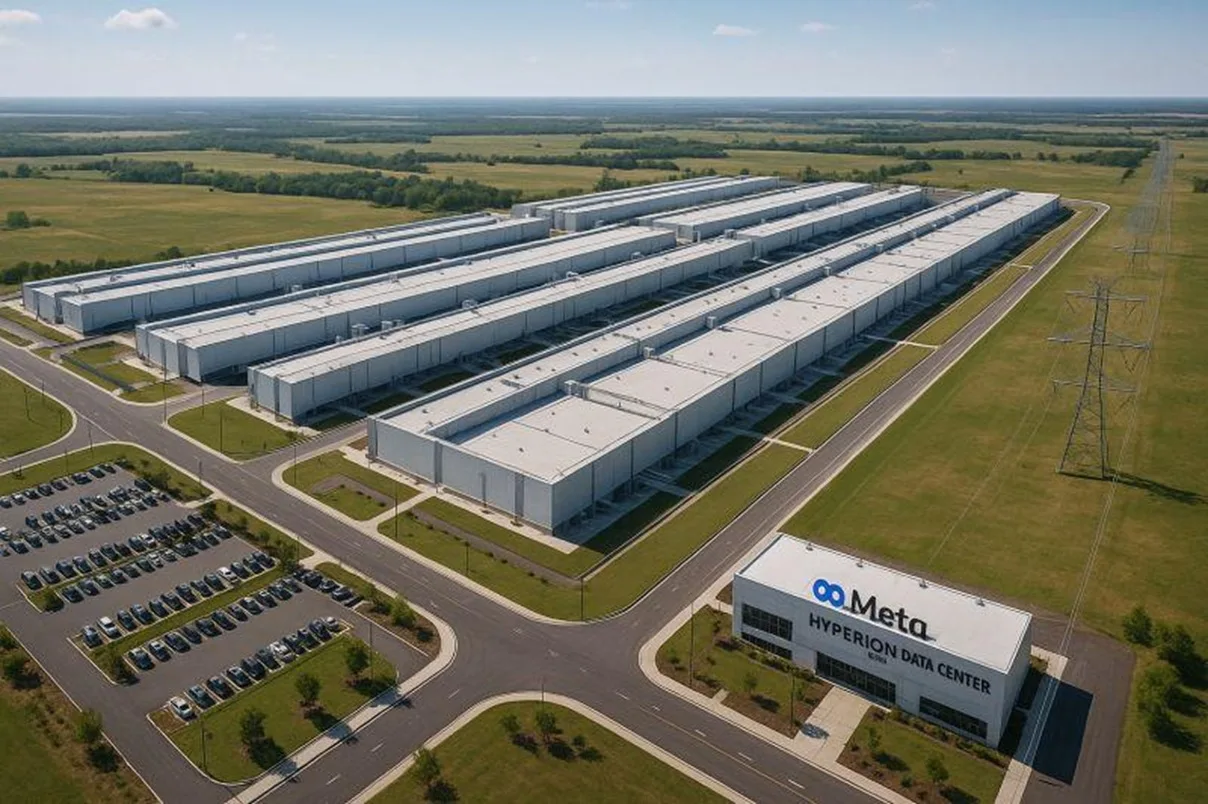
On October 21, 2026, Meta Platforms reported financial results that captured one of the most significant contradictions in the contemporary technology economy. The American group continues to expand its revenues at a remarkable pace, supported by digital advertising and the growing efficiency of its platforms. Yet, even as its established business demonstrates its commercial strength, the investments required to pursue its artificial intelligence ambitions are now absorbing more than its quarterly operating cash generation. The company expects to allocate between $135 billion and $145 billion to capital expenditures in 2026, a commitment that illustrates the extraordinary scale of the global competition for computing power.
The third quarter offered a particularly revealing picture of this transformation. Revenue reached $64.6 billion, an increase of 26% year over year. Cash flow from operating activities amounted to $32.79 billion. However, capital expenditures, including principal payments on finance leases, reached $34.91 billion. Free cash flow consequently turned negative, at $2.12 billion, compared with a surplus of $10.63 billion a year earlier. This development does not indicate a collapse in the underlying business. Rather, it reveals a change in financial conditions: one of the most profitable companies in the digital economy must now mobilize capital on a scale comparable to that of major infrastructure industries.
The distinction is fundamental. Meta is not experiencing a revenue crisis, nor do its results demonstrate that its artificial intelligence investments are unproductive. They show that the pace at which the company is building computing capacity has exceeded, during the quarter, the rate at which its business generates cash after capital expenditures. For financial markets, the question is therefore no longer simply whether artificial intelligence will transform the economy, but how quickly that transformation can generate sufficient returns to justify the capital being committed.
From Digital Platform to Industrial Powerhouse
For nearly two decades, major digital platforms benefited from an exceptionally favorable economic model. Once their initial infrastructure had been developed, they could distribute services to hundreds of millions, and eventually billions, of users at relatively limited marginal cost. Targeted advertising, network effects and the accumulation of data enabled them to generate high margins and substantial cash flows.
Generative artificial intelligence is changing this equation. Developing and operating advanced models requires specialized data centers, graphics processing units, ultra-high-speed communications networks, cooling systems and uninterrupted electricity supplies. Unlike conventional digital applications, expanding capacity does not depend solely on distributing software. It requires the construction, acquisition and continuous renewal of expensive physical assets.
Meta is deeply involved in this transformation. The company is investing simultaneously in the infrastructure supporting its existing operations, in the training of artificial intelligence models and in the computing capacity required to deploy them at scale. These expenditures are not exclusively associated with experimental projects. Some directly support recommendation systems, content ranking, advertising and features already integrated into Facebook, Instagram and WhatsApp.
This dual application represents a strategic advantage. Unlike a company that must establish an entirely new market to recover its investments, Meta already possesses a global commercial base. Its platforms served approximately 3.64 billion daily active people in September 2026, according to the consolidated metric published by the company. Even a relatively modest improvement in advertising monetization, applied across such an extensive user base, can generate substantial additional revenue.
Yet this advantage does not eliminate the financial constraint. It shifts its location. Meta must now demonstrate that the gains generated by artificial intelligence are increasing rapidly enough to absorb the costs of an infrastructure whose scale continues to expand.
The $145 Billion Threshold
The investment forecast announced for 2026 represents a fundamental change in magnitude. The projected range of $135 billion to $145 billion includes capital expenditures and principal payments on finance leases. It therefore represents neither spending devoted exclusively to artificial intelligence models nor cash already disbursed throughout the year.
At its upper limit, the forecast amounts to more than half of a theoretical annual revenue figure calculated by multiplying third-quarter sales by four. This comparison is not a forecast of annual revenue, but it illustrates the capital intensity of the investment program.
During the first nine months of 2026, Meta spent $83.06 billion on purchases of property and equipment, compared with $48.31 billion during the corresponding period in 2025. The increase approaches 72%. Principal payments on finance leases also rose, bringing investment measured according to the company's broader definition to approximately $85.82 billion over nine months.
These figures reflect an industrial acceleration whose consequences will extend well beyond the current financial year. Data centers, electricity networks and computing equipment involve long-term commitments. They subsequently generate operating, maintenance and replacement costs. Specialized processors may also experience rapid economic obsolescence when new generations deliver superior computing performance or energy efficiency.
The risk therefore lies not only in the initial amount invested. It also concerns the period during which each generation of infrastructure can generate satisfactory economic returns.
Profitability Beneath the Growth
Meta's quarterly results require careful interpretation. Net income reached $9.86 billion, compared with $2.71 billion a year earlier. At first glance, this increase might appear to contradict concerns about the company's profitability.
The comparison, however, is affected by exceptional items. The third quarter of 2026 included a $9.89 billion charge related to a settlement with several US state attorneys general concerning the effects of social media on adolescent mental health. Conversely, the third quarter of 2025 had been heavily affected by an exceptional tax charge.
Reported operating income declined from $20.54 billion to $12.99 billion, while the operating margin fell from 40% to 20%. Excluding only the 2026 legal charge, quarterly operating income would have reached approximately $22.88 billion. The underlying business therefore appears considerably more resilient than the reported margin alone suggests.
This distinction prevents three separate developments from being confused: the company's commercial growth, exceptional charges recognized in its financial statements and the intensification of its investment program.
The most significant financial tension emerges in cash flows. During the third quarter, operating activities generated $32.79 billion, exceeding the approximately $30 billion recorded a year earlier. Yet this improvement was insufficient to offset the increase in capital expenditures.
Over the first nine months of the year, Meta nevertheless maintained positive free cash flow of $11.05 billion. The company is therefore not structurally incapable of financing its operations. It is choosing to accelerate industrial commitments to the point of substantially reducing its immediate financial flexibility.
Financing Becomes a Strategic Question
At the end of September 2026, Meta held $82.45 billion in cash, cash equivalents and marketable securities. This reserve provides considerable capacity to sustain its investments. Nevertheless, the company is also turning to capital markets.
During the first nine months of 2026, a debt issuance completed in May generated approximately $24.91 billion in net proceeds. The transaction illustrates a broader development: even companies with highly cash-generative businesses may find it advantageous to combine internal financing, debt and other financial instruments to support their expansion into artificial intelligence.
On October 21, Meta also announced plans to introduce a new class of publicly traded, non-voting Class C common stock, with implementation expected in January 2027. The company presented the structure as a means of facilitating future capital raising, equity compensation, acquisitions and other strategic transactions while preserving its founder-centered governance model.
The decision is particularly revealing. It directly connects the scale of investment required for artificial intelligence with a transformation of the company's financial architecture.
Potential new equity issuance could help finance projects without proportionately increasing debt, but it could also dilute existing shareholders. Debt financing better preserves existing ownership in the short term, while introducing interest expenses and repayment obligations. Internal financing limits dependence on capital markets but reduces the resources available for share repurchases, dividends or other investments.
Every option carries a cost. Financial strategy is consequently becoming inseparable from technological strategy.
Markets Begin to Price the Risk
Investors' reaction to the October 21 results illustrates this growing sensitivity. On October 22, Meta shares declined by approximately 6.1%, while the cost of protection against default on its five-year debt, measured through credit default swaps, reached a record level near 115 basis points, according to Reuters.
Such a movement does not mean that Meta faces an imminent solvency crisis. It indicates that investors are demanding greater compensation for assuming certain risks associated with its financing requirements and future prospects.
The change is significant. During the initial expansion of generative artificial intelligence, financial markets largely rewarded announcements of additional computing capacity, processor purchases and data center construction commitments. Higher investment could be interpreted as evidence of strategic strength.
As the amounts involved become larger, the assessment grows more complicated. Additional spending may reinforce a company's competitive position, but it may also reduce free cash flow, increase indebtedness or weigh on valuation if expected revenues take longer to materialize.
The issue extends beyond Meta. It concerns the entire ecosystem involved in constructing artificial intelligence infrastructure, from cloud service providers and data center operators to semiconductor manufacturers and energy companies.
Markets are increasingly distinguishing between the expansion of computing capacity and the actual creation of economic value.
An Industrial Supply Chain Under Pressure
Meta's investments extend across an ecosystem far broader than digital platforms. Every data center requires advanced semiconductors, memory systems, networking equipment, transformers, electrical installations, cooling infrastructure and specialized construction work.
This demand benefits several industrial segments, but it also creates constraints. Electricity grid connection delays can slow the opening of new facilities. Manufacturing capacity for the most advanced components remains concentrated among a limited number of companies. Water requirements, energy availability and land constraints complicate certain projects. Supply chains must absorb massive orders while the underlying technologies continue to evolve rapidly.
Artificial intelligence is therefore bringing digital companies closer to the traditional logic of heavy industry: securing supplies, ensuring energy availability, controlling construction costs and planning long-term capacity.
This transformation also introduces a geopolitical dimension. Access to advanced components depends on international trade relationships, export restrictions and the industrial capabilities of a small number of territories. The location of data centers is increasingly influenced by electricity prices, regulatory conditions and infrastructure security.
Computing power is gradually becoming a strategic asset whose economic and political significance resembles, in certain respects, that of major transportation, telecommunications and energy infrastructure.
The Risk of Excess Capacity
One of the central economic challenges concerns uncertainty about future demand. Companies are constructing infrastructure today to meet requirements that are not yet fully observable.
Computing demand could continue to expand rapidly with the proliferation of autonomous agents, personal assistants, industrial applications and multimodal systems. But the trajectory is unlikely to be linear. Improvements in model efficiency may reduce the computing resources required for individual tasks, while better performance may simultaneously encourage entirely new applications.
Predicting the exact quantity of computing power required three or five years from now is therefore exceptionally difficult.
Expanding too slowly could prevent Meta from developing its models or meeting demand. Expanding too rapidly could leave some equipment underutilized, increase depreciation expenses and reduce returns on invested capital.
The problem becomes particularly complex when several competitors build their own capacity simultaneously. Each company may have an individual incentive to invest in order to avoid technological dependence. Collectively, however, those decisions can generate supply exceeding commercially viable demand.
Similar mechanisms have appeared in other capital-intensive industries. Telecommunications, semiconductors and certain energy sectors have experienced cycles in which optimistic growth expectations triggered substantial investment, followed by periods of consolidation.
Artificial intelligence will not necessarily follow the same trajectory. But it remains subject to the fundamental principles governing capital allocation.
Advertising as the First Engine of Returns
Meta nevertheless possesses a considerable advantage: its investments can improve a business that is already highly profitable.
During the third quarter of 2026, advertising impressions increased by 10% year over year, while the average price per advertisement rose by 14%. Together, these developments contributed to 26% growth in advertising revenue, which reached approximately $63.06 billion.
Artificial intelligence contributes to several dimensions of this performance. It improves content recommendations, advertising relevance, creative tools and campaign optimization. A greater ability to predict user interests can increase engagement and improve outcomes for advertisers.
The profitability of these applications may materialize more quickly than that of entirely new artificial intelligence services still under development.
This is why Meta's investment program cannot be assessed solely by searching for revenue directly attributable to its most advanced models. Some returns emerge indirectly through improvements in established activities.
The difficulty lies in measuring those returns precisely. Advertising revenue growth also depends on economic conditions, advertiser demand, pricing, changes in user behavior and competition. Consolidated financial results do not make it possible to isolate perfectly the contribution of each technological investment.
Meta maintains that its artificial intelligence investments are already generating substantial incremental advertising revenue. This assertion is consistent with its strategy, but it does not, by itself, constitute an independent measurement of the return on its entire infrastructure portfolio.
The Long Horizon of Capital
The gap between immediate expenditure and future revenue lies at the center of the financial equation.
A data center may require several years of preparation and construction. Equipment must subsequently be installed, tested and integrated into existing systems. Models must be developed, trained and deployed. Commercial applications may require additional time before achieving satisfactory profitability.
During this period, expenditures are concrete, while economic benefits remain partly anticipated.
Meta itself acknowledges that some of its newer artificial intelligence initiatives will take longer to generate returns than its established businesses. The company nevertheless considers that monetization opportunities, internal efficiency gains and product improvements justify substantial investment beyond 2026.
This approach may be rational for a company with a strong competitive position and considerable financial resources. It nevertheless depends on one condition: the assets constructed today must remain economically useful long enough to generate the expected returns.
As commitments increase, forecasting errors become more expensive. A delay of several quarters in commercializing a product may be manageable at a small scale. For infrastructure representing tens of billions of dollars, the same delay can materially alter financial prospects.
A New Discipline for the AI Economy
Meta's latest results represent less a rejection of artificial intelligence than a change in the criteria used to assess its economic value.
The first phase of the competition was dominated by model performance, processor availability and the speed of infrastructure expansion. The next phase will require more precise answers concerning actual capacity utilization, revenue generation, efficiency gains and returns on invested capital.
Investors will also need to distinguish between companies selling the equipment required for this expansion and those purchasing, financing and ultimately attempting to monetize it. The former may benefit relatively quickly from incoming orders, while the latter assume greater exposure to uncertainty surrounding final demand.
For Meta, the stakes are particularly high. The company possesses a global user base, a powerful advertising business and considerable financing capacity. Yet these advantages do not make the amount of capital it can deploy without changing its financial profile unlimited.
The proposed introduction of non-voting shares, the use of bond markets and the contraction in free cash flow already illustrate this transformation.
Over time, competition may favor not only the companies capable of building the most powerful infrastructure, but above all those able to use it with the greatest economic efficiency.
The race for artificial intelligence is therefore entering a more demanding stage. It is no longer sufficient to demonstrate that a technology can perform more tasks, or even that it can transform entire markets. Companies must now show that the value created by this transformation will sustainably exceed the cost of the capital required to make it possible.
Meta still possesses the resources to pursue its ambitions. But its financial results underscore a reality that technological enthusiasm has sometimes pushed into the background: even the most powerful companies must eventually confront their promises of the future with the economics of their investments.
The true frontier of artificial intelligence may now lie as much in corporate balance sheets as in research laboratories.
Main Sources
- Meta Platforms — Third Quarter 2026 Results, October 21, 2026. https://investor.atmeta.com/investor-news/press-release-details/2026/Meta-Reports-Third-Quarter-2026-Results/
- Meta Platforms — Quarterly Report, Form 10-Q, quarter ended September 30, 2026, SEC. https://www.sec.gov/Archives/edgar/data/1326801/000162828026066773/meta-20260930.htm
- Meta Platforms — Second Quarter 2026 Results, July 2026. https://investor.atmeta.com/investor-news/press-release-details/2026/Meta-Reports-Second-Quarter-2026-Results/
- Reuters — Meta's credit risk indicator hits record high on increased AI spending plan, October 22, 2026. https://www.reuters.com/business/metas-credit-risk-indicator-jumps-record-high-after-results-2026-10-22/
Atlas Limits Research Desk
Atlas Limits’ editorial and analytical desk.