On the night of September 19–20, Moscow was not simply attacked. It confronted a scale of threat that is gradually changing the geography of the war in Ukraine.
According to Russian authorities, more than 1,600 drones have been intercepted since Saturday across multiple approaches, including 450 reportedly heading toward the capital. Russia’s Defense Ministry says 1,110 aircraft were destroyed during the night alone over Russian territory, annexed Crimea and the Black Sea. These exceptionally high figures come from Russian sources and cannot be independently verified in their entirety.
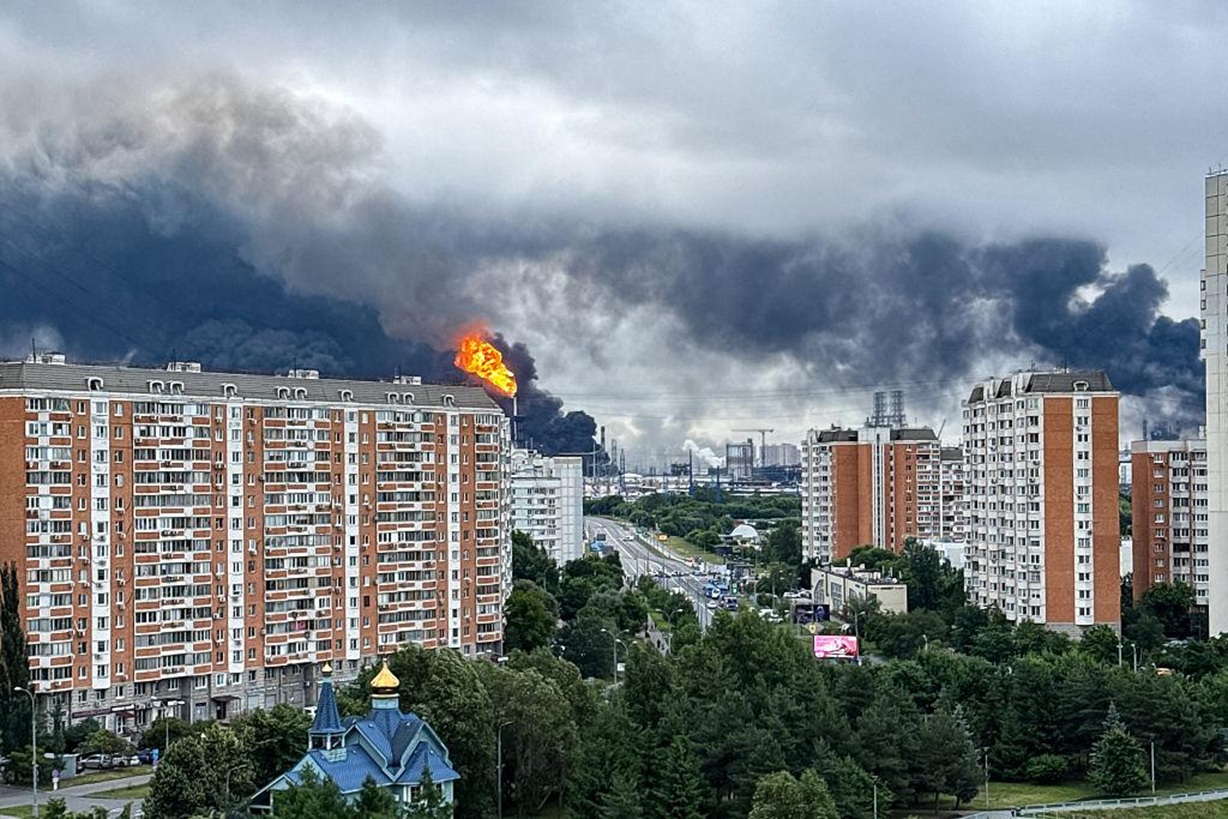
The uncertainty surrounding the exact numbers does not alter the central point. Several drones penetrated the layers of defense protecting Moscow. The capital’s oil refinery was hit. Reuters witnesses reported hearing explosions and seeing columns of smoke rising from the complex. Residential buildings were also struck in the Moscow region. Two people were killed, around twenty were injured according to regional authorities, and approximately 400 residents of an apartment building in Ramenskoye had to be evacuated.
The casualties give the attack an immediate human dimension. Its strategic significance, however, lies elsewhere. Since the beginning of Russia’s full-scale invasion of Ukraine, Moscow has built one of the country’s densest air-defense environments around its capital. The September 20 operation suggests that the question is no longer simply whether a handful of Ukrainian drones can reach Moscow. It is increasingly whether Russia can sustainably defend an immense territory against waves that are becoming larger, more diverse and capable of penetrating deeper into the country.
Numbers Become a Weapon
Air defense traditionally operates according to a logic of quality: detect a threat, identify it, intercept it. The proliferation of drones introduces another variable — volume.
A defense system can be highly effective and still encounter limits when enough targets appear simultaneously. Radars must track them, command systems must prioritize them, electronic warfare systems must disrupt them, and air-defense batteries must have sufficient interceptors available. The attacker no longer necessarily needs every aircraft to penetrate the defense. Only a fraction needs to get through.
This is precisely what makes the figures announced by Moscow significant, even if they must be treated cautiously. If several hundred drones did indeed converge on the capital region, Ukraine is experimenting with a form of warfare in which mass itself becomes a strategic capability.
Russia claims to have intercepted the overwhelming majority of the aircraft. Yet several reached their targets or caused damage after interception. The relevant question is therefore not simply the interception rate. It is the cost of maintaining that rate as the number of incoming threats increases.
Every additional layer of protection deployed around Moscow requires radars, electronic warfare systems, crews and air-defense assets that cannot simultaneously be deployed elsewhere. Russia must protect its forces at the front, its air bases, ports, energy infrastructure and industrial centers while increasingly defending strategic sites across thousands of kilometers of territory.
Ukraine is therefore seeking not necessarily to eliminate Russian air defenses, but to force them to disperse.
Moscow Is No Longer Entirely in the Rear
The Russian capital still benefits from considerable strategic depth. It lies hundreds of kilometers from Ukrainian-controlled territory and remains protected by military systems on a scale unmatched by those surrounding many other Russian cities.
But the very concept of the strategic rear is changing.
For much of the war, Russia benefited from a fundamental geographical asymmetry. Ukraine regularly endured missile and drone strikes against its cities, power grid and industrial base, while most Russian infrastructure remained beyond the reach of Ukrainian weapons.
The development of Ukrainian long-range systems is gradually reducing that asymmetry.
President Volodymyr Zelensky confirmed the operation against Moscow and its surrounding region and said Ukrainian long-range weapons had been used. According to him, drones were accompanied by Flamingo cruise missiles. The attack therefore illustrates a broader development: Kyiv is gradually building a deep-strike capability that relies increasingly on systems produced on Ukrainian territory.
That autonomy matters as much as range. Domestically produced weapons can be employed with fewer political constraints than some Western-supplied systems. They can also be manufactured according to a different industrial logic: producing relatively simple vectors in large numbers rather than relying exclusively on a limited inventory of sophisticated missiles.
Long-range warfare is consequently becoming a war of production as well.
Energy at the Center of the Equation
The choice of the Moscow refinery is not incidental.
The facility processed approximately 11.6 million tonnes of oil in 2024, producing around 2.9 million tonnes of gasoline and 3.2 million tonnes of diesel. It is an important component of fuel supply for Moscow and the surrounding region. The precise extent of the damage caused on September 20 had not yet been established at the time of publication.
But the strike belongs to a much broader campaign.
For months, Ukraine has intensified attacks against Russian refineries, storage facilities, terminals and other energy infrastructure. These operations have already reduced part of the country’s refining capacity and contributed to strains in the supply of petroleum products as well as higher fuel prices in several regions.
The logic differs from attacking an oil field. Russia can continue extracting crude while encountering difficulties transforming it into gasoline, diesel or aviation fuel. Vulnerability then shifts toward complex industrial installations that are geographically concentrated and difficult to replace quickly.
The Moscow refinery lies only a few dozen kilometers from Russia’s political center. Its vulnerability therefore carries a dual significance: economic because of its function, strategic because of its location.
The Cost of Strategic Depth
Russia retains considerable military advantages and possesses a much larger long-range strike capability of its own. During the same period, Russian strikes continued to hit Ukrainian cities and infrastructure. Developments around Moscow therefore do not mean that the balance of air power has been reversed. They indicate instead that one of Russia’s structural advantages — the protective scale of its territory — is becoming less absolute.
This may be the most important consequence of the night of September 20.
For decades, territorial depth has been one of the foundations of Russian power. It complicated an adversary’s ability to reach the country’s political, industrial, energy and military centers simultaneously. Long-range drones do not eliminate that depth. They progressively increase the cost of defending it.
A refinery in Moscow, an air base hundreds of kilometers from the front and a logistics depot deep inside Russian territory must increasingly be incorporated into the same defensive architecture.
As the number of sites requiring protection grows, Russia faces an expanding trade-off: concentrate its best systems around priority centers or disperse them across an immense territory.
Saturation turns that trade-off into a potential vulnerability.
An Industrial War as Much as a Military One
The Moscow episode points to a transformation deeper than the simple extension of drone range.
In a war once dominated by the scarcity of precision missiles, a few dozen vectors could constitute a major operation. Industrial drone production now makes it possible to envisage attacks involving hundreds of aircraft, combined with missiles and potentially decoys. The sophistication of each individual system becomes less decisive than the ability to manufacture, coordinate and launch a sufficient mass of them.
The defender must succeed almost every time. The attacker can achieve a strategic effect with only a small number of penetrations.
This imbalance does not mean air defenses are becoming irrelevant. The interceptions claimed by Moscow suggest, on the contrary, that they probably prevented substantially greater destruction. But their mission is changing: they must now absorb volumes that would have been difficult to imagine at the beginning of the conflict.
This is also an economic competition. If the marginal cost of an additional drone becomes sufficiently low, the attacker can seek to impose disproportionate expenditures on the defender while forcing it to protect an expanding number of facilities.
The central question is therefore no longer purely technological. It is becoming industrial: who can most sustainably produce, replace and deploy the systems required for this form of aerial attrition?
The Gradual Disappearance of the Sanctuary
Moscow Mayor Sergei Sobyanin has claimed that the attack was intended to disrupt Russia’s parliamentary elections, whose final day of voting was taking place on Sunday. No independent evidence currently establishes that intention.
The strategic significance of the event does not depend on that interpretation.
The central development lies elsewhere: several years into the war, the geographical space in which it is being fought continues to expand. After the front, Crimea, Russian air bases and oil infrastructure, the Moscow region itself is becoming a recurring theater of confrontation.
The capital has not become indefensible. Russia has not lost its strategic depth. But it must devote growing resources to protecting it.
And when several hundred drones can converge on one of the best-defended cities in the country while only a handful need to penetrate its defenses to reach strategic infrastructure, a new equation emerges.
In this war, distance still provides protection.
It no longer provides sanctuary.
Main Sources
Reuters, September 20, 2026; statements by Moscow Mayor Sergei Sobyanin and Moscow Region Governor Andrei Vorobyov; Russian Ministry of Defense; statements by Volodymyr Zelensky; corroborating reporting by the Financial Times and Meduza.
Atlas Limits Research Desk
Atlas Limits’ editorial and analytical desk.