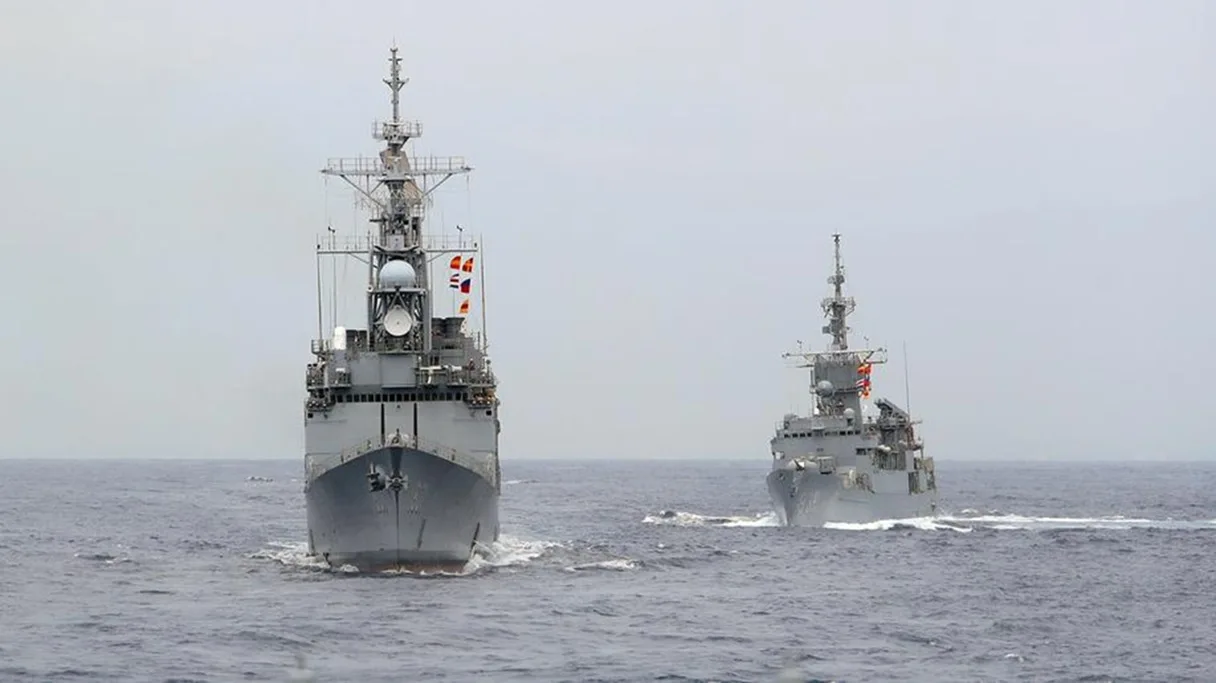
Taiwan's eastern coast gives the island access to the Pacific that scenarios focused on the strait alone do not fully capture. Pressure in that area would concern supply routes and possibilities for external assistance. It would change distances, required capabilities and the risks accepted by ships seeking to reach the island, rather than merely extend western exercises across a map.
In their declaration published on 11 November 2026 after meeting in Paris on 9–10 November, G7 foreign ministers expressed concern about more assertive Chinese activity in waters east of Taiwan. They linked it to regional stability, freedom of navigation and shipping safety. [1] This is the G7's diplomatic assessment. It does not prove that Beijing has decided to impose a blockade.
Taiwan's Foreign Ministry welcomed the declaration the next day. [2] Attribution matters: Taiwan is directly affected and seeks wider international attention to its security. Its assessments and those of the G7 differ from specific operational observations or knowledge of Chinese intentions. Neither a communiqué nor repeated patrols alone establishes the timing or form of a crisis.
A blockade is a problem of duration as well as geography. Sustained interruption of trade would require tracking movements, maintaining presence and managing attempts to pass. Surveillance, replenishment and rotation become as important as initial deployment. A demonstration of force does not automatically establish the ability to maintain that effort against opposition.
Coercion can nevertheless affect commerce before a complete prohibition. Inspections, warnings or persistent uncertainty may cause insurers and shipowners to avoid routes. Commercial decisions can then reduce traffic without physically closing every passage. The scale would depend on threat credibility, contracts and alternatives; it cannot be quantified from the G7 statement alone.
This complicates outside responses. A threatened merchant ship, a disputed inspection and an armed attack present different political decisions. Taiwan's partners would have to assess the risks of inaction and escalation while verifying events. Coordinated messages and documented incidents could influence operators' decisions alongside additional military presence.
Economic consequences would follow several channels: delayed deliveries affecting inventories, longer routes raising costs and uncertainty changing orders or financing. Effects would depend on duration, geography and affected products. Taiwan's role in electronics supply chains makes the risk significant without turning each patrol into evidence of an approaching interruption of global production.
Attention to the east therefore requires looking beyond the crossing of the strait. Relevant indicators would include restrictions actually enforced, transport operators' behaviour, supply continuity and support capabilities. The G7 text identifies a strategic concern. Analysis must preserve the distance between that signal and a blockade scenario whose political and military conditions remain hypothetical.
Sources
[1] G7, foreign ministers' declaration, published 11 November 2026.
[2] Taiwan Foreign Ministry, response of 12 November 2026. Logistical and economic scenarios are Atlas Limits analysis, not an announcement of a blockade.
Atlas Limits Research Desk
Atlas Limits’ editorial and analytical desk.