With Nador West Med approaching its operational launch, the announced development of Tanger Med 3, and construction progressing at Dakhla Atlantic, Morocco is entering a new phase of economic transformation. Beyond port infrastructure, the Kingdom is seeking to establish an integrated industrial, energy, and logistics system connecting the Mediterranean, the Atlantic, Europe, and sub-Saharan Africa. This strategy could significantly reshape Morocco’s position within global value chains while raising fundamental questions about international competition, territorial integration, and the long-term economic returns of major infrastructure investments.
A New Phase in Morocco’s Maritime Strategy
On October 28, 2026, a working session chaired by King Mohammed VI at the Royal Palace in Rabat outlined the next stages of two major infrastructure projects: the operational launch of Nador West Med’s first terminal and the forthcoming construction of Tanger Med 3.
These announcements come as another strategic project, Dakhla Atlantic, continues to advance along the southern Atlantic coastline.
Considered individually, these investments address distinct economic and territorial objectives. Taken together, however, they reveal a broader ambition: transforming Morocco into a platform capable of organizing commercial, industrial, and energy flows between several major geographical regions.
The implications extend well beyond the modernization of national infrastructure.
Morocco is gradually seeking to move from an economy that benefits from its geographical location to one capable of converting that location into a structural competitive advantage.
This transformation involves attracting investment, developing industrial activities, expanding logistics capabilities, and establishing connections with international commercial corridors.
It reflects a strategic conviction: in a global economy increasingly shaped by fragmented supply chains, geopolitical competition, and the securitization of critical infrastructure, control over logistics interfaces has become a significant source of economic influence.
Yet building ports is not sufficient.
Their ability to generate lasting economic value depends on the industries they attract, the territories they serve, and the international networks into which they become integrated.
This is the central challenge underlying Morocco’s maritime strategy.
Tanger Med: From National Infrastructure to Global Maritime Platform
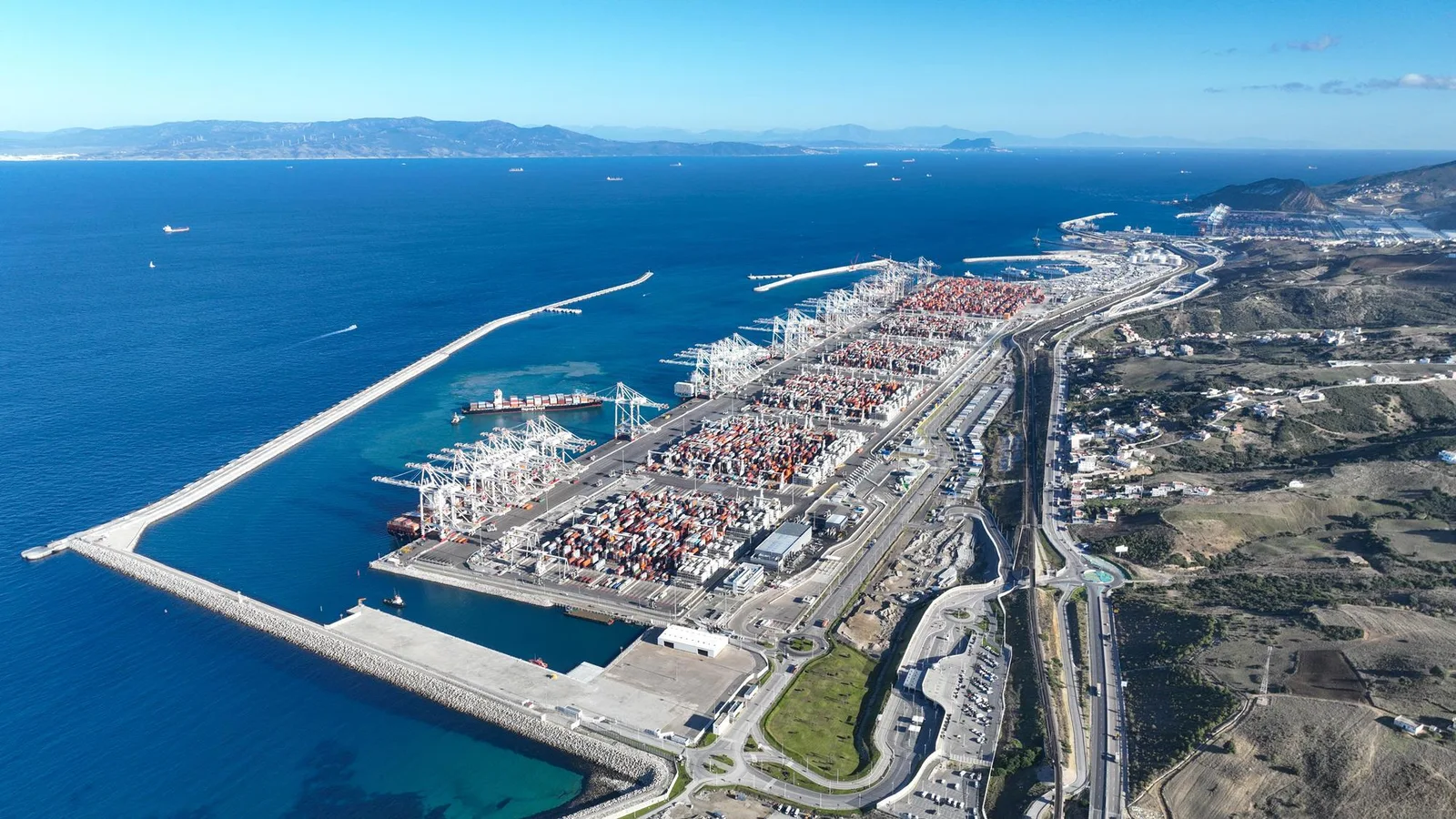
The development of Tanger Med represents one of Morocco’s most significant economic transformations since the beginning of the twenty-first century.
Located near the Strait of Gibraltar, at the intersection of maritime routes connecting the Atlantic Ocean, the Mediterranean Sea, Europe, and Africa, the port complex benefits from an exceptional geographical position.
Geography, however, explains only part of its success.
Tanger Med’s competitive advantage also rests on a combination of port infrastructure, inland transport connections, industrial zones, logistics services, and integration into the networks of major international shipping operators.
In 2025, the complex handled 11.1 million twenty-foot equivalent units (TEUs), representing an 8.4% increase compared with the previous year.
Total cargo traffic reached approximately 161 million tonnes.
These volumes position Tanger Med among the world’s major container-handling platforms and reinforce its leading role in Mediterranean and African maritime trade.
Its significance, however, cannot be measured solely through container throughput.
The complex has become an essential component of northern Morocco’s industrial organization.
Automotive manufacturing, subcontracting activities, distribution platforms, and manufactured exports benefit from the proximity between production facilities and international shipping networks.
This proximity reduces transportation times, facilitates supply-chain coordination, and strengthens the region’s attractiveness to investors.
The port has consequently evolved beyond its original function as a transportation facility.
It has become an instrument of industrial competitiveness.
Tanger Med 3: Expanding the Scale of Morocco’s Maritime Ambitions
The Tanger Med 3 project is intended to extend this development.
Presented during the October 28 royal working session, the project involves constructing a new port west of Tanger Med 2.
The announced investment amounts to MAD 8 billion.
The project includes approximately 1,200 meters of quays and is expected to provide an additional annual capacity of 4.5 million containers.
A concession agreement has been signed with Maersk–APM for the development of the new terminal.
The participation of a major international operator carries considerable strategic importance.
It could facilitate the integration of the future terminal into global maritime networks while helping secure commercial activity.
Over time, the planned expansions could increase Tanger Med’s overall capacity to approximately 20 million containers annually.
Such capacity could potentially place the complex among the world’s ten largest container ports, depending on developments at competing facilities.
However, a distinction must be maintained between theoretical capacity and actual traffic.
Constructing new infrastructure does not automatically guarantee its utilization.
Global trade growth, shipping companies’ strategic decisions, port tariffs, terminal productivity, and regional competition will ultimately determine whether Tanger Med can translate additional capacity into sustainable growth.
The objective is therefore not simply to construct the largest possible port.
It is to consolidate Morocco’s position within the global organization of maritime transportation.
Nador West Med: Transforming the Eastern Mediterranean Coast into an Industrial and Energy Platform
Several hundred kilometers east of Tanger Med, Nador West Med follows a complementary strategic logic.
The objective is not merely to reproduce the Tangier model elsewhere.
The new complex is intended to establish an industrial, logistics, and energy platform along Morocco’s eastern Mediterranean coastline.
During the October 28 meeting, public and private investments already mobilized around the project were estimated at MAD 54 billion.
The first container terminal is expected to begin operations within days.
Its eventual capacity is projected to reach 3.5 million containers.
A second terminal, with a capacity of 1.8 million containers, is scheduled for April 2027.
Private investment associated with these two terminals amounts to approximately MAD 8 billion.
These figures demonstrate the scale of the project, but they do not fully capture its strategic significance.
Nador West Med is also designed to contribute to Morocco’s energy diversification.
A New Dimension of Energy Security
The complex includes plans for a hydrocarbon terminal and an associated storage zone with a potential capacity of 4 million cubic meters.
A liquefied natural gas terminal is also envisaged, with an annual processing capacity of up to 5 billion cubic meters.
These facilities could strengthen the flexibility of Morocco’s energy system.
For a country dependent on imported hydrocarbons, diversified reception, storage, and distribution infrastructure represents an important source of resilience.
Natural gas could also support the evolution of the national electricity system by providing dispatchable generation capacity alongside the expansion of renewable energy.
However, planned infrastructure should not be confused with operational capacity.
Actual construction, financing arrangements, supply contracts, and connections to the national energy network will determine the project’s contribution to Morocco’s energy security.
Nador West Med could therefore become an important interface between port policy, industrial development, and energy diversification.
The Challenge of Territorial Integration
The project also carries a significant regional development dimension.
Nador West Med could encourage the emergence of new economic activities in Morocco’s Oriental region and contribute to a more geographically balanced distribution of industrial investment.
The associated industrial zone already hosts one operating factory, while three others are under construction.
Projections presented on October 28 anticipate 14,000 direct jobs and 20,000 indirect jobs in the near term.
These figures represent targets rather than employment already created.
Their realization will depend on companies establishing operations, port activities expanding, and the availability of appropriately trained workers.
The complex’s integration into the national economy also depends on transport infrastructure.
Key projects include the Selouane–Nador West Med railway connection, the Guercif–Nador West Med motorway, and improvements to surrounding road networks.
These connections are decisive.
A port may possess advanced terminals while remaining economically underutilized if its connections to production centers and consumer markets are insufficient.
Nador West Med’s success will therefore depend as much on its hinterland as on its maritime capabilities.
Dakhla Atlantic: Morocco’s Southern Atlantic Coast and Its African Projection
The third pillar of Morocco’s maritime strategy lies along the Atlantic coast of Western Sahara, a territory largely administered by Morocco whose final status remains disputed under the United Nations political process.
Dakhla Atlantic differs fundamentally from Tanger Med and Nador West Med.
While the two Mediterranean complexes are primarily oriented toward major international shipping routes and industrial integration, Dakhla Atlantic is intended to support economic development in the southern territories and strengthen connections with West Africa.
Construction began in 2021.
According to Moroccan budget documents, physical progress had reached approximately 70% by mid-September 2026.
A project official subsequently reported a completion rate of approximately 74% in early October.
The projected cost has been revised to around MAD 15.06 billion, partly to incorporate additional expansion works.
Budget documents anticipate completion of construction by the end of 2028, with operations beginning in 2029.
This distinction is essential.
Dakhla Atlantic remains under construction and does not yet possess the operational capabilities of an active commercial port.
A Port Designed to Transform a Territory
Dakhla Atlantic is intended to accommodate several categories of economic activity, including commercial shipping, fisheries, logistics, industrial production, and associated services.
Its development is linked to a broader industrial-port zone and the economic exploitation of regional resources.
Fisheries and seafood processing represent an initial opportunity.
The establishment of storage, processing, and export facilities could allow a greater share of the value generated by marine resources to remain within the local economy.
Renewable energy and green hydrogen projects represent another potential development pathway.
The region possesses substantial solar and wind resources that could attract investment in renewable electricity generation, synthetic fuels, and certain low-emission industrial activities.
However, these opportunities remain dependent on financing, electricity infrastructure, water availability, desalination facilities, and access to export markets.
The existence of a port does not automatically create a competitive energy industry.
It can nevertheless provide one of the essential foundations for its development.
Connecting the Sahel: A Geopolitical Ambition
Dakhla Atlantic’s most significant strategic dimension concerns Morocco’s relations with landlocked Sahelian countries.
In November 2023, King Mohammed VI presented an initiative intended to facilitate Sahelian states’ access to the Atlantic Ocean.
The proposal addresses a major structural challenge.
Countries without direct maritime access depend on infrastructure and commercial corridors crossing neighboring territories to reach international markets.
Transportation costs, customs procedures, security conditions, and infrastructure reliability directly affect their economic competitiveness.
From this perspective, Dakhla Atlantic could eventually provide an additional maritime outlet for certain Sahelian trade flows.
The objective would be to connect Moroccan port infrastructure with overland corridors extending across the Sahara and into the Sahel.
Such developments could create opportunities for commodity exports, industrial equipment imports, food supplies, and regional trade.
Yet substantial obstacles remain.
Overland distances are considerable.
Road and logistics infrastructure require further development.
Security conditions remain uncertain across several Sahelian regions.
Above all, maritime access cannot be established through port construction alone.
It requires durable political agreements, compatible customs procedures, transit guarantees, competitive transportation services, and coordination among several governments.
Dakhla Atlantic could therefore become an instrument of African economic integration.
Its future role, however, will depend on whether a diplomatic initiative can be transformed into commercially viable and regularly used transportation corridors.
Three Maritime Fronts, Three Functions: Toward an Integrated National Port System
The most distinctive feature of Morocco’s strategy lies in the intended complementarity of its major maritime infrastructures.
Tanger Med, Nador West Med, and Dakhla Atlantic should not be understood as three independent ports competing in the same race for capacity.
They occupy different geographical positions and serve distinct economic functions.
Tanger Med benefits from an established position within major international shipping networks.
Its development aims to consolidate transshipment activities, industrial exports, and connections to European markets.
Nador West Med is intended to expand national capacity in the Mediterranean while developing specific industrial and energy functions.
Dakhla Atlantic seeks to establish a new platform for regional economic development and connections with Atlantic Africa.
This organization could allow Morocco to diversify its maritime capabilities and reduce dependence on a limited number of facilities.
It could also strengthen the resilience of the national logistics system.
When disruptions affect particular shipping routes or facilities, infrastructure distributed across several maritime fronts may provide additional opportunities to reorganize commercial flows.
However, the ports are not automatically interchangeable.
Their equipment, water depths, specializations, operators, and inland connections determine the types of cargo they can handle.
Complementarity will therefore require coherent national planning.
The alternative risk would be domestic competition between expensive infrastructure projects attempting to attract similar traffic without sufficiently developing their respective competitive advantages.
Morocco and the Restructuring of Global Value Chains
Morocco’s port strategy is unfolding in an international environment fundamentally different from the one that prevailed when Tanger Med was first launched.
For decades, global trade was organized around minimizing production costs, extending supply chains, and optimizing international transportation.
Health crises, trade tensions, geopolitical conflicts, and disruptions to maritime transportation have gradually altered corporate priorities.
Resilience, supplier diversification, and proximity to consumer markets have become increasingly important.
For Morocco, this transformation presents an opportunity.
Its proximity to the European Union, trade agreements, transportation infrastructure, and existing industrial base could attract companies seeking to diversify their production locations.
The automotive industry already illustrates the potential benefits of integrating manufacturing capabilities with international logistics.
Other activities could follow similar trajectories, including electrical components, industrial equipment, electronics, chemicals, agribusiness, and technologies associated with the energy transition.
Port infrastructure could therefore support a broader diversification of Morocco’s industrial economy.
However, this transformation is not automatic.
Companies make investment decisions based on multiple factors: energy costs, workforce skills, productivity, taxation, infrastructure quality, regulatory stability, and market access.
Ports are an important factor in industrial attractiveness, but they do not guarantee industrialization.
Morocco’s ability to move into higher-value activities will also depend on industrial policy, vocational training, research capabilities, and the integration of domestic companies into international production networks.
Mediterranean and Atlantic Competition: The Battle for Maritime Flows
The expansion of Morocco’s maritime capacity is taking place in an increasingly competitive port environment.
In the Mediterranean, Spain’s ports of Algeciras, Valencia, and Barcelona occupy important positions in maritime transportation and European distribution.
Other platforms in Italy, Greece, and Egypt also compete for transshipment services and international cargo flows.
Along Africa’s Atlantic coastline, several countries are investing in modernizing their port infrastructure.
Mauritania, Senegal, Côte d’Ivoire, Ghana, Togo, and Nigeria operate ports serving different roles in supplying domestic markets and connecting neighboring territories.
Major shipping companies and terminal operators consequently have an expanding range of options for organizing their networks.
In this environment, port performance depends less on size alone than on the ability to provide competitive services.
Cargo-handling speed, berth availability, inland transport reliability, logistics costs, and digital service quality directly influence commercial decisions.
Ports must also adapt to changes in the global shipping fleet, vessel sizes, and environmental requirements.
Maritime competition is therefore becoming simultaneously technological, industrial, financial, and regulatory.
Morocco possesses genuine geographical advantages.
Converting those advantages into sustainable competitiveness will require continuous investment in operational performance.
Global Shipping Operators: Opportunity and Dependence
Maersk–APM’s participation in Tanger Med 3 illustrates the importance of partnerships between governments, port authorities, and international operators.
Such partnerships can accelerate infrastructure development and facilitate integration into global commercial networks.
They provide technical expertise, investment capacity, and detailed knowledge of shipping companies’ requirements.
But they also create interdependence.
Major maritime transportation companies possess considerable influence over the organization of cargo flows.
Their decisions concerning port calls, commercial alliances, service rotations, and investments can rapidly alter terminal activity.
A port integrated into a major operator’s network may benefit from a substantial commercial advantage while remaining exposed to that operator’s strategic decisions.
For Moroccan authorities, the challenge will be to maintain a balance between attracting international investors and preserving national influence over critical infrastructure.
Port land ownership, concession regulation, operator diversification, and the quality of domestic connections are important instruments in maintaining that balance.
Logistics sovereignty does not necessarily require complete public ownership of terminals.
It requires the ability to protect national economic interests within a system largely organized by international companies.
The Financial Dimension: Investing at Scale Without Dispersing Resources
Major port projects require substantial capital and operate over long investment horizons.
The announced investments in Nador West Med, Tanger Med 3, and Dakhla Atlantic demonstrate the scale of resources being mobilized.
However, their financial figures are not directly comparable.
The MAD 54 billion associated with Nador West Med includes public and private investments covering several components of the complex.
The MAD 8 billion announced for Tanger Med 3 concerns a specific expansion project.
The approximately MAD 15 billion allocated to Dakhla Atlantic represents a revised budget for its port construction program.
Adding these figures without distinguishing their scope would produce a misleading interpretation.
Economic evaluation must also consider complementary infrastructure, including motorways, railways, energy networks, industrial facilities, and logistics services.
The true cost of a port system is never limited to the construction of quays.
Its financial performance depends on port revenues, concessions, terminal utilization, associated industrial investments, and economic benefits for surrounding territories.
Some infrastructure projects may also generate collective benefits that do not appear directly in their financial accounts.
These include improved connectivity, lower transportation costs, enhanced energy security, and regional development.
Such benefits nevertheless require rigorous evaluation.
Strategic investments are not exempt from economic constraints.
The central question is therefore not simply how much Morocco invests, but how much sustainable value those investments will ultimately generate.
The Social Dimension: Turning Ports into Engines of Development
Large port complexes can generate substantial economic activity while producing uneven territorial benefits.
Modern terminals are capital-intensive and increasingly automated.
Direct employment does not necessarily increase at the same pace as cargo volumes.
A significant share of employment opportunities may instead emerge in related activities, including transportation, maintenance, industrial processing, warehousing, services, and subcontracting.
The broader territorial impact therefore depends on the development of surrounding business ecosystems.
This question is particularly important for Nador and Dakhla.
In both regions, infrastructure investment is also intended to diversify local economies and create professional opportunities.
Workforce training, access to contracts for local companies, housing availability, and public services will influence how widely economic benefits are distributed.
During the October 28 working session, Mohammed VI emphasized the importance of translating major investments into tangible improvements for local populations.
This reflects a fundamental challenge associated with large infrastructure projects.
Technical success does not automatically produce social success.
A port may perform efficiently at the international level without sufficiently transforming its immediate economic environment.
The ultimate measure of success must therefore include the creation of skilled employment, the development of local businesses, and the reduction of territorial inequalities.
Environmental and Energy Constraints on Maritime Expansion
The multiplication of port infrastructure also raises environmental questions.
Breakwater construction, dredging, coastal development, and the expansion of industrial activities can alter marine ecosystems.
Water, electricity, and transportation requirements increase as industrial-port complexes expand.
In certain regions, particularly along the southern Atlantic coastline, water availability represents a structural constraint.
The development of new industries will therefore require appropriate solutions, including desalination, wastewater treatment, and improved energy efficiency.
At the same time, maritime transportation faces growing pressure to reduce emissions.
Ports capable of providing shore-side electricity, adapted energy services, and infrastructure compatible with next-generation marine fuels may acquire competitive advantages.
For Morocco, renewable energy development creates opportunities for convergence between port strategy and energy transition.
However, the necessary investments will be substantial and must respond to sufficiently strong commercial demand.
The challenge is to prevent infrastructure constructed today from becoming prematurely incompatible with tomorrow’s technological and environmental requirements.
From Geography to Economic Power: The Conditions for Lasting Transformation
Morocco’s location near the Strait of Gibraltar, between the Atlantic Ocean and the Mediterranean Sea, has long represented a geographical advantage.
What is changing today is the determination to transform that location into a structured economic system.
Tanger Med has demonstrated that port infrastructure can become the foundation of industrial transformation.
Nador West Med seeks to extend that logic to the eastern Mediterranean coast while incorporating a significant energy dimension.
Dakhla Atlantic pursues a different ambition: opening new development opportunities along the southern Atlantic coastline and strengthening economic connections with West Africa and the Sahel.
Together, these projects could contribute to repositioning Morocco within international commercial networks.
They do not, however, automatically give the country control over global maritime routes.
Major shipping corridors remain shaped by geography, markets, shipping operators, transportation costs, and geopolitical conditions.
Maritime power should therefore be understood as a capacity to attract, connect, and organize economic activity rather than as sovereign control over international trade flows.
Morocco’s challenge is to bring several public policies into alignment: infrastructure, industry, energy, education, foreign trade, and territorial development.
It must also preserve the financial coherence of projects whose economic returns will unfold over several decades.
Success will depend on governance quality, the ability to attract productive investment, and integration into durable economic networks.
Conclusion: A Maritime Ambition That Extends Beyond Ports
The approaching operational launch of Nador West Med, the announcement of Tanger Med 3, and continued construction at Dakhla Atlantic mark a new phase in Morocco’s economic strategy.
The Kingdom is no longer focused solely on improving its import and export capacity.
It is seeking to establish an infrastructure system capable of supporting industrialization, strengthening energy security, diversifying international connections, and reinforcing its economic positioning in Africa.
This ambition is part of a broader transformation of the global economy.
As supply chains increasingly become matters of competitiveness and security, territories capable of efficiently connecting production, energy, and transportation acquire growing strategic importance.
Morocco possesses significant advantages in this emerging environment.
But the transition from port capacity to integrated economic power will require more than investment in concrete, terminals, and equipment.
It will require competitive industries, efficient inland connections, productive capital, workforce development, and a sufficiently broad distribution of economic benefits.
The decisive question will not simply be how much cargo passes through Moroccan ports.
It will be how much economic value the country can produce, transform, and retain through those flows.
Maritime power is not defined solely by the ability to accommodate the world’s trade. It is built through the capacity to transform that trade into a lasting source of industrial development, economic sovereignty, and international influence.
Atlas Limits Research Desk
Atlas Limits’ editorial and analytical desk.