Washington, October 2026. With less than a month remaining before the midterm elections, Donald Trump is traveling across the United States to defend his record and campaign for Republican candidates. At political rallies, promises of reindustrialization, trade protection, and restored national power remain central to his message. Yet outside factory gates, at gas stations, and along supermarket aisles, another question increasingly dominates: how much does American life now cost?
On November 3, voters will elect all 435 members of the House of Representatives, roughly one-third of the Senate, and numerous state and local officials. The president himself will not appear on the ballot. Nevertheless, the ability of his administration to pursue its policies will be at stake. Two years after returning to the White House, Donald Trump faces a defining feature of the American political system: presidential power depends not only on the electoral victory that brought a leader into office, but also on the ability to maintain a congressional majority and a social coalition over time.
The election comes under unusual circumstances. The United States has embarked on a transformation of its trade policy, expanded government intervention in industry, and prolonged its military confrontation with Iran. The administration presents these decisions as instruments of restored sovereignty. Their economic, fiscal, and diplomatic consequences now occupy an increasingly prominent place in the campaign.
November's vote will therefore determine more than the balance between Republicans and Democrats. It will establish the political conditions under which the world's leading power continues its transformation.
A Majority That Has Become Essential
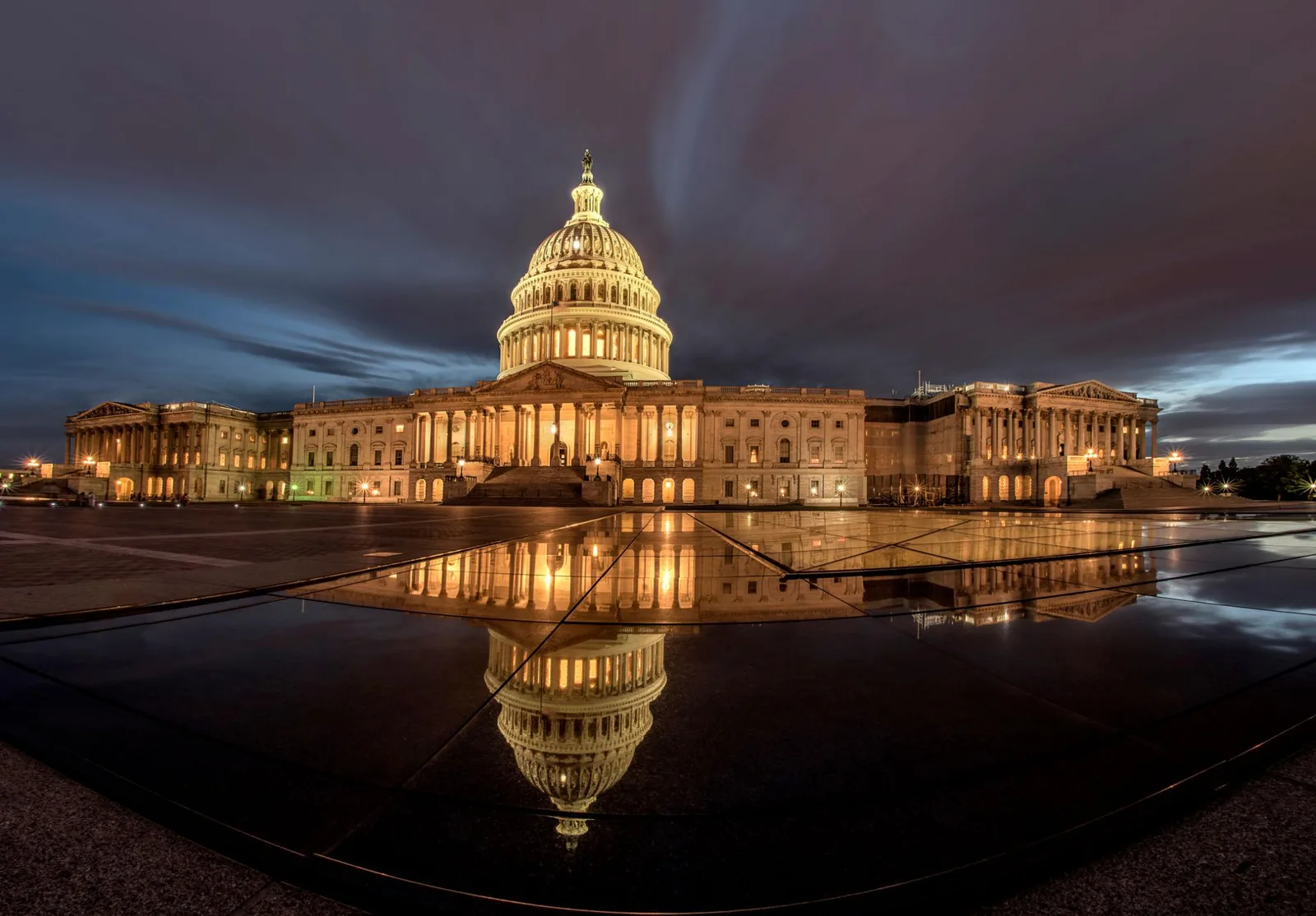
The American constitutional system rests on a separation of powers that makes the presidency simultaneously powerful and dependent on Congress. The president directs the executive branch, commands the armed forces, and exercises considerable influence over foreign policy. But legislation, federal appropriations, tax reforms, and appointments requiring Senate confirmation depend on other institutions.
Since January 2025, Republicans have controlled the White House and both chambers of Congress. In the Senate, their 53-to-47 majority gives them substantial influence over confirmations and legislative priorities. In the House of Representatives, the balance is narrower, leaving important votes vulnerable to internal divisions within the Republican Party.
Midterm elections represent the first major opportunity for voters to alter the political balance of a presidency. They cannot replace the president, but they can profoundly change the administration's ability to govern.
American history provides several precedents. In 1994, Republicans gained 54 House seats, ending four decades of almost uninterrupted Democratic control. In 2010, they gained 63 seats under Barack Obama. In 2018, during Donald Trump's first term, Democrats achieved a net gain of 40 seats and regained control of the House.
These outcomes do not constitute an electoral law. They nevertheless reveal an enduring feature of the system: presidential elections assemble a coalition around a candidate, while midterm elections test that coalition against the record of its government.
In 2026, this mechanism carries particular significance. A Democratic majority in the House could strengthen congressional oversight, initiate new investigations, and constrain certain legislative ambitions. A change of control in the Senate would also alter the confirmation process for presidential appointments. Conversely, continued Republican control of both chambers would preserve institutional continuity without eliminating disagreements within the party.
The result will therefore define less the personal authority of Donald Trump than the political instruments available to him until the end of his presidency.
The Economy, or the Return of Everyday Life
The 2024 presidential campaign rested heavily on an economic promise: protect purchasing power, control inflation, and restore American prosperity through domestic production.
Two years later, the cost of living dominates electoral concerns.
A Reuters/Ipsos survey conducted in late August found that 47% of registered voters considered the cost of living the most important factor in their November voting decision. In the same survey, 71% of adults disapproved of Trump's handling of the issue, compared with 22% who approved.
Findings published on October 9 confirmed the persistence of the problem. According to Reuters/Ipsos, 78% of Americans surveyed attributed some responsibility for rising prices to presidential policies. Among Republican respondents, 57% said their expenses were increasing faster than their incomes.
These figures cannot, by themselves, establish the actual economic responsibility of individual government decisions. They do, however, reveal a political reality: part of the electorate supporting the president shares the economic anxieties expressed by his opponents.
The contrast with certain financial indicators is striking. Major technology companies continue to mobilize enormous amounts of capital, investment in artificial intelligence supports several industrial sectors, and equity markets benefit from the concentration of earnings among large corporations. Yet these developments do not translate uniformly into higher disposable incomes for American households.
On October 9, the University of Michigan's preliminary consumer sentiment index fell to 46.3 points, close to historical lows. Its current economic conditions index reached 44.7.
Financial prosperity and the social perception of prosperity no longer necessarily follow the same trajectory.
This divergence represents one of the fundamental political problems of the American economy. Expanding industrial investment may create future productive capacity without immediately improving purchasing power. Rising asset valuations disproportionately benefit households that already own financial assets. And nominal wage growth loses part of its significance when essential expenses increase more rapidly.
The campaign therefore confronts two different time horizons: the long-term economic reconstruction promised by the administration and the much more immediate constraints of household budgets.
Protectionism Confronts Its Costs
American trade policy occupies a distinctive place within this contradiction.
Since returning to office, Donald Trump has expanded the use of tariffs as instruments of negotiation and industrial policy. The stated objective is to protect domestic producers, encourage investment in the United States, reduce strategic dependencies, and obtain commercial concessions.
This doctrine responds to genuine structural transformations. The industrial decline of several American regions, the concentration of supply chains in Asia, and dependence on foreign components have progressively turned industrial policy into a matter of national security.
But trade protection also generates costs.
A tariff is paid at the border by the American importing company. Depending on market conditions, that company may absorb part of the cost, pass it on to customers, or change suppliers. The final effect depends on competition, exchange rates, profit margins, and the availability of substitutes.
American manufacturers may benefit from reduced import competition, while companies relying on foreign components face higher production costs. Households may also bear part of the adjustment through retail prices.
The administration presents these costs as the price of a long-term productive transformation. Its opponents regard them as additional pressure on purchasing power and on businesses dependent on international trade.
Yet the debate cannot be reduced to a confrontation between free trade and protectionism. It concerns the distribution of the costs of industrial sovereignty.
Who finances the restoration of productive capacity? Consumers, through higher prices? Companies, through narrower margins? The federal government, through subsidies and tax incentives? Or trading partners, through negotiated concessions?
The answer differs across industries. It also determines which regions and social groups actually benefit from reindustrialization.
November's elections will give political expression to this question without necessarily producing a coherent national economic settlement.
Foreign War Enters the Ballot Box
Foreign policy adds another dimension to the campaign.
The war against Iran has contributed to instability in energy markets and intensified concerns about fuel prices. Tensions around the Persian Gulf and regional shipping routes have demonstrated that American military power alone cannot eliminate the interdependencies of the global economy.
Oil remains a commodity priced in an international market. Even a country with substantial domestic production remains exposed to global price movements, refining constraints, and logistical disruptions.
This reality places the administration before a strategic contradiction. Military operations may be presented as necessary for national security while producing economic consequences that complicate domestic politics.
On October 9, Reuters reported that the White House was considering the use of certain instruments under the Defense Production Act to facilitate increased oil and fuel production, particularly in response to higher diesel prices.
The potential use of legislation rooted in American industrial mobilization to address an energy shock illustrates the growing overlap between security, industry, and purchasing power.
The electoral consequences of war, however, are not automatic. Voters may support military objectives while questioning their costs, approve certain diplomatic positions without supporting the president, or regard domestic concerns as more important.
The political question therefore extends beyond support for or opposition to a particular military operation. It concerns Washington's ability to finance its military ambitions, industrial policies, and social commitments simultaneously.
A different congressional majority could change the budgetary conditions under which this strategy operates, even though the presidency would retain considerable foreign-policy authority.
Two Americas, Multiple Divisions
American electoral geography can no longer be understood through a simple division between Democratic and Republican states.
Large metropolitan areas, residential suburbs, industrial cities, rural communities, and the rapidly growing regions of the South are experiencing different demographic and economic transformations. Divisions involving education, income, age, social background, and ways of life overlap without necessarily coinciding.
The 2024 elections demonstrated Donald Trump's ability to broaden certain segments of his coalition, including among Hispanic voters and working-class groups traditionally associated with Democrats.
But a presidential coalition is not necessarily a stable congressional coalition.
Congressional candidates operate within local political environments. One district may be dominated by agricultural concerns, another by automobile manufacturing, and a third by housing affordability or healthcare costs. National issues influence these contests without eliminating territorial differences.
The structure of the electoral system reinforces this diversity.
In the House of Representatives, 435 seats are distributed among congressional districts whose boundaries are established through redistricting procedures. In several states, those boundaries are subject to significant legal and political disputes. The geographical concentration of voters and the configuration of districts can produce differences between the national popular vote and the number of seats obtained.
The Senate follows a different logic. Every state elects two senators, regardless of population. California and Wyoming therefore have identical representation in the upper chamber despite their vastly different demographic weights.
This federal architecture means that a party's national electoral gains do not automatically translate into a Senate majority.
In 2026, Democrats need a net gain of four seats to reach 51 senators, assuming the other institutional balances remain unchanged. In the House, the narrow Republican majority makes a relatively small number of competitive districts particularly consequential.
The electoral battle is therefore being fought across two distinct political maps, each governed by different constraints.
The Republican Party Confronts Its Own Transformation
One of the most significant dimensions of the election concerns the evolution of the Republican Party itself.
Since 2016, Donald Trump has profoundly altered its political orientation and electoral coalition. The defense of free trade, once central to important sections of the American right, has lost ground to industrial protection. Immigration policy has become a defining issue. Relations with international alliances, federal institutions, and major corporations have been redefined.
This transformation does not mean the party has become homogeneous.
The interests of manufacturers benefiting from tariffs do not always coincide with those of importers. Energy producers, technology companies, farmers, and conservative households may support the same electoral coalition while pursuing divergent economic priorities.
Fiscal policy also reveals tensions between advocates of reduced federal spending and those seeking to preserve strategic investment, social programs, or spending benefiting their constituencies.
War and foreign commitments introduce another level of differentiation between interventionist, nationalist, and restraint-oriented currents.
Donald Trump remains the central figure in this political realignment. But the midterm elections also raise the question of whether the Republican Party can sustain this coalition when the president himself is not on the ballot.
That question will become increasingly important as 2028 approaches and the party prepares for presidential succession.
November's vote is therefore one stage in the lasting transformation of the American right, rather than simply a judgment on the first two years of a presidency.
Democrats Search for a Coalition
The Democratic Party approaches the election with a different challenge.
Opposition to Donald Trump can unite voters with diverse economic and social preferences, but that convergence does not necessarily constitute a common governing program.
Democrats bring together supporters of greater public intervention, progressive constituencies focused on social rights, centrist lawmakers concerned with fiscal balances, and representatives of industrial regions whose trade interests may diverge.
Industrial policy provides a revealing example. Democrats do not necessarily reject the objective of rebuilding American productive capacity. The Biden administration itself launched major initiatives in semiconductors, infrastructure, and energy technologies.
Differences concern the instruments employed, the role of trading partners, environmental standards, taxation, and the distribution of economic benefits.
On immigration, security, energy, and international relations, significant differences also remain within the party.
The Democratic campaign must therefore meet two demands: present an alternative to Republican policies and build candidacies suited to very different congressional districts.
Regaining a congressional majority would not automatically resolve these tensions. On the contrary, it would require Democrats to transform electoral opposition into an ability to negotiate and exercise institutional power.
This is one of the distinctive characteristics of midterm elections: they can alter the balance of power without immediately producing a unified political direction.
Congress as a Global Economic Actor
For America's trading partners, the election matters far beyond the country's borders.
Congress influences taxation, federal spending, military appropriations, industrial support programs, and several dimensions of economic regulation. It also possesses important trade powers, although some have been delegated to the executive branch.
Its composition can affect Washington's ability to finance new infrastructure, support strategic industries, negotiate certain agreements, and maintain international programs.
For Europe, the stakes include trade relations, defense, energy, and technology policy. For China, they concern semiconductor restrictions, investment, supply chains, and industrial competition. For emerging economies, they involve access to the American market, investment flows, and the international consequences of US fiscal and monetary policy.
It would nevertheless be excessive to assume that a congressional change of control would automatically restore the previous international trade order.
Strategic competition with China, the security of critical supply chains, and the preservation of certain industrial capabilities enjoy support, in different forms, within both major parties.
A Democratic majority could challenge the methods of particular presidential policies without rejecting all their strategic objectives.
America's transformation therefore runs deeper than partisan alternation.
For several years, the United States has been moving away from the assumption that economic openness and market integration alone can guarantee its security and prosperity. The federal government is playing a greater role in industrial decisions, technology restrictions, and the organization of economic dependencies.
The debate now concerns the costs, beneficiaries, and limits of that intervention.
A Power Confronted by Its Own Constraints
The distinctive character of the 2026 elections ultimately lies in the convergence of three developments.
The first is institutional. The American presidency possesses considerable powers, but its legislative effectiveness depends on congressional majorities that can change independently of presidential elections.
The second is economic. The United States is seeking to strengthen its productive autonomy while remaining dependent on global markets whose disruptions directly affect American consumers and businesses.
The third is social. The expected benefits of reindustrialization, technological innovation, and financial power are neither immediate nor evenly distributed. Households assess their circumstances through income, prices, and prospects that may differ substantially from the aggregate performance of the economy.
These three developments meet at the ballot box.
November's elections will not independently determine the future of American trade policy, Washington's military posture, or the transformation of its productive system. They will, however, establish the conditions under which these policies can be pursued, negotiated, or challenged over the following two years.
Donald Trump returned to the White House promising to restore America's control over its economy, its borders, and its power. Two years later, that ambition confronts a more difficult question: how can such control be exercised in an economy whose prices, technologies, capital flows, and military commitments remain profoundly globalized?
On November 3, Americans will not choose a new president. They will determine the composition of the legislative branch that must confront this contradiction.
And in a democracy designed to prevent any single branch of government from deciding everything, that distinction is essential.
Principal Sources
- USAGov, Congressional Elections and Midterm Elections, institutional overview of congressional elections and renewal.
- Reuters/Ipsos, August 28–31, 2026 survey on electoral concerns and the cost of living.
- Reuters/Ipsos, September 30–October 5, 2026 survey on the Trump presidency and the midterm elections.
- Reuters, October 8, 2026, analysis of Democratic campaigns in Republican-held congressional districts.
- Reuters, October 9, 2026, survey on prices, purchasing power, and public perceptions of Donald Trump's economic policies.
- Reuters, October 9, 2026, American consumer confidence and preliminary University of Michigan data.
- Reuters, October 9, 2026, measures considered by the US administration concerning oil and fuel production.
- US House of Representatives / US Senate, institutional documentation on elections, representation, and congressional powers.
Atlas Limits Research Desk
Atlas Limits’ editorial and analytical desk.