Peace requires governments to account for their performance. It exposes the quality of schools, the reliability of infrastructure, the condition of public finances, the economy’s capacity to create employment, and the ability of institutions to correct their own failures. It leaves little room for excuses when promises accumulate without producing results. War changes this political grammar. It replaces scrutiny with urgency, debate with mobilisation, and the search for responsibility with the identification of a threat.
This does not mean that states wage war solely to conceal their failures. International history cannot be reduced either to a permanent conspiracy by governments against their societies or to a mechanism through which every fiscal crisis inevitably leads to external confrontation. Wars also arise from power rivalries, territorial claims, nationalism, security dilemmas, poorly controlled alliances, misperceptions, and decisions made under the pressure of events.
Yet another reality remains: when war breaks out, or when a threat can be presented as existential, political power acquires instruments that would be unavailable under ordinary circumstances. Governments can demand unity, postpone reform, increase expenditure, restrict certain freedoms, reorganise the economy, and portray dissent as irresponsible. War is therefore not always produced by domestic crisis. It can nevertheless become a refuge for a system that can no longer justify itself through results.
Redirecting judgment
The theory of “diversionary war” begins with a simple intuition: a leader confronted with declining popularity, social unrest, or a threat to political survival may be tempted to provoke an external crisis in order to redirect public attention. The emergence of a common enemy can generate a temporary rally around the flag and place the government back at the centre of the national community.
The mechanism is politically attractive. Economic difficulties are complex, slow-moving, and distributed across multiple layers of responsibility. An external enemy, by contrast, simplifies the world. It draws a visible boundary between inside and outside, loyalty and betrayal, those defending the nation and those accused of weakening its effort. A debate over debt, prices, productivity, or deindustrialisation can fragment into competing diagnoses. A military threat offers a far more immediately mobilising narrative.
Empirical research nevertheless calls for caution. The relationship between domestic difficulties and the use of force is neither automatic nor uniform. Many unpopular leaders do not start wars, while relatively stable governments may enter conflicts for strategic reasons unrelated to their domestic circumstances. Foreign intervention is also a dangerous gamble: defeat can accelerate a government’s fall rather than prevent it.
The 1982 Falklands/Malvinas War illustrates this ambiguity. Argentina’s military junta was facing a deep economic crisis, growing opposition, and the exhaustion of its legitimacy. Retaking the islands was supposed to revive a widely shared national claim and restore the armed forces to the centre of Argentina’s destiny. The patriotic mobilisation was real but brief. Defeat destroyed what remained of the regime’s prestige and accelerated the return to civilian rule. Diversion worked as a narrative; it failed as a survival strategy.
The lesson reaches beyond that episode. An external enemy can suspend judgment, but it cannot guarantee its abolition. To endure, mobilisation must produce victory, or at least preserve the belief that victory remains possible. When war exposes the incompetence of a government even more brutally than peace, the refuge becomes a trap.
What emergency makes possible
The political value of war does not lie solely in its ability to divert attention. It also stems from the institutional transformation it enables. In peacetime, the state must negotiate, arbitrate, justify its decisions, and follow procedures that constrain the speed of government action. Under emergency conditions, the executive can centralise decisions, accelerate expenditure, alter budgetary priorities, and obtain a degree of social obedience that would otherwise be difficult to impose.
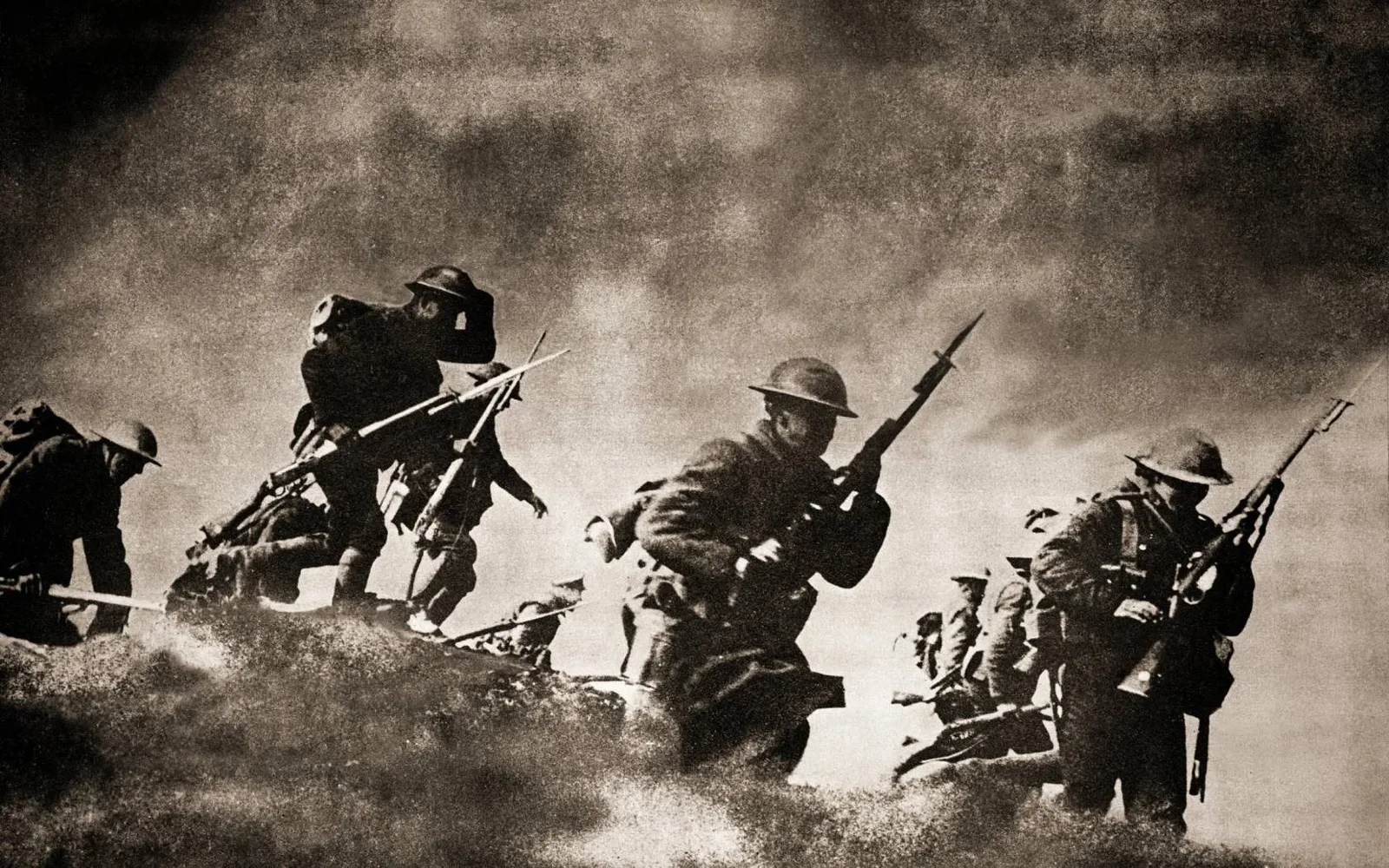
The First World War offers a major demonstration. European states did more than mobilise their armies. They organised production, controlled strategic resources, regulated trade, expanded taxation, and strengthened their administrative reach. In the United Kingdom, the Defence of the Realm Act gave the executive extensive powers over the economy and information. In several countries, the boundary between civilian administration, industrial production, and military command became increasingly blurred.
Some of these arrangements disappeared after the conflict. Others survived, directly or in altered forms. War had demonstrated that the state could raise more resources, coordinate entire sectors, and intervene more deeply in social life. It had also accustomed populations to taxes, controls, and obligations initially presented as temporary.
This dynamic illuminates Charles Tilly’s argument that war helped make the state just as the state organised war. In early modern Europe, military competition pushed governments to build tax administrations, count and classify their populations, develop infrastructure, and consolidate their monopoly over violence. The demands of conflict frequently created institutional capabilities that were later employed for civilian purposes.
It would nevertheless be misleading to conclude that war invariably strengthens the state. It can also destroy its resources, fragment its territory, ruin its finances, and weaken its institutions for generations. Its effects depend on the preceding political structure, the duration and location of the fighting, and the government’s capacity to convert mobilisation into lasting organisation. War may build administrations; it may just as easily produce overindebted, authoritarian states unable to return to normality.
Producing unity
In a society at peace, national unity is always incomplete. Social classes, territories, generations, and economic sectors do not bear the same costs or defend the same interests. The purpose of politics is precisely to organise these disagreements without abolishing them.
War tends to present this plurality as a danger. Because the nation is supposedly threatened in its very existence, internal divisions must recede, particular demands must wait, and institutions must align themselves behind the common effort. This movement can be sincere. A genuine external threat sometimes requires collective mobilisation and rapid decisions. But it also creates a considerable political resource: the government can conflate its own survival with that of the nation.
Language consequently changes function. Expenditure is no longer assessed according to its effectiveness but according to its contribution to security. A restriction is no longer a potential infringement of liberty but a sacrifice. A strategic error can be shielded from criticism in the name of solidarity with those serving on the front. Disagreement, meanwhile, risks being presented not as a normal component of democracy but as an advantage offered to the adversary.
This logic does not require total war. A prolonged confrontation, a diffuse threat, or a succession of crises can produce an intermediate state of mobilisation: intense enough to discipline public debate, but not decisive enough to bring about a conclusion. Conflict then becomes a permanent horizon. Emergency no longer has a clearly defined end, and normality never entirely returns.
It is through this duration that the external threat can become indispensable. Not because political leaders necessarily control every event, but because an institutional system gradually organises itself around the continuation of the danger. Budgets, careers, administrations, industries, and doctrines increasingly depend on its perception. The enemy is no longer merely an external actor. It becomes a principle of domestic organisation.
The political economy of threat
War does not suspend the economy. It changes its priorities, financing mechanisms, and power relationships. Resources are redirected towards defence, production chains are reorganised, and certain companies acquire strategic importance. Ordinary fiscal constraints may be relaxed because urgency makes politically acceptable what routine government would not permit.
This does not mean that military expenditure is inherently wasteful. A country incapable of defending itself exposes its population, infrastructure, and sovereignty. Security is a public good whose cost cannot be dismissed in the name of an abstract conception of economic efficiency. Yet the defence imperative can also shield decisions from scrutiny. When every programme becomes indispensable and every question suspicious, the allocation of resources ceases to be policy and becomes an article of faith.
War also facilitates borrowing. Populations are more willing to make future generations bear part of the cost when national survival appears to be at stake. Historically, conflicts have accelerated fiscal innovation, debt issuance, and the development of state financial capacity. They have sometimes helped modernise public administrations. They have also left behind lasting debt burdens, inflation, and postponed social trade-offs.
The essential question is therefore not whether the state spends, but what the threat allows it to remove from scrutiny. A democracy can legitimately strengthen its armed forces while demanding a clear doctrine, defined objectives, parliamentary oversight, and an assessment of results. The danger arises when emergency becomes a universal response—to debt, industrial decline, the loss of public trust, social unrest, or the absence of a collective project.
In such circumstances, foreign policy no longer resolves the domestic crisis. It merely provides it with a different vocabulary.
The limits of a total explanation
The opposite temptation would be to interpret every war as a manipulation designed to save a threatened elite. This reading is as reductive as one that isolates foreign policy entirely from domestic politics.
The First World War cannot be explained solely by the fiscal difficulties of the European empires. The alliance system, naval competition, nationalism, the fragility of Austria-Hungary, Russian ambitions, German strategy, and the sequence of military mobilisations were all decisive. Nor did the Second World War result simply from a German desire to divert attention from economic problems. It arose from an explicitly stated racial and expansionist ideology, a project of continental domination, and strategic decisions whose objectives extended far beyond the regime’s immediate political survival.
The Soviet Union did not project its influence solely because its planned economy encountered difficulties. Its behaviour also reflected a universalist ideology, the pursuit of strategic depth, the memory of invasion, and a global competition with the United States. Likewise, Western interventions during the Cold War cannot be reduced either to the defence of freedom or to a pure diversionary strategy. They combined security, influence, economic interests, ideological beliefs, and domestic political constraints.
Serious analysis must therefore resist single-cause explanations. Domestic fragility can increase the appeal of confrontation, alter a government’s tolerance for risk, or enhance the political usefulness of an enemy. It does not eliminate other determinants. It operates among them.
This distinction is crucial because an excessively broad theory eventually becomes impossible to disprove. If every war proves the failure of the state, every armed peace demonstrates its preparation, and every negotiation conceals it, analysis no longer explains anything. It turns history into the automatic confirmation of a pre-existing conviction.
Europe’s return to strategy
The return of high-intensity warfare to the European continent has placed military questions back at the centre of public debate. Defence budgets are increasing, arms industries are being asked to expand capacity, and governments are rediscovering the vulnerability of supply chains long organised around cost alone. This evolution responds to genuine threats. Russia is neither an administrative invention nor an imaginary adversary, and the invasion of a sovereign state cannot be interpreted merely as a narrative manufactured by Western governments.
Recognising the reality of a threat, however, does not require suspending scrutiny of the policies pursued in its name. Europe continues to face weak growth, disputed energy choices, substantial technological dependencies, strained public finances, and demographic ageing that undermines its social balance. Rearmament will not make these problems disappear. It could make them more difficult if additional expenditure is accompanied neither by a coherent industrial strategy nor by openly acknowledged budgetary choices.
The danger does not lie in militarisation alone. It also lies in allowing the external threat to become the convenient explanation for every European weakness. Some have been aggravated by the war and its consequences; others predate it. Declining competitiveness, technological delays, regulatory complexity, insufficient productive investment, and difficulties of political integration cannot all be attributed to Moscow, Washington, or Beijing.
A mature power must be able to defend itself without abandoning self-examination. It must distinguish between what an adversary imposes upon it and what it has inflicted upon itself. Otherwise, external security risks becoming the alibi for internal immobility.
Peace as a test of truth
War is sometimes necessary to resist aggression. It can mobilise societies, accelerate innovation, and reveal forms of solidarity that ordinary life had made invisible. But it also creates an environment in which political power expands more easily and justifies itself differently.
Peace imposes a less spectacular and perhaps more difficult discipline. It requires societies to build without an enemy, reform without emergency, distribute sacrifices without invoking national survival, and preserve cohesion without erasing disagreement. It requires governments to derive legitimacy from competence rather than mobilisation.
This is why the aftermath of war is often politically difficult. Once the threat has diminished, postponed questions return: who paid, who benefited from mobilisation, which exceptional powers must be relinquished, which expenditures should continue, and which failures were temporarily concealed by the emergency? Military victory itself does not answer these questions. It can only delay the moment when they are asked.
The necessary enemy is not necessarily one invented by those in power. It may be entirely real. It becomes politically necessary when its existence begins to exempt institutions from reform, absorb every debate, and provide a permanent justification for what was supposed to remain temporary.
The decisive question is not whether governments are lying when they identify a threat. It is what they cease to explain once they have identified it.
A strong democracy does not deny the existence of its enemies. It simply refuses to surrender to them the power to define its entire future.
Main sources
- Jack S. Levy, “The Diversionary Theory of War: A Critique,” in Handbook of War Studies, 1989.
- Jaroslav Tir, “Territorial Diversion: Diversionary Theory of War and Territorial Conflict,” The Journal of Politics, 2010.
- Luis L. Schenoni, Sean Braniff and Jorge Battaglino, “Was the Malvinas/Falklands a Diversionary War? A Prospect-Theory Reinterpretation of Argentina’s Decline,” Security Studies, 2020.
- Charles Tilly, Coercion, Capital, and European States, AD 990–1992, Blackwell, 1992.
- Mark Dincecco and Yuhua Wang, “State Capacity in Historical Political Economy,” The Oxford Handbook of Historical Political Economy, 2023.
- Bryan Rooney, “Emergency Powers in Democracies and International Conflict,” Research & Politics, 2019.
- Matthew Stibbe, “State of Emergency Regimes in the First World War Era,” First World War Studies, 2023.
Atlas Limits Research Desk
Atlas Limits’ editorial and analytical desk.