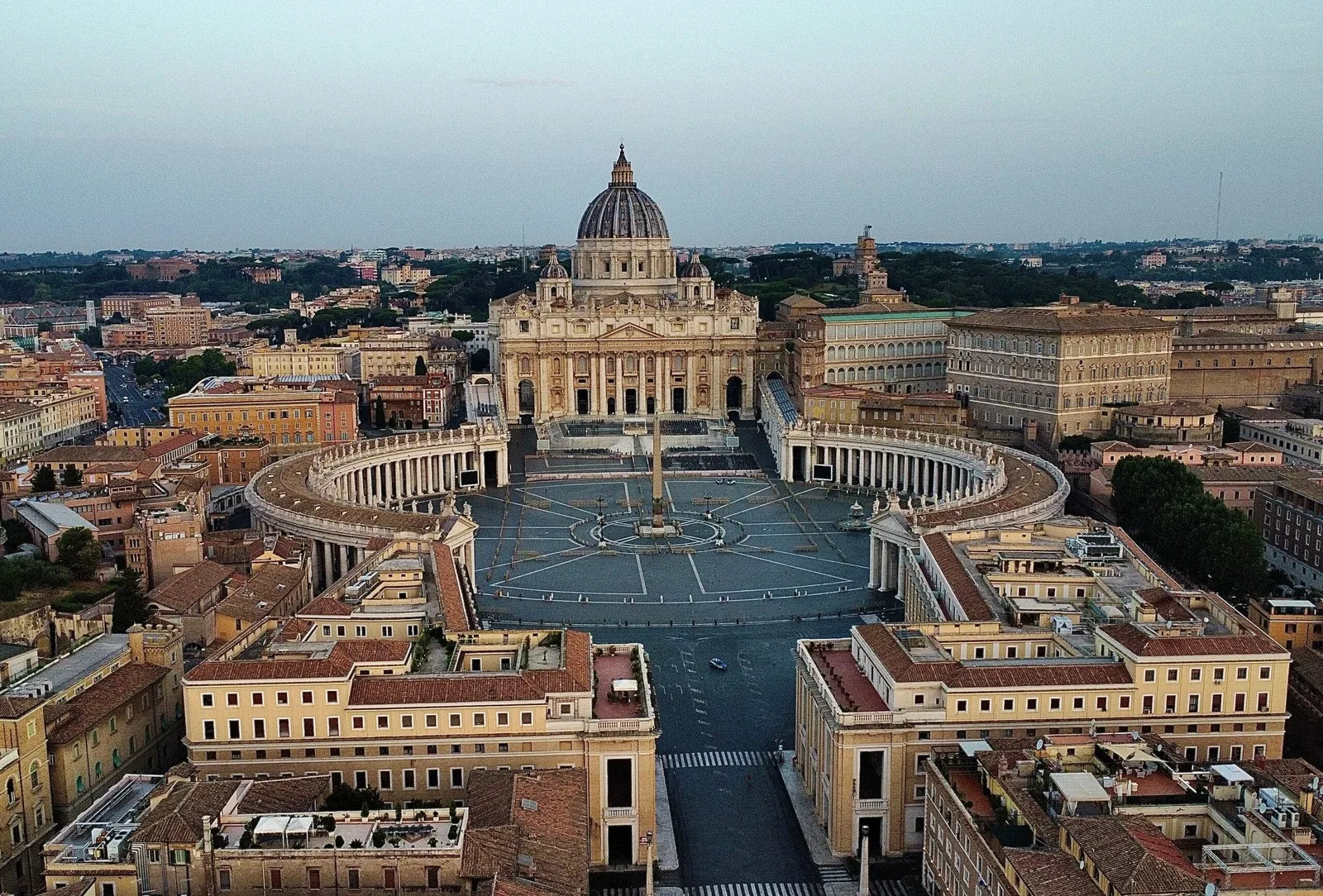
The world’s smallest state possesses no significant natural resources, no industrial base, and no conventional military capable of defending its territory. Yet from a few dozen hectares enclosed within the heart of Rome, the Holy See maintains diplomatic relations with 184 states and exercises political, social, and cultural influence on a scale vastly disproportionate to the size of Vatican City. This singular position cannot be explained by religion alone. It is the result of an exceptional historical construction: after losing almost all of its territory, the papacy gradually transformed its spiritual authority, global network, and institutional continuity into instruments of power.**
At first glance, the Vatican appears almost anomalous within the international system. Its territory is so small that it can be crossed on foot in a matter of minutes. Its economy rests neither on a productive base comparable to that of conventional states nor on energy, agricultural, or mineral resources capable of ensuring economic autonomy. Nor does it possess the military instruments traditionally associated with sovereignty. Yet dozens of embassies are established in Rome specifically to maintain relations with the Holy See, while apostolic nuncios represent it across much of the world. As of January 2026, the Holy See maintained diplomatic relations with 184 states, in addition to relations with the European Union and the Sovereign Order of Malta. Ninety-three diplomatic missions accredited to the Holy See have their chancelleries in Rome.
This disproportion between material capabilities and international influence is the key to understanding the Vatican. Its power does not truly reside in the state visible on a map. It rests on a much more complex institutional architecture in which three distinct realities overlap: Vatican City State, the Holy See, and the Catholic Church. To confuse them is to miss the essential nature of the system.
From Territorial Empire to Minimal Sovereignty
For more than a millennium, popes were not merely religious authorities. They were territorial rulers. The Papal States occupied a substantial part of the Italian peninsula for centuries and placed the papacy at the centre of European rivalries. The pope governed territories, collected taxes, maintained armed forces, concluded alliances, and participated directly in the balance of power among European states.
This territorial dimension was progressively weakened by the political transformations of the nineteenth century. Italian unification directly challenged the existence of the Papal States, and in September 1870 troops of the Kingdom of Italy entered Rome. The temporal power of the pope appeared to have effectively come to an end. Pius IX nevertheless refused to fully recognise the new situation and regarded himself as a prisoner in the Vatican. For almost sixty years, the resulting “Roman Question” divided the papacy and the Italian state.
The historical paradox emerged precisely at this point. The disappearance of almost all papal territory could have reduced the papacy to a religious authority dependent on the Italian state. Instead, it gradually produced the opposite effect. Freed from the administration of a relatively extensive territory and from the military rivalries directly associated with its possession, the papacy retained an international diplomatic capacity that no longer depended on geographical size.
The issue was finally settled in 1929 by the Lateran Agreements concluded between the Holy See and Benito Mussolini’s Italy. Vatican City became a sovereign state designed to guarantee the material and political independence of the Holy See. This distinction is fundamental: the Vatican was not created to become a miniature territorial power, but to provide a sovereign base for an institution whose activities extend far beyond its borders.
The smallness of the territory is therefore not an accidental weakness of the system. It is almost its organising principle.
Vatican City, the Holy See and the Catholic Church: Three Different Realities
In everyday language, “the Vatican” is used interchangeably to refer to the state, the pope, the papal administration and sometimes the entire Catholic Church. Legally and politically, this simplification is misleading.
Vatican City State is the territorial entity created in 1929. It has its own institutions, legal order, administrative services, gendarmerie and the mechanisms required for the exercise of state sovereignty. Its fundamental purpose, however, is to guarantee the independence of the Holy See.
The Holy See is a far older entity. It refers to the central authority of the Catholic Church centred on the pope and the institutions that assist him in governing the universal Church. It is principally the Holy See, rather than Vatican City State, that conducts international diplomatic relations. When an ambassador is sent “to the Vatican”, that ambassador is legally accredited to the Holy See.
The Catholic Church, finally, is an immensely larger reality. It encompasses approximately 1.4 billion faithful and operates through dioceses, parishes, religious congregations, schools, universities, hospitals, charitable organisations and social institutions distributed across almost every region of the world. This infrastructure does not belong in its entirety to the Vatican and cannot be regarded as a vast centrally administered organisation. It nevertheless gives Rome something virtually no other microstate possesses: global human depth.
This architecture explains how a few dozen hectares in Rome can be connected to an institutional presence extending from Kinshasa to Manila, from São Paulo to Montreal, and from Seoul to Beirut.
Diplomacy Without Military Divisions
International power is traditionally assessed through material criteria: population, territory, gross domestic product, resources, industrial capacity and military strength. By virtually all of these measures, the Vatican should be insignificant. It is not, because it operates in a different register.
The Holy See possesses an old and professional diplomatic apparatus. Its representatives, the apostolic nuncios, combine a diplomatic function in their relations with governments with an ecclesiastical function connected to local Churches. This dual presence gives them access to information and interlocutors that sometimes extend beyond traditional diplomatic channels.
Continuity is another considerable advantage. Governments change, coalitions disappear, political regimes can collapse and international alliances are reorganised. The Holy See operates across much longer time horizons. Its institutional perspective is not determined by an electoral cycle or a presidential term.
This permanence allows the Vatican to maintain channels with actors that other powers can find difficult to approach simultaneously. It can engage Washington without belonging to the American alliance system, communicate with Moscow without sharing Russian objectives, negotiate with Beijing despite the absence of full diplomatic relations, interact with Middle Eastern governments while maintaining relationships with local Christian communities, and engage African or Latin American states in which the Church sometimes possesses a social presence older than the contemporary political institutions themselves.
This does not mean that the Vatican can impose its choices. Its influence is fundamentally different from coercive power. It can persuade, transmit messages, negotiate, facilitate mediation, provide a discreet channel or confer moral legitimacy. It can rarely compel.
The distinction between power and influence is therefore one of the fundamental limits of Vatican power.
China: A Laboratory of Vatican Diplomacy
Few issues illustrate this logic better than relations with China. The Holy See and the People’s Republic of China do not maintain formal diplomatic relations, while the Vatican continues to maintain relations with Taiwan. Nevertheless, Rome and Beijing have negotiated for years over an especially sensitive issue: the appointment of Catholic bishops in China.
For Beijing, allowing a foreign authority to participate in the appointment of Chinese religious leaders touches directly upon political sovereignty. For Rome, abandoning the pope’s role in episcopal appointments would challenge a fundamental component of the institutional unity of the Church.
The Provisional Agreement reached in 2018 on the appointment of bishops therefore represented a delicate compromise. Following several renewals, it was extended in October 2024 for a further four years. The Holy See presents the arrangement as a means of maintaining dialogue and preserving the ecclesial unity of Chinese Catholics.
The agreement remains controversial, particularly because of the state of religious freedom in China and the complex relationship between Chinese authorities and Catholic communities. Yet its very existence reveals something more profound: even a power of China’s scale considers negotiation with Rome potentially necessary for the long-term management of a domestic religious question.
The Vatican cannot compel Beijing. Beijing, for its part, cannot simply eliminate the spiritual authority Rome exercises over part of China’s Catholic population. The two institutions are therefore, to a certain extent, compelled to negotiate.
A Power Without a Conventional Army
The absence of meaningful military power constitutes another major Vatican singularity. The famous Pontifical Swiss Guard primarily performs missions related to the protection of the pope and security. The Vatican Gendarmerie, meanwhile, carries out policing, public-order and security functions, including the protection of individuals and installations, in coordination where necessary with the Italian authorities.
The Vatican therefore possesses no credible conventional defence capability against an external power. In a purely military scenario, its territory would be impossible to defend through its own resources.
This apparent vulnerability demonstrates, however, how contemporary sovereignty can rest on more than force. An attack against the Vatican would not simply constitute an operation against a handful of buildings in Rome. It would trigger a crisis involving Italy, target an internationally recognised sovereign entity and carry enormous symbolic consequences for hundreds of millions of people.
Vatican security therefore rests upon a legal, political and symbolic environment whose deterrent value bears little relation to its own material capabilities.
The Economy of a State That Is Not Really a National Economy
Vatican finances have long generated both fascination and controversy. Popular representations tend to oscillate between two caricatures: an immensely wealthy state possessing priceless treasures and an opaque financial institution whose wealth is almost impossible to measure.
The reality is considerably more complex.
The Vatican does possess an extraordinary artistic, property and cultural patrimony. The Vatican Museums, St Peter’s Basilica, works of art, archives, libraries and collections accumulated over centuries represent immense historical value. Yet confusing this patrimonial value with readily available financial wealth is a mistake. A Michelangelo fresco may possess enormous cultural and theoretical value; it is not an asset the Holy See could normally sell to finance its annual budget.
Revenue comes from several sources, including property and financial income, contributions from ecclesiastical structures, donations, activities carried out by Vatican institutions, museum revenues and various forms of asset management. The Institute for the Works of Religion, commonly known as the IOR or the “Vatican bank”, has also contributed for decades to perceptions of financial opacity surrounding the Holy See.
Financial scandals during different periods prompted successive reforms involving supervision, transparency, control procedures and asset management. The issue remains sensitive because the Vatican faces a difficult institutional contradiction: an organisation claiming global moral authority must administer substantial assets and complex financial operations while meeting contemporary standards of transparency and accountability.
Recent accounts nevertheless demonstrate that “wealth” does not mean an absence of budgetary constraints. The Holy See’s consolidated financial statements for 2024 reported a modest surplus of €1.6 million following a deficit of €51.2 million the previous year. The improvement was substantial, but Vatican economic authorities themselves have indicated that it must be sustained over time.
The Vatican’s patrimonial wealth should therefore not be confused with unlimited financial capacity.
The Southward Shift of Catholicism
A much deeper transformation may ultimately determine the Vatican’s future: the global geography of Catholicism is changing.
Europe remains the institutional and historical centre of the Church, but it is no longer its principal demographic engine. Ecclesiastical statistics published in 2026 showed that Africa counted more than 288 million Catholics in 2024, compared with slightly more than 281 million a year earlier. Africa’s share of the global Catholic population rose from 19.9 per cent to 20.3 per cent, while Europe’s declined slightly from 20.4 per cent to 20.1 per cent. The contrast is also visible in vocations: the number of priests is increasing in Africa and Asia while declining in Europe.
This evolution will necessarily have political and institutional consequences. Internal Church debates cannot indefinitely be interpreted through a predominantly European prism. Questions of poverty, development, religious coexistence, demographics, migration, family and the relationship between religion and society do not arise in the same way in Paris, Lagos, Kinshasa, Manila or Buenos Aires.
The administrative centre will probably remain in Rome, but the demographic centre of Catholicism continues to move.
Over time, this phenomenon could affect the composition of the College of Cardinals, the diplomatic priorities of the Holy See, internal theological debates and, ultimately, the way the Church understands its own position in the world.
From Francis to Leo XIV: A Global Institution After the Transition
The death of Pope Francis in April 2025 and the election on 8 May of the American Cardinal Robert Francis Prevost as Leo XIV opened a new chapter. Born in the United States but deeply connected to Latin America through his years in Peru, Leo XIV himself embodies a Catholic geography that can no longer be reduced to Europe. He became the 267th Bishop of Rome.
A papal succession also provides a striking demonstration of Vatican institutional continuity. A pope exercises considerable personal authority, but his death does not take the institution with him. Procedures developed and refined over centuries govern the vacancy of the Apostolic See, the conclave, the election and the transfer of authority.
Under Leo XIV, the diplomacy of the Holy See has continued to emphasise peace, dialogue and the maintenance of channels between opposing actors. Cardinal Pietro Parolin, the Secretary of State, described this orientation in May 2025 as a “diplomacy of encounter”, placing the new pontificate within a diplomatic continuity broader than the personality of the pontiff himself.
This is an essential feature of the system: popes change, their sensitivities and priorities differ, but the diplomatic apparatus, institutional memory and international network remain.
The Pope as a Geopolitical Actor
The pope’s personal power nevertheless deserves particular attention because few leaders possess a comparable global platform without governing a major power.
A papal visit can become a major diplomatic event. A statement concerning war, migration, the environment, poverty or interreligious relations can provoke governmental reactions across several continents. Audiences granted to heads of state are themselves diplomatic acts that are closely scrutinised.
Yet this influence depends directly on the credibility of the person and institution exercising it. Because the Vatican lacks significant coercive instruments, moral authority constitutes part of its strategic capital. When that authority is strong, papal statements can resonate far beyond the Catholic community. When it is weakened by scandals, internal contradictions or perceptions of partiality, the Holy See’s principal instrument of influence depreciates.
The crises surrounding sexual abuse within the Church have therefore produced consequences extending far beyond religion itself. They have damaged confidence in the institution and, indirectly, its ability to claim moral authority in international affairs.
For the Vatican, credibility and power are far more closely connected than they are for a state possessing armoured divisions or a reserve currency.
A Global Network No Microstate Could Build
The Holy See’s other fundamental resource is its network. It would be virtually impossible for a state the size of the Vatican to construct, through its own resources, a worldwide presence comparable to that enjoyed by the Catholic Church.
This presence should not be interpreted as an apparatus entirely controlled from Rome. A Catholic school in Kenya, a university in Chile, a hospital operated by a religious congregation in India or a charitable organisation in France are not simply branches of the papal government. Their legal structures, degrees of autonomy and responsible authorities vary considerably.
Taken together, however, they create an exceptional transnational network.
In some fragile regions, religious institutions remain present where public administrations are weak. They participate in education, healthcare, humanitarian assistance, support for displaced populations and local mediation. They also enable information to circulate between local realities, national episcopal conferences and Rome.
The Vatican therefore benefits from a form of global infrastructure that is neither an imperial administration nor a conventional diplomatic network. This ambiguity is precisely part of its strength.
The Limits of Moral Power
It would nevertheless be excessive to portray the Vatican as an occult power capable of directing world affairs. Its influence faces substantial limitations.
The first is secularisation. Across much of Western Europe, the Church’s social authority has declined sharply. Even in historically Catholic societies, Vatican positions on social issues no longer automatically determine electoral behaviour or public policy.
The second derives from the religious pluralisation of the world. Catholicism remains a major force but coexists with Islam, the various branches of Protestantism, Orthodoxy, Hinduism, Buddhism and numerous other religious and secular traditions. In many states, Catholic influence is marginal.
The third limitation originates within the Church itself. A community of more than a billion people distributed across every continent does not constitute a homogeneous political bloc. American, Congolese, Polish, Brazilian, Filipino and French Catholics can hold radically different views on the same political and social questions.
Finally, the Vatican remains dependent on the willingness of other actors to listen. It can offer mediation; it cannot compel belligerents to accept it. It can condemn a war; it cannot impose a ceasefire. It can defend a particular conception of human dignity; it possesses no mechanism for directly transforming that position into binding law within another sovereign state.
Its power is therefore real, but conditional.
Power After Territory
The history of the Vatican ultimately invites a reconsideration of the meaning of power itself.
For centuries, power was almost inseparable from territorial possession. The more land, population, resources and soldiers a ruler controlled, the greater that ruler’s power was assumed to be. According to this logic, the disappearance of the Papal States in 1870 should have condemned the papacy to progressive marginalisation.
The opposite occurred.
By effectively abandoning the territorial ambitions that had characterised part of its history, the Holy See gradually developed a form of power better adapted to an interconnected world: networks, diplomacy, information, representation, institutional permanence and normative influence.
There is something strikingly contemporary about this form of power. Major technology companies, international organisations, financial networks and transnational actors likewise demonstrate that influence is no longer necessarily proportional to the territory directly controlled. The Vatican began experimenting with this separation long before the concept of “soft power” was formulated.
Its position nevertheless remains unique because this transnational power rests on an institution whose history is measured in centuries and whose claimed legitimacy derives neither from an international election, nor from a market, nor from military superiority.
The Vatican is tiny because it does not need to be large.
Its territory guarantees its independence; it does not measure its influence. Its true geography begins at the boundaries of St Peter’s Square but does not end there. It extends through nunciatures, dioceses, parishes, universities, hospitals, missions, humanitarian organisations and Catholic communities scattered across every continent.
That is why looking only at Vatican City’s 0.44 square kilometres means looking at the wrong map.
The power of the Holy See is measured not by the territory it governs, but by the reach of the network to which it can speak.
Main Sources
- Holy See Press Office, Informative Note on the Diplomatic Relations of the Holy See, 9 January 2026 — diplomatic relations of the Holy See and diplomatic missions accredited to it.
- Vatican News, Holy See and China Extend Provisional Agreement on Appointment of Bishops, 22 October 2024 — four-year extension of the Provisional Agreement between the Holy See and China.
- Vatican News / Central Office of Church Statistics, data from the Annuario Pontificio 2026 and Annuarium Statisticum Ecclesiae 2024 — geographical evolution of the Catholic population, clergy and vocations.
- Vatican News, Leo XIV Is the New Pope, 8 May 2025 — election of Cardinal Robert Francis Prevost as Pope Leo XIV.
- Secretariat for the Economy of the Holy See, 2024 consolidated financial statements — financial position of the Holy See and return to a modest surplus in 2024.
- Vatican City State, Directorate of Security and Civil Protection Services — organisation and responsibilities of the Vatican Gendarmerie and security services.
Atlas Limits Research Desk
Atlas Limits’ editorial and analytical desk.