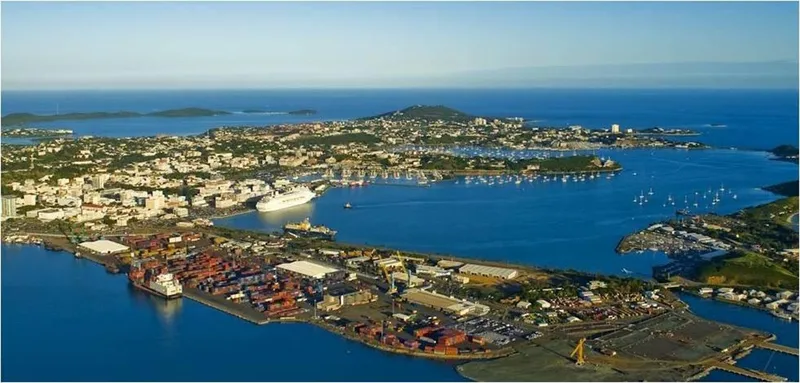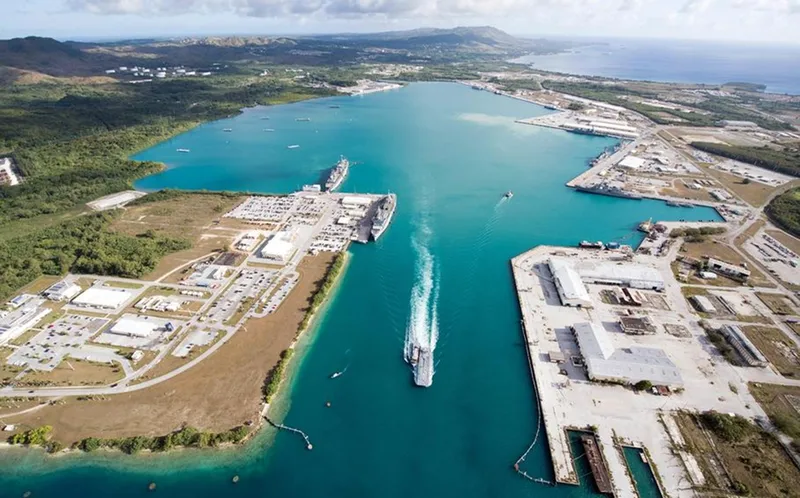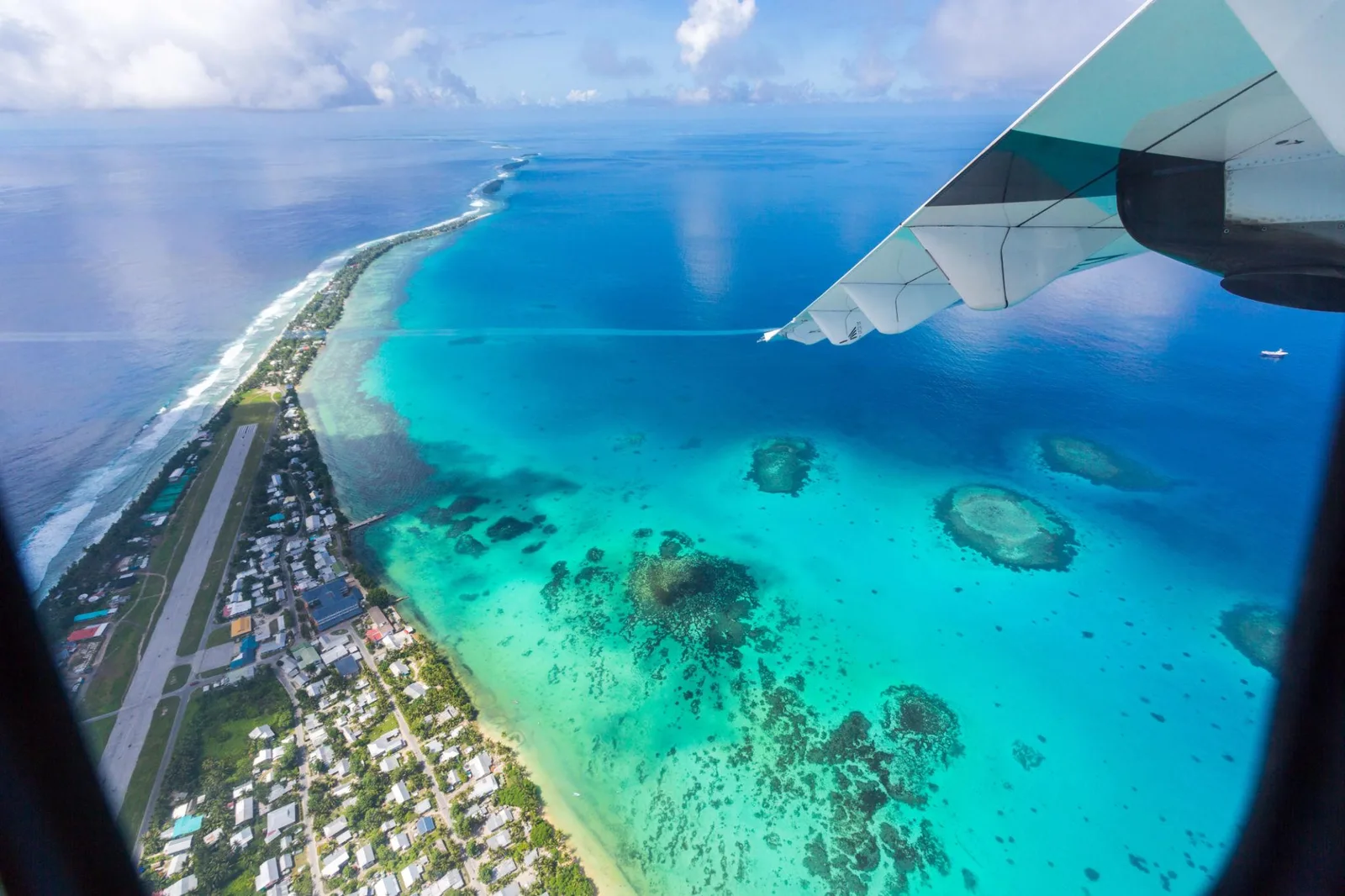
In Funafuti, the capital of Tuvalu, the boundary between land and ocean has never seemed more uncertain. On this Pacific atoll, homes, roads, government buildings and the airport occupy such a narrow strip of land that the sea is never far away, even when it remains out of sight. Some parts of the archipelago rise only a few metres above sea level. When exceptionally high tides coincide with adverse weather conditions, seawater can flood inhabited areas, disrupt transportation and threaten freshwater supplies. What elsewhere might be regarded as an exceptional disaster is gradually becoming a recurring constraint on everyday life.
Yet Tuvalu represents an almost imperceptible fraction of the world's geography. Its nine islands and atolls cover approximately 26 square kilometres of land, less than the area of many cities. Its population is around 11,000. Its maritime domain, however, extends across a vast expanse of the Pacific, containing much of the country's natural resources, economic opportunities and sovereign rights.
This disproportion between its tiny landmass and extensive maritime territory captures part of Tuvalu's paradox. The country possesses internationally recognised sovereignty, institutions, a history, a culture and diplomatic representation, yet the physical foundations of its existence are exposed to a climatic transformation it has virtually no power to stop.
The question confronting Tuvalu therefore extends far beyond environmental adaptation. It reaches into the foundations of the international order. Can a state continue to exist if its territory becomes uninhabitable? Can it retain its maritime boundaries when its coastlines retreat? Can its population live abroad without the nation from which it originates disappearing? And how far can a foreign power guarantee the survival of a small country without gradually acquiring decisive influence over its sovereign choices?
Tuvalu is turning these theoretical questions into political, legal and diplomatic decisions. The archipelago could therefore become one of the first contemporary laboratories of national sovereignty confronted with the progressive loss of the territorial conditions necessary for its exercise.
When Territory Becomes a Climate Variable
Sea-level rise is not an abstract prospect for Tuvalu. It is already a measurable reality.
According to analyses published by NASA, sea levels around the archipelago have risen by approximately 15 centimetres over three decades, at an average rate close to 5 millimetres per year. This increase, higher than the global average over the period examined, reflects worldwide climatic processes whose local consequences are amplified by the islands' extremely low elevation.
NASA projections indicate that several Pacific island states, including Tuvalu, are expected to experience at least another 15 centimetres of sea-level rise over the thirty years following 2024, regardless of short-term variations in emissions. By 2050, substantial portions of Tuvalu's infrastructure and inhabited land could lie below the average high-tide level. This does not necessarily imply permanent submergence, but it does mean significantly greater exposure to flooding.
The distinction is essential. The future of coral atolls cannot be reduced to a scenario of sudden geographical disappearance. Coral islands are dynamic formations capable of experiencing sediment redistribution, changes in surface area and, in some cases, local land gains. Research has shown that several islands in Tuvalu maintained or increased their surface area during recent periods despite rising seas.
These findings do not eliminate the danger. An island can retain its geographical footprint while becoming progressively more difficult to inhabit. Saltwater intrusion into groundwater, soil degradation, repeated damage to homes and inadequate infrastructure can undermine everyday life long before the land itself disappears beneath the ocean.
The critical threshold may therefore be habitability rather than submergence.
This introduces a considerable political difficulty. States traditionally operate within relatively stable borders, organising public services, economic activity and population security within them. In Tuvalu, the authorities must contemplate a future in which the physical conditions necessary for these functions deteriorate over the course of only a few generations.
The country is consequently forced to govern across two different time horizons. The first concerns immediate needs: housing, drinking water, healthcare, infrastructure and employment. The second concerns the possibility that an increasing proportion of its population may no longer be able to live permanently on the islands that constitute its historical territory.
Between these horizons, a strategy is emerging that cannot be reduced either to abandoning the country or to defending its physical territory at any cost. 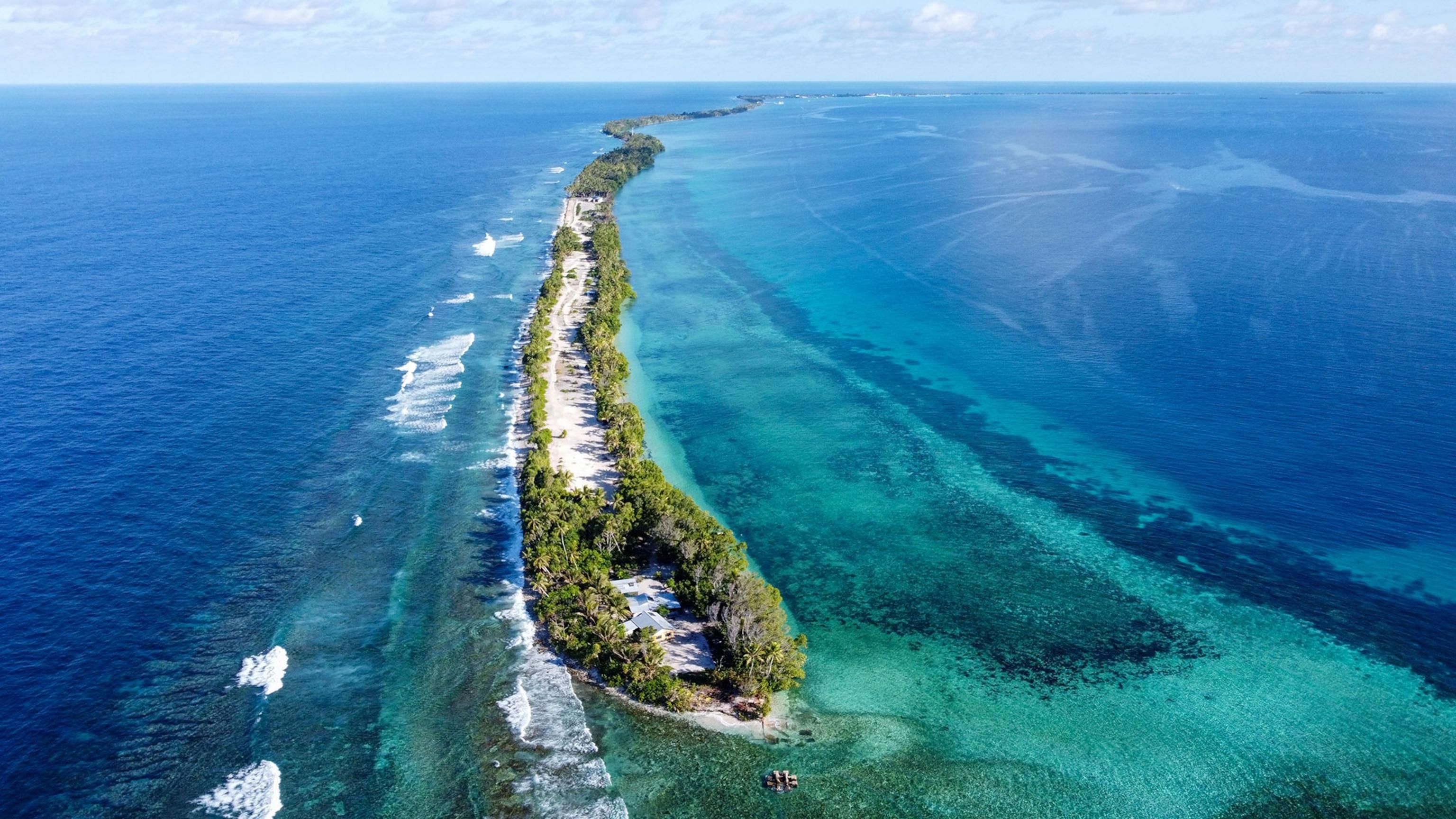
A Sovereignty Declared Perpetual
Faced with this prospect, Tuvalu has undertaken a remarkable legal initiative.
Its revised Constitution of 2023 affirms that the State of Tuvalu shall remain in perpetuity, regardless of the effects of climate change or other phenomena that might result in the loss of its physical territory.
This provision is more than a symbolic declaration. It expresses a conception of sovereignty under which the existence of a state cannot automatically be extinguished by an environmental transformation for which it bears virtually no responsibility.
Under the classical understanding of international law, statehood is generally associated with four elements: a permanent population, a defined territory, a government and the capacity to enter into relations with other states. These criteria, notably articulated in the 1933 Montevideo Convention, have long provided a reference point for analysing the formation of states.
Their application to the possible disappearance of territory, however, raises an entirely different question. Should the criteria used to establish the emergence of a state also determine its extinction? Can a country already recognised by the United Nations lose its international legal personality simply because its land becomes uninhabitable?
Tuvalu argues that it cannot.
This position rests on a fundamental distinction between the creation of a state and its continuity. Throughout international history, governments have retained diplomatic recognition despite territorial occupation, institutional exile or temporary inability to exercise authority within their borders. Climate-related territorial loss would differ in its causes and duration, but it could justify a comparable presumption of continuity.
In July 2025, the International Court of Justice contributed an important element to this debate through its advisory opinion on the obligations of states in respect of climate change. The Court considered that, once a state has been established, the disappearance of one of its constituent elements does not necessarily entail the loss of its statehood.
This formulation does not resolve every legal difficulty. It does not precisely define the operating conditions of a state whose territory has been entirely submerged, nor does it settle all the rights and obligations that would survive such a development. Nevertheless, it marks a significant evolution: the physical disappearance of territory can no longer simply be assumed to produce the automatic extinction of the state to which it belongs.
Tuvalu is seeking to translate this emerging understanding into durable international recognition.
The stakes also extend to maritime boundaries. Under the law of the sea, maritime zones are generally measured from baselines determined by coastal geography. If coastlines retreat or certain land formations disappear, the question arises whether maritime entitlements must be recalculated.
For Tuvalu, such a development could be devastating. Its maritime domain represents a strategic and economic asset vastly greater than its terrestrial surface. Fisheries resources, particularly revenue associated with tuna fishing rights, constitute an essential component of public income.
The 2023 Constitution therefore also provides for the preservation of the reference coordinates defining its maritime zones despite physical changes to the coastline, unless legislation determines otherwise.
This approach aligns with positions advanced by members of the Pacific Islands Forum, which adopted a declaration in 2021 on preserving maritime zones in the face of sea-level rise, followed in 2023 by a declaration concerning the continuity of statehood and the protection of persons.
Behind these legal texts lies a discreet but fundamental struggle. If rising oceans were allowed to diminish the maritime rights of island countries, those states would suffer a double dispossession: the degradation of their habitable territory and the erosion of the resources needed to finance their adaptation.
By defending the stability of its legal boundaries despite the instability of its coastlines, Tuvalu is attempting to prevent climate change from becoming an involuntary mechanism for redistributing sovereignty.
Australia: Protector and Regional Power
Tuvalu's response, however, is not confined to international law. It also involves a transformation of its alliances.
On 9 November 2023, Tuvalu and Australia signed the Falepili Union Treaty, which entered into force on 28 August 2024. The agreement represents one of the most significant recent diplomatic innovations in the Pacific.
It combines three dimensions that are usually addressed separately: climate adaptation, population mobility and national security.
Australia formally recognises the continuity of Tuvalu's statehood and sovereignty despite the effects of rising sea levels. It also commits to providing assistance in the event of a major natural disaster, pandemic or military aggression.
Most notably, the treaty establishes a specific migration pathway allowing Tuvaluan citizens to settle permanently in Australia, where they can live, work and study. The programme opened in 2025, with 280 visa places allocated for each of its first two years.
Compared with a national population of approximately 11,000, that annual allocation is equivalent to roughly 2.5% of Tuvalu's population, although the actual demographic impact depends on visa uptake, family composition and possible return migration.
At first glance, the agreement offers a pragmatic response to a problem without an immediate solution. Rather than waiting for a humanitarian emergency involving mass displacement, the two governments are organising gradual, legally regulated mobility that allows individuals to prepare for their future without necessarily severing their connections to their country of origin.
Yet this arrangement carries a much more sensitive geopolitical dimension.
The treaty requires Tuvalu to mutually agree with Australia on partnerships, arrangements or engagements with other states or entities concerning security and defence. This provision gives Canberra a formally recognised role in Tuvalu's external security relationships.
It must be understood against the background of intensifying strategic competition in the Pacific.
For several years, China has expanded its economic, diplomatic and security relationships with various island states. The security agreement concluded with Solomon Islands in 2022 particularly heightened Australian and American concerns about the possible expansion of China's strategic presence in the region.
Tuvalu occupies a distinctive position within this environment. It remains among the countries maintaining formal diplomatic relations with Taiwan rather than the People's Republic of China. This gives the archipelago diplomatic significance far beyond its geographical size.
Australia consequently has two overlapping interests in supporting Tuvalu. It seeks to respond to genuine climate vulnerability while also consolidating a regional environment in which small island states remain connected to Western security arrangements.
For Tuvalu, the calculation is more complicated. Australian protection can strengthen the state's material capabilities, improve the prospects of its population and reinforce international recognition of its sovereignty. It can also constrain its room for manoeuvre in certain strategic decisions.
The paradox is profound: to preserve its independence against the possible loss of habitable territory, Tuvalu accepts a degree of coordination over its security policy with a much larger power.
This compromise does not amount to the disappearance of sovereignty. Rather, it reveals how sovereignty is negotiated when a state's material resources are insufficient to confront an existential threat independently.
Leaving Without Ceasing to Belong
The mobility arrangements established by the Falepili Union raise another question, less visible in diplomatic documents but potentially more decisive for Tuvalu's future: what happens to a nation when its inhabitants increasingly build their lives elsewhere?
Emigration is not new to the Pacific. Island communities have long maintained family, economic and cultural networks extending beyond national borders. Remittances, overseas employment and educational mobility contribute to the functioning of many regional economies.
In Tuvalu, however, these movements acquire particular significance because they may progressively become a structural component of national survival.
The departure of part of the population could strengthen the country's economic resilience. Workers established in Australia may send money to their families, finance housing or support local businesses. Skills acquired abroad could also benefit those who choose to remain.
Conversely, substantial emigration can weaken public services, reduce the availability of essential skills and accelerate the relative ageing of the population remaining on the islands.
The problem extends beyond economics.
The continuity of a nation also depends on the transmission of its language, social practices, collective memory and relationship with its territory. In Tuvalu, the islands are not merely the physical foundations of the state. They are the places where communities, genealogies, traditions and distinctive relationships with the ocean have developed.
A dispersed population could retain a strong national identity over several generations. But such continuity would require appropriate institutions: language education, political representation, preservation of citizenship rights, cultural transmission and opportunities to participate in public decisions from abroad.
Climate-related mobility therefore raises a question distinct from that of refugee status.
People leaving territories exposed to the effects of climate change do not automatically qualify as refugees under the 1951 Refugee Convention. Specific migration arrangements, such as the agreement between Tuvalu and Australia, provide complementary responses without establishing a universal legal right to climate migration.
The danger would be to regard departure as a sufficient solution.
A population may achieve physical safety while progressively losing the ability to preserve the collective forms of its political existence. Tuvalu's challenge is therefore not simply to allow its citizens to live safely. It is to preserve their capacity to continue constituting a politically organised people.
This explains why Tuvaluan authorities emphasise the principle of mobility with dignity while maintaining the right of citizens to remain on their ancestral lands for as long as possible.
The Prospect of a Digital State
Alongside this legal and demographic transformation, Tuvalu has undertaken an unusual technological experiment.
In 2022, the country attracted international attention by presenting a project to digitally preserve its territory, institutions and cultural heritage. Often described as an initiative to create a digital nation, it aims to preserve representations of the islands, historical archives and elements of the country's collective identity.
The idea carries considerable symbolic force. If physical landscapes change, their digital representation could preserve part of the nation's memory. Future generations might therefore remain able to encounter the places, buildings and communal spaces that shaped the lives of their predecessors.
But it would be misleading to suggest that a country could simply be replaced by its virtual equivalent.
A digital environment produces neither drinking water nor housing nor agricultural land. It cannot replace ecosystems, everyday practices or social relationships that depend on physical presence. Nor can it independently resolve questions of citizenship, jurisdiction or international recognition.
Its function could nevertheless become important in a scenario of demographic dispersal.
National archives accessible remotely, digital administrative services, secure identification mechanisms and institutions capable of operating beyond the territory could help maintain relationships between the state and its citizens.
This prospect opens a political field that remains largely unexplored.
Can a government exercise its functions permanently from abroad? How should electoral participation be organised for a population living predominantly overseas? Where would official archives be stored? Which jurisdiction would apply to the state's digital infrastructure? And how could these systems remain autonomous when they depend on technology companies or facilities located in other countries?
Digitalisation can support institutional continuity, but it also creates new dependencies.
Tuvalu's digital sovereignty therefore cannot be separated from its financial capabilities, technological partnerships and the legal safeguards governing the storage and administration of its data.
The Tuvaluan experiment demonstrates that the possible loss of territorial habitability would not eliminate the material requirements of statehood. It would merely relocate some of those requirements to infrastructure situated elsewhere.
An Economy Too Small to Finance Its Future Alone
This potential dependence is already visible in public finances.
Tuvalu has an exceptionally narrow economic base, characterised by limited domestic production, a small internal market, high logistical costs and heavy reliance on imports. Its geographical isolation complicates investment and increases the cost of supplying many goods and services.
Public revenue depends notably on fishing rights, investment income, international assistance and certain distinctive resources, including those associated with its national internet domain, .tv.
Agreements governing access to Pacific fisheries represent a major financial instrument. They illustrate once again the importance of legally preserving the country's maritime zones, even as the physical conditions of its islands change.
The Tuvalu Trust Fund, established in 1987 with the support of international partners, provides another mechanism for budgetary stabilisation. Its purpose is to help the country maintain long-term financial resources in an economic environment marked by volatility.
But the costs of climate adaptation far exceed the ordinary capabilities of an economy of this size.
Protecting coastlines, elevating infrastructure, strengthening drinking-water systems, securing public buildings and creating new habitable land require investments that can represent a considerable proportion of national resources.
The Tuvalu Coastal Adaptation Project, supported by the United Nations Development Programme and international climate financing, illustrates this strategy of physical protection. Land reclamation and coastal reinforcement are intended to preserve spaces essential to collective life.
Australia has also substantially increased its assistance. In May 2024, the two governments announced Australian development assistance of at least AUD 86.7 million for the 2024–2025 financial year, compared with an estimated AUD 17.1 million for 2023–2024.
This increase reflects the growing importance attached to Tuvalu's stability, but also the structural nature of its financial dependence.
A question of climate justice emerges here with particular clarity.
Tuvalu contributes an infinitesimal share of global greenhouse gas emissions, yet its population must bear adaptation costs capable of profoundly transforming its economy and social organisation.
International financing therefore concerns more than humanitarian solidarity. It forms part of a broader debate about the responsibility of emitting states, compensation for climate-related damage and the distribution of the costs associated with global environmental transformation.
The advisory opinion delivered by the International Court of Justice in July 2025 strengthens the legal significance of these discussions by clarifying states' obligations to protect the climate system and the potential consequences of breaching those obligations.
It does not, however, establish an automatic compensation mechanism for Tuvalu. The implementation of legal responsibility, the establishment of causal relationships and the determination of possible remedies remain subject to specific conditions.
The country therefore faces a contradiction: its climate vulnerability is internationally recognised, but translating that recognition into predictable, sufficient and lasting financial resources remains uncertain.
The Pacific Is Redefining the Boundaries of Statehood
Tuvalu's experience extends far beyond the limits of the archipelago.
Kiribati, the Marshall Islands and other island states face comparable vulnerabilities, although their geographical, demographic and economic circumstances differ. For them too, rising seas raise questions that cannot be resolved solely through seawalls or population relocation.
Pacific states have gradually developed a collective diplomatic response.
The 2021 declaration on the preservation of maritime zones and the 2023 declaration on the continuity of statehood reflect a determination to establish legal stability where climate change is producing physical instability.
This evolution could have consequences extending well beyond the Pacific.
Modern international law has largely developed around a territorial conception of sovereignty. Borders define the space within which a government exercises its authority. Natural resources are associated with territories. Citizenship, taxation, public services and political institutions are generally organised around a population residing, at least partly, within a national space.
Climate change introduces a situation for which this architecture was not originally designed: that of recognised states whose territories may become permanently uninhabitable without their peoples relinquishing their political existence.
Broader international recognition of the continuity of such states could gradually produce new rules concerning maritime boundaries, diplomatic representation, institutions and citizens living abroad.
But several difficulties remain.
Recognition of legal continuity does not guarantee the material means of exercising it. A state without habitable territory would depend on other countries to accommodate its institutions and part of its population. It might retain its seat at the United Nations while its administrative, financial and economic capacities relied on foreign infrastructure.
Such a situation would not necessarily be incompatible with sovereignty. It would nevertheless profoundly transform the practical conditions under which sovereignty operates.
Tuvalu therefore reveals a distinction that may become central in the decades ahead: sovereignty can be preserved in law even as the material autonomy of the state deteriorates.
This tension is not exclusive to countries threatened by rising oceans. It already runs through international relations in other forms, whenever states depend on foreign powers for their security, energy supplies, digital infrastructure or financial stability.
Tuvalu represents an extreme manifestation of this phenomenon because dependence may no longer concern only particular functions of the state, but the physical conditions of its existence.
A Nation's Survival Cannot Be Measured by Land Alone
It would be premature to announce Tuvalu's disappearance. Future trajectories will depend on global emissions, regional sea-level changes, the natural dynamics of coral atolls and adaptation policies. Technological advances and investment may preserve habitable areas and considerably extend the possibilities of life on the islands.
But it would be equally misleading to reduce the situation to a problem of coastal engineering.
What is unfolding in Tuvalu is a transformation of the relationship between a people, its territory and its sovereignty.
For centuries, the existence of a state has been understood through the relative permanence of a geographical space. Wars could move borders, empires could collapse and populations could be forced into exile, but territory remained the material foundation around which political life was organised.
Climate change introduces a different kind of rupture. It can progressively render territory unsuitable for certain forms of human occupation without any military conquest, treaty of cession or collective decision to dissolve the state.
Tuvalu refuses to allow this physical transformation to be interpreted as political extinction.
Its Constitution affirms the continuity of the state. Its alliances seek to protect the living conditions of its population. Its digital initiatives attempt to preserve collective memory and institutional functions. Its diplomacy defends the stability of its maritime boundaries and the recognition of its rights.
None of these responses, taken individually, guarantees survival. Together, however, they outline a new conception of national permanence.
The question is not whether an archipelago covering 26 square kilometres can resist rising oceans indefinitely. It is whether the international community will accept that a people retains its political existence when the geography in which it emerged can no longer provide the same conditions for human life.
Tuvalu thus compels international law to confront a possibility that long remained theoretical: a state whose sovereignty is no longer entirely attached to the habitability of its territory.
And behind this legal question lies something more fundamental. If land can become uninhabitable without the nation disappearing, then a country's survival no longer depends solely on the preservation of its borders. It also depends on the collective willingness to recognise that a people does not cease to exist when the physical world surrounding it changes.
Tuvalu is not merely asking the world to help preserve its islands. It is asking the world to recognise that the future of those islands must not, by itself, determine the future of its state.
Main Sources
NASA — Sea Level Change Team (2023–2024). Funafuti Atoll, Tuvalu; NASA Analysis Shows Irreversible Sea Level Rise for Pacific Islands. Satellite observations and projections concerning sea-level rise. Projections involve local uncertainties and should not be interpreted as precise dates for complete submergence.
https://science.nasa.gov/earth/earth-observatory/funafuti-atoll-tuvalu-153047/
https://www.nasa.gov/earth/climate-change/nasa-analysis-shows-irreversible-sea-level-rise-for-pacific-islands/
Constitution of Tuvalu (2023). Provisions concerning the perpetual continuity of the state and the preservation of maritime boundary coordinates. These are national constitutional provisions whose international implications also depend on recognition and state practice.
https://www.constituteproject.org/constitution/Tuvalu_2023
Australian Government — Department of Foreign Affairs and Trade (2023–2026). Australia–Tuvalu Falepili Union Treaty. Treaty provisions concerning mobility, security cooperation and recognition of the continuity of statehood.
https://www.dfat.gov.au/geo/tuvalu/australia-tuvalu-falepili-union-treaty
International Court of Justice (23 July 2025). Obligations of States in Respect of Climate Change, advisory opinion. Major legal reference concerning international climate obligations and the possible continuity of statehood. The opinion does not constitute a contentious judgment automatically awarding compensation to Tuvalu.
https://www.icj-cij.org/case/187
Pacific Islands Forum (2021 and 2023). Declarations concerning the preservation of maritime zones and the continuity of statehood in the face of sea-level rise. These texts represent important regional positions in the development of international law.
United Nations Development Programme — Tuvalu Coastal Adaptation Project. Information on coastal protection, adaptation measures and territorial resilience.
https://www.undp.org/pacific
Australian Government — Joint Statement on Commitment to the Falepili Union (9 May 2024). Bilateral commitments and announced development assistance. Figures represent announced budgetary commitments rather than necessarily final disbursements.
https://www.dfat.gov.au/countries/tuvalu/joint-statement-commitment-falepili-union
Atlas Limits Research Desk
Atlas Limits’ editorial and analytical desk.