With its new M8000 computing module, China's ZTE illustrates a profound transformation of the digital industry. As artificial intelligence drives unprecedented demand for computing capacity, technological competition is increasingly shifting toward electricity, cooling systems, and the physical infrastructure required to sustain ever-greater concentrations of processing power.
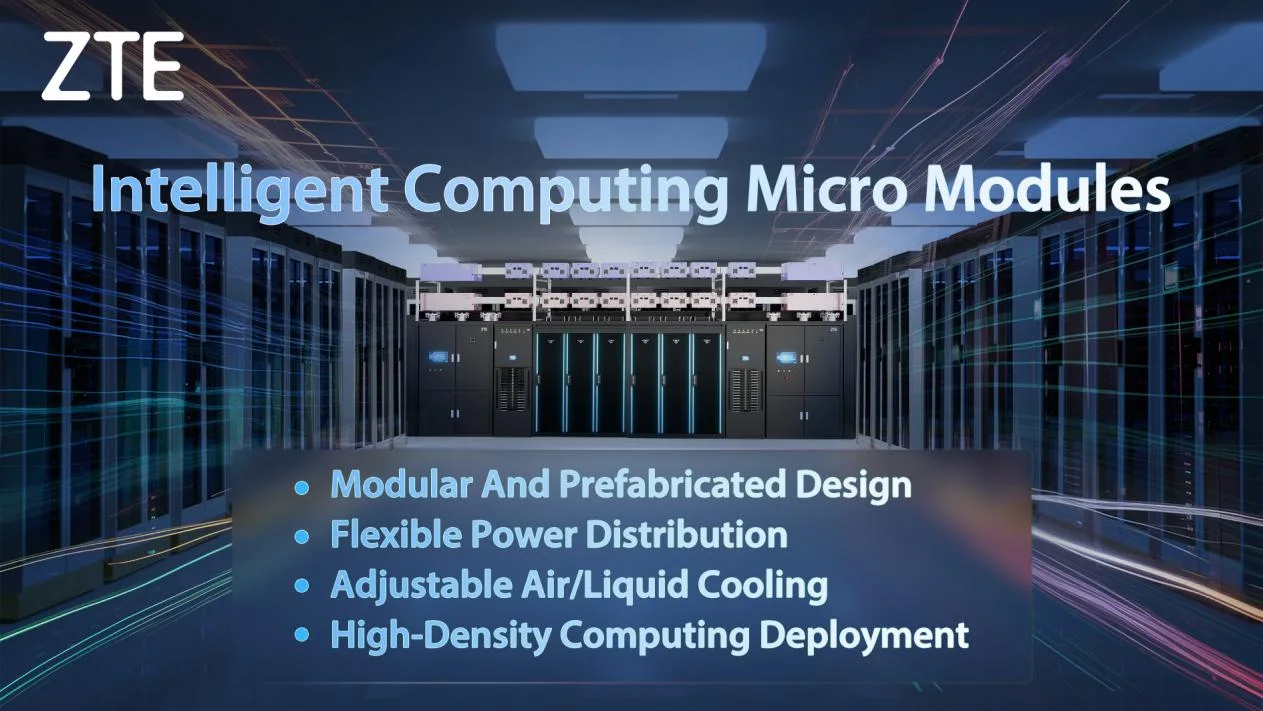
In Singapore, on October 20, 2026, ZTE introduced a piece of equipment that looks more like a miniature industrial installation than a conventional computing product. The ZXFDC M8000, unveiled at Data Centre World Asia, brings together server racks, liquid and air cooling systems, high-voltage power distribution equipment, and automated monitoring technologies within a modular architecture. Behind this combination of technical components lies a much broader development: artificial intelligence is gradually transforming data centers into energy-intensive industrial facilities whose performance depends as much on controlling heat and electricity as on the computing power of their processors.
For decades, the computing industry advanced primarily by increasing processing capabilities while reducing the cost of operations. Processors became faster, servers more compact, and infrastructure more efficient. The rise of generative artificial intelligence is disrupting this balance. Specialized accelerators now concentrate considerable electrical power within relatively limited spaces. Their operation requires stable electricity supplies, continuous heat removal, and infrastructure capable of evolving alongside successive generations of hardware whose technical characteristics are changing rapidly.
This transformation is no longer marginal. According to estimates from the International Energy Agency, data centers consumed approximately 415 terawatt-hours of electricity in 2024, representing nearly 1.5% of global electricity demand. Their consumption could reach approximately 950 terawatt-hours by 2030, accounting for close to 3% of worldwide electricity use. Artificial intelligence is the principal driver of this expansion, although traditional digital services continue to grow.
The industrial question is becoming unavoidable: how can computing capacity continue to multiply when the physical infrastructure required to sustain it is itself becoming a constraint?
Heat, the New Frontier of Computing
The M8000 offers one response to this challenge by addressing one of the most immediate problems facing artificial intelligence infrastructure: thermal density.
ZTE describes an architecture designed to accommodate racks consuming between 20 and 60 kilowatts, with a claimed maximum capacity of 250 kilowatts per rack. The latter represents an extraordinary concentration of electrical power. By way of illustration, ten racks operating at 250 kilowatts each would require 2.5 megawatts of IT power, even before accounting for auxiliary cooling and power distribution requirements.
The difficulty is not simply supplying this electricity. Most of the electrical energy consumed by electronic components ultimately becomes heat, which must be removed to maintain reliable operation. As computing power increases, conventional ventilation systems increasingly encounter physical and economic limitations.
Liquid cooling is therefore emerging as a structural evolution rather than a minor technical improvement. Water and other heat-transfer fluids can transport heat much more effectively than air within appropriately designed systems. This makes it possible to bring cooling closer to the most demanding components while reducing dependence on the circulation of large volumes of air.
The system presented by ZTE combines both approaches. Its hybrid architecture integrates direct-to-chip liquid cooling through cold plates, coolant distribution units, and air-based cooling equipment. The objective is to allow operators to adapt their installations progressively as computing hardware evolves, without rebuilding their entire infrastructure with every new generation of servers.
This flexibility carries significant economic value. A data center represents an investment in real estate, electrical infrastructure, and industrial equipment whose useful life often extends well beyond that of the computing hardware it houses. Designing facilities capable of accommodating several processor generations is therefore a way of protecting invested capital against technological obsolescence.
ZTE claims that its architecture can support three successive generations of computing equipment. If confirmed under actual operating conditions, this capability could reduce the costs associated with adapting facilities to new accelerators.
Electricity Becomes a Central Factor in Competitiveness
Cooling, however, is only one part of the problem. The other concerns the delivery of electricity to computing equipment.
The M8000 incorporates an 800-volt high-voltage direct-current distribution architecture, combined with intelligent busbar systems. According to ZTE, this configuration can achieve power distribution efficiency of 98%.
The difference between 98% efficiency and a figure just a few percentage points lower may appear modest. Yet it becomes economically significant when applied to installations operating continuously at tens or hundreds of megawatts.
For an IT load of 100 megawatts, a distribution system operating at 98% efficiency would theoretically require approximately 102 megawatts at its input, compared with nearly 106 megawatts at 94% efficiency. The difference, approximately four megawatts, would amount to more than 34 gigawatt-hours over a year of continuous operation. This is a theoretical illustration, not a measured saving achieved by the M8000, but it demonstrates why electrical losses have become a major financial consideration.
At this scale, optimizing power distribution is no longer a secondary engineering concern. It directly influences operating costs, grid connection requirements, and investment profitability.
The International Energy Agency emphasizes that data centers pose a particular challenge for electricity networks. Although their consumption remains relatively limited at the global level, it is heavily concentrated in certain locations, often around major technology clusters. Transmission infrastructure, transformers, and local generation capacity must therefore accommodate demand growth that can be considerably faster than overall electricity consumption.
A data center can be constructed within a few years, while strengthening an electrical grid or developing additional generation capacity may require substantially longer periods.
Artificial intelligence thus introduces an industrial contradiction: technology companies are seeking to accelerate computing investments, but their ability to execute those projects depends on energy infrastructure constrained by financing, regulation, and construction timelines.
The cost of computing can no longer be reduced to the price of chips. It also depends on the availability, reliability, and price of electricity, as well as the time required to secure access to it.
An Efficiency Promise That Requires Scrutiny
ZTE claims that the M8000 can achieve a power usage effectiveness, or PUE, as low as 1.15. This indicator compares the total energy consumed by a data center with the energy used directly by its computing equipment.
A PUE of 1.15 theoretically means that for every 100 units of energy consumed by servers and other IT equipment, an additional 15 units are required to operate supporting infrastructure. The closer the indicator approaches 1, the lower the energy overhead associated with non-computing systems.
ZTE also states that its optimization algorithms can reduce cooling-related energy consumption by more than 10%, according to the manufacturer's own performance measurements.
These figures are industrially relevant, but they require careful interpretation. The company's announcement does not provide an independently verified measurement campaign establishing the climatic conditions, operating loads, or methodologies under which these performances were obtained. PUE can vary considerably depending on outdoor temperatures, equipment utilization, and facility configuration.
It would therefore be premature to treat these results as universally guaranteed performance levels.
Another distinction is essential: improving PUE does not necessarily mean reducing total electricity consumption. A data center can become more efficient while consuming more electricity if its computing capacity increases sufficiently.
This is one of the paradoxes of artificial intelligence expansion. Technological improvements allow certain operations to be performed with less energy, but they can simultaneously encourage broader adoption and greater installed computing capacity.
Efficiency consequently becomes a condition for growth rather than a guarantee of lower overall consumption.
China Invests in the Physical Infrastructure of AI
ZTE's announcement also carries strategic implications extending far beyond the technical characteristics of its equipment.
Global competition in artificial intelligence is frequently described through language models, semiconductors, and American restrictions on exports of advanced technologies. While essential, this perspective covers only part of the industrial value chain.
Between manufacturing an accelerator and operating it inside a data center, an extensive infrastructure must be constructed. It includes electrical equipment, power conversion systems, cooling installations, communication networks, monitoring software, and security systems.
This market constitutes an arena of competition in its own right.
American companies possess major advantages in accelerators and computing platforms, particularly Nvidia and the leading cloud service providers. Other groups, including Schneider Electric, Vertiv, Eaton, and Huawei, hold important positions in electrical and thermal equipment and integrated infrastructure architectures.
ZTE is seeking to strengthen its position in this environment by offering not merely individual components, but a preassembled system capable of simplifying the construction and evolution of data centers.
This approach is particularly relevant for countries and companies seeking to develop computing capacity rapidly without independently mastering every element of the underlying infrastructure.
It also forms part of a broader Chinese industrial strategy. As restrictions complicate access to certain advanced semiconductors, mastering complementary infrastructure becomes an additional source of industrial leverage. It cannot eliminate constraints associated with processor performance, but it can improve the efficiency of the systems in which those processors operate.
Usable computing capacity ultimately depends on the entire technological chain, not simply on the theoretical performance of individual chips.
The ability to supply complete, standardized, and rapidly deployable solutions may therefore become a commercial advantage in regions where demand for computing services is expanding faster than available infrastructure.
Asia, a Laboratory for the New Digital Industry
The choice of Singapore to introduce the M8000 is significant.
Southeast Asia is experiencing rapid growth in demand for digital infrastructure. International companies are expanding cloud capacity, artificial intelligence services, and facilities designed to support the digital transformation of regional economies.
According to projections from the International Energy Agency, electricity consumption by data centers in Southeast Asia could more than double by 2030. Singapore and southern Malaysia occupy particularly important positions in this development because of their concentration of infrastructure, international connectivity, and proximity to regional markets.
Yet this growth is encountering physical limitations. In densely urbanized territories, access to land, electricity, and cooling resources can become restrictive factors.
Modular infrastructure and improvements in computing density are emerging as potential responses to these constraints.
ZTE does not present the M8000 merely as a conceptual product. The company states that it secured a contract in 2025 covering 666 computing modules for a project in China's Yangtze River Delta, with 345 units reportedly delivered by the time of the announcement. It also cites a delivery period of approximately one month between ordering and arrival on site for that project.
These claims, supplied by the company and not independently verified, nevertheless point toward a strategy based on industrializing data center construction.
The objective is to transfer part of the work traditionally performed on construction sites into standardized factory production processes. This approach can improve consistency, shorten certain deployment stages, and facilitate the installation of large computing capacities.
It is gradually transforming data center construction into an activity resembling the production of modular industrial equipment.
The New Geography of Computing
The evolution of infrastructure could also alter the global distribution of artificial intelligence capacity.
Until recently, major digital hubs developed primarily around concentrations of capital, technology companies, telecommunications networks, and specialized expertise.
These factors remain decisive, but access to abundant and competitively priced energy is becoming increasingly important.
Territories capable of providing substantial electrical capacity, reliable grid connections, and favorable cooling conditions may attract investments that would previously have prioritized immediate proximity to established technology centers.
This evolution creates opportunities for certain regions with significant energy resources, particularly the Middle East, North America, and several Asian economies. It could also create opportunities in parts of Africa, provided that the necessary electricity networks, international connectivity, and financing conditions are available.
However, inexpensive energy alone is insufficient. Large data centers require continuous power supplies, robust transmission infrastructure, backup systems, and predictable regulatory environments.
The location of computing capacity is therefore becoming an energy, industrial, and geopolitical decision simultaneously.
This transformation could intensify competition between states seeking to attract digital investment, much as they have long competed to host automotive factories, chemical plants, and semiconductor manufacturing facilities.
The Environmental Paradox of Artificial Intelligence
The promise of more efficient infrastructure comes with a fundamental environmental question.
ZTE presents the M8000 as a solution intended to support the development of lower-carbon artificial intelligence infrastructure. Yet data center energy efficiency and carbon footprint are not equivalent concepts.
A facility with an excellent PUE can remain highly carbon-intensive if its electricity comes primarily from fossil fuels. Conversely, a slightly less efficient installation may have a lower operational carbon footprint when supplied with largely decarbonized electricity.
Environmental performance also depends on equipment manufacturing, replacement cycles, materials, and resources consumed by cooling systems.
The International Energy Agency estimates that renewable energy could meet nearly half of the increase in global data center electricity demand through 2030, while natural gas and coal are expected to retain significant roles in several regions.
The development of artificial intelligence therefore cannot be separated from the trajectory of the energy systems supporting it.
Efficiency gains promised by manufacturers are part of the solution, but they do not replace investment in electricity networks, the development of lower-carbon generation capacity, or the need to measure actual consumption accurately.
The central question is not simply how much energy an individual computing operation can save. It is how the total consumption of a sector will evolve when its applications and installed capacity are expanding simultaneously.
Infrastructure Becomes the Real Industrial Frontier
The introduction of the M8000 ultimately illustrates a gradual shift in where value is created within the artificial intelligence economy.
Models and semiconductors remain central to technological competition. Yet their deployment at scale depends on physical infrastructure whose complexity increases alongside computing power.
Electricity, cooling, power distribution, modularity, and monitoring software are no longer merely supporting functions. They are becoming determinants of the industrial capacity to produce computation.
This development could favor companies capable of integrating multiple technical disciplines into coherent solutions, while also increasing operators' dependence on specialized suppliers. It could accelerate the standardization of facilities while raising capital requirements and demand for energy infrastructure.
For ZTE, the M8000 represents an attempt to establish a stronger position on this emerging industrial frontier. For data center operators, it illustrates the need to design facilities capable of accommodating increasingly concentrated electrical loads. For governments, it is a reminder that digital sovereignty also depends on the electrical and industrial infrastructure that makes computing possible.
For decades, computing power was measured primarily through processor speed, memory capacity, and network performance. These indicators remain essential, but they no longer adequately describe the limits of artificial intelligence.
The next generation of data centers will be built as much around transformers, cooling circuits, and available megawatts as around the chips they supply.
Artificial intelligence is often portrayed as an immaterial technology composed of algorithms and data. Its expansion reveals a fundamentally industrial reality: behind every advance in computation stand machines, materials, electricity, and heat that must be removed.
The next frontier of artificial intelligence is therefore not merely digital. It is physical.
Main Sources
ZTE Corporation, “ZTE Launches M8000 Intelligent Computing Micro-Module Data Center, New-Gen AIDC IT POD Solution for Global Deployment,” official announcement, October 20, 2026. Primary source for technical specifications, claimed performance, and commercial references. The manufacturer's performance claims have not been independently verified.
https://www.zte.com.cn/global/about/news/zte-launches-m8000-intelligent-computing-micro-module-data-center%2Cnew-gen-aidc-it-pod-solution-for-global-deployment.html
International Energy Agency (IEA), Energy and AI, April 2025. Analysis of global electricity demand, data center growth, and energy infrastructure constraints.
https://www.iea.org/reports/energy-and-ai
International Energy Agency (IEA), Key Questions on Energy and AI, 2026. Updated assessment of global data center electricity consumption projections through 2030.
https://www.iea.org/reports/key-questions-on-energy-and-ai
ZTE Corporation, “Powering the AI Era: How ZTE Is Redefining Data Center Infrastructure,” 2026. Additional information on integrated infrastructure architecture, 800-volt electrical distribution, and hybrid cooling systems. Manufacturer-provided information requiring independent operational verification.
https://www.zte.com.cn/global/about/news/powering-the-ai-era-how-zte-is-redefining-data-center-infrastructure.html
Atlas Limits — Independent Global Analysis
Atlas Limits Research Desk
Atlas Limits’ editorial and analytical desk.