With the launch of the first Windows computers powered by the RTX Spark superprocessor, NVIDIA is pursuing a transformation that extends far beyond graphics performance and gaming laptops. The company aims to bring artificial intelligence directly into personal computing, reshape the architecture of the PC, and expand its influence across the computing industry. Behind this technological shift lies an industrial confrontation involving semiconductor manufacturers, software developers, and cloud operators, centered on a fundamental question: where will computing power reside in the next generation of computers?
The Return of Computing Power to the Desktop
For nearly two decades, the computing industry has progressively shifted the center of gravity of its processing capabilities toward remote infrastructure. Personal computers have become thinner, more energy-efficient, and increasingly integrated with services hosted in data centers. The widespread adoption of cloud computing has transformed their role. Rather than performing every operation locally, computers have increasingly become gateways to processing power located elsewhere.
This organization has supported the emergence of a global digital infrastructure economy. Major technology platforms have concentrated computing resources, businesses have outsourced significant portions of their information systems, and users have gradually accepted that increasingly sophisticated applications depend on permanent connectivity.
Generative artificial intelligence has accelerated this transformation. The most advanced models have been trained on enormous computing infrastructures and subsequently offered through remotely accessible services.
The commercial introduction of the first Windows computers powered by NVIDIA RTX Spark, announced for October 16, 2026, points toward a different trajectory.
NVIDIA is presenting an architecture combining substantial graphics capabilities, unified memory configurations reaching 128 gigabytes, and specialized artificial intelligence performance advertised at up to one petaflop using FP4 numerical precision.
These figures do not mean that a laptop can now compete with the world's largest data centers. They nevertheless reveal an important industrial ambition: transferring part of the computational workload traditionally associated with remote infrastructure back to individual devices.
The objective is not simply to build a faster computer. It is to redraw the boundary between operations performed locally and those entrusted to centralized infrastructure.
For NVIDIA, that boundary represents an enormous economic opportunity.
Having become one of the principal suppliers of the infrastructure supporting modern artificial intelligence, the company now intends to occupy a central position in the machines through which individuals and businesses will use these technologies every day.
This strategy opens a new chapter in personal computing, with consequences extending well beyond the consumer electronics market.
From Graphics Cards to Complete Computing Architectures
NVIDIA's history helps explain the significance of this transition.
Founded in 1993, the company initially established itself through graphics processors designed for video games and visual applications. At a time when computing performance depended primarily on central processing units, NVIDIA developed specialized components capable of performing large numbers of operations simultaneously.
This parallel architecture eventually proved valuable in fields far removed from gaming.
Scientific simulation, numerical modeling, industrial engineering, and machine learning increasingly exploited the capabilities of graphics processors.
The introduction of CUDA in 2006 marked a decisive turning point.
By allowing developers to use NVIDIA GPUs for general-purpose computing, CUDA transformed a hardware component into a broader computing platform. The value of NVIDIA's products increasingly depended not only on their physical specifications but also on the software libraries, development tools, and applications built around them.
When deep learning emerged as a major technological field, NVIDIA already possessed an ecosystem capable of accelerating the mathematical operations required to train neural networks.
This advantage fundamentally transformed the company's industrial position.
Graphics processors became essential components of artificial intelligence infrastructure, while CUDA established itself within many development workflows.
NVIDIA subsequently expanded into high-speed networking, integrated computing systems, orchestration software, and enterprise platforms.
The evolution from Hopper to Blackwell and subsequent architectures reflects this broader strategy of integration.
NVIDIA no longer seeks merely to supply accelerators. It increasingly develops the different layers required to operate complete computing environments.
RTX Spark represents another expression of this ambition.
The central processor, graphics processor, memory architecture, communication mechanisms, and specialized AI capabilities are designed to function as a coordinated system.
This brings NVIDIA more directly into a market historically structured around Intel, AMD, Microsoft, and the major PC manufacturers.
The distinction is fundamental.
Supplying a graphics card to a computer manufacturer does not provide the same industrial influence as defining the central architecture of the machine itself.
A Different Definition of Computing Power
The RTX Spark architecture combines an Arm-based CPU with an NVIDIA Blackwell RTX GPU.
In its highest configurations, NVIDIA describes systems featuring up to 20 CPU cores, 6,144 CUDA cores, and specialized hardware designed to accelerate artificial intelligence operations.
The architecture can also access up to 128 gigabytes of unified memory.
This organization differs from conventional computers, where the central processor primarily uses system memory while a dedicated graphics card generally relies on separate video memory.
In a unified memory architecture, different computing engines can access a shared memory space.
This arrangement can reduce certain data transfers and facilitate workloads requiring frequent communication between the CPU and GPU.
For artificial intelligence, the implications are particularly important.
Large language models rely on billions of parameters that must be stored and accessed during inference.
Available memory therefore influences the size of models that can run locally, while memory bandwidth affects the speed at which their parameters can be processed.
A computer equipped with a powerful GPU but limited graphics memory may struggle to load a large model entirely into the available memory.
A larger unified memory pool can alleviate this constraint, although total capacity does not replace bandwidth or actual processing performance.
NVIDIA presents RTX Spark as capable of running certain models exceeding 120 billion parameters locally, depending on their numerical representation and quantization.
The company also highlights the ability to manipulate three-dimensional scenes exceeding 90 gigabytes, process demanding professional video workloads, and achieve frame rates above 100 frames per second at 1440p in selected gaming scenarios.
These figures are manufacturer claims associated with particular workloads and configurations. They should not be interpreted as universally achievable performance levels.
The advertised petaflop also requires careful interpretation.
It refers to peak theoretical performance for certain artificial intelligence operations using reduced numerical precision, particularly FP4.
It is not equivalent to one petaflop of general-purpose double-precision scientific computing.
Directly comparing this figure with the performance of a traditional supercomputer would therefore be misleading.
The significance of RTX Spark lies less in any single benchmark than in the combination of memory capacity, parallel processing, specialized acceleration, and software integration.
Together, these capabilities could allow certain professional applications to operate on individual machines without continuously relying on remote computing infrastructure.
Artificial Intelligence Moves Partly Beyond the Cloud
One of the most consequential changes concerns inference: the process through which an already trained model generates responses, analyzes documents, produces content, or performs tasks.
Until recently, the most capable consumer AI applications depended primarily on models hosted remotely.
Users submitted requests, those requests were processed by external servers, and the resulting outputs were returned to their devices.
This arrangement offers substantial advantages.
Providers can pool expensive infrastructure, update models centrally, and deliver capabilities far beyond those available on most individual computers.
However, it also creates constraints.
Every request depends on remote infrastructure, network availability, provider access policies, and pricing mechanisms that may change over time.
Sensitive information may need to leave the user's computing environment, raising questions about confidentiality, compliance, and digital sovereignty.
Local inference changes part of this equation.
A model installed directly on a personal computer can process certain documents, analyze sensitive information, and perform repetitive tasks without systematically transmitting data to an external service.
This capability could prove valuable to law firms, engineering companies, financial institutions, industrial organizations, and businesses handling confidential information.
A legal practice could use a local model to examine thousands of internal documents. An engineering team could analyze technical files without uploading them to an external platform. A software developer could run an assistant capable of examining a code repository directly on a workstation.
Local processing does not, however, automatically guarantee confidentiality.
Security still depends on the operating system, application permissions, storage mechanisms, logging policies, and the protection of the device itself.
Nor does a locally executed model necessarily match the capabilities of the most advanced cloud-hosted systems.
Model architecture, size, specialization, and available computing resources all influence performance.
The development of local artificial intelligence therefore does not imply the disappearance of cloud computing.
It suggests a more complex distribution of workloads.
Simple, repetitive, or sensitive operations may increasingly be performed locally. Tasks requiring greater processing power, constantly updated external information, or particularly demanding computations will continue to rely on remote infrastructure.
Such a hybrid architecture could become one of the defining characteristics of computing over the coming years.
The Personal Computer Becomes an Agent Platform
NVIDIA's ambitions extend beyond the occasional use of conversational assistants.
The company and Microsoft increasingly present advanced personal computers as platforms for AI agents.
Unlike a conventional application that waits for a direct command, an AI agent can be designed to perform sequences of operations, use software tools, consult files, execute programs, and pursue objectives defined by a user.
In professional environments, this development could transform everyday computing.
An analyst might ask an agent to monitor a collection of documents, extract new information, compare it with historical data, and prepare a report.
An engineer could delegate portions of software verification. A creative team might automate the organization, preparation, and processing of digital assets.
Local execution could allow some of these agents to remain available without continuous dependence on external services.
It could also reduce the marginal cost of repetitive operations once the necessary hardware has been acquired.
This explains why NVIDIA is not positioning RTX Spark merely as another generation of graphics technology.
The company wants its architecture to become part of a computing environment in which software systems do more than respond to direct instructions.
They increasingly perform actions under human supervision.
Yet this transition introduces significant challenges.
An agent with extensive access to files, applications, or network resources can cause substantial damage if its permissions are poorly defined.
It may modify documents, transmit information, or initiate unintended operations.
Local execution does not eliminate these risks.
Instead, it transfers additional security responsibilities to the device, operating system, and agent-control mechanisms.
The success of personal AI agents will therefore depend on isolation, authorization, auditing, and supervision mechanisms as much as on raw computing performance.
A computer capable of running a sophisticated model is not automatically capable of hosting a reliable autonomous agent.
Microsoft and NVIDIA Reshape the Windows Ecosystem
The introduction of RTX Spark forms part of a broader strategic relationship between NVIDIA and Microsoft.
The two companies have collaborated for years, but their interests now intersect across multiple layers of the computing industry.
Microsoft is a major cloud and artificial intelligence provider through Azure and its wider software ecosystem.
NVIDIA supplies important components of the accelerated computing infrastructure used by cloud operators.
Their cooperation around RTX Spark extends this relationship into personal computing.
For Microsoft, the challenge is to preserve the central role of Windows in an industry where hardware architectures are becoming increasingly diverse.
For decades, the PC market was organized primarily around Windows and x86 processors supplied by Intel and, increasingly, AMD.
The emergence of Arm architectures, integrated processors, and specialized AI hardware is gradually challenging that structure.
Apple has demonstrated that close integration between processors, memory, operating systems, and applications can deliver substantial improvements in performance and energy efficiency.
Microsoft must now ensure that Windows operates effectively across different processor architectures while maintaining compatibility with an enormous existing software ecosystem.
RTX Spark participates in this transition.
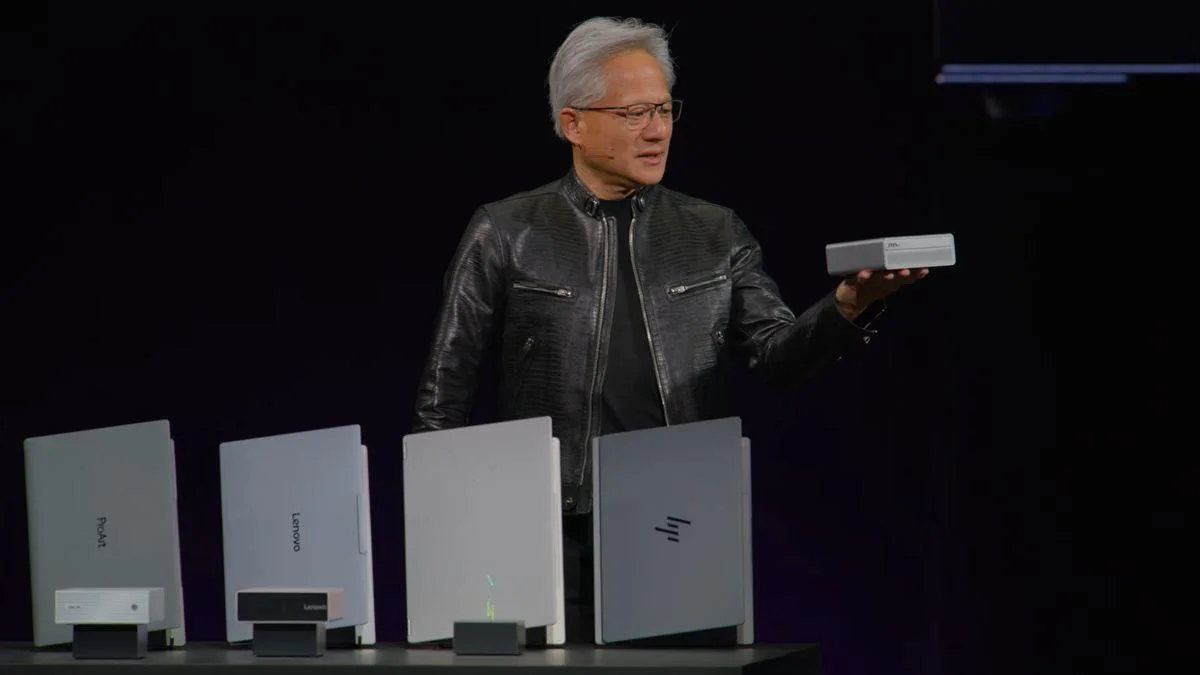
The announced launch involves manufacturers including ASUS, Dell, HP, Lenovo, Microsoft, and MSI.
Their participation gives the architecture a broader industrial dimension than a single experimental device could achieve.
Nevertheless, the presence of multiple manufacturers does not guarantee the emergence of a durable ecosystem.
Success will depend on native software availability, compatibility with existing Windows applications, the effectiveness of emulation, and the ability of manufacturers to deliver balanced products.
Microsoft's broader approach involves hybrid intelligence.
Windows should be capable of using local resources when appropriate and drawing on cloud infrastructure when tasks exceed the device's capabilities.
This approach preserves the advantages of centralized computing while incorporating increasingly powerful individual machines.
It also reveals an economic tension.
Microsoft derives substantial value from cloud services.
The growth of local inference could reduce certain forms of remote consumption, but it could also expand the overall use of artificial intelligence and generate additional demand for centralized infrastructure.
Cloud computing and personal computing are therefore not necessarily competing in a zero-sum market.
Both could grow simultaneously as AI applications become more widespread.
Apple and the Precedent That Changed the Industry
NVIDIA's strategy cannot be understood without examining Apple's transformation of personal computing.
Beginning in 2020, Apple progressively replaced Intel processors in its Mac computers with internally designed Apple Silicon chips.
The transition altered the competitive balance of the high-end personal computer market.
Apple adopted a highly integrated architecture combining CPU, GPU, specialized accelerators, and unified memory within a closely coordinated system.
This approach enabled the company to deliver substantial performance while maintaining relatively efficient power consumption.
It also strengthened Apple's control over its hardware and software ecosystem.
The success of Mac computers powered by M-series processors demonstrated that high-performance laptops did not necessarily require the traditional combination of an x86 CPU and a separate graphics processor.
NVIDIA is adopting certain principles of this integration, but with different priorities.
Apple designs its processors to optimize the overall experience of its devices, including battery life, application performance, and operating-system integration.
NVIDIA places particular emphasis on graphics acceleration, AI inference, and compatibility with its CUDA computing ecosystem.
Comparing the two approaches therefore requires more than examining core counts or theoretical processing capacity.
Actual application performance, energy consumption, memory bandwidth, thermal constraints, software compatibility, and total system cost must all be considered.
Early independent evaluations of RTX Spark indicate that NVIDIA has not eliminated Apple's accumulated advantages.
Some tests highlight promising graphics and local AI capabilities but also identify weaker CPU performance, limited battery life in certain conditions, and compatibility difficulties.
Results vary substantially between machines.
Cooling systems, battery capacity, power settings, and software optimization can produce significant differences even when computers use related processor architectures.
Apple therefore retains important advantages in vertical integration and software control.
NVIDIA, however, introduces a different competitive proposition: Windows machines combining substantial unified memory with an accelerated computing environment already widely used in research and enterprise AI development.
The competition extends beyond the computers themselves.
It concerns the development environments in which future AI applications will be created and deployed.
Intel and AMD Confront a Changing Market
NVIDIA's expansion into central Windows computing architectures also affects Intel and AMD.
Both companies possess extensive experience in processor design, established global customer bases, and longstanding relationships with PC manufacturers.
Intel remains deeply embedded in enterprise computing and personal computers.
AMD has developed into a major competitor across desktop processors, laptops, workstations, servers, and AI accelerators.
Both companies are investing in integrated architectures and specialized artificial intelligence capabilities.
NVIDIA's arrival therefore does not imply the immediate disappearance of their markets.
The more important question concerns the criteria through which customers evaluate computing performance.
Traditionally, purchasing decisions have emphasized CPU speed, GPU performance, memory, storage, and battery life.
Artificial intelligence introduces additional considerations.
Inference speed, the ability to load large models, energy efficiency per operation, software development tools, and compatibility with AI frameworks are becoming increasingly relevant.
If these criteria become decisive for professional customers, processor manufacturers will need to adapt their products accordingly.
AMD possesses important assets through Ryzen processors, Radeon graphics, Instinct accelerators, and its software technologies.
Intel retains extensive engineering capabilities, development tools, and a deep understanding of the Windows ecosystem.
NVIDIA's particular advantage lies in the established role of CUDA within artificial intelligence development.
This position could encourage organizations to adopt machines capable of running applications originally developed for NVIDIA-powered data centers.
The risk for competitors extends beyond losing individual processor sales.
It concerns the possibility that a growing share of computing value will migrate toward a hardware and software platform whose technical standards are largely defined by NVIDIA.
Such an evolution would increase the importance of development ecosystems in purchasing decisions.
It could also accelerate investment in open standards, alternative software libraries, and architectures designed to reduce dependence on CUDA.
Gaming as the Showcase for a Larger Transformation
The presentation of RTX Spark as a technology capable of transforming powerful gaming laptops naturally attracts attention.
Gaming has been one of NVIDIA's core markets for decades.
Graphics performance, rendering quality, frame rates, and visual reconstruction technologies have accompanied the development of its GeForce products.
High-end gaming laptops have traditionally combined powerful CPUs with dedicated GPUs, substantial cooling systems, and relatively high energy consumption.
An integrated architecture such as RTX Spark could modify some of these compromises.
By combining multiple computing engines within a coordinated system, NVIDIA aims to provide strong graphics capabilities in machines that can also support professional applications and local AI models.
Technologies such as DLSS form part of this strategy.
By using artificial intelligence to reconstruct or generate visual information, these systems can improve displayed frame rates and perceived image quality in compatible games.
However, the results require careful interpretation.
A high displayed frame rate does not necessarily correspond to an equivalent number of frames independently rendered by the game engine.
Latency, native rendering performance, visual quality, and frame-generation mechanisms must be evaluated separately.
Early RTX Spark assessments also indicate that some games remain constrained by CPU performance or compatibility limitations associated with Windows on Arm.
It would therefore be premature to announce the end of conventional gaming laptops.
Systems equipped with dedicated GPUs retain advantages in several performance categories, particularly when energy consumption and physical size are less restrictive.
The more consequential development concerns the convergence of computing uses.
A single machine could increasingly function as a software development environment, creative workstation, gaming computer, and local AI platform.
This versatility could gradually redefine the premium personal computer market.
Gaming would then serve as a commercial showcase for a much broader industrial transformation.
The First Limits of an Ambitious Architecture
The commercial introduction of RTX Spark makes it possible to compare NVIDIA's claims with early independent testing.
The initial picture is mixed.
Graphics capabilities and performance in certain AI applications appear promising, particularly when software efficiently uses specialized accelerators and available memory.
But several constraints remain.
CPU performance does not consistently exceed that of competing architectures.
Some Windows applications still depend on emulation, whose effectiveness varies between programs.
Gaming performance remains uneven, particularly when software depends heavily on CPU performance or has not been optimized for Arm.
Energy consumption presents another challenge.
Running large AI models locally can place substantial demands on hardware and reduce battery life.
Early assessments suggest considerable variation between machines and workloads, with some systems offering only a few hours of operation under demanding conditions.
Pricing also limits immediate adoption.
Initial configurations occupy the premium segment, with some models costing several thousand dollars.
For businesses, such investments may be justified by productivity improvements, confidentiality requirements, or reduced cloud expenditure.
For ordinary consumers, the economic case is less obvious.
Most everyday office tasks, browsing, communication, and lightweight creative applications do not require 128 gigabytes of unified memory or exceptionally high inference capacity.
The broader adoption of RTX Spark will therefore depend on applications that convert additional processing power into tangible benefits.
The history of computing repeatedly demonstrates that technological capability alone does not immediately create the uses that make it indispensable.
Developers must adapt their software, prices must become more accessible, and customers must identify sufficient practical value to change their purchasing behavior.
NVIDIA has already demonstrated its ability to build a powerful software ecosystem around accelerated computing.
It must now establish whether a comparable advantage can be translated into the personal computer market.
Memory Becomes a Strategic Computing Resource
The importance assigned to memory in RTX Spark reveals a deeper transformation in computing architecture.
For decades, improvements in performance were primarily associated with processor frequency, core counts, and increasingly sophisticated execution units.
Artificial intelligence has made data movement equally important.
Large models require substantial quantities of parameters to be stored and repeatedly accessed.
Performance depends not only on how quickly computing units can perform operations but also on how efficiently data can reach those units.
This explains the growing importance of memory bandwidth in modern AI accelerators.
It also helps explain the appeal of integrated architectures.
A large unified memory pool can enable workloads that would be more difficult to distribute across separate memory spaces.
Yet integration introduces its own compromises.
Shared memory must serve the CPU, GPU, and other accelerators simultaneously.
Performance can be constrained by competing memory requests, available bandwidth, and energy limitations.
Large memory capacity therefore does not guarantee high processing speed.
This distinction is essential when evaluating computers designed for artificial intelligence.
Capacity influences which models can be loaded.
Bandwidth affects the speed at which data can be accessed.
Computing units determine which operations can be performed efficiently.
Software determines how effectively the available resources are used.
The next phase of processor competition may therefore focus as much on memory architecture as on raw computational performance.
This development directly concerns memory manufacturers, advanced packaging specialists, and companies designing chip interconnections.
It reinforces the systemic character of competition in artificial intelligence.
The Economics of Local Artificial Intelligence
One argument in favor of local AI concerns the possibility of reducing dependence on cloud services.
The economics deserve closer examination.
When an organization uses a remotely hosted model, it generally pays for access through subscriptions, usage-based pricing, or enterprise agreements.
This arrangement provides access to substantial capabilities without requiring the organization to finance the entire computing infrastructure upfront.
However, costs may rise with request volumes, model complexity, and the size of processed datasets.
Local computing changes the cost structure.
Organizations must purchase equipment, maintain it, manage software updates, and pay for electricity.
But once the infrastructure is installed, certain operations can be performed without incurring additional per-request charges from an external provider.
The economic comparison therefore depends heavily on utilization.
For occasional users, remote services may remain more economical.
For organizations performing large numbers of repetitive operations, local infrastructure may become attractive, provided the available models meet their performance and quality requirements.
Total cost of ownership must also include hardware replacement, administration, security, and operational maintenance.
The economics of local AI cannot therefore be reduced to a simple comparison between a monthly subscription and a one-time computer purchase.
They depend on workload characteristics, frequency, confidentiality requirements, and the useful life of the equipment.
At the global level, this transition could diversify computing investment.
Some expenditure would continue flowing toward data centers, while additional investment would support personal computers and workstations capable of running specialized AI models locally.
This potential redistribution is directly relevant to NVIDIA.
The company could supply accelerators to cloud operators while simultaneously providing architectures for individual machines.
It would therefore be positioned to capture value at multiple levels of computing infrastructure.
Digital Sovereignty and the Limits of Local Control
Local artificial intelligence is frequently associated with promises of greater digital sovereignty.
By keeping data and certain processing operations within their own equipment, organizations can reduce operational dependence on remote providers.
This possibility is particularly important for public administrations, financial institutions, healthcare organizations, strategic industries, and businesses handling sensitive information.
It could also interest countries whose digital infrastructure remains heavily dependent on foreign suppliers.
However, data sovereignty and technological sovereignty are not identical.
An organization may keep its documents on a local computer while remaining entirely dependent on a foreign supplier for processors, drivers, computing libraries, updates, and development tools.
In NVIDIA's case, that dependence can extend to CUDA and the wider software environment.
Local processing reduces certain risks associated with data transfers, but it does not eliminate industrial dependencies.
It may create new ones when applications become highly optimized for a particular architecture.
This situation illustrates one of the contradictions of the contemporary digital economy.
Companies and governments seek greater control over their information and infrastructure, yet the technologies enabling that autonomy remain concentrated among a limited number of corporations.
Digital sovereignty therefore becomes a question of balance between data localization, software control, supplier diversification, and the long-term ability to maintain systems independently.
For emerging economies, computers capable of running advanced models locally could create opportunities in education, engineering, research, and industrial development.
They would not, however, replace telecommunications infrastructure, technical expertise, or sustained investment in domestic digital ecosystems.
Hardware can expand access to capabilities.
It cannot, by itself, create technological independence.
A Potential Redistribution of Energy Demand
The location of computing workloads also raises an important energy question.
The rapid expansion of artificial intelligence has increased electricity requirements across data centers.
Operators are investing heavily in cooling systems, electrical networks, and generation capacity to support growing demand.
Local computing could alter the distribution of some of this consumption.
Certain operations would take place on personal computers rather than remote servers.
This might reduce data transfers and avoid some centralized processing.
However, it would be incorrect to assume that local AI automatically reduces overall energy consumption.
Data centers benefit from shared infrastructure and can achieve high utilization rates.
Individual computers, by contrast, may remain underused for substantial periods.
Manufacturing millions of powerful devices also requires materials, energy, and industrial resources.
Energy efficiency must therefore be evaluated across the full equipment lifecycle and in relation to the tasks actually performed.
Local computing may be more efficient in some circumstances and less efficient in others.
Greater accessibility can also stimulate demand.
When computing becomes cheaper or more convenient, users often perform additional operations that were previously impractical.
Local AI could therefore increase the total number of computations even as individual operations become more efficient.
The overall energy balance will depend on processor efficiency, equipment lifetimes, actual usage patterns, and the parallel development of cloud infrastructure.
The relevant question is not whether local computing is inherently more sustainable.
It is under which conditions distributed computing enables a more efficient use of resources.
NVIDIA and the Concentration of Computing Power
Perhaps the most significant dimension of RTX Spark concerns its implications for competition across the computing industry.
NVIDIA already occupies a major position in accelerated computing infrastructure.
Its influence rests on a combination of hardware technologies, software tools, industrial relationships, and network effects.
The more developers use its environment, the more attractive compatible hardware becomes to businesses.
The more businesses invest in that hardware, the stronger the incentive for developers to optimize applications for NVIDIA architectures.
This dynamic gradually increases the cost of switching platforms.
The arrival of RTX Spark in personal computers could extend that mechanism.
A developer could design an AI application on a local NVIDIA machine and subsequently deploy it on a workstation or data center using related software tools.
Such continuity offers significant operational advantages.
It can reduce adaptation requirements, facilitate tool reuse, and simplify movement between different computing environments.
But it can also increase dependence on a single supplier.
If a growing proportion of professional AI applications is developed around NVIDIA libraries and architectures, competing platforms will need to provide not only powerful hardware but also sufficient software compatibility.
This raises a broader industrial question.
Competition in semiconductors no longer depends exclusively on manufacturing the fastest or least expensive processor.
It increasingly depends on controlling the environments in which software is developed, distributed, and executed.
NVIDIA is seeking precisely that position.
The company could become simultaneously a major supplier of cloud infrastructure, an architect of professional workstations, and a central player in personal AI computing.
Such integration would strengthen its ability to influence technical standards.
It could also expose the company to greater competitive pressure and potentially increased regulatory scrutiny, particularly if certain practices were found to restrict interoperability or market access.
The debate over computing competition may therefore shift progressively from individual components toward complete ecosystems.
The Changing Relationship Between Hardware and Software
The computing industry has traditionally maintained a relatively clear distinction between component manufacturers, operating-system developers, and application providers.
That division has never been absolute, but it has structured much of the market.
Artificial intelligence increasingly favors tighter integration.
Model performance depends heavily on hardware optimization.
Processors are designed to accelerate specialized operations.
Operating systems must manage new resources, while applications rely on dedicated software libraries.
Traditional boundaries consequently become less distinct.
Apple already controls much of its hardware and software environment.
Microsoft seeks to make Windows a platform capable of coordinating local and remote intelligence.
Google develops its own accelerators while operating an extensive software ecosystem.
AMD and Intel are investing in AI architectures and development tools.
NVIDIA, meanwhile, seeks to connect the most powerful computing infrastructure with individual machines through a common hardware and software environment.
Competition may therefore increasingly take place between complete architectures rather than isolated components.
For PC manufacturers, this creates both opportunities and risks.
They can introduce new machines differentiated by AI capabilities and professional applications.
But their strategic freedom may diminish if most of the product's value becomes concentrated in processors, operating systems, and software environments controlled by a small number of suppliers.
Manufacturers could increasingly become integrators responsible primarily for displays, keyboards, cooling systems, batteries, and industrial design.
This tendency already exists in several electronics markets.
Artificial intelligence could intensify it by increasing the economic value of computing architectures and software platforms.
A Revolution That Remains Conditional
Technological history contains numerous announcements presenting new architectures as the immediate end of their predecessors.
Industrial reality is usually more gradual.
Businesses maintain existing equipment, developers need time to adapt software, and customers evaluate new machines using criteria that extend beyond peak performance.
RTX Spark is no exception.
Its commercial introduction represents an important development, but early results do not establish comprehensive technical superiority.
Computers powered by Intel and AMD remain competitive across numerous applications.
Apple retains advantages in several dimensions of integration and energy efficiency.
Dedicated GPUs continue to offer substantial performance for demanding workloads.
Cloud infrastructure remains essential for the largest models, massive processing tasks, and globally accessible services.
NVIDIA's success will therefore depend on several developments occurring together.
AI applications must become useful enough to justify substantial local computing capacity.
Models must continue improving in efficiency.
Operating systems must provide stable and secure environments.
Manufacturers must refine the balance between performance, battery life, and price.
Businesses must ultimately identify measurable economic benefits.
Demonstrating that a computer can execute a model containing 120 billion parameters will not be sufficient.
The industry must establish why that capability improves work, reduces costs, or enables activities that were previously impossible.
That is where the future of personal artificial intelligence will be decided.
The Next Frontier of Computing
RTX Spark arrives at a distinctive moment in the history of digital technology.
Data centers are attracting enormous investment, AI-related energy requirements are increasing, and major technology companies are competing to control the infrastructure supporting future generations of models.
At the same time, personal computers are becoming more capable, while quantization and optimization techniques allow increasingly sophisticated models to operate with fewer resources.
These developments are not contradictory.
They could produce a computing environment distributed across several levels: personal devices, professional workstations, enterprise servers, regional infrastructure, and large-scale data centers.
Workloads would be directed toward the resources best suited to their complexity, cost, sensitivity, and availability requirements.
In such an environment, strategic value would no longer depend exclusively on possessing the most powerful processors.
It would also depend on the ability to coordinate computing across these different levels.
NVIDIA is attempting to build precisely that continuity.
The company already supplies a substantial share of the infrastructure used to train and execute advanced AI models.
With RTX Spark, it seeks to extend that environment into personal computing.
The industrial logic is clear.
This strategy allows NVIDIA to diversify its markets, reinforce its software ecosystem, and participate in the evolution toward more distributed artificial intelligence.
But it also carries a risk: concentrating a growing share of global computing around a limited number of proprietary architectures.
The future will therefore depend not only on competition between processor manufacturers but also on the availability of open standards, interoperable systems, and credible technological alternatives.
The central question will not simply be which processor delivers the highest performance.
It will be who controls the environments in which applications are designed, executed, and maintained.
For decades, the personal computer has increasingly served as an access point to computing resources located elsewhere.
NVIDIA is now betting on a machine capable of recovering part of its computational autonomy, not by separating itself from the cloud, but by becoming another layer of the artificial intelligence infrastructure.
This transformation could produce more versatile computers, more autonomous software, and new ways of organizing professional work.
It could also reinforce dependence on the corporations controlling the underlying hardware and software architectures.
The real disruption would therefore not be the disappearance of powerful gaming laptops, or even the introduction of a processor capable of reaching one petaflop in selected operations.
It would be a lasting redistribution of computing power.
Having helped move processing capacity into data centers, NVIDIA now seeks to bring part of that capacity back to desks, workplaces, and individual machines.
The personal computer could once again become a major site of computational production rather than merely an interface to resources located elsewhere.
Whether this new autonomy expands users' technological freedom or establishes another form of industrial dependence inside their own machines remains an open question.
That contradiction defines the next battle for control of global computing.
Main Sources
- NVIDIA, NVIDIA RTX Spark PCs Available Today — A New Beginning for Windows PCs, October 16, 2026. https://nvidianews.nvidia.com/news/nvidia-rtx-spark-pcs-available-today-a-new-beginning-for-windows-pcs
- NVIDIA, NVIDIA and Microsoft Reinvent Windows PCs for the Age of Personal AI, May 31, 2026. https://nvidianews.nvidia.com/news/nvidia-microsoft-windows-pcs-agents-rtx-spark
- NVIDIA, RTX Spark Launches With Hundreds of Top Games on October 16, October 13, 2026. https://www.nvidia.com/en-us/geforce/news/rtx-spark-dlss-reflex-ray-tracing-games/
- Microsoft, Building Windows for Hybrid Intelligence, October 7, 2026. https://blogs.windows.com/windowsexperience/2026/10/07/building-windows-for-hybrid-intelligence/
- NVIDIA, DGX Spark — Technical Specifications. https://www.nvidia.com/en-us/products/workstations/dgx-spark/
- The Verge, A Week With RTX Spark: Everything We've Learned Using Nvidia's New Laptops, October 16, 2026. https://www.theverge.com/tech/1012748/nvidia-rtx-spark-windows-arm-laptops-asus-hp-lenovo-impressions
- Windows Central, RTX Spark Tested: Strong GPU, Just Okay CPU, October 2026. https://www.windowscentral.com/hardware/nvidia/rtx-spark-review-benchmarks-2026
- WIRED, Microsoft Surface Laptop Ultra Review, October 2026. https://www.wired.com/review/microsoft-surface-laptop-ultra
Atlas Limits Research Desk
Atlas Limits’ editorial and analytical desk.