Ten years after the referendum that was supposed to restore Britain's control over its laws, borders and economic choices, London is once again negotiating with Brussels to reduce certain barriers, align certain rules and rebuild common mechanisms. It would be tempting to see this as Brexit in reverse. That, however, would misunderstand what is happening. The United Kingdom is not seeking to return to the European Union. It is attempting something more subtle: to recover some of the benefits of integration without recovering the membership that once organised them.
This ambiguity now lies at the heart of the relationship across the Channel. It explains why an apparently technical discussion over future "Made in Europe" rules is enough, in September 2026, to delay preparations for the next summit between London and Brussels once again. Behind rules of origin, industrial policy and access to European markets lies a question that the first years of Brexit had largely left aside: how deeply can a country belong to the European economy after choosing to remain outside its political architecture?
On 23 June 2016, 51.9% of participating British voters chose to leave the European Union. The vote opened nearly four years of negotiations, government crises and constitutional debate before the United Kingdom formally left the Union on 31 January 2020. The transition period ended eleven months later. From 2021, the Trade and Cooperation Agreement became the principal framework governing the new relationship.
The compromise was remarkable both for what it preserved and for what it abandoned. Goods complying with rules of origin could continue to circulate without tariffs or quotas. But the United Kingdom left the single market and the customs union. An economy that had spent several decades removing commercial borders with its immediate neighbours had to relearn customs declarations, sanitary certificates, regulatory checks and rules of origin.
Brexit therefore did not end trade. It introduced friction into an economic relationship that had been built precisely to remove it.
Geography, meanwhile, did not participate in the referendum. The European Union remains the United Kingdom's largest trading partner, and British companies remain deeply embedded in continental value chains. In automotive manufacturing, chemicals, food, energy and services, political borders changed far more rapidly than productive structures.
Yet the first years were dominated by the management of separation. Northern Ireland became its most visible contradiction. London had simultaneously to preserve the integrity of the United Kingdom, prevent the return of a physical border on the island of Ireland and allow the European Union to protect its single market. Those three imperatives did not fit naturally together.
The Northern Ireland Protocol consequently produced several years of tension. The Windsor Framework agreed in 2023 did not eliminate the contradictions, but it reduced them sufficiently for London and Brussels gradually to move beyond permanent confrontation. The relationship was no longer devoted exclusively to managing the terms of the divorce.
Britain's political change in 2024 accelerated this movement. Keir Starmer's Labour government came to power with a carefully defined position: relations with the European Union should be substantially improved without reopening the question of membership. London ruled out returning to the single market, the customs union or freedom of movement.
The chosen word was "reset".
It allowed the government to say a great deal without promising too much. Britain did not intend to erase Brexit; it intended to reduce some of its consequences. Brussels, for its part, had little interest in maintaining indefinitely a confrontational relationship with one of the continent's major economic, military and diplomatic powers.
More importantly, the Europe of 2026 is no longer the Europe of 2016.
The war in Ukraine, renewed competition between major powers, strains on supply chains, changes in the transatlantic relationship, the return of industrial policy and the pursuit of greater strategic autonomy have placed economic security at the centre of the European project. In this environment, the institutional separation between Britain and the Union remains complete, but their strategic separation looks increasingly artificial.
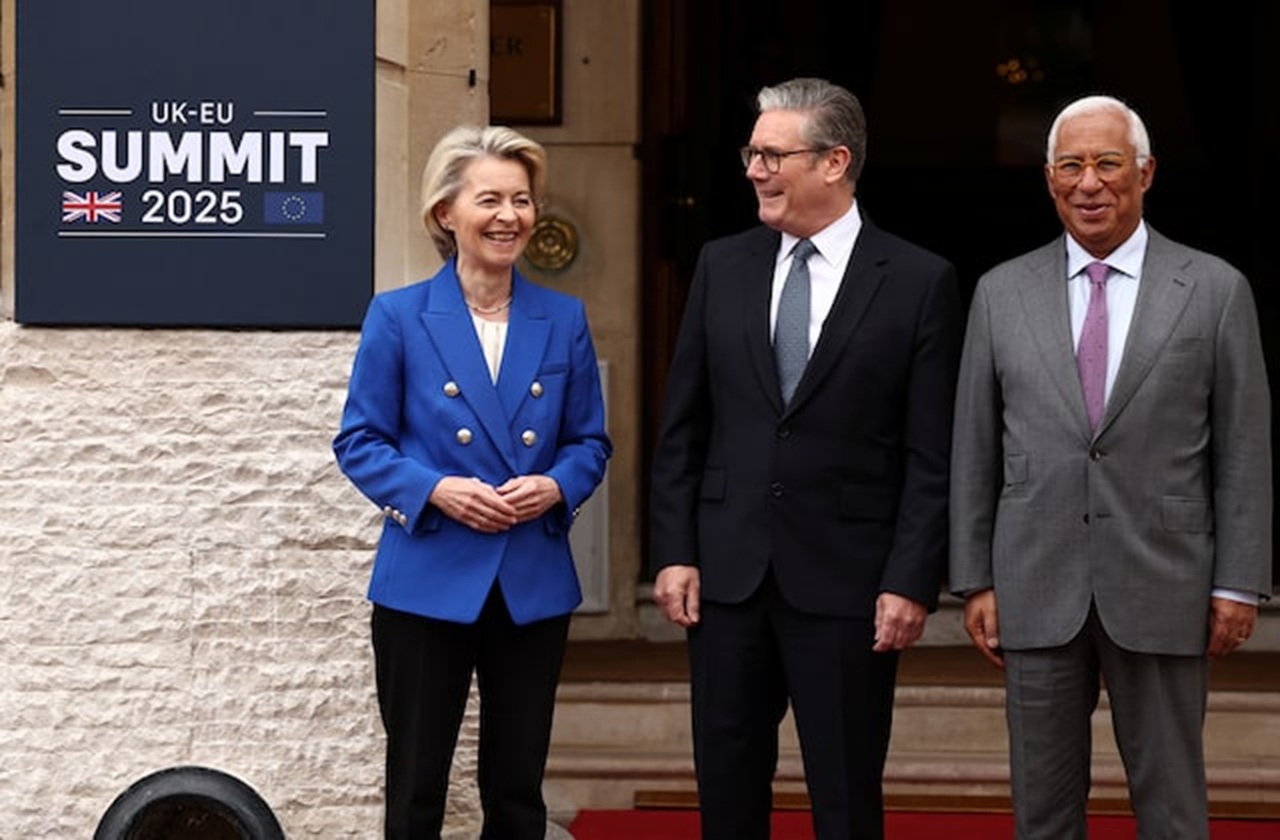
The EU–UK summit held in London on 19 May 2025 embodied this shift. The first formal summit of its kind since Brexit opened a new phase of cooperation. A Security and Defence Partnership was adopted, while a broader agenda committed both sides to negotiations intended to reduce some of the frictions accumulated since 2021.
The dossiers themselves are revealing. London and Brussels have been working towards a sanitary and phytosanitary agreement that could remove a large share of the checks affecting agricultural and food trade. They have sought to link their carbon markets, deepen energy cooperation, facilitate certain forms of mobility and rebuild connections in education and research. By early 2026, both sides were also reporting progress on Erasmus+, energy and several components of the wider economic relationship.
Taken individually, each of these dossiers looks technical. Taken together, they describe a trajectory.
The United Kingdom remains legally outside the Union while progressively seeking to reconnect with some of its mechanisms whenever the cost of divergence becomes greater than the benefit of autonomy. This is neither silent re-entry nor an abandonment of Brexit. It is the pragmatic construction of an intermediate status that does not truly exist in the European treaties.
Such an arrangement could appear relatively straightforward as long as the principal objective was to facilitate trade. It becomes considerably more difficult as the European Union itself changes its economic model.
The Europe Britain chose to leave was still largely conceived as a market to be opened. The Europe with which it is negotiating today increasingly sees itself as an industrial space to be protected.
Defence, critical technologies, energy, infrastructure, raw materials and supply chains are progressively being incorporated into a broader logic of economic sovereignty. Trade policy is moving closer to industrial policy. The origin of a product, the location of a factory or the geography of a value chain can increasingly determine access to funding, programmes or markets.
Here, a new Brexit frontier emerges.
Policies organised around the "Made in Europe" logic seek to give greater preference to European production in certain strategic sectors. For London, the risk is clear: British companies that remain deeply embedded in continental industrial chains could nevertheless be treated as outsiders when it comes to accessing benefits reserved for European production.
The situation is almost paradoxical. Britain can be indispensable to European security, closely connected to the continent's energy system, associated with European programmes and industrially integrated with several EU economies, while remaining legally a third country.
London wants this strategic proximity to receive economic recognition. Brussels must decide how far it can go without erasing the distinction between partnership and membership.
By September 2026, the divergence had become serious enough to disrupt the political timetable of the reset. According to the Financial Times, discussions surrounding the next EU–UK summit have again been delayed amid tensions over "Made in Europe" rules. London is seeking to protect British manufacturers, particularly those participating in European value chains. Brussels does not want renewed cooperation automatically to grant Britain the same advantages as an EU member state.
The dispute probably reveals more about the future of Brexit than the larger diplomatic declarations do.
During the first years after Britain's departure, the central question was how to organise separation. The question now is how far reconnection can go.
The two operations are not symmetrical. Leaving the Union had a legal procedure: Article 50 provided an exit door. Constructing partial integration afterwards, sector by sector, without the single market, customs union or freedom of movement is considerably more complicated. Every step towards closer integration requires decisions over which rules will be shared, who will define them, how they will evolve and which advantages can be granted to London without creating a precedent for every other EU partner.
This is where one of Brexit's fundamental questions returns: sovereignty.
Sovereignty is not merely the ability to write one's own rules. It is also the ability to influence the rules governing the economic spaces on which one depends.
By leaving the Union, the United Kingdom recovered considerable regulatory autonomy. But the European Union retained its own. When Brussels changes an industrial, climate or commercial standard, British companies wishing to continue operating on the continent frequently have to adapt even though London no longer has a seat at the table where that standard is decided.
"Made in Europe" policies add another dimension to this asymmetry. Complying with European rules may no longer always be enough to benefit from the market those rules organise. In some areas, it may become necessary to belong to the European industrial space itself.
The debate then changes in nature.
Brexit was presented as giving Britain the freedom to choose the relationships it wished to maintain with Europe and the rest of the world. Ten years later, London is exercising precisely that freedom by choosing to move closer again to its immediate neighbourhood. But choosing rapprochement does not mean being able to determine its terms alone.
None of this means Brexit is being reversed. Britain's political landscape remains deeply marked by the 2016 referendum. The Labour government itself excludes the principal forms of institutional reintegration, while Brussels shows little appetite for reopening an accession debate that would consume years of political capital.
Something more pragmatic is taking shape: a relationship in which Britain could become one of the Union's most deeply integrated external partners without becoming a member again.
Europe already contains several degrees of integration. Norway participates in the single market through the European Economic Area. Switzerland has built an architecture of bilateral agreements. Candidate countries, trading partners and neighbouring states each occupy different positions around the EU core.
But the British case remains singular. Through the size of its economy, its industrial base, its financial centre, its military and nuclear capabilities, its permanent seat on the United Nations Security Council and the depth of its ties with the continent, Britain is too important to be treated as an ordinary external partner. Yet it has chosen not to belong to the institutions that organise this interdependence.
The future relationship lies entirely within that gap.
Ten years after the referendum, Brexit is therefore entering a second period. The first was about departure. The next may be about the permanent negotiation of Britain's optimal distance from Europe.
Too far away, and the economic, industrial and strategic costs increase. Too close, and the questions surrounding regulatory and political autonomy that Brexit was supposed to resolve begin to return.
The controversy over "Made in Europe" has the merit of making this contradiction visible. Britain wants to be close enough for its companies to be considered European when Europe protects its industry, while remaining distant enough to preserve the autonomy secured by leaving.
There is nothing incoherent about that position. But Brussels has its own logic. If membership of the Union no longer provides advantages distinct from those that a neighbouring country can negotiate à la carte, the distinction between member and partner itself begins to lose some of its value.
Brexit gave the United Kingdom back the right to decide for itself. Ten years later, London is discovering the other half of that restored sovereignty: the European Union can also decide for itself what it reserves for those who chose to remain.
Main Sources
European Council and Council of the European Union — EU–UK relations; the United Kingdom's withdrawal, the Trade and Cooperation Agreement and the institutional framework of the post-Brexit relationship.
Council of the European Union — EU–UK Summit 2025, 19 May 2025; summit documents, the renewed strategic partnership and the Security and Defence Partnership.
UK Government — UK–EU Summit: key documentation, 19 May 2025; reset roadmap and areas of negotiation between the United Kingdom and the European Union.
UK Government — Joint Statement on the Withdrawal Agreement Joint Committee and Trade and Cooperation Agreement Partnership Council meetings, 2 February 2026; progress concerning Erasmus+, energy and economic negotiations.
Financial Times — "EU-UK reset talks delayed again amid tension over 'Made in Europe' rules", 13 September 2026; tensions surrounding European industrial policy and the timetable for the next summit.
Reuters — 1 July 2026; the UK position on "Made in Europe" policies, integrated supply chains and preparations for the next EU–UK summit.
Atlas Limits Research Desk
Atlas Limits’ editorial and analytical desk.