At the heart of a region long shaped by Russian and Soviet imperial power, Uzbekistan is attempting to build an autonomous economic and diplomatic position. With approximately 38.5 million inhabitants, substantial gold reserves, a transforming industrial base and a strategic location between China, Russia and South Asia, Tashkent aims to become one of the principal economic centers of inner Eurasia. Yet its ambitions rest on a fundamental contradiction: transforming a doubly landlocked country into a crossroads of continental trade.
A country at the center of a continent, far from the oceans
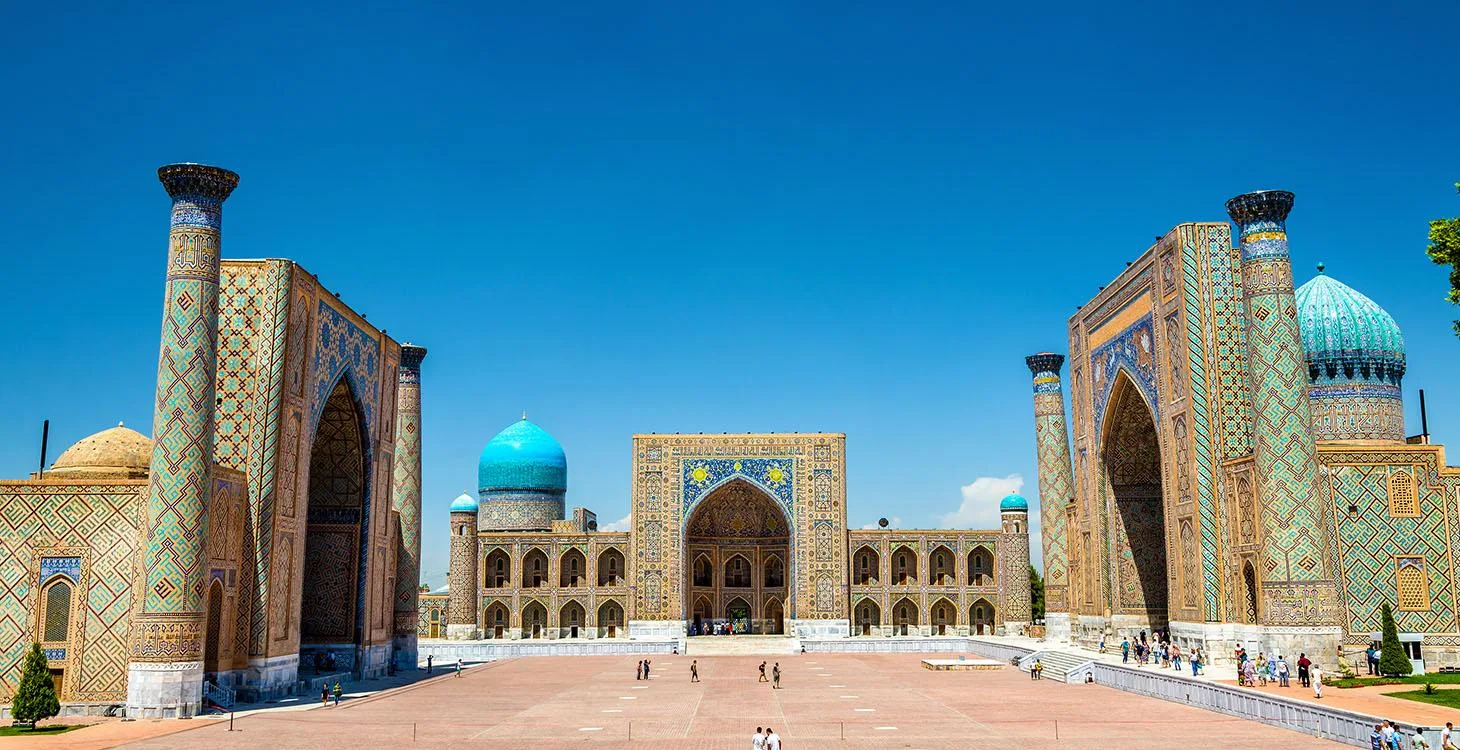
In Tashkent, the broad avenues inherited from Soviet urban planning stand alongside new business districts, construction sites and the infrastructure of a capital undergoing rapid transformation. Farther west, Samarkand and Bukhara recall another era, when commercial routes connecting China, Persia, India and the Mediterranean passed through the great cities of Central Asia. Between these two legacies lies Uzbekistan's contemporary ambition: to become an indispensable passage for Eurasian trade once again.
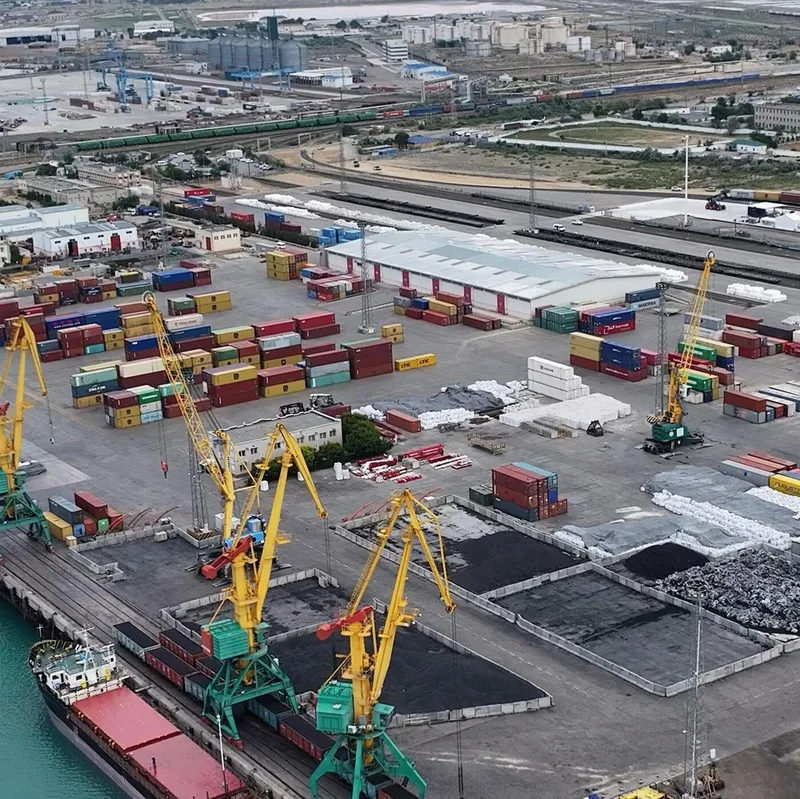
The country possesses a rare geographical characteristic. It is doubly landlocked: not only does it lack access to the sea, but every country bordering it is itself landlocked. Only Liechtenstein shares this distinction. To reach an ocean port, Uzbek goods must therefore cross at least two international borders.
This constraint has long weighed on its development. It increases logistics costs, multiplies customs procedures and makes foreign trade dependent on the infrastructure and political decisions of other states. Paradoxically, it also provides the foundation for Uzbekistan's new national strategy.
Uzbekistan borders Kazakhstan to the north and west, Kyrgyzstan to the northeast, Tajikistan to the southeast, Afghanistan to the south and Turkmenistan to the southwest. It therefore occupies a central position among the routes that could connect the Chinese, Russian, European, Iranian and South Asian economies.
For decades, this geography primarily represented dependence. Today, Tashkent is attempting to turn it into an instrument of power.
The demographic weight of a regional power
With approximately 38.5 million inhabitants in 2026, Uzbekistan is by far the most populous country in Central Asia. It accounts for a substantial share of the region's population and benefits from a relatively young demographic structure, distinguishing it from several Eurasian economies facing population aging.
This demographic weight represents one of its principal strategic advantages. It provides a comparatively large domestic market, an expanding labor force and a potential foundation for industrial development. In a region where many economies depend heavily on hydrocarbon or mineral extraction, Uzbekistan can pursue diversification supported by domestic demand.
But demographic growth also places considerable pressure on the economy. Every year, new generations enter the labor market. Absorbing them requires sustained increases in investment, productivity and formal employment.
Remittances from Uzbek workers abroad, particularly in Russia, remain an important component of household income. They support consumption and foreign currency inflows, but also reveal the domestic economy's limited capacity to generate sufficient well-paid employment.
This dependence creates an external vulnerability. Fluctuations in the Russian ruble, changes in Russian migration policies and economic conditions in host countries can directly affect the incomes of Uzbek families.
The central demographic challenge is therefore not simply population growth. It is the country's ability to transform that population into productive capital through education, urbanization, industrialization and the emergence of businesses capable of moving into higher-value activities.
From a controlled economy to gradual liberalization
When Uzbekistan became independent in 1991, it inherited a Soviet economy organized around central planning, cotton production, mineral extraction and an industrial system closely integrated with other Soviet republics.
Under President Islam Karimov, who ruled until 2016, the state pursued a cautious transition characterized by extensive economic controls, currency restrictions and limited openness to foreign capital. This approach preserved certain industrial capacities but constrained competition, innovation and international integration.
The arrival of Shavkat Mirziyoyev in 2016 marked a change in direction.
Foreign exchange liberalization in 2017, the gradual reduction of trade barriers, tax reforms and greater openness to foreign investors formed the first stages of a broader transformation.
The authorities sought to reduce the dominance of state-owned enterprises, encourage private investment and improve economic relations with neighboring countries. The objective was not to dismantle the state-led economy overnight, but to build a more open system while preserving strategic government influence.
The results are visible in the expansion of construction, services, trade and certain manufacturing industries.
Uzbekistan's economy expanded by approximately 7.7% in real terms in 2025, following growth of around 6.7% in 2024. Its nominal GDP reached approximately $147 billion in 2025, illustrating the scale of its economic transformation while also highlighting its still modest size in global terms.
These figures require careful interpretation. Part of the expansion reflects the catch-up potential of a formerly controlled economy, public investment, remittances and rising consumption. Rapid GDP growth does not automatically translate into equivalent gains in productivity or international competitiveness.
The Uzbek economy remains characterized by substantial state involvement in banking, energy, transport and several strategic industries. Corporate governance, legal protections for investors and competitive market structures remain essential if the current opening is to become a durable development process.
Gold: The financial foundation of a changing economy
Uzbekistan possesses an advantage that many emerging economies lack: an extensive mineral resource base.
The country ranks among the world's major gold producers. The Muruntau mining complex, located in the Kyzylkum Desert and operated by Navoi Mining & Metallurgical Company, is one of the largest open-pit gold mines in the world.
Gold performs several functions simultaneously within the national economy. It provides a major source of export revenue, contributes to international reserves and offers financial diversification against fluctuations in foreign currencies.
Gold exports reached approximately $13.9 billion in 2025, demonstrating the metal's central importance to Uzbekistan's external accounts.
For Tashkent, this resource provides a macroeconomic buffer, particularly valuable for an economy facing substantial infrastructure and industrial import requirements.
Yet this wealth also exposes the country to fluctuations in global commodity prices. Higher gold prices can rapidly improve external revenues without necessarily reflecting equivalent improvements in productivity across the wider economy.
Copper represents another strategic priority.
The Almalyk Mining and Metallurgical Complex occupies a central position in the country's industrial ambitions. Expanding extraction and processing capacity could allow Uzbekistan to strengthen its position in markets for metals used in electricity networks, industrial equipment and electrification.
Uranium completes this resource portfolio. Its production gives Uzbekistan a role in international nuclear fuel supply chains, although its influence remains considerably smaller than that of neighboring Kazakhstan.
The fundamental question is not simply whether Uzbekistan can produce more minerals. It is how much of their value can be retained domestically.
Exporting gold, copper and uranium generates revenue. Developing metallurgy, industrial equipment manufacturing, technical services, maintenance and specialized engineering skills would create a much more diversified economic structure.
The transformation of natural resources into industrial capabilities will be one of the decisive tests of Uzbekistan's development model.
Cotton, manufacturing and the end of an old economic model
Uzbekistan's modern economic history is inseparable from cotton.
During the Soviet period, the country became one of the Union's principal cotton-producing regions. This specialization involved extensive irrigation, large-scale agricultural planning and production targets established in Moscow.
It also contributed to one of the greatest environmental disasters of the modern era: the shrinking of the Aral Sea, caused largely by the diversion of water from the Amu Darya and Syr Darya rivers for irrigation.
Following independence, cotton remained a major economic sector, but its organization gradually changed.
Reforms introduced after 2016 sought to dismantle coercive labor mobilization practices, expand domestic processing and encourage investment in textile manufacturing.
In 2022, the international Cotton Campaign coalition ended its call for a boycott of Uzbek cotton after finding that systemic state-imposed forced labor had been eliminated during the 2021 harvest. This marked an important turning point for the industry's integration into international supply chains, although it did not eliminate every labor-related concern.
The industrial objective is now to export fewer raw materials and more processed products: yarn, fabrics, garments and finished textiles.
The same logic applies to automobiles, chemicals, construction materials and food processing.
Uzbekistan already possesses a relatively diversified manufacturing base by regional standards. However, its competitiveness remains heavily dependent on reliable energy supplies, access to foreign currency, logistics infrastructure and the ability to attract foreign technology.
The country is therefore attempting to move beyond two successive economic models: the cotton-producing economy inherited from the Soviet Union and the commodity-exporting economy that followed independence.
Its ambition is to become a middle-income industrial economy capable of supplying both its domestic market and neighboring countries.
Energy: The essential condition for industrialization
That ambition faces an increasingly visible constraint: energy.
Uzbekistan possesses natural gas reserves and an electricity system historically built around thermal power generation. Yet population growth, urbanization, industrial demand and aging infrastructure have intensified pressure on domestic supply.
The country has experienced seasonal shortages of gas and electricity, particularly during winter.
Domestic resource availability is therefore insufficient to guarantee energy security.
The challenge lies in the interaction between production capacity, consumption, infrastructure efficiency, regulated prices and investment in electricity networks.
Tashkent is pursuing several responses simultaneously.
The first involves modernizing existing power plants and transmission infrastructure to reduce losses and improve efficiency. The second is the rapid expansion of solar and wind capacity, supported by international investors, including companies from the Gulf.
The third concerns nuclear power.
Uzbekistan has developed cooperation with Russia around a nuclear energy project, although its technical configuration and implementation timetable have evolved during negotiations.
This decision reflects the desire to diversify electricity generation, but also demonstrates the continuing importance of Russian industrial and technological relationships.
Uzbekistan's energy transition is therefore not driven exclusively by climate considerations. It is a prerequisite for industrialization.
Without reliable electricity, investment in metallurgy, textile factories, chemical processing and digital infrastructure will remain constrained.
Energy is becoming a direct determinant of economic sovereignty.
The battle for corridors: Escaping geographical isolation
Geography is arguably Uzbekistan's most significant strategic challenge.
Unlike major maritime powers, which organize trade around ports and ocean routes, Tashkent depends on continental networks crossing multiple jurisdictions.
Historically, Central Asia's railway infrastructure was largely oriented northward toward Russia. This configuration reflected the organization of the Soviet economy and remains a structural legacy today.
Diversifying transport corridors has become a national priority.
To the east, the China–Kyrgyzstan–Uzbekistan railway project promises a more direct connection between China's rail network, the Ferghana Valley and Central Asian markets.
The project has moved into construction, with work on tunnels, bridges and associated infrastructure progressing in 2026.
Once operational, the line could shorten certain routes and strengthen Uzbekistan's role in continental trade.
Its construction nevertheless involves substantial technical and financial challenges, particularly across Kyrgyzstan's mountainous terrain. Its eventual economic value will also depend on freight tariffs, transported volumes, border procedures and effective connections with other railway networks.
To the south, Tashkent has long advocated a trans-Afghan railway linking Uzbekistan to Pakistan through Mazar-i-Sharif, Kabul and Peshawar.
Such a route could provide more direct access to Pakistani ports and the Indian Ocean.
It could fundamentally alter Central Asia's commercial geography, but remains subject to financing, security, terrain and governance constraints.
Afghanistan therefore occupies a distinctive place in Uzbekistan's strategy.
For Tashkent, it is not merely an unstable neighbor or a potential source of security risks. It is also the territory through which one of Central Asia's most important potential routes to global markets could pass.
To the west, connections through Turkmenistan, Iran, the Caspian Sea, Azerbaijan and Turkey offer alternative access to international markets.
This diversification has become more important amid sanctions against Russia, trade tensions between major powers and the search for alternative routes between Europe and Asia.
But announcing corridors is not the same as creating commercially viable transport systems.
A corridor becomes economically meaningful only when infrastructure, customs procedures, insurance, financing and freight flows operate together.
Uzbekistan can become a continental crossroads, provided that its proposed routes develop into functioning logistics networks.
Between Moscow, Beijing and Washington: Balance as a doctrine
Uzbekistan's foreign policy rests on a fundamental necessity: preventing any single external power from determining its economic and strategic choices.
Russia remains a major partner.
Historical, linguistic, migratory, energy and security connections retain considerable depth. Economic and family relationships link the two countries, while Russian companies remain active in several sectors.
Yet Tashkent has consistently sought to preserve its autonomy.
Uzbekistan is not a member of the Collective Security Treaty Organization and has not joined the Eurasian Economic Union, although it maintains institutional relations with the latter.
This position allows the country to retain regulatory and diplomatic flexibility.
China represents a second major pole.
Chinese companies participate in infrastructure, telecommunications, energy and industrial projects. Beijing also provides a significant export market and source of financing.
China's interest in Uzbekistan forms part of a broader strategy to strengthen continental connections, expand economic relations with Central Asia and diversify routes linking western China with Eurasian markets.
The relationship offers substantial opportunities but also raises questions about technological, financial and commercial dependence.
The United States and the European Union constitute a third group of partners.
Their interests include critical minerals, infrastructure, regional connectivity, investment and Central Asian stability.
For Tashkent, these relationships represent less an invitation to choose a geopolitical camp than an opportunity to expand its range of partners.
Turkey, the United Arab Emirates, Saudi Arabia, South Korea and Japan further diversify this diplomatic portfolio, bringing different combinations of financing, industrial capabilities and technology.
Uzbekistan is therefore not seeking to abandon its traditional partners. It is attempting to multiply its interdependencies so that none becomes exclusive.
This strategy of balance is one of the foundations of its international autonomy.
Central Asia as a political and economic space to rebuild
The most important diplomatic transformation initiated by Tashkent does not directly concern the major powers. It concerns Uzbekistan's immediate neighbors.
For many years, relations among Central Asian states were marked by border disputes, trade restrictions, water-related tensions and difficulties in cross-border movement.
Since 2016, Uzbekistan has made improving regional relations a priority.
Rapprochement with Kazakhstan, Kyrgyzstan, Tajikistan and Turkmenistan has helped revive trade, border negotiations and infrastructure cooperation.
The Ferghana Valley illustrates the importance of this evolution.
This densely populated area, divided among Uzbekistan, Kyrgyzstan and Tajikistan, concentrates agricultural, water, economic and security interests.
Stabilizing its borders carries significance far beyond administrative arrangements. It affects the movement of workers, local commerce and the integration of transport networks.
Water remains a particularly sensitive issue.
Countries located upstream in major river basins seek to expand hydropower generation, while downstream countries depend on the same water resources for irrigation and agriculture.
Climate change, population growth and rising energy demand are likely to intensify these competing requirements.
Uzbekistan must therefore contribute to regional governance capable of reconciling sometimes contradictory interests.
Its demographic weight and central geographical position give it considerable influence, but do not allow it to dictate the terms of cooperation unilaterally.
Its regional power may ultimately be measured by its ability to transform historically fragmented relationships into functioning economic interdependence.
The Aral Sea: The environmental limits of development
In western Uzbekistan, within the autonomous Republic of Karakalpakstan, the landscape surrounding the former Aral Sea demonstrates the historical costs of agricultural and industrial development pursued without regard for environmental constraints.
Once one of the world's largest inland bodies of water, the Aral Sea lost most of its surface area and volume following massive withdrawals from the rivers that sustained it.
Areas formerly covered by water have become desert landscapes, where dust containing salt and chemical residues contributes to soil degradation and health problems.
The collapse of fisheries, increasing salinity and difficulties accessing water have profoundly affected local communities.
This catastrophe remains a warning for Uzbekistan's entire economic strategy.
Cotton production, industrial expansion, urban growth and energy development all require water in a region already exposed to significant climatic variability.
Reforestation programs on the exposed seabed, international initiatives and improvements in irrigation efficiency can mitigate some consequences. They cannot easily restore the original ecological system.
Uzbekistan must now develop a more productive economy while using water more efficiently.
This constraint could become as decisive as access to international markets or the availability of investment capital.
Economic liberalization without equivalent political democratization
Uzbekistan's modernization should not be confused with a complete transformation of its political system.
The country remains organized around a powerful presidency, institutions largely dominated by the executive and a restricted political environment.
Economic and administrative reforms under Shavkat Mirziyoyev have brought changes compared with the preceding period, but have not produced fully open political competition.
The 2023 constitutional referendum modified the institutional framework and enabled the president to seek further terms in office.
Restrictions affecting political opposition, independent media and certain civil liberties continue to raise concerns.
Events in Karakalpakstan in 2022, when demonstrations against proposed changes to the region's constitutional status were followed by a deadly crackdown, exposed the limits of political liberalization.
This reality is central to understanding Uzbekistan's development model.
The government seeks to attract foreign investment, modernize public administration and expand private enterprise without fundamentally challenging the concentration of political power.
In the short term, such an arrangement can facilitate continuity in major infrastructure and industrial projects.
Over the longer term, it raises questions about transparency, legal certainty, institutional accountability and the ability to correct economic policy failures.
The durability of economic development depends not only on the capacity to make decisions, but also on the institutional mechanisms through which those decisions can be scrutinized and challenged.
2030: The conditions for an emerging economic power
Uzbekistan possesses a combination of advantages rarely found within a single Central Asian economy: a large population, an existing industrial base, substantial mineral resources, a central geographical position and a relatively diversified foreign policy.
Yet none of these advantages is sufficient on its own.
Demographic growth can support economic expansion or intensify unemployment. Mineral resources can finance industrialization or prolong dependence on commodities. Transport corridors can create a logistics platform or remain expensive infrastructure projects. Foreign investment can improve productivity or reinforce the position of already dominant economic actors.
The next stage of Uzbekistan's development will depend on several simultaneous transformations.
The country must improve energy reliability, increase water efficiency, continue reforming state-owned enterprises and banks, strengthen technical education and develop internationally competitive manufacturing exports.
It must also convert diplomatic diversification into durable industrial partnerships capable of transferring expertise and creating productive activities within the country.
The railway projects connecting Uzbekistan to China and South Asia will be particularly revealing.
Their actual completion, freight volumes and commercial integration will help determine whether Uzbekistan is genuinely reducing the economic costs of its geographical isolation.
Political stability and institutional quality will also shape the country's ability to continue reforms without accumulating financial, social or territorial imbalances.
The government's ambition to achieve upper-middle-income status will become credible only if rising incomes are supported by sustained productivity gains rather than investment expansion and commodity exports alone.
The possible return of a Eurasian crossroads
Uzbekistan is unlikely to become a great power in the conventional military or maritime sense.
Its capacity to project power remains limited, its economy is still relatively small on a global scale and its geography exposes it to decisions made by neighboring states.
Its potential influence rests on a different form of power: the ability to organize economic flows, connect political spaces and provide markets, resources and infrastructure to a region undergoing structural change.
In a world where supply chains are increasingly shaped by geopolitical rivalry, intermediary territories are acquiring new strategic value.
They do not necessarily control the most advanced technologies or the principal maritime routes. But they can become indispensable to the diversification of trade.
This is the opportunity Tashkent is attempting to seize.
Samarkand and Bukhara prospered when Central Asia formed one of the principal circulation spaces of the Eurasian economy. Their relative decline accompanied the gradual movement of global trade toward ocean routes.
Contemporary Uzbekistan cannot reverse that history.
It can, however, benefit from renewed interest in continental connectivity, the fragmentation of commercial networks and the search for new industrial partners.
Its future will depend less on recreating the grandeur of the ancient Silk Roads than on solving distinctly modern problems of transport, energy, financing, governance and productivity.
Uzbekistan's paradox is ultimately straightforward: one of the countries with the most difficult access to the world's oceans is attempting to become one of the most useful transit points on the Eurasian continent.
If it succeeds, landlocked geography will cease to be merely an economic disadvantage. It will become the foundation of a new form of continental centrality.
Main Sources
- World Bank — Uzbekistan Overview: Economic development, population, growth and structural reforms. https://www.worldbank.org/en/country/uzbekistan/overview
- International Monetary Fund — Uzbekistan: Article IV Consultations: Macroeconomic performance, public finances, banking and structural reforms. https://www.imf.org/en/Countries/UZB
- Asian Development Bank — Asian Development Outlook: Economic indicators, development and infrastructure. https://www.adb.org/countries/uzbekistan/main
- US Geological Survey — Mineral Commodity Summaries: Gold, copper and uranium production and resources. https://www.usgs.gov/centers/national-minerals-information-center
- European Bank for Reconstruction and Development — Transition Report: Market reforms, private sector development and investment. https://www.ebrd.com
- International Labour Organization — Research on forced labor, cotton harvesting and labor reforms in Uzbekistan. https://www.ilo.org
- Cotton Campaign — Documentation on the conclusion of the Uzbek cotton boycott in 2022. https://www.cottoncampaign.org
- International Energy Agency — Energy systems, electricity generation and energy transition in Uzbekistan. https://www.iea.org
- United Nations Development Programme — Environmental sustainability, water management and the Aral Sea crisis. https://www.undp.org/uzbekistan
Atlas Limits — Independent Global Analysis
Atlas Limits Research Desk
Atlas Limits’ editorial and analytical desk.