West Africa occupies a distinctive position in the restructuring of global economic and geopolitical balances. Located between the Atlantic Ocean, the Sahara and the Gulf of Guinea, it brings together some of the continent's most dynamic economies, considerable energy and mineral resources, expanding demographic markets and several commercial corridors essential to relations between Africa, Europe and the Americas. Yet this accumulation of advantages has not produced a coherent regional power. National economies are advancing at different speeds, common institutions are experiencing a profound crisis, and conflicts across the Sahel are redrawing the region's political and security boundaries.
This contradiction is one of the defining characteristics of contemporary West Africa. The region possesses the resources of a major economic area, but its organization remains fragmented across several monetary, commercial and political systems. Its infrastructure is still largely oriented toward external markets, while trade between neighboring economies remains constrained by logistical obstacles, regulatory differences and institutional tensions.
The paradox is particularly significant because the region is undergoing three major transformations simultaneously. Its population is growing rapidly, creating considerable demand for employment, energy, housing and public services. Its natural resources are attracting international investment amid intensifying competition for strategic supplies. Meanwhile, political ruptures in the Sahel are challenging several decades of regional integration.
West Africa is consequently becoming a region in which economic growth, political sovereignty and territorial security increasingly follow sometimes contradictory trajectories.
The first difficulty lies in defining the region itself.
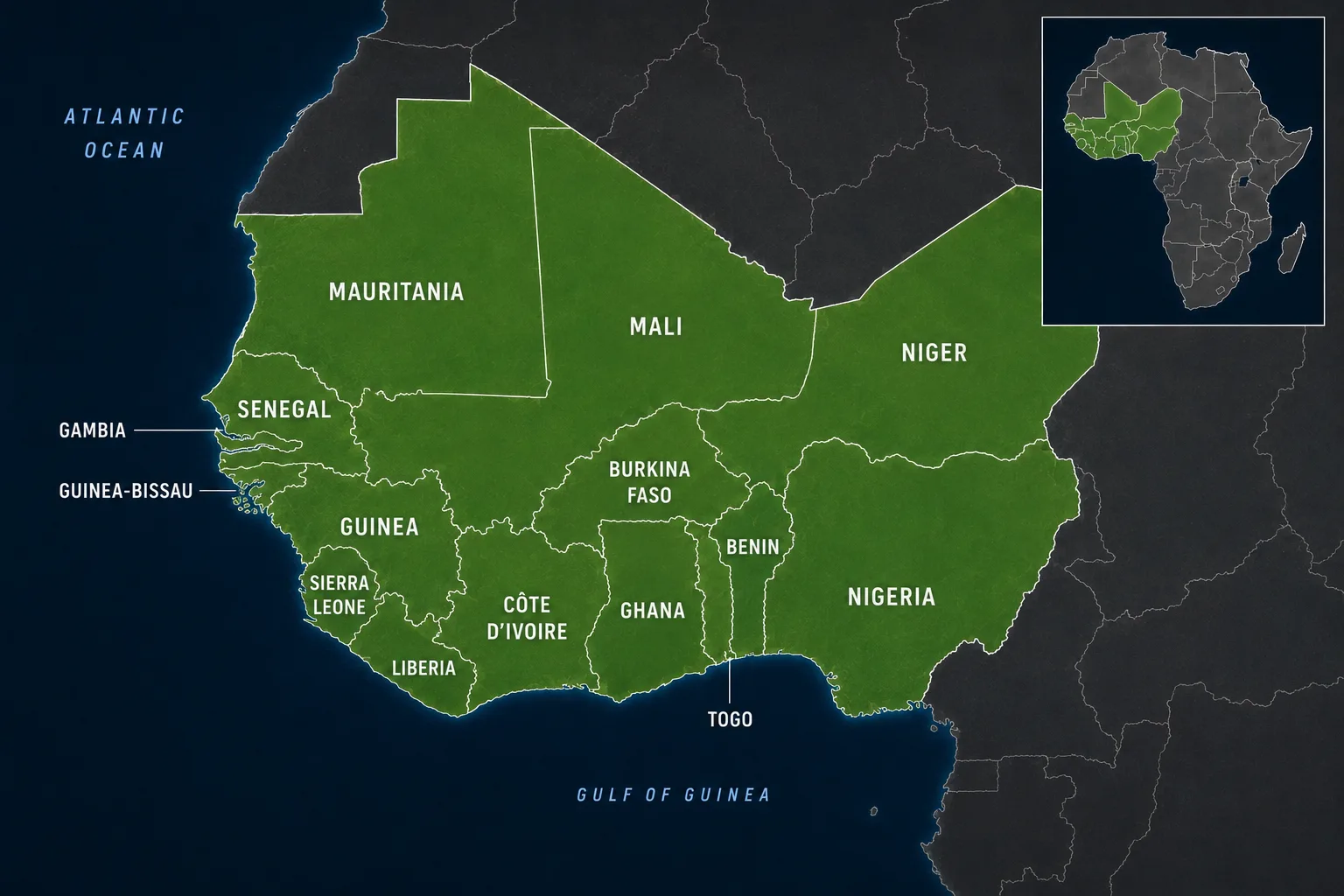
Under the geographical classification used by the United Nations, Western Africa comprises sixteen countries, including Mauritania. The Economic Community of West African States, established in 1975, has a different institutional perimeter, particularly since Mali, Burkina Faso and Niger formally withdrew from the organization in January 2025.
This distinction is essential. Geographical West Africa remains a relatively identifiable region, but its political and economic architecture is undergoing profound transformation.
The region is home to more than 400 million people, with Nigeria accounting for a particularly large share of its population. Its demographic expansion is expected to continue over the coming decades, although projections vary according to national circumstances, fertility assumptions and the geographical boundaries used.
This expansion represents a major structural transformation.
It can encourage the emergence of larger domestic markets, support investment and increase the available workforce. But it also requires a rapid expansion of productive capacity.
Population growth becomes an economic advantage only when businesses, infrastructure and institutions can absorb rising demand and an expanding labor force.
Otherwise, demographic growth can intensify pressures on employment, housing, education and public finances.
This challenge is particularly acute in Nigeria.
With more than 220 million inhabitants in the mid-2020s, the country represents by far the region's largest demographic market. Its economy combines hydrocarbons, agriculture, commerce, telecommunications, financial services, manufacturing and digital activities.
Lagos is one of the continent's principal economic centers. Its concentration of businesses, services, port activities and capital gives it a regional role extending well beyond Nigeria's borders.
But Nigeria's demographic weight does not guarantee economic dominance in every dimension.
Fluctuations in the naira's exchange rate have considerably altered the value of its gross domestic product when expressed in current US dollars. International comparisons can therefore show dramatic changes without reflecting an equivalent transformation in real production.
The distinction between nominal GDP, purchasing-power-parity GDP and real economic growth is consequently indispensable.
The Nigerian market remains considerable, but its ability to attract sustained investment also depends on macroeconomic stability, access to foreign currency, electricity supply, security and infrastructure.
Economic reforms introduced since 2023, particularly those concerning fuel subsidies and the exchange-rate regime, have sought to correct certain structural imbalances. They have also imposed substantial social costs amid high inflation and currency depreciation.
Nigeria therefore illustrates a fundamental difficulty: possessing a vast market is not sufficient to create the conditions for sustained industrial growth.
The economy must also be capable of converting domestic demand into productive investment.
Around Nigeria, several countries are following different trajectories.
Côte d'Ivoire has established itself as one of the principal economic centers of French-speaking West Africa. Its growth rests on a combination of commercial agriculture, services, infrastructure, agro-industrial processing and investment.
Abidjan plays a major role in regional trade, financial activities and logistics. Its port and overland connections constitute important infrastructure for landlocked countries in the hinterland.
Ghana has a relatively diversified economy combining gold production, cocoa, hydrocarbons, services and industrial activities. But its recent experience also demonstrates the risks associated with fiscal imbalances, indebtedness and fluctuations in external revenues.
Senegal has undertaken substantial investment in infrastructure, transport and energy. The commencement of production at new oil and gas projects offers prospects for additional revenues, but it also raises questions about how those revenues will be used and how they will contribute to productive development.
Benin and Togo occupy important logistical positions through their ports and commercial relationships with neighboring countries.
These economies possess different advantages, but they face a common question: how can growth in trade, investment and infrastructure be converted into lasting productivity gains?
This question is particularly important in a region where natural resources play a central role.
Nigeria remains one of Africa's principal oil producers and possesses substantial natural gas reserves. Guinea occupies a major position in global bauxite supplies. Ghana, Mali and Burkina Faso have significant gold-mining industries. Niger possesses uranium resources, while Liberia and Sierra Leone exploit iron ore deposits, among other minerals.
Côte d'Ivoire and Ghana have historically dominated global cocoa production, although their respective shares and combined contribution vary significantly between agricultural seasons.
These resources give West Africa considerable importance in several international supply chains.
But their exploitation reveals a persistent asymmetry between ownership of raw materials and control over their transformation.
Cocoa provides one of the clearest examples.
Côte d'Ivoire and Ghana produce a major share of the beans used by the global chocolate industry. Yet much of the final value of commercialized products depends on activities further downstream: industrial processing, formulation, branding, distribution and marketing.
The price paid to producers represents only a fraction of the final price of products sold to consumers.
This difference does not arise exclusively from rent capture. It also reflects processing, transport, distribution, financing and marketing costs.
Nevertheless, it highlights the importance of the position occupied within the value chain.
A country can dominate the production of a raw material without controlling the segments that generate the highest margins.
Local processing strategies seek precisely to change this distribution.
Côte d'Ivoire is developing cocoa-grinding and processing capacity. Ghana also possesses industrial facilities and institutions involved in organizing the sector.
However, primary processing does not automatically guarantee access to the most profitable segments.
Producing cocoa paste or cocoa butter represents an additional industrial stage, but manufacturing finished products, controlling brands and gaining direct access to international markets require other capabilities.
Industrialization must therefore be understood as a progression through successive levels of added value.
The same problem appears in the mining sector.
Guinea possesses some of the world's largest bauxite reserves. This resource is the raw material used to produce aluminum, a metal essential to transportation, electricity infrastructure, construction and several strategic industries.
But converting bauxite into alumina and then aluminum requires considerable industrial investment and substantial energy supplies.
Exporting more ore can increase revenues and trade volumes without producing a proportional diversification of industrial activity.
The central question then becomes one of energy infrastructure, metallurgical capacity and the profitability of processing investments.
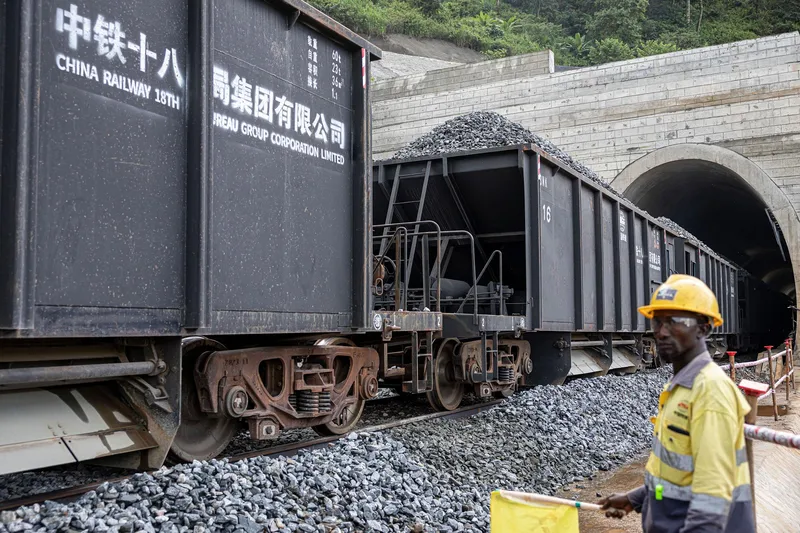
The development of the Simandou project, centered on Guinea's iron ore deposits, also illustrates the importance of infrastructure in resource development.
Exploiting deposits located far from the coast requires railways, port facilities and large-scale investment.
Such infrastructure can transform the economy of a territory.
But its contribution to development depends on its ability to support activities beyond mineral exports.
A corridor built to transport ore can remain a specialized infrastructure project with limited integration into the local economy.
It can also become an axis of regional development if it facilitates freight transport, business establishment, access to services and the movement of people.
The difference depends on financing conditions, infrastructure governance and the public policies accompanying the projects.
This distinction between extraction and transformation is equally apparent in the energy sector.
Nigeria has exported hydrocarbons for decades, but its economy has long faced insufficient operational refining capacity, leading to substantial imports of petroleum products.
The expansion of new refining capacity, particularly at the Dangote refinery, could alter some of these balances.
The issue extends beyond import substitution.
Competitive refining capacity can improve fuel availability, support petrochemical activities and change regional trade flows.
But its effects depend on prices, crude oil supply, market conditions and the regulatory framework.
The existence of a major industrial facility does not, by itself, guarantee a broader transformation of the economy.
It can nevertheless constitute an important component of a wider productive strategy.
Senegal and Mauritania are also entering a new phase of energy development through the exploitation of offshore gas resources, particularly under the Greater Tortue Ahmeyim project.
This cross-border project illustrates the possibilities for economic cooperation between neighboring states.
It also demonstrates that energy resources can support different strategies: liquefied natural gas exports, domestic supply, electricity generation or industrial development.
The choices made between these uses will have significant consequences for the structure of the economies concerned.
An exported energy resource generates foreign currency and public revenues.
A resource used domestically can also help reduce certain industrial costs and support new productive activities.
The most effective allocation depends on prices, domestic needs, infrastructure and contractual commitments.
There is therefore no uniform answer applicable to every country.
This economic diversity is reflected in political structures.
West Africa brings together institutional systems, administrative traditions and historical trajectories that differ considerably.
Ghana and Cabo Verde have relatively consolidated experiences of electoral competition and political alternation.
Senegal has long occupied a distinctive position in the region's political history, with electoral institutions and a tradition of pluralism that have nevertheless not prevented periods of tension.
Côte d'Ivoire has experienced successive political crises and periods of economic consolidation.
Nigeria combines a federal system, competitive political life and profound territorial, communal and security tensions.
Guinea, Liberia and Sierra Leone also possess institutional trajectories shaped by different political legacies.
This diversity does not necessarily constitute an obstacle to economic cooperation.
States with different political systems can develop trade and shared infrastructure.
But integration becomes more difficult when institutional disagreements turn into diplomatic ruptures or conflicts over the legitimacy of governments.
That is precisely what has happened in the Sahel.
Since 2020, Mali, Burkina Faso and Niger have experienced military takeovers that have profoundly altered their relationships with several regional and international partners.
These political ruptures occurred against a background of deteriorating security.
Armed violence, difficulties in controlling territory and criticism of existing security arrangements contributed to the weakening of institutions.
Military authorities presented their interventions as responses to insecurity, a crisis of sovereignty and the inability of previous governments to protect their populations.
But the seizure of power by armed forces does not automatically guarantee an improvement in security.
Conflicts in the Sahel are rooted in complex dynamics involving jihadist groups, local tensions, territorial rivalries, governance failures and illicit economies.
Military operations can change the balance of power without resolving the political and economic causes of violence.
The Liptako-Gourma region, situated at the intersection of Mali, Burkina Faso and Niger, constitutes one of the principal centers of this instability.
Groups affiliated with Al-Qaeda and the Islamic State organization have developed capabilities for mobilization, movement and territorial control.
Their activities disrupt trade, displace populations and weaken local administrations.
Insecurity also affects agriculture, livestock farming and cross-border commercial networks.
In some areas, populations face a combination of violence, restrictions on movement and deteriorating public services.
The economic consequences extend far beyond the territories directly affected.
Investors incorporate security risks into their decisions. Businesses face additional logistical costs. Governments devote increasing resources to military expenditure.
Coastal countries along the Gulf of Guinea are also affected.
Benin, Togo, Côte d'Ivoire and Ghana are seeking to prevent violence from spreading into their northern regions.
Their strategies combine border surveillance, intelligence, military cooperation and local development programs.
But securing borders is insufficient when commercial networks, population movements and community relationships cross historical spaces that predate present-day state boundaries.
Regional security therefore depends on a combination of military capabilities, institutional cooperation and territorial policies.
This situation has profoundly transformed West Africa's political architecture.
The Economic Community of West African States, established in 1975, had gradually developed a role extending beyond commercial matters.
It also intervened in crisis prevention, political mediation and the defense of certain constitutional principles.
The Sahelian coups placed the organization before a major contradiction.
On the one hand, it sought to preserve common rules concerning changes of government and institutional legitimacy.
On the other, it needed to maintain functional relationships with states whose cooperation remains indispensable to regional security and trade.
Sanctions, diplomatic tensions and disagreements over political transitions progressively deepened the rupture.
Mali, Burkina Faso and Niger announced their withdrawal from ECOWAS in January 2024, with the withdrawal becoming effective in January 2025.
At the same time, they developed their own framework for cooperation through the Alliance of Sahel States, transformed into a confederation in 2024.
This development constitutes one of the most important institutional ruptures in the region's recent history.
It does not mean that economic and human relationships between the countries concerned and their neighbors have disappeared.
Populations continue to trade, travel and maintain family, social and economic ties.
But it introduces new uncertainty concerning the rules that will govern these exchanges over the long term.
The questions concern customs regimes, freedom of movement, trade agreements, shared infrastructure and mechanisms for security cooperation.
Political fragmentation could increase transaction costs in a region already suffering from insufficient economic integration.
It could also lead to a multiplication of bilateral arrangements and competing institutional frameworks.
The issue therefore extends beyond relations between governments.
It concerns the ability of West African economies to preserve a relatively coherent commercial space despite their political disagreements.
The monetary dimension adds further complexity.
West Africa does not possess a single currency shared by all its economies.
Eight countries use the CFA franc of the West African Economic and Monetary Union, while Nigeria, Ghana, Guinea, Sierra Leone, Liberia, Gambia and Cabo Verde operate under distinct monetary regimes.
Differences in exchange rates, inflation, banking regulation and financing conditions influence regional trade.
Projects for monetary integration face substantial macroeconomic divergences.
A monetary union requires more than a political decision.
It presupposes mechanisms for fiscal coordination, sufficient convergence in economic conditions and institutions capable of responding to shocks affecting member countries differently.
Current tensions make this prospect particularly complex.
The monetary question nevertheless reveals a broader issue: regional integration depends on the compatibility of economic policies as much as on the willingness to cooperate.
Infrastructure constitutes another determining factor.
West Africa possesses several major ports, including those serving Lagos, Tema, Abidjan, Lomé, Cotonou and Dakar.
These facilities handle a substantial share of external trade and also serve as gateways to landlocked economies.
But overland connections remain uneven.
Transport costs, border delays, road conditions, railway capacity and administrative procedures can reduce the advantages of geographical proximity.
Goods produced in one country may encounter greater difficulties reaching a neighboring market than being exported to a partner on another continent.
This situation limits the formation of regional value chains.
It also favors an economic organization built around corridors connecting production zones to ports, rather than integrated industrial networks.
The historical legacy of export infrastructure continues to shape contemporary economic geography.
Transforming these networks is one of the conditions necessary for deeper integration.
But it requires considerable investment.
States must finance roads, railways, border facilities, electricity networks and digital infrastructure.
They must also ensure maintenance, security and interoperability.
Building infrastructure without regulatory coordination can produce limited results.
Conversely, ambitious trade agreements remain insufficient when businesses lack the physical means to transport their goods.
The African Continental Free Trade Area provides an additional framework for this transformation.
It seeks progressively to reduce commercial barriers among African economies and encourage the emergence of a more integrated continental market.
For West Africa, this initiative could help diversify commercial opportunities beyond traditional relationships with Europe, Asia and the Americas.
But its effectiveness will depend on countries' ability to produce competitive goods and services.
A larger market does not automatically guarantee stronger industrialization.
It can also intensify competition between domestic companies and external suppliers.
The central question therefore becomes one of productive competitiveness.
Economies must develop their industrial capabilities, improve training, reduce energy costs and facilitate access to financing.
This transformation is particularly important in a region where agriculture still accounts for a considerable share of employment.
West African agriculture combines commercial production destined for international markets with food production essential to regional food security.
Cocoa, cotton, cashew nuts, palm oil and several other products play important roles in exports.
But cereals, vegetable crops and livestock farming remain fundamental to domestic markets.
Agricultural productivity remains constrained in several territories by limited access to irrigation, equipment, financing, storage infrastructure and distribution networks.
Climate change adds further pressure.
Rainfall variability, droughts and floods affect yields and agricultural incomes.
In the Sahel, these constraints can intensify tensions between different uses of land and water resources.
But explaining conflicts exclusively through climate would be reductive.
Land institutions, mediation mechanisms, public policies and local power relationships largely determine how environmental pressures translate into political tensions.
Food security therefore depends on agricultural productivity, but also on the quality of territorial governance.
This question will become increasingly important as the population grows.
West African cities are expanding rapidly.
Lagos, Abidjan, Accra, Dakar, Kano and several other urban centers concentrate an increasing share of the population and economic activity.
This urbanization can encourage productivity gains by bringing businesses, workers and consumers closer together.
But it can also generate high costs when infrastructure fails to keep pace with growth.
Demand for housing, transportation, sanitation, water and electricity is increasing rapidly.
Urban expansion can therefore reinforce economic growth while intensifying territorial inequalities.
The challenge is to transform major metropolitan areas into centers of production and innovation rather than spaces where precarious living conditions become concentrated.
This transformation requires urban planning, training and investment policies.
It also demands financing capacity that several states struggle to mobilize.
Public debt, fiscal deficits and borrowing costs constitute important constraints for certain West African economies.
International financial conditions can aggravate these difficulties.
An increase in global interest rates raises the cost of external financing. Currency depreciation increases the burden of debt denominated in foreign currencies. A decline in commodity prices reduces export revenues and can weaken public finances.
These mechanisms limit governments' ability to invest over the long term.
They also explain why an abundance of natural resources does not guarantee a sound financial position.
Revenues from oil, gold or cocoa can fluctuate sharply.
When public expenditure rises during favorable periods without sufficient stabilization mechanisms, market reversals can trigger difficult adjustments.
Managing extractive revenues therefore becomes a central question of economic policy.
Stabilization funds, fiscal rules, contractual transparency and productive investment can help limit certain vulnerabilities.
But their effectiveness depends on institutional quality and the continuity of public policies.
This question is closely connected to economic sovereignty.
West African governments are seeking to strengthen their ability to negotiate with foreign investors, develop domestic industries and retain a larger share of the value produced within their territories.
International competition may offer new opportunities.
China remains an important actor in infrastructure, equipment, trade and mining investment.
The European Union maintains deep economic, financial and institutional relationships with several countries in the region.
The United States is active in commercial, energy, technological and security matters.
Russia has strengthened certain military and diplomatic relationships, particularly with Sahelian governments that emerged from military transitions.
Turkey, India and several Gulf states are also developing commercial, financial or security activities.
This diversification of partnerships changes the balance of negotiations.
States potentially possess more options for financing infrastructure, acquiring equipment or developing industries.
But it does not automatically guarantee greater autonomy.
A government may replace dependence on one partner with dependence on another.
The multiplication of agreements constitutes a lasting advantage only when it strengthens national capabilities.
This requires administrations capable of negotiating contracts, monitoring their implementation and defending public interests.
It also requires local companies sufficiently competitive to participate in projects and benefit from skills transfers.
Economic sovereignty therefore cannot be reduced to diplomatic diversification.
It depends on the ability to convert external partnerships into productive assets, capabilities and lasting revenues.
Security, however, remains an essential condition for this transformation.
Violence in the Sahel threatens not only populations and institutions in the countries directly concerned.
It also affects investment prospects throughout the region.
Commercial corridors cross territories where transport security becomes a determining economic factor.
Agricultural exchanges, worker mobility and relationships between markets can be disrupted by conflict.
The fragmentation of regional cooperation mechanisms risks aggravating these difficulties.
It could also weaken states' ability to coordinate their responses to armed groups operating across national borders.
But security cooperation cannot be permanently separated from political and social conditions.
Military operations can contain certain threats.
They cannot replace judicial institutions, local administrations, public services and mechanisms of representation necessary for stability.
The future of the Sahel will therefore depend as much on rebuilding public authority as on changes in the military balance of power.
This reality constitutes one of the principal sources of uncertainty for West Africa.
The region could simultaneously experience sustained economic growth in several coastal countries and prolonged deterioration in security conditions across certain Sahelian areas.
Such divergence would intensify territorial contrasts.
It could also alter migration flows, investment and commercial relationships.
But it does not necessarily mean that regional economies will cease to be interdependent.
Trade between the Sahel and coastal countries rests on deep historical relationships.
Landlocked economies depend on Atlantic ports for a substantial share of their supplies.
Agricultural markets, livestock networks and labor migration cross political borders.
These interdependencies can help preserve economic relationships despite diplomatic ruptures.
They can also become instruments of pressure when governments seek to use corridors, borders or trade agreements as part of their political strategies.
West Africa therefore faces a major institutional contradiction.
Its economy requires greater integration at the very moment when its political architecture is undergoing profound fragmentation.
This contradiction distinguishes the region from several other African areas.
North Africa suffers particularly from interstate rivalries that limit economic integration. West Africa is experiencing a rupture more directly connected to the political legitimacy of governments, territorial security and changing military alliances.
In both cases, geographical proximity is insufficient to create an economic community.
But the mechanisms of fragmentation differ.
West Africa nevertheless retains several advantages capable of supporting its transformation.
The growth of domestic markets, natural resources, port infrastructure, agricultural capabilities and the emergence of industrial centers can encourage gradual diversification.
Investment in energy, transportation and telecommunications can reduce certain structural obstacles.
Mining, agrifood and petroleum-processing projects can contribute to increasing local value added.
The African Continental Free Trade Area can also provide new markets for businesses.
But these prospects depend on specific conditions.
Macroeconomic stability must allow companies to invest over sufficiently long horizons.
Infrastructure must reduce production and transport costs.
Institutions must guarantee a minimum degree of regulatory predictability.
Training systems must respond to the needs of productive activities.
Finally, states must preserve mechanisms for cooperation despite their political disagreements.
The challenge is not necessarily to reconstruct complete institutional integration immediately.
Sectoral agreements, logistics corridors, electricity interconnections and pragmatic commercial arrangements could preserve certain forms of cooperation.
But their development requires political will and negotiating capacity.
The region must also avoid confusing economic growth with structural transformation.
An increase in GDP driven by commodity prices can temporarily improve public revenues.
Rising mineral exports can strengthen foreign-exchange reserves.
The development of new oil or gas fields can alter fiscal prospects.
But these changes do not guarantee an equivalent increase in productive employment, industrial capabilities or household incomes.
Structural transformation requires a lasting increase in productivity and diversification of economic activities.
It also demands better connections between agriculture, industry and services.
The development of local businesses therefore becomes essential.
Major international investments can play an important role, but they cannot alone constitute the foundation of a diversified economy.
Small and medium-sized enterprises, industrial suppliers, transport operators, technical service providers and local financial institutions must be able to participate in value creation.
Their participation depends on access to credit, training, infrastructure and the quality of the economic environment.
The distribution of value is consequently closely linked to sovereignty.
A state can legally control its natural resources without possessing the industrial capabilities required to process them.
It can attract foreign capital without sufficiently developing domestic businesses.
It can construct modern infrastructure without creating regional production chains.
Economic power depends on the ability to connect these different elements.
West Africa possesses several of the material conditions necessary for this transformation, but their combination remains incomplete.
Political fragmentation, energy deficits, financial constraints and logistical difficulties continue to limit the benefits of its advantages.
At the same time, the region is becoming more important to the strategies of external powers.
Its energy and mineral resources, demographic markets, ports and commercial corridors attract investment and diplomatic initiatives.
Changes in global trade and the pursuit of more diversified supply chains could strengthen this attractiveness.
But greater strategic importance does not necessarily mean stronger economic autonomy.
West Africa could become increasingly indispensable to international supply chains while remaining dependent on external technologies, financing and markets.
It could also increase its exports without sufficiently developing the activities that generate the highest margins.
This possibility constitutes one of the principal risks to its development.
Conversely, a strategy combining local processing, regional infrastructure, institutional stability and commercial integration could support lasting growth in value added.
National trajectories will remain different.
Nigeria must address its macroeconomic, energy and infrastructure constraints to take full advantage of its domestic market.
Côte d'Ivoire, Ghana and several other coastal economies will seek to strengthen their industrial and logistical capabilities.
Senegal and Mauritania will need to determine how to integrate their new energy resources into broader development strategies.
Guinea must navigate the relationship between mining expansion and industrial transformation.
Sahelian countries must rebuild the institutional and security conditions necessary for investment and stability.
These trajectories will not converge automatically.
They could diverge further if political ruptures and development gaps intensify.
But economic interdependence will continue to influence national decisions.
Stability in the Sahel affects the security of coastal countries. Atlantic ports remain essential to landlocked economies. Agricultural, energy and mineral resources offer opportunities for complementarity.
The region therefore has powerful economic reasons to preserve mechanisms for cooperation.
The question is whether these interdependencies can be organized within a sufficiently stable institutional framework.
West Africa has reached a point where its structural advantages and political vulnerabilities are becoming simultaneously more visible.
Demographic growth increases the importance of its markets but intensifies demand for employment and infrastructure.
Natural resources strengthen its international attractiveness but expose several economies to price fluctuations and asymmetries within value chains.
Investment in ports, mines and energy creates new capabilities, but its contribution to development depends on integration into local economies.
Finally, the pursuit of political sovereignty can expand states' negotiating room while weakening regional institutions when diplomatic ruptures undermine cooperation mechanisms.
West Africa's potential power is therefore considerable.
But it remains subject to a fundamental condition: transforming resources, population and geographical position into lasting productive and institutional capabilities.
Growth will not be sufficient if it remains concentrated in extractive activities. Investment will not be sufficient if it fails to strengthen local businesses. Political sovereignty will not be sufficient if it produces greater economic fragmentation.
West Africa possesses the resources, markets and infrastructure necessary to become one of the continent's major economic regions. But its future will depend less on the abundance of these advantages than on states' ability to organize them collectively. The region is becoming strategically important to external powers at the very moment when its own institutions are fragmenting. This contradiction constitutes its central challenge: building regional economic power while the political conditions required for integration become increasingly uncertain.
Atlas Limits Research Desk
Atlas Limits’ editorial and analytical desk.