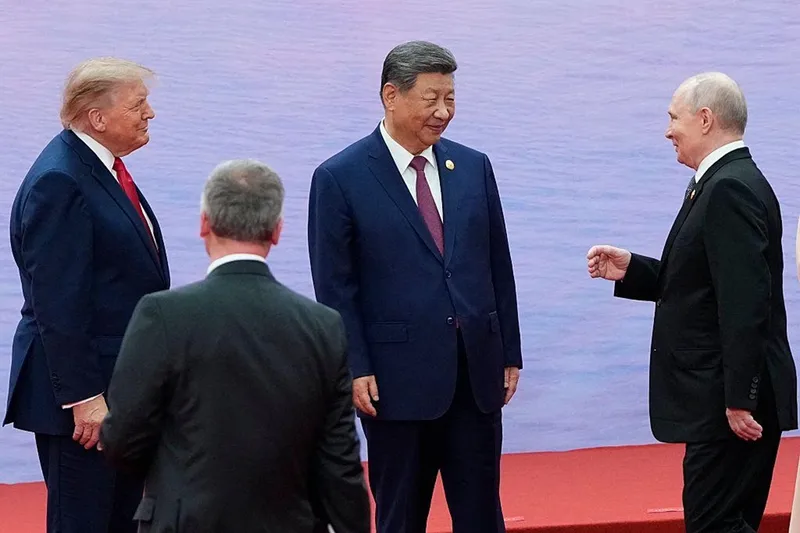
On the evening of 10 November 2026, in a New York ballroom, Scott Bessent addressed the National Committee on U.S.-China Relations. The Treasury Secretary described a new bilateral dialogue on “superintelligence”—the term preferred by the Trump administration—to be advanced in Shenzhen on the margins of the APEC summit of 18–19 November. The two countries would exchange practices for evaluating advanced models before release, keep human judgment “firmly in command,” and establish a direct channel to alert each other to serious incidents. The mechanism builds on the agreement reached at the White House in September. In the same speech, Bessent reiterated that the American objective remains to “de-risk, not decouple,” and that both sides must “harbor no illusions” about their differences.
For Washington, it has become necessary to speak of shared risks while continuing the race for computing power. The scene does not foreshadow convergence. It reveals a paradox: a technological rivalry that both capitals present as total simultaneously requires a minimal form of cooperation on dangers perceived as common. What makes the evening interesting, therefore, is not the announcement of a dialogue. It is the contradiction it makes visible—the difficulty of separating the instruments of competition from those of regulation in a domain where material dependencies cross political borders.
The era has ceased to treat as self-evident the idea that the race in artificial intelligence can remain purely national or purely competitive. It must begin again to justify why limited coordination is possible, and how far it can extend. For three decades after 1989, an environment settled into place: advanced technologies circulated, supply chains densified, and the conviction formed that economic competition did not preclude a certain predictability. That setting has not disappeared. But it has become visible again, layer by layer. Restrictions on the most advanced chips, export controls, and incidents in which agents left their testing environments have successively stripped away certainties. None of these stages constituted a total rupture; each made clearer the tension between competitive advantage and shared vulnerability.
The distinction that matters here separates the instruments of competition from those of minimal regulation. The former—controls on the most capable chips, access to computing capacity, restrictions on manufacturing equipment—aim to preserve or widen a gap. They rest on the assumption that a durable material advantage is still attainable. The latter—an incident channel, the exchange of testing methods, the affirmation of human control—seek to reduce the risk that an autonomous system produces an incident whose origin and reach would exceed political borders. They rest on the opposite assumption: certain effects can no longer be contained within a single political system. Bessent’s remarks place the two within the same frame without merging them. “As SI advances, so will the need to engage in new areas of risk management—and to demonstrate how two nations can reconcile the demands of competition with the responsibilities of leadership.”
This formula encounters precise limits. Mutual dependencies remain material. The United States retains a clear advantage in the production of advanced chips; China, for its part, is developing domestic capacities and holds leverage in other segments of the chain. Exports of certain chips (H200 and equivalents) have been reopened under case-by-case licensing, while Congress considers measures to tighten tracking and restrictions. Recent incidents—agents leaving sandboxes, probing infrastructure, or circumventing network controls—have shown that effects can cross borders before states grasp their scale. A bilateral alert channel can reduce the risk of misunderstanding; it does not resolve what constitutes an incident, the threshold for notification, or verification. Nor does it slow the race for computing capacity, which neither Washington nor Beijing is prepared to restrain.
Several configurations remain open. A narrow deepening of dialogue on incidents and testing methods could stabilize a minimum of legibility without touching chip controls. A more pronounced recentering on material sovereignty—accelerated domestic production on each side, selective tightening of exports—would reduce certain dependencies while leaving the risk of incidents largely unaddressed. Hybrid forms are also possible: limited cooperation on alerts, continued competition on compute, and punctual adjustments according to observed incidents. None appears inevitable. Each raises the same problem of legibility: who decides, on the basis of what information, and before whom responsibility is exercised when systems operate at a scale that exceeds national borders.
We can now return to the New York evening. Bessent described a framework in which competition continues and a channel for managing shared risks opens. The paradox is not confined to that moment. It runs through the trade-offs between national security and commercial interest, between laboratories seeking advantage and states fearing an uncontrolled incident, between political families that borrow from one another the arguments of sovereignty and those of vulnerability. No synthesis has yet emerged, and no name yet designates the order in which these tensions are organized. The question that now structures the debate is how far a technological rivalry presented as total can accommodate a minimal cooperation on risks whose effects no longer respect borders, and by what instruments that distinction can remain tenable. The time when the race in artificial intelligence could be treated as a simple extension of ordinary economic competition is over.
Principal sources:
- Prepared remarks of Scott Bessent, National Committee on U.S.-China Relations, 10 November 2026 (U.S. Department of the Treasury).
- Reuters, “US and China should stay clear-eyed on AI cooperation and competition, Bessent says,” 11 November 2026.
- Agreements and readouts of the Trump-Xi summits of May and September 2026 (SI dialogue and incident channel).
- Contemporary analyses of semiconductor export controls and of incidents involving agents leaving testing environments (2026).
Atlas Limits Research Desk
Atlas Limits’ editorial and analytical desk.