In Texas, a waiting list has become larger than the system it is asking to access.
By the end of the summer of 2026, ERCOT, the operator of the Texas power grid, was reviewing more than 474 gigawatts of requests for new connections. Nearly 90% came from data centers. The figure is more than five times the state's record peak electricity demand. It therefore does not describe demand that is likely to materialize as submitted. It reveals something else: America's race for computing power has begun to generate more projects than the infrastructure expected to support them can realistically absorb.
On September 21, Texas decided to stop the machinery.
Governor Greg Abbott ordered the Texas Commission on Environmental Quality to temporarily stop issuing permits requested by data centers. Other state agencies must also suspend regulatory approvals associated with new projects while several audits examine their impact on the power grid, water resources and public finances.
The decision does not mean Texas is turning away from data centers. It signals something more important: in one of the places that had come to embody the seemingly frictionless expansion of America's digital infrastructure, the promise of investment is no longer enough.
A project must now demonstrate that it can physically exist.
From the chip to the territory
For several years, the competition surrounding artificial intelligence has largely been described through things that can be counted: GPUs, advanced semiconductors, billions of dollars invested, model parameters and data-center capacity.
That representation had an advantage. It made compute look like an industry whose main constraints were technological and financial. Secure the chips, raise the capital, build the facilities and connect enough machines, and most of the problem appeared to be solved.
But a data center is not an abstract infrastructure.
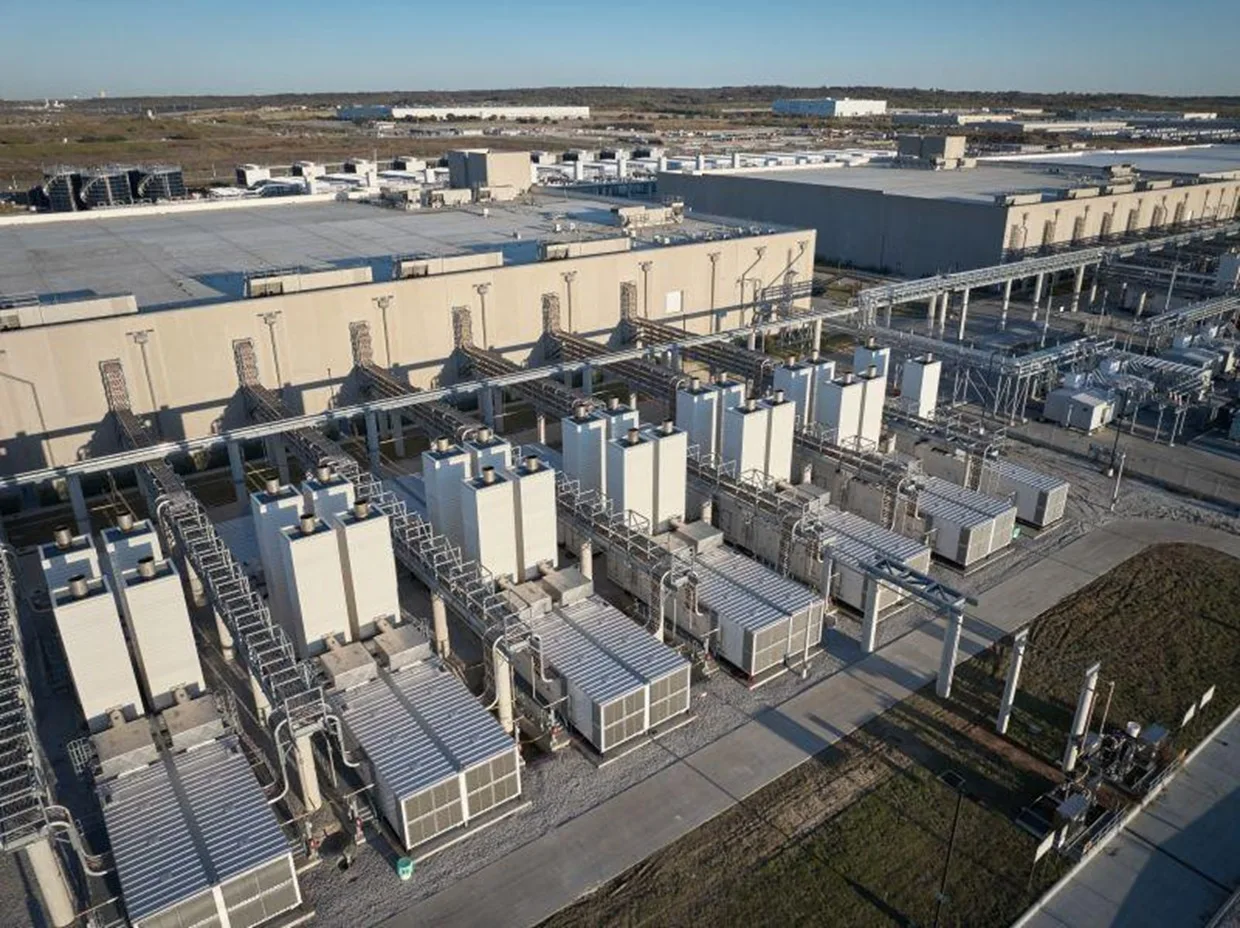
It occupies land. It consumes electricity continuously. It requires transmission lines, substations and, in some cases, additional generating capacity. Depending on its design and cooling systems, it can consume substantial quantities of water. It produces noise. It changes the infrastructure requirements of the communities that host it.
As projects become larger, these constraints stop being secondary. They begin to determine whether construction is possible at all.
That is precisely what Texas is discovering.
The state had assembled almost every characteristic operators were looking for: available land, rapid demographic and economic growth, a favorable regulatory environment, a largely deregulated electricity market and access to substantial energy resources. Together, they made Texas one of the leading destinations for new US computing capacity.
They also created an illusion: that the state's capacity to absorb new infrastructure was almost unlimited.
The 474 gigawatts sitting in ERCOT's queue now expose the limit of that assumption.
Demand that may not exist
No one seriously expects 474 gigawatts of new load to appear on the Texas grid.
Some of the requests correspond to real projects. Others probably reflect operators submitting multiple applications, securing alternative locations or attempting to reserve capacity before making final investment decisions. Several projects may also be competing simultaneously for the same capital, customers or equipment.
In other words, the interconnection queue no longer measures only future demand.
It also measures options being taken on the grid.
The distinction matters.
A power system must be built for decades. A high-voltage transmission line, generating plant or substation cannot be planned like a provisional reservation of computing capacity. If announced demand triggers billions of dollars of investment and then disappears, the cost of that error does not disappear with it. It remains embedded in the electricity system and must ultimately be borne somewhere.
Texas's problem, therefore, is not simply how to produce more electricity.
It is deciding which demand deserves to have infrastructure built for it.
Since August, ERCOT had already begun subjecting new large-load connections to greater scrutiny. The September 21 decision, however, changes the scale of the intervention. Oversight moves beyond the electricity grid to encompass the broader economic and territorial footprint of data centers.
Operators must now specify their electricity and water requirements, their energy sources, any on-site generation capacity, the infrastructure they intend to finance themselves and the public assistance they receive. The state also wants information on ownership structures and the measures planned to limit disruption to surrounding communities.
The change in the questionnaire says almost everything about the change in doctrine.
Texas is no longer asking only: how much do you want to consume?
It is asking: who will pay to make that consumption possible?
The end of the invisible subsidy
That question is becoming central because the economics of data centers depend partly on infrastructure extending far beyond their walls.
When a project requires a new substation, reinforced transmission lines, additional generating capacity or investment in water infrastructure, the boundary between private investment and collective infrastructure becomes less clear.
A data center may finance its building, servers and part of its grid connection. But the consequences of its arrival can spread across a system whose costs are shared with other consumers.
As long as the volumes involved remained relatively modest, that question could be absorbed within the broader growth of the system.
The scale promised by AI changes the equation.
A digital facility capable of demanding several gigawatts at a single site begins to look, from the grid's perspective, less like an ordinary customer and more like a territorial industrial decision.
Greg Abbott is now pushing that logic further. He has said he will ask the next Texas legislature to eliminate financial incentives granted to the sector.
The signal is remarkable coming from Texas. This is not a state historically hostile to large industrial investments, nor a government seeking to slow technological development as a matter of principle. That is precisely why the decision matters.
The debate is no longer simply between states that favor AI and states that want to regulate it.
It is beginning to divide projects capable of bearing their physical footprint from those expecting the territory around them to absorb it.
Texas and California, the same problem
The contrast becomes even more interesting when looking west.
At almost the same moment, California adopted a package of seven laws strengthening oversight of data centers, including their effects on electricity, water, land use and infrastructure costs.
It would be easy to interpret the two decisions through the familiar political opposition between Austin and Sacramento. Yet they lead toward a remarkably similar principle.
California regulates. Texas audits and suspends.
But both are now asking the same question: what conditions should a private computing infrastructure have to meet before gaining durable access to collective resources?
That convergence is probably more important than the instruments being used.
It suggests that the constraint now emerging is not ideological.
It is physical.
A transmission line remains a transmission line in a Republican state or a Democratic one. An aquifer does not gain capacity when a legislative majority changes. A power plant takes years to develop regardless of how quickly artificial-intelligence models evolve.
Technology can accelerate many things.
It cannot necessarily accelerate the infrastructure that makes it possible.
The new geography of compute
None of this means construction of US data centers is about to stop.
It may, in fact, continue expanding rapidly. But its geography is likely to become more selective.
Projects with their own power generation, those capable of financing their grid connections, or those able to locate near existing capacity will enjoy an increasing advantage. Regions with abundant electricity but also networks robust enough to transport it will become more valuable. Access to water, long secondary in the geography of the digital economy, could become a decisive factor in some areas.
Competition between states may change as well.
For years, attracting a data center meant offering land, tax incentives and rapid approvals. Tomorrow, the competitive advantage could be almost the opposite: having a system capable of quickly separating credible projects from speculative ones and making them bear the marginal cost of their arrival.
Capital does not disappear from the equation.
Neither do semiconductors.
But neither is sufficient anymore.
Global computing power increasingly depends on a chain that begins inside semiconductor fabs and ends in much older realities: power plants, transformers, high-voltage transmission lines, reservoirs, water pipes, land and administrative decisions.
That is where the frontier of artificial intelligence is gradually moving.
During the first phase of the race, the question was who could buy enough GPUs.
The next may be simpler to formulate — and much harder to solve:
Who will agree to power them?
Main sources
- Office of the Governor of Texas — September 21, 2026 directive suspending permits and ordering further review of data centers.
- ERCOT / Texas authorities — data on large-load interconnection requests and audits initiated in 2026.
- Public Utility Commission of Texas — regulatory framework governing large electricity consumers and grid infrastructure.
- Texas Water Development Board — review of water requirements associated with new projects.
- Office of California Governor Gavin Newsom — September 21, 2026 legislative package covering data centers, electricity, water and land use.
- Reuters — reporting on the Texas suspension and speculative demand in US grid interconnection queues.
Atlas Limits Research Desk
Atlas Limits’ editorial and analytical desk.