ASML has warned that its planned manufacturing capacity will not be sufficient to meet customer demand in 2027 and 2028. Some semiconductor manufacturers are already discussing equipment deliveries for 2029 and 2030. Behind the Dutch company's exceptional financial results lies a fundamental constraint on the expansion of artificial intelligence: investment decisions can be made in months, but the machines required to turn those investments into production capacity take years to develop, manufacture and deploy.
In Veldhoven, in the southern Netherlands, the machines that will help manufacture some of the world's most advanced processors in the next decade are already entering commercial negotiations. On October 14, 2026, ASML reported record quarterly results alongside an unusual warning for an industrial equipment manufacturer: despite planned capacity expansions, it will not be able to fully satisfy customer requirements in 2027 and 2028.
The announcement extends far beyond the company's financial performance. It exposes a widening gap between the speed at which technology companies are investing in artificial intelligence and the pace at which the global industrial system can build the physical infrastructure required to support that expansion.
Semiconductor manufacturers are no longer securing equipment exclusively for their next production facilities. Some are discussing deliveries scheduled for the end of the decade. Future processor manufacturing capacity is therefore being planned years before the applications that will eventually use those processors have reached commercial maturity.
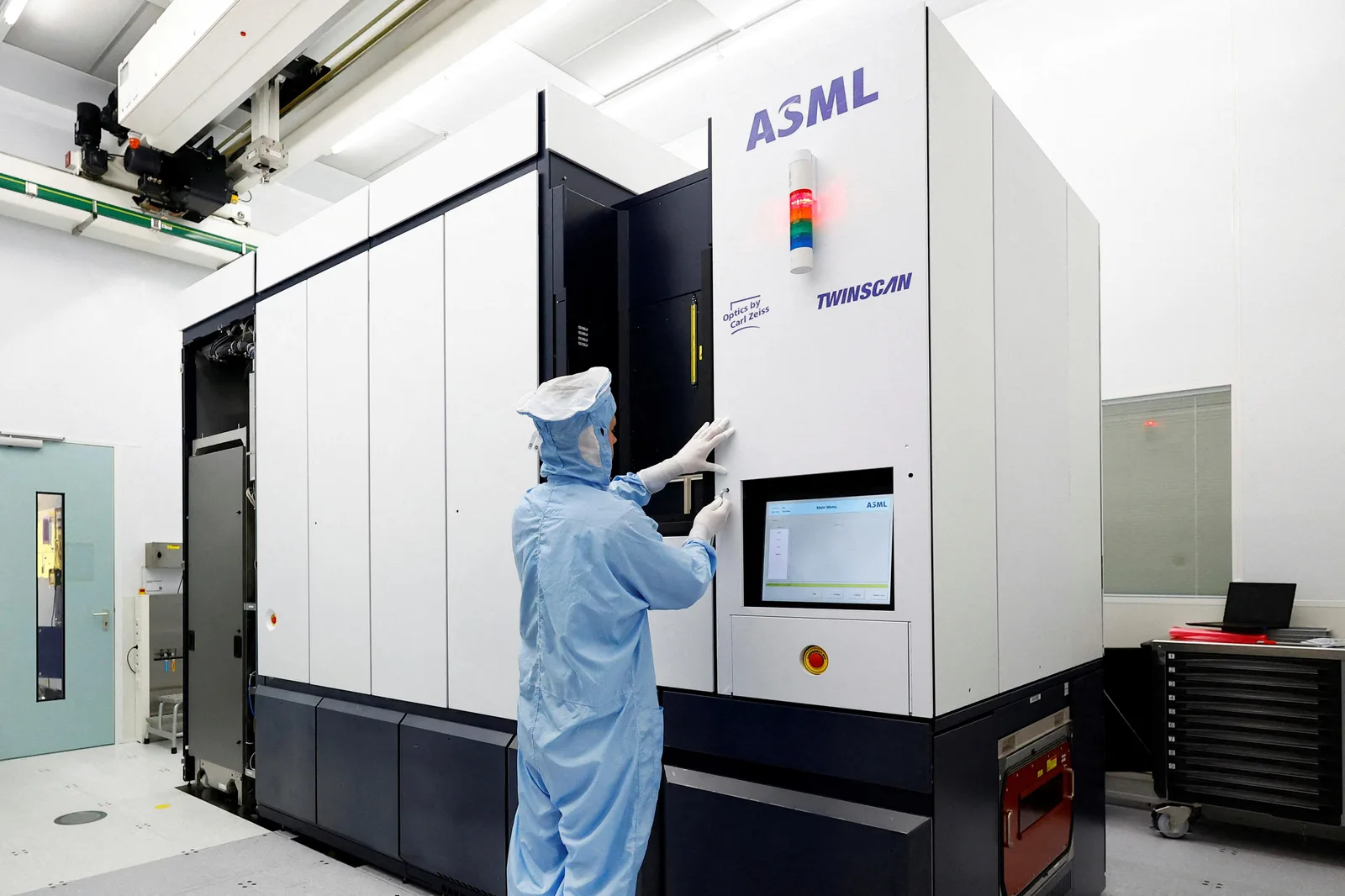
This anticipation places ASML at the center of a major industrial transformation. The Dutch company does not manufacture the processors installed in data centers, nor does it develop the artificial intelligence models running on them. Instead, it produces some of the equipment indispensable to manufacturing those processors.
Its position several stages upstream from the final market gives it considerable influence over the pace at which the semiconductor industry can expand.
An Exceptional Quarter Reveals an Industrial Constraint
In the third quarter of 2026, ASML generated €11.66 billion in revenue, compared with €9.33 billion in the preceding quarter, representing an increase of approximately 25%.
Net income reached €4.96 billion, while gross margin climbed to 57.5%, compared with 54% in the second quarter.
The company sold 113 new lithography systems, up from 86 in the previous quarter. Revenue from maintenance, services and upgrades to equipment already installed at customer facilities also increased, reaching €3.29 billion.
This last figure is particularly revealing.
Semiconductor manufacturers are not simply trying to construct new production capacity. They are also investing in improving the productivity of machines they already operate, demonstrating that existing equipment has itself become a strategic industrial resource.
ASML raised its full-year outlook, forecasting revenue of between €44 billion and €45 billion in 2026, with a gross margin of approximately 56%.
For the fourth quarter, the company expects sales of between €14.2 billion and €15.2 billion.
These results nevertheless require careful interpretation.
Net income includes a valuation gain of approximately €500 million associated with ASML's investment in French artificial intelligence company Mistral AI. Consequently, the increase in reported profit cannot be attributed entirely to improvements in recurring industrial operations.
The expansion in revenue, stronger margins and rising demand for equipment upgrades nonetheless point to substantial operational momentum.
Yet the most consequential information lies in the company's manufacturing outlook.
Chief Executive Christophe Fouquet indicated that currently planned capacity for 2027 and 2028 would not be sufficient to meet all customer requirements.
ASML is therefore examining additional expansion opportunities beyond the increases already incorporated into its industrial plans.
Management has also acknowledged commercial discussions extending into 2029 and, in some cases, 2030.
This does not mean that every machine scheduled for those years has already been sold. Firm orders, purchasing forecasts and preliminary discussions represent different levels of commitment.
Nevertheless, the extension of negotiations so far into the future constitutes a significant industrial signal.
Semiconductor manufacturers are attempting to secure their future means of production before the associated investment programs have been fully executed.
ASML: An Essential Gateway to Advanced Semiconductor Manufacturing
ASML's position rests on a technological specialization developed over several decades.
Lithography involves transferring extremely fine patterns onto silicon wafers to manufacture integrated circuits. As semiconductor components become smaller and more complex, the precision required increases dramatically.
ASML is the world's sole commercial supplier of extreme ultraviolet lithography systems, commonly known as EUV, used in critical stages of manufacturing the most advanced logic semiconductors.
These machines enable the production of structures that are difficult to achieve economically with previous generations of lithography technology.
They play a central role in manufacturing advanced processors used in smartphones, computers and artificial intelligence accelerators.
This does not mean that all semiconductors require EUV equipment.
Many industrial, automotive, analog and power-management chips are manufactured using older technologies. Even the most advanced semiconductor factories continue to rely on several categories of lithography systems.
However, for certain critical stages in producing the highest-performance logic chips, the absence of a directly equivalent industrial alternative places ASML in an exceptional position.
Major global manufacturers, including TSMC, Samsung and Intel, depend on its equipment for parts of their technological roadmaps.
Growing demand for artificial intelligence accelerators reinforces that dependence.
Processor designers such as Nvidia, AMD and Broadcom rely on semiconductor foundries capable of manufacturing extraordinarily complex integrated circuits.
Those foundries require not only modern fabrication plants but also a coordinated combination of manufacturing, metrology, inspection and advanced packaging equipment.
A new semiconductor factory cannot therefore be considered operational simply because construction of its buildings has been completed.
It must receive its equipment, install and calibrate the systems, qualify its manufacturing processes and achieve sufficient production yields to operate commercially at scale.
The availability of lithography equipment is one of the essential conditions for that transition.
Why Manufacturing Capacity Cannot Expand as Quickly as Investment
Manufacturing an advanced lithography system is fundamentally different from assembling conventional industrial equipment.
An EUV machine combines exceptionally complex subsystems produced by an international network of specialized suppliers.
Its construction requires close coordination between optics, lasers, precision mechanics, control systems, software and vacuum technologies.
Germany's ZEISS occupies a particularly important position in supplying optical systems.
The generation of EUV light also relies on highly specialized laser technologies and components.
These systems must operate together within extraordinary precision tolerances.
Increasing manufacturing capacity therefore depends on far more than ASML's ability to construct additional buildings or recruit employees.
Its suppliers must also be capable of expanding production without compromising technical requirements.
Some components require substantial industrial investment, specialized manufacturing equipment and highly qualified personnel.
Their production cannot be multiplied immediately.
The difficulty extends throughout the supply chain.
If ASML intends to increase deliveries by 30%, this does not necessarily mean that every supplier can increase its own output by the same proportion within the same period.
Some suppliers may have unused capacity. Others must invest in new facilities. Still others face technological limitations or lengthy qualification procedures.
The expansion of final production therefore depends on the least flexible elements of the industrial chain.
This explains why massive investments in artificial intelligence cannot immediately be converted into additional semiconductor manufacturing capacity.
Capital can finance industrial expansion.
It cannot eliminate construction schedules, qualification requirements or shortages of specialized expertise.
An Industrial Expansion Already Extending Toward 2030
ASML has already initiated a substantial expansion of its manufacturing capabilities.
The company previously announced plans to increase capacity for certain categories of EUV and immersion deep ultraviolet lithography systems by approximately 30% in 2027, relative to planned 2026 levels.
Additional increases were being considered for 2028.
Management now believes that these plans may remain insufficient.
In September 2026, ASML began construction of a new industrial campus in Eindhoven to support its expansion.
However, the first phase of the project is not expected to be completed until 2029.
This timetable illustrates the fundamental difficulty confronting the company.
Investments undertaken today to expand industrial capacity will only produce their full effects several years later.
ASML is therefore also seeking to increase output from existing facilities and improve the performance of machines already installed at customer sites.
This second strategy could become increasingly important.
The manufacturing capacity of a semiconductor fabrication plant depends not only on the number of machines installed but also on how many wafers each system can process, its operational availability, maintenance requirements and production yields.
Productivity improvements can increase output without immediately requiring the construction of entirely new production lines.
The €3.29 billion generated from services and installed-base upgrades during the third quarter demonstrates that this activity already represents an important part of ASML's business.
It also provides a way to alleviate some capacity constraints more rapidly.
Nevertheless, productivity gains cannot indefinitely replace the installation of new equipment.
As semiconductor manufacturers multiply their investment projects, physical expansion remains necessary.
The central question becomes how quickly the entire industrial ecosystem can respond.
The Next Generation of Lithography Introduces Another Constraint
The pressure on manufacturing capacity coincides with another technological transition.
ASML is developing and industrializing a new generation of extreme ultraviolet lithography systems known as High-NA EUV.
These machines are designed to support further semiconductor miniaturization through higher-resolution patterning.
Their development represents an enormous technological investment.
It requires not only new equipment but also adaptations to manufacturing processes, materials, photomasks and inspection systems.
Intel is among the first manufacturers pursuing the integration of this technology.
Samsung plans to adopt High-NA EUV for DRAM memory manufacturing from 2028, while TSMC is considering its introduction into high-volume manufacturing around 2030.
These schedules do not imply that every manufacturer will immediately adopt identical processes or that High-NA systems will rapidly replace existing EUV technologies.
Adoption will depend on economic advantages, manufacturing yields and the specific requirements of individual chipmakers.
However, the transition creates an additional industrial challenge.
ASML must simultaneously expand production of its existing equipment and industrialize an even more complex generation of machines.
Demand growth therefore concerns not only higher volumes but also a transformation of the underlying manufacturing technology.
This combination makes expansion considerably more difficult than simply increasing assembly rates.
The Industrial Competition Between the United States, Europe and Asia
ASML's capacity constraints have direct geographical consequences.
Over recent years, the United States, the European Union, Japan, South Korea and Taiwan have sought to strengthen their semiconductor manufacturing capabilities.
Their motivations differ: economic security, technological autonomy, industrial competitiveness, geographical diversification and the need to respond to growing demand.
Yet these strategies depend partly on the same equipment suppliers.
The United States can mobilize substantial public and private investment to develop new semiconductor fabrication plants.
Europe can support the establishment of additional manufacturing capacity within its territory.
Asian semiconductor groups can accelerate their own investment programs.
All must nevertheless operate within the production schedules of the companies supplying the required equipment.
Competition for access to manufacturing systems is therefore becoming an increasingly important dimension of global industrial rivalry.
This does not mean that every machine delivered to an American factory is necessarily unavailable to a European or Asian facility.
Equipment categories, contractual schedules and technological requirements differ.
However, when a strategic supplier faces limited capacity, reservation decisions and delivery priorities can influence the implementation schedules of industrial projects.
Manufacturers capable of anticipating their requirements, securing orders and coordinating investments with suppliers may therefore obtain a competitive advantage.
Competition is no longer limited to the ability to finance new factories.
It increasingly concerns the ability to organize their supply chains several years in advance.
For Europe, this creates a notable paradox.
The continent is seeking greater semiconductor autonomy while already hosting, through ASML, one of the industry's most difficult-to-replace industrial assets.
Yet possessing a strategic equipment supplier does not guarantee control over the entire semiconductor value chain.
ASML itself depends on international suppliers, while the world's most advanced chip manufacturing capacity remains heavily concentrated in Asia.
Europe therefore occupies a major industrial position without independently controlling the global semiconductor ecosystem.
China Faces a Persistent Technological Dependency
ASML's position also carries significant geopolitical implications.
Western restrictions on exports of advanced semiconductor manufacturing equipment to China have transformed lithography into a strategic issue.
Beijing is seeking to develop domestic semiconductor production capabilities and reduce dependence on foreign suppliers.
However, mastering the most advanced lithography technologies remains one of the major obstacles to achieving that ambition.
ASML's EUV systems are not exported to China.
Other categories of equipment are also subject to restrictions depending on their technical specifications and the applicable export-control regulations.
This situation is contributing to a growing separation between markets with access to the most advanced manufacturing technologies and those required to develop alternatives.
For ASML, global demand associated with artificial intelligence can strongly support its business prospects, while trade restrictions simultaneously limit certain sales opportunities.
For China, the challenge is to develop sufficient domestic capabilities to reduce technological dependence while preserving industrial competitiveness.
The objective extends beyond reproducing a particular machine.
It involves building an entire ecosystem of suppliers, optical components, light sources, software, materials and industrial processes.
ASML's own development demonstrates why such substitution can require many years.
The technological concentration that currently strengthens the Dutch company's position may therefore also contribute to the fragmentation of the global semiconductor industry.
The longer restrictions persist, the stronger the incentives for affected countries and companies to develop alternative technologies, even when those alternatives initially deliver lower performance.
Can Artificial Intelligence Investment Grow Faster Than Industrial Production?
ASML's results arrive amid growing debate about the profitability of artificial intelligence investment.
Major technology companies are committing enormous amounts of capital to data centers, processors, electricity networks and digital infrastructure.
These expenditures depend on expectations of sustained growth in computing demand.
However, their ultimate profitability will be determined by several factors: actual capacity utilization, revenue generated by AI applications, energy costs, productivity improvements and the pace of technological change.
Exceptional demand for ASML equipment does not, by itself, demonstrate that all investments in artificial intelligence will prove profitable.
It does show that semiconductor manufacturers anticipate requirements substantial enough to justify commercial discussions extending several years into the future.
Three different investment horizons must be distinguished.
The first concerns companies developing and commercializing artificial intelligence applications.
Their prospects can change rapidly as adoption patterns and business models evolve.
The second concerns data center operators investing in computing infrastructure, electricity supply and networking systems.
Their investment decisions generally involve longer time horizons.
The third concerns semiconductor manufacturers and their equipment suppliers, whose industrial investments must be planned years before production capacity becomes operational.
These three horizons are not perfectly synchronized.
A technology company can revise its spending plans within a few quarters.
A semiconductor manufacturer that has ordered equipment and begun constructing a fabrication plant has considerably less flexibility.
ASML, meanwhile, must make its own manufacturing expansion decisions before demand for the following decade can be established with certainty.
This difference in timing represents one of the central structural risks of the current expansion.
If demand continues to accelerate, industrial capacity may remain insufficient despite substantial investment.
If demand slows sharply, previously ordered equipment and newly constructed factories could contribute to excess capacity.
The semiconductor industry has historically experienced repeated cycles of shortages, heavy investment and subsequent production adjustments.
Artificial intelligence does not eliminate this cyclicality.
It may amplify certain mechanisms by concentrating investment in particularly expensive technologies and manufacturing capabilities.
Shortages Can Coexist With Excessive Investment
The apparent contradiction between financial concerns about artificial intelligence and exceptional demand for ASML equipment deserves particular attention.
An industry can attract excessive capital into certain segments while simultaneously experiencing persistent shortages elsewhere.
There may be too many planned data centers, insufficient electricity infrastructure, shortages of particular memory technologies and limited availability of advanced semiconductor manufacturing equipment.
These imbalances are not contradictory.
They arise because different components of the industrial value chain cannot expand at the same speed.
Constructing a data center depends on land availability, buildings, electricity, cooling systems and computing equipment.
Manufacturing processors requires specialized semiconductor production capacity, which itself depends on complex industrial machinery.
Producing that machinery relies on another network of suppliers, some of which possess manufacturing capabilities that are particularly difficult to expand.
An investment decision made at one end of the chain can therefore generate successive industrial requirements that take years to materialize.
The growth of artificial intelligence does not encounter a single physical limitation.
It faces a series of interconnected constraints, each operating according to its own industrial timetable.
This also helps explain why companies occupying critical positions in the value chain can benefit from sustained demand independently of the immediate profitability of final applications.
ASML sells the manufacturing equipment required by semiconductor producers.
Its revenue depends on their investment decisions, rather than directly on the income generated by each artificial intelligence application.
This distinction provides some insulation from fluctuations in the final market without making the company independent of them.
A prolonged reversal in semiconductor capital expenditure would ultimately affect its order book as well.
Industrial Power Lies in Capabilities That Are Difficult to Replace
The current expansion of artificial intelligence reveals a broader transformation in the global economy.
Access to capital is no longer sufficient to guarantee rapid industrial execution.
In certain sectors, the most decisive resources are specialized manufacturing capabilities, technical expertise, critical components and equipment whose production schedules cannot easily be compressed.
These capabilities function as industrial chokepoints.
Their importance does not necessarily depend on their visibility to the general public.
It derives from the number of economic activities that cannot operate without them.
ASML occupies precisely such a position.
The Dutch company does not control global demand for artificial intelligence or the investment strategies of its customers.
Nor does it independently determine the construction schedules of semiconductor fabrication plants.
But its ability to supply certain manufacturing systems influences how quickly parts of the industry can expand.
This influence also has limits.
Customers can improve the productivity of existing equipment, adapt manufacturing processes or use alternative technological generations where economically and technically feasible.
Suppliers can expand their own capabilities.
Manufacturers can adjust investment schedules.
And technological dominance in a particular industrial segment does not guarantee permanently increasing demand.
ASML's strategic strength therefore lies less in absolute control over semiconductor manufacturing than in the difficulty its customers face when attempting to replace the capabilities it provides.
That difficulty transforms industrial time into a strategic resource.
The Next Decade Is Being Prepared Before Its Demand Is Known
The results published on October 14, 2026, demonstrate that the expansion of artificial intelligence is entering a phase in which some of the most consequential decisions are being made increasingly far upstream from final applications.
Semiconductor manufacturers are anticipating equipment requirements extending into 2029 and 2030.
ASML is preparing manufacturing capacity increases that themselves require several years.
Its suppliers must invest before final production volumes are known.
The entire industrial chain is therefore operating on long-term expectations.
This dynamic could support a considerable technological expansion.
It could also create imbalances if demand forecasts prove excessive or if investment progresses at different speeds across the various segments of the industry.
The essential question is no longer simply how much companies will spend on artificial intelligence.
It is what proportion of that investment can be converted into genuinely operational capacity, at what cost and within what timeframe.
ASML's announcement exposes a fundamental limitation: the digital economy depends on an industrial infrastructure whose constraints remain profoundly physical.
Software can be deployed rapidly.
Capital can be mobilized within weeks.
Financial expectations can change during a single trading session.
But the machines required to manufacture the world's most advanced processors demand years of research, investment and industrial coordination.
Artificial intelligence may accelerate the functioning of the economy. It cannot abolish the time required to construct its own means of production.
Main Sources
ASML Holding NV, official third-quarter 2026 financial results, published October 14, 2026. Financial performance, annual outlook, equipment sales and statements by CEO Christophe Fouquet.
ASML Investor Relations, management presentation and commentary accompanying the third-quarter results, October 14, 2026.
ASML, September 8, 2026, announcement concerning the construction of the new Eindhoven industrial campus.
ASML and Intel Foundry, September 8, 2026, announcement concerning the development and industrialization of High-NA EUV technology.
ASML and Samsung Electronics, September 8, 2026, announcement concerning technological cooperation and the planned adoption of High-NA EUV systems.
Reuters, October 14, 2026, reporting on ASML's industrial outlook, lithography equipment demand and manufacturing capacity constraints extending toward 2030.
Atlas Limits Research Desk
Atlas Limits’ editorial and analytical desk.