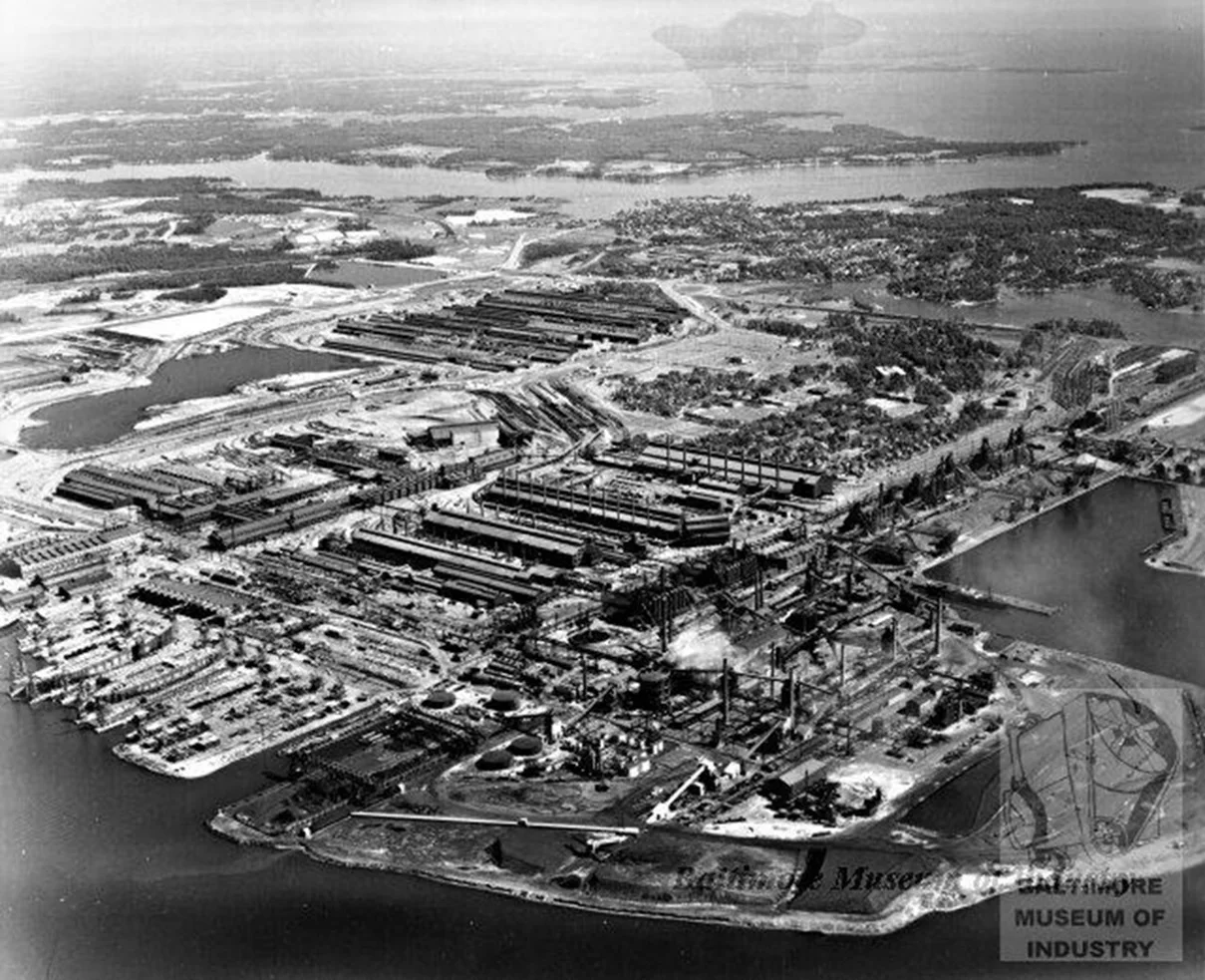
At Sparrows Point, near Baltimore, the ground still carries the memory of America’s former industrial power. For much of the twentieth century, this vast stretch of land on the Chesapeake Bay was one of the centers of gravity of U.S. steelmaking. Bethlehem Steel employed tens of thousands of workers there. The steel produced at the site fed railroads, automobiles, infrastructure and ships across an economy that had become the largest in the world.
Then the mill went silent.
In October 2026, Donald Trump returned to the same ground to announce a different form of heavy industry. Anduril Industries plans to invest $3.7 billion to build Arsenal-2 at Sparrows Point, an industrial complex of more than 185,000 square meters dedicated in part to manufacturing components for Virginia-class nuclear-powered attack submarines. The U.S. Navy has simultaneously awarded the company a contract worth up to $2.9 billion, with payments tied to actual industrial performance.
Together, the commitments associated with the program could reach $6.6 billion, but the two figures represent different things: $3.7 billion of private capital invested by Anduril in productive capacity, and up to $2.9 billion in public procurement linked to production.
Behind those numbers lies something more important than another factory.
The United States is rediscovering that military power does not depend solely on the sophistication of the weapons a country can design. It also depends on how many systems it can actually manufacture, how long they take to build and how deep the industrial base is that can sustain production for years.
War is becoming a question of factories again.
The American Bottleneck
Virginia-class submarines rank among the most complex industrial machines ever built. Nuclear propulsion, acoustic stealth, combat systems, sensors, weapons and thousands of components must be assembled according to extraordinarily demanding standards.
Only two companies sit at the core of their construction: General Dynamics Electric Boat and Huntington Ingalls Industries through Newport News Shipbuilding.
On paper, the United States has been buying roughly two Virginia-class submarines a year for more than a decade. Inside the shipyards, the reality is different.
Since 2022, recruitment difficulties, supplier constraints and insufficient industrial capacity have limited effective production to roughly 1.2 to 1.4 submarines per year. A widening gap has therefore emerged between submarines ordered and submarines actually delivered.
AUKUS makes the equation even more difficult.
To meet the requirements of the U.S. fleet, replace the three to five Virginia-class submarines expected to be transferred to Australia and absorb the existing backlog, the U.S. Navy estimates that industrial capacity will eventually have to rise to around 2.33 Virginia-class submarines per year.
Moving from 1.2–1.4 to 2.33 does not simply mean asking existing shipyards to work harder.
It requires more welders, electricians, pipefitters, engineers and inspectors. Shipyards must expand. Hundreds of suppliers must increase capacity. More reactors, tubes, valves, electronic systems and metal structures must be produced. Above all, the entire system has to be synchronized.
America’s weakness is therefore not technological.
It has become industrial.
Nine Million Additional Hours
This is where Arsenal-2 acquires its real significance.
According to information released around the project, the complex could add roughly nine million industrial labor hours per year to the U.S. submarine production base, equivalent to approximately 15% of additional capacity for the Virginia program.
The site is expected to employ around 3,100 people directly and could support more than 11,000 indirect jobs. Anduril estimates its annual economic impact at close to $2 billion.
Initial operations at Sparrows Point are expected in 2030, followed by a gradual ramp-up.
But the company does not intend to wait until then.
A facility of roughly 15,000 square meters in California is expected to begin developing the manufacturing processes, quality-control systems and skills required to produce components for Virginia-class submarines. Torpedo tubes are among the first components involved. The facility is intended to allow Anduril to learn how to manufacture according to the extraordinarily demanding standards of the naval nuclear industry before transferring those methods to a much larger scale in Maryland.
The factory itself therefore becomes a prototype.
And this is precisely where Anduril’s project begins to diverge from conventional reindustrialization.
The Factory as an Operating System
Anduril does not come from traditional shipbuilding. Founded in 2017, the company developed around autonomous systems, artificial intelligence, drones, sensors and military software.
Its ambition is now to apply a logic borrowed from technology companies to defense manufacturing.
Arsenal-2 is expected to be organized around ArsenalOS, a software platform designed to connect manufacturing, material flows, assembly, quality control, inspection and industrial documentation.
In a traditional shipyard, a significant share of lost time does not necessarily come from the industrial operation itself. It comes from waiting between operations, moving components, poorly synchronized assembly sequences, workforce availability or the documentation required before work can continue.
Anduril wants to treat the factory as an integrated system.
Production halls are designed to be configurable. Distances between manufacturing, assembly, testing and integration are meant to be reduced. Work instructions become digital. Quality controls are embedded in the process. Physical flows are tracked through software.
Automation, however, does not eliminate the skilled worker.
It seeks to increase that worker’s productivity.
A nuclear submarine will still require highly qualified welders, pipefitters, electricians, inspectors and technicians. But their work will take place inside an industrial architecture in which information is expected to move as quickly as components.
This is a very different conception from that of the old arsenals.
Yet it pursues exactly the same objective: producing more.
Arsenal-1, Arsenal-2
Maryland is not an isolated experiment.
In Ohio, Anduril is already building Arsenal-1, a roughly $1 billion industrial complex designed for the mass production of drones and autonomous systems.
The underlying logic is similar: do not merely design a weapon. Design the industrial system capable of manufacturing thousands of them rapidly.
Arsenal-1 targets the world of relatively modular autonomous systems.
Arsenal-2 is now moving toward the opposite end of the spectrum: nuclear shipbuilding, where industrial cycles are measured in years, certification requirements are extreme and individual components can weigh tens or hundreds of tons.
If the approach works in both environments, it could become one of the models for the new American defense industry.
Because this is precisely the problem Washington is trying to solve.
An Arsenal That Became Too Narrow
Over several decades, the American defense industry progressively consolidated.
The end of the Cold War reduced orders. Companies merged. Suppliers disappeared. Some production lines were shut down. Inventories declined.
The system that emerged remained extraordinarily capable of designing technologically superior weapons, but it became far less suited to sustaining prolonged consumption of military equipment.
Ukraine exposed that contradiction with unusual clarity.
Producing missiles, artillery shells or air-defense systems in large quantities requires production lines, machinery, raw materials, suppliers and workers that cannot simply appear when demand suddenly increases.
The same constraint exists in shipbuilding.
The United States must simultaneously modernize its fleet, construct Columbia-class ballistic-missile submarines, accelerate Virginia production, support AUKUS and prepare for a maritime competition with China whose center of gravity lies precisely in the Pacific.
Meanwhile, China now possesses the world’s largest commercial shipbuilding industry.
That asymmetry is gradually changing how Washington thinks about military power.
The question is no longer simply: which navy has the best ships?
It is becoming: which economy can build enough of them, quickly enough, and then replace potential losses?
The Return of the Industrial State
Arsenal-2 also reveals a broader transformation in American economic policy.
Anduril provides the private capital. The Navy guarantees potentially massive demand. Maryland and Baltimore County are preparing their own support mechanisms. The federal government is using military procurement to trigger the creation of productive capacity that had become insufficient.
The state is not directly building the factory.
But it is organizing the economic conditions that make its construction possible.
The boundary between industrial policy and defense policy is therefore becoming increasingly difficult to draw.
Semiconductors, critical minerals, batteries, shipbuilding, energy, drones, missiles: every sector considered strategic now raises the same question of domestic capacity.
For decades, the United States operated on the assumption that its technological and financial superiority would allow it to retain control over the most important segments of the economy while an increasing share of industrial production moved elsewhere.
Competition with China is weakening that assumption.
A technology that cannot be produced at scale represents only partial superiority.
A New Industrial Geography
The choice of Sparrows Point therefore carries an almost symbolic weight.
At its peak, Bethlehem Steel’s industrial complex employed tens of thousands of people. Its disappearance appeared to encapsulate the trajectory of part of industrial America: deindustrialization, blast-furnace closures, declining manufacturing employment and the transformation of immense productive territories into brownfields.
Arsenal-2 will not resurrect that world.
The factory returning to Sparrows Point will be more automated, more digital and far less labor-intensive than the industrial complexes of the previous century. Its workforce will be smaller but more specialized. Software will matter almost as much as the machine tool.
The nature of production is changing as well.
Sparrows Point once produced steel for the American economy.
It will now manufacture components for one of the most complex military machines in existence.
This is therefore not the restoration of twentieth-century American industry.
It is the emergence of another industry on the same ground.
Building to Remain Powerful
For a long time, American power appeared to rest on an almost ideal combination: financial dominance, technological superiority, control over global networks, military strength and the ability to purchase abroad what no longer needed to be manufactured at home.
That architecture has not disappeared.
But it is no longer sufficient.
Strategic competition is forcing Washington to rediscover an older truth: a great power must preserve the material capacity to transform capital, energy, raw materials and labor into physical objects.
Ships. Missiles. Reactors. Drones. Semiconductors. Ammunition.
Sophistication matters. Software matters. Artificial intelligence matters.
But at the end of the chain, someone still has to weld the metal.
That is what Sparrows Point is really about.
America is not returning to the industry it lost. It is building another war industry on its ruins.
The blast furnaces are gone. The machines have changed. So have the companies. Even the strategic adversary is different.
But after several decades in which power seemed capable of becoming ever more financial, digital and immaterial, the United States is rediscovering a constraint it had almost forgotten.
To remain an arsenal, it must still know how to build. 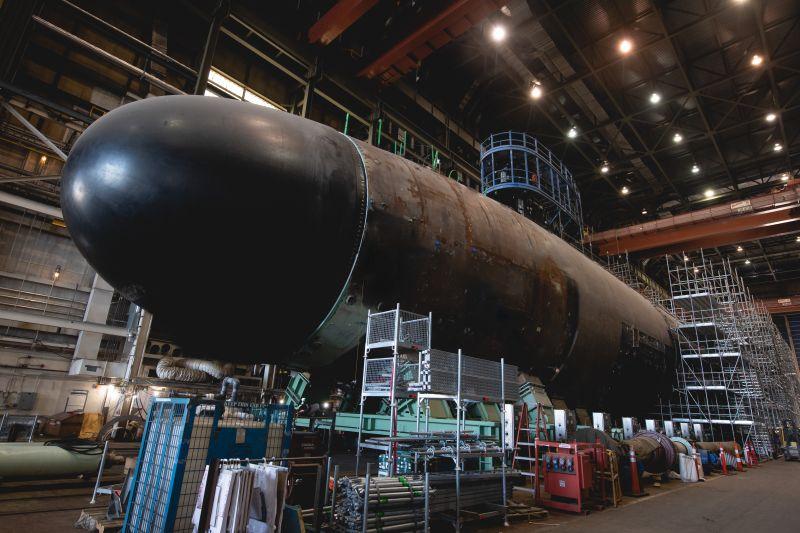
Main Sources
Anduril Industries — Anduril, U.S. Navy Invest $6.6 Billion to Expand America’s Submarine Industrial Base, October 6, 2026.
Anduril Industries — Arsenal-2, industrial presentation of the Sparrows Point project.
Congressional Research Service — Navy Virginia-Class Submarine Program and AUKUS Submarine Project, reports and updates on Virginia-class production and the U.S. submarine industrial base.
USNI News — Anduril to Build New Submarine Component Facility, October 6, 2026.
Reuters — reporting on the Sparrows Point announcement, Anduril’s investment and the U.S. Navy contract, October 6, 2026.
State of Maryland — announcements regarding Anduril’s Sparrows Point investment and proposed state and local support.
Atlas Limits Research Desk
Atlas Limits’ editorial and analytical desk.