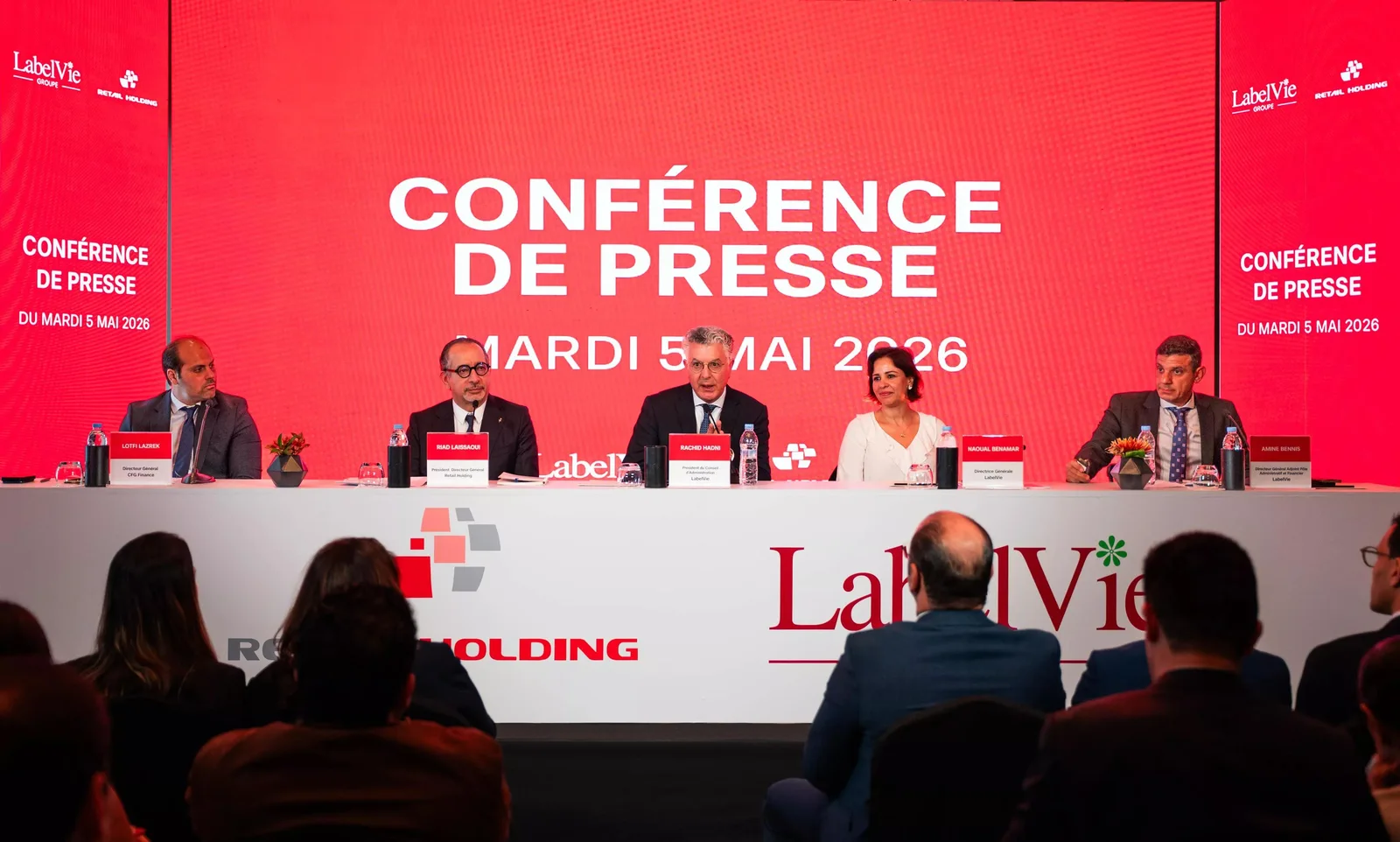
The planned merger between Label’Vie and Retail Holding goes far beyond a financial restructuring. By bringing retail, food service and other consumer-facing businesses under a single listed company, the Moroccan group aims to strengthen its commercial position, diversify its growth drivers and reorganize its capital structure. Yet behind the expected synergies lies a more fundamental question: how can a company broaden its investor base while preserving control in the hands of its historical shareholders?
A Merger That Goes Beyond Appearances
In retail, scale is an economic advantage, but it is not a guarantee of profitability. Larger purchasing volumes generally improve bargaining power, wider store networks can reduce certain unit costs, and a diversified portfolio of brands allows companies to reach consumers with different incomes and purchasing habits. Yet growth can also create organizational complexity, undermining the very efficiencies it is supposed to generate.
This is the equation behind the proposed merger by absorption of Label’Vie into Retail Holding, whose prospectus received approval from Morocco's Capital Market Authority (AMMC) on November 5, 2026, under reference VI/EM/034/2026. The transaction carries a declared value of MAD 6.264 billion and involves the issuance of 1,056,736 new Retail Holding shares.
That amount does not represent a cash acquisition price. It corresponds to the issue value of the new shares involved in the exchange. The distinction matters: this is not the purchase of an unrelated company, but a reorganization of capital within businesses already connected through their ownership structures.
The project dates back to May 4, 2026, when the boards of both companies approved its principal terms. Its architecture is somewhat unusual: Retail Holding, the parent company of Label’Vie, will absorb its listed subsidiary. Label’Vie will cease to exist as a separate legal entity without undergoing liquidation, while Retail Holding will inherit its assets and liabilities and is expected to enter the Casablanca Stock Exchange under the proposed name Label Vie Groupe.
The AMMC's approval of the prospectus represents a regulatory milestone, not the final completion of the merger. Extraordinary general meetings of both companies, scheduled for November 20, must still approve the transaction. It also remains subject to a separate regulatory approval concerning Retail Holding's stock market listing.
Behind these procedures lies a transformation affecting both the organization of Moroccan retail and the mechanisms through which major family-controlled businesses preserve their influence.
From Retail Chain to Integrated Group
Label’Vie developed around modern food retail, particularly through the Carrefour, Carrefour Market, Atacadao and Supeco brands. Its operations span several commercial formats serving different consumer needs: hypermarkets, neighborhood supermarkets, discount-oriented retail and wholesale distribution.
Retail Holding operates across a more diversified perimeter. The merger is intended to combine food retail with other activities, including fashion through Kiabi, fast food through Burger King, retail and cultural activities through Brands & Corners, and contract catering through Ansamble. The broader group also has an international dimension, notably through King Cash in Côte d’Ivoire.
This represents a significant change. A company primarily associated with food retail would become part of a listed group spanning several consumer markets.
The diversification follows a clear industrial logic. Food expenditure is relatively recurring, but margins remain constrained by competition, logistics costs and household sensitivity to prices. Fashion, restaurants and services operate under different consumption cycles and profitability structures. Bringing these businesses together may help distribute commercial risks while creating operational complementarities.
Diversification, however, does not automatically generate economies of scale. A restaurant, a supermarket and a fashion retailer do not share identical supply chains, property requirements or inventory cycles. Potential efficiencies are more likely to emerge in cross-functional activities: financing, real estate, information systems, indirect procurement, human resources and selected logistics infrastructure.
The central question is therefore not simply how many brands the group will own, but which functions can genuinely be integrated without undermining operational efficiency.
The Pursuit of Greater Economic Scale
The financial ambitions announced by the companies illustrate the project's magnitude. In their May 4 communication, Label’Vie and Retail Holding outlined a trajectory under which group revenue would increase from MAD 21.7 billion in 2025 to MAD 47 billion by 2030.
This scenario implies an announced compound annual growth rate of approximately 16.7%. Earnings before interest, taxes, depreciation and amortization, or EBITDA, are projected to rise from MAD 1.7 billion to MAD 3.8 billion, while net income would increase from MAD 403 million to MAD 1.434 billion.
These figures represent management ambitions rather than achieved performance. They must also be interpreted carefully, since the consolidation perimeter and financial assumptions used can affect comparisons between reporting periods.
The prospectus identifies expected EBITDA synergies of MAD 118 million in 2027 and MAD 166 million in 2028. The principal drivers include joint commercial initiatives, shared expenditure and more efficient financial management.
These amounts reveal an important characteristic of the transaction: the merger itself is not expected to generate most of the group's projected growth. The announced synergies represent a relatively modest contribution compared with the overall financial ambitions. Expansion will therefore also depend on store openings, sales performance, investment and improvements in the profitability of existing operations.
The increase in scale is consequently an industrial wager. To succeed, the group must translate a broader capital structure into measurable commercial gains.
Capital at the Center of the Transaction
One of the most significant dimensions of the merger lies in its financial engineering.
The transaction establishes an exchange ratio of eight Retail Holding shares for every eleven Label’Vie shares. Label’Vie shareholders will therefore receive shares in the absorbing company under the terms specified in the prospectus. The issuance of 1,056,736 new shares would increase Retail Holding's total share count from 1,168,395 to 2,225,131.
This mechanism is more than a straightforward exchange of securities. It changes the ownership distribution of the future listed company and, more importantly, requires a distinction between economic ownership and decision-making power.
Documents and disclosures surrounding the transaction describe a double-voting-rights mechanism for registered shares held for a specified period. Such arrangements allow qualifying shareholders to exercise greater voting influence than their percentage ownership alone would otherwise provide.
They can promote shareholder stability, protect long-term strategies and reduce the likelihood of abrupt changes in control. Yet they also create a separation between economic rights and political rights within the company.
This distinction is particularly important for Best Financière, the historical reference shareholder. The proposed voting arrangements, combined with commitments among certain shareholders, are designed to preserve continuity of control within the enlarged group.
The merged company could therefore have a broader economic shareholder base without an equivalent redistribution of voting power.
Such arrangements are not inherently unusual. Many listed companies use mechanisms intended to stabilize governance. Nevertheless, their existence requires careful examination of minority shareholder protections, decisions reserved for shareholder meetings and the ability of outside investors to influence strategic direction.
Opening a company's capital is not necessarily the same as opening its control.
The Stock Exchange as an Instrument of Reorganization
The transaction also illustrates an evolving role for Morocco's capital markets.
Traditionally, a company goes public to raise funds, finance investment or allow existing shareholders to sell part of their holdings. Here, the proposed mechanism is different: an already listed company would be absorbed by a holding company, which would subsequently become listed.
The stock exchange thus becomes an instrument for reorganizing corporate ownership and economic activities, rather than merely a source of primary financing.
For investors, the potential attraction lies in exposure to a more diversified collection of businesses. The listed company would no longer represent only the performance of Label’Vie's historical retail formats, but that of a group operating across several sectors.
This transformation nevertheless complicates financial valuation. Investors will need to assess businesses with different margins, capital requirements, operating risks and growth prospects. The group's valuation will also depend on the quality of segment reporting, transparency regarding related-party transactions and the ability to identify each business's contribution to overall performance.
Extensive diversification can reduce certain risks while making financial statements more difficult to interpret.
The market will consequently have to determine whether the combined group deserves a higher valuation than its businesses considered separately, or whether the complexity of the new structure warrants a discount.
Moroccan Retail Confronts Its Own Limits
The implications of the merger extend beyond the two companies involved.
Modern retail in Morocco operates alongside neighborhood shops, traditional merchants and various forms of specialized distribution. Organized retail chains benefit from stronger financing capabilities, logistics systems and inventory management, but they must compete in a market where consumers remain sensitive to prices and traditional commercial networks retain deep roots.
The creation of a more integrated group could strengthen investment capacity in warehouses, cold-chain infrastructure, digital systems and new stores. It could also increase the group's bargaining power with certain suppliers.
This potential advantage raises a competition question. When purchasing volumes become concentrated among a limited number of distributors, commercial terms may evolve to the disadvantage of smaller producers, particularly those heavily dependent on a few major customers.
Conversely, more efficient distribution networks can reduce waste, improve product availability and exert downward pressure on certain retail prices.
Both effects can coexist. The outcome depends on the actual degree of competition among retailers, suppliers' ability to diversify their customer bases and the extent to which productivity gains are passed on to consumers.
It would be premature to conclude that the merger will automatically weaken or strengthen competition. Many of the businesses involved were already part of the same ownership structure. The restructuring therefore does not necessarily eliminate an independent competitor.
It may, however, facilitate closer coordination across operations, making its consequences for commercial practices and bargaining relationships within supply chains worth examining.
An Ambition Beyond the Domestic Market
The presence of operations in Côte d’Ivoire also gives the project a regional dimension.
For Moroccan companies, African expansion offers growth opportunities but brings specific challenges: different regulatory frameworks, adaptation of commercial formats, logistics infrastructure, currency management and diverse consumer behavior.
A group operating several retail brands can theoretically adapt its offerings to the characteristics of each market. Wholesale, neighborhood retail and restaurant formats do not require identical investment levels or serve the same needs.
International expansion, however, requires more than financial capacity. It demands detailed knowledge of local markets and disciplined cost management. Scale achieved in Morocco does not guarantee success abroad.
The challenge will be to determine whether the new structure supports disciplined expansion or encourages commitments across an increasingly difficult collection of businesses and territories.
Geographical growth can become a source of profitability. It can also absorb capital for several years before generating the expected returns.
The Risks Behind the Synergies
Every major merger involves a transition period during which its promised benefits remain uncertain.
The first risk concerns integration. Businesses may share shareholders without operating according to the same methods. Harmonizing information systems, financial procedures, purchasing policies and decision-making structures takes time and can generate additional costs.
The second concerns capital allocation. In a diversified group, financial resources must be distributed among businesses with different prospects. A mature retail chain may finance the expansion of a newer activity, but this redistribution creates value only when investments generate adequate returns.
The third risk relates to governance. A lasting concentration of voting rights can support strategic continuity, but it may also reduce the effective influence of minority shareholders. The quality of oversight mechanisms, independent directors and financial disclosure therefore becomes decisive.
Finally, the group must contend with the constraints inherent in retail: cost inflation, changes in purchasing power, competitive pressure, property investment and inventory financing.
The merger eliminates none of these risks. It primarily changes the scale at which they must be managed.
The Real Test Comes After the Merger
The immediate timetable remains legal and regulatory. Following the November 5 prospectus approval, shareholder votes and the stock market listing process must determine whether the transaction can proceed.
The economic test will begin later.
Investors and observers will need to monitor margins, cash generation, debt levels, capital expenditure and the actual contributions of the different businesses. Announced synergies will have to be measured against published results rather than the projections contained in the prospectus.
The planned trajectory toward MAD 47 billion in revenue by 2030 represents an ambitious objective. Achieving it will depend less on the merger mechanism itself than on the group's ability to enter new markets, improve operational performance and maintain financial discipline across an enlarged perimeter.
The combination of Label’Vie and Retail Holding thus illustrates a broader evolution in Moroccan capitalism: the transformation of groups historically organized around reference shareholders into diversified listed companies capable of mobilizing capital markets without necessarily relinquishing stable ownership control.
This evolution can encourage investment and the emergence of companies with regional reach. At the same time, it requires a reconsideration of the relationship between capital, control and transparency.
The fundamental question is therefore not whether Morocco will have a larger retail group. That is precisely what the transaction is designed to achieve. It is whether this additional scale will produce a more efficient company, a more competitive market and a sufficiently broad distribution of the value created.
A merger can bring balance sheets, brands and shareholders together through a single transaction. Bringing their performance together is a considerably longer undertaking.
Main Sources
- Moroccan Capital Market Authority (AMMC) — Prospectus Approval for the Merger by Absorption of Label’Vie by Retail Holding, November 5, 2026, reference VI/EM/034/2026. View link
- Label’Vie and Retail Holding — Joint Announcement Concerning the Proposed Strategic Merger, May 4, 2026, published through the AMMC. View link
- Retail Holding — Financial Disclosures, merger prospectus, merger agreement, consolidated financial statements and statutory auditors' reports. View link
- Groupe Label’Vie — Announcement of the Proposed Strategic Merger, May 5, 2026. View link
Methodological note: The transaction's legal characteristics and financial amounts are distinguished from management's financial projections. Potential effects on competition, governance and profitability constitute economic analysis rather than outcomes already observed. Information current as of November 6, 2026.
Atlas Limits Research Desk
Atlas Limits’ editorial and analytical desk.