With an estimated investment of $25–26 billion, the African Atlantic Gas Pipeline is entering a phase in which diplomatic commitments must be translated into financial guarantees. Behind the ambition to connect Nigeria’s gas resources to Morocco and European markets lies a broader question: can an energy infrastructure project contribute to integration and stability in a West African region marked by deep political and security divisions?
The Nigeria–Morocco gas pipeline belongs to a category of projects whose significance extends far beyond their technical purpose. It is not simply about transporting natural gas over several thousand kilometres. It is about establishing an economic corridor across much of West Africa, connecting energy markets at different stages of development and bringing together states whose interests do not always coincide.
Nigeria’s renewed efforts to attract international investors to a project estimated at between $25 billion and $26 billion mark another step in this ambition. They follow years of feasibility studies, negotiations and institutional agreements intended to provide a legal and political foundation for an infrastructure project whose implementation remains highly complex.
Yet this development does not amount to a final investment decision. Between government endorsement, capital mobilisation, commercial agreements and actual construction, substantial obstacles remain. The most important arise from the nature of the project itself: its profitability depends as much on gas markets as on the stability of the territories, institutions and political relationships connecting the participating countries. 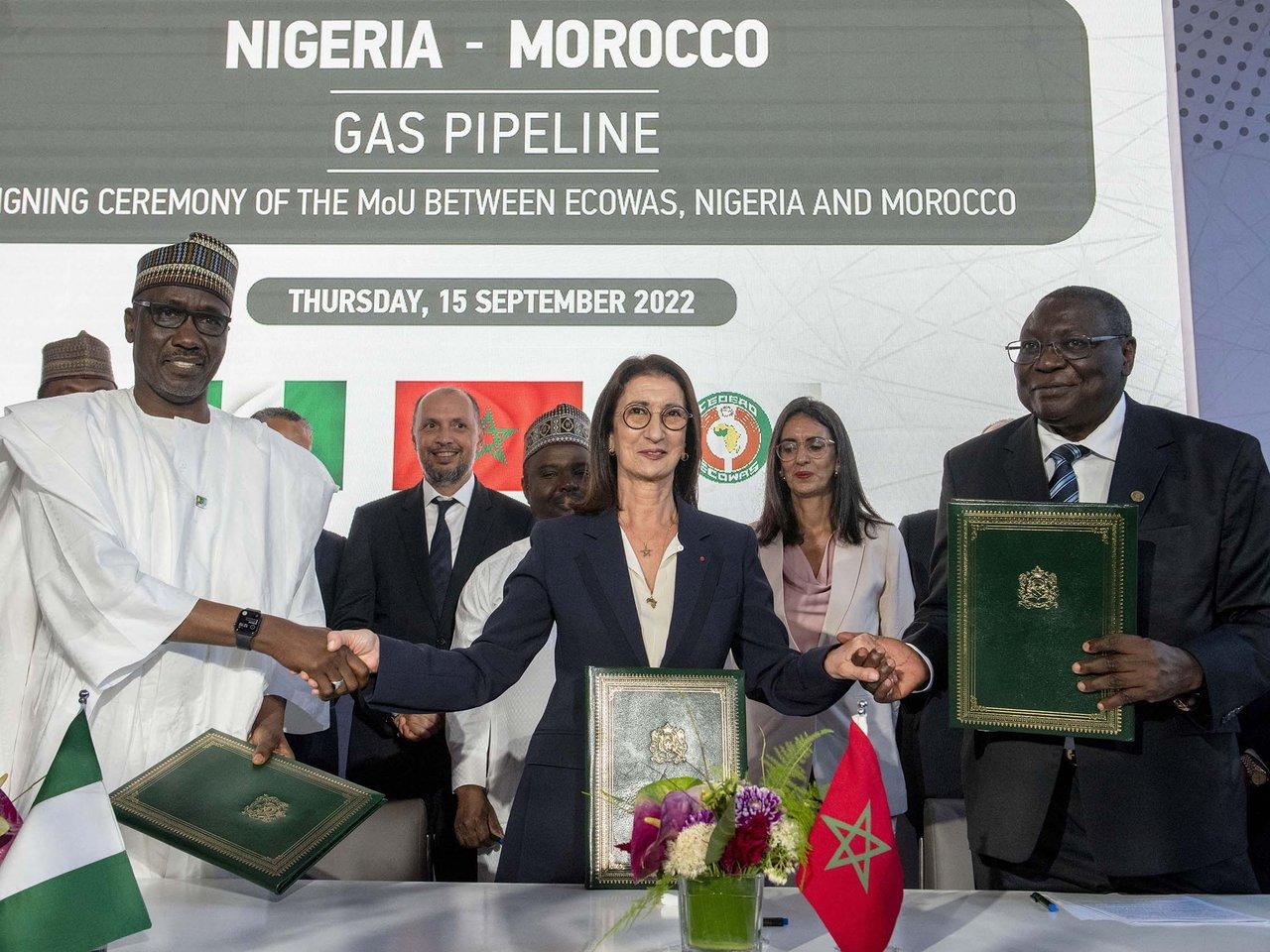
An Energy Corridor on a Regional Scale
The project originated in the energy partnership established between Nigeria and Morocco in 2016. Its underlying logic differs from that of conventional infrastructure designed primarily to connect a producing country to an importing market.
Nigeria possesses substantial natural gas reserves, estimated at more than 200 trillion cubic feet according to figures regularly published by its energy authorities. Yet the abundance of these resources has not guaranteed reliable supplies to its domestic market. Infrastructure deficiencies, gas gathering and processing constraints, financing difficulties and security problems have long limited the country's ability to develop this potential.
The Atlantic pipeline seeks to place these resources within a regional framework. Its proposed route follows the western African coastline from Nigeria to Morocco, passing through or connecting coastal states and Mauritania. Depending on the technical configuration, its total length is generally estimated at approximately 6,800 kilometres, with a target capacity of around 30 billion cubic metres annually.
These figures describe the project's ambition, not an operational capacity already available. They imply substantial investment in onshore and offshore pipelines, compressor stations, interconnections and monitoring systems.
The corridor's strategic appeal lies in its potential to serve multiple markets. Nigerian gas could supply power plants, support industrial activities, strengthen national energy networks and eventually contribute to the energy requirements of Morocco and Europe.
This diversity of potential customers is an advantage, but it also creates commercial complexity. Energy demand across the participating countries is substantial; their ability to purchase gas consistently at prices sufficient to cover infrastructure costs is another matter.
The project must therefore reconcile two objectives: regional integration, which requires affordable energy, and financial viability, which requires predictable revenues capable of remunerating invested capital.
Twenty-Six Billion Dollars in Search of Conviction
The transition towards active investor engagement changes the nature of the negotiations. As long as a project remains primarily diplomatic, governments can agree on broad objectives. Once financing becomes the central issue, those ambitions must be converted into contractual obligations, guarantees and projected cash flows.
An investment of $26 billion cannot be financed on the promise of future demand alone.
Lenders and equity investors will require visibility over transported volumes, producer commitments, buyer creditworthiness and transit tariffs. Long-term gas purchase agreements, frequently essential to financing major energy infrastructure, must be sufficiently robust to withstand fluctuations in international markets.
The multinational character of the pipeline makes these requirements more demanding. Every border introduces questions involving regulation, taxation, security, liability and dispute resolution.
An incident in one country could disrupt supplies to several others. Changes to transit conditions could undermine the financial structure of an entire segment. Payment defaults could weaken revenues expected by infrastructure operators.
The project therefore requires more than a collection of bilateral agreements. It needs a contractual framework capable of ensuring operational continuity and allocating risks among producers, transport companies, buyers, governments and financial institutions.
Phased construction, beginning with existing gas infrastructure around the Gulf of Guinea, could reduce investors' initial exposure. Individual segments could be developed around identifiable markets and their own economic fundamentals.
Such an approach may reduce the risks associated with financing the entire route at once. It nevertheless has an important limitation: the commercial viability of individual sections does not necessarily guarantee the profitability of the complete corridor.
Interest from international investors, including potential partners in the Gulf, reflects the search for institutions with substantial capital and experience in energy infrastructure. But discussions with prospective investors should not be confused with binding financial commitments.
The decisive transition will occur when project sponsors can demonstrate that contracted revenues will sustainably cover construction, operating, financing and maintenance costs.
The Sahel: Outside the Route, Inside the Equation
The choice of an Atlantic corridor carries fundamental geopolitical implications. Unlike the Trans-Saharan Gas Pipeline, which would connect Nigeria to Algeria through Niger, the Nigeria–Morocco project largely bypasses the central Sahel.
This geographical distinction does not mean that instability in the Sahel is irrelevant.
West Africa is characterised by extensive economic, human and security interdependencies. Coastal countries maintain close commercial relationships with landlocked states. Their ports, transport networks, agricultural markets and energy systems are exposed, to varying degrees, to political developments further inland.
The institutional transformations in Mali, Burkina Faso and Niger, together with their withdrawal from the Economic Community of West African States, have increased uncertainty surrounding regional governance. Insecurity in border areas and mounting pressure on some coastal countries demonstrate that geographical distance does not provide complete protection from regional instability.
A pipeline following the Atlantic coastline reduces certain forms of direct exposure, particularly those associated with crossing Niger. It does not eliminate the risks of sabotage, social unrest or the potential consequences of political crises for investment and public commitments.
Mauritania occupies a particularly important position. Situated at the intersection of the Maghreb, Sahara, Sahel and Atlantic regions, it represents a strategic connection towards Morocco. Its institutional stability and continuity in energy policy are important considerations for the corridor's overall coherence.
The project illustrates a fundamental distinction: it is possible to bypass conflict zones geographically without escaping the political and economic interdependencies surrounding them.
Stability in the Sahel therefore remains a regional variable, even when the main infrastructure does not directly cross its territory.
Can Energy Contribute to Stability?
The relationship between energy development and political stability is one of the project's central questions.
Across parts of West Africa, unreliable electricity supplies constrain industrial production, increase business costs and limit opportunities to process natural resources locally.
Infrastructure capable of delivering natural gas to power stations and industrial facilities could improve economic conditions in several countries. It could also reduce dependence on certain imported fuels and diversify energy supplies.
These effects would matter. More reliable and accessible energy can encourage productive investment, support employment and broaden government tax revenues.
But the transition from economic benefits to greater political stability is far from automatic.
Conflicts across the Sahel arise from complex combinations of institutional weaknesses, local rivalries, land disputes, territorial marginalisation, armed violence and governance failures. No pipeline can resolve these problems on its own.
Large infrastructure projects can even become sources of tension when benefits are concentrated, when affected communities bear environmental or land-related costs without adequate compensation, or when revenues flow through opaque distribution systems.
The relevant question is therefore not simply whether the pipeline will generate wealth, but where that wealth will be created, how it will be distributed and which institutions will ensure its effective use.
The benefits for the central Sahel would also remain largely indirect without dedicated connections. For Mali, Burkina Faso or Niger to obtain direct access to gas transported through the Atlantic corridor, additional infrastructure and commercial agreements would be required.
The project's institutional framework has envisaged possible connections to landlocked countries, but such provisions do not establish that those links have been financed or scheduled for construction.
The pipeline could strengthen certain regional economic interdependencies. It is not, in itself, a stabilisation policy.
Two Corridors and a Changing Regional Balance
The Nigeria–Morocco pipeline cannot be analysed independently of the Trans-Saharan Gas Pipeline linking Nigeria, Niger and Algeria.
Both projects rely on the same broad resource base but follow different geographical routes and political architectures.
The trans-Saharan corridor proposes a comparatively direct connection between Nigerian gas reserves and Algerian infrastructure, crossing Niger. It would reinforce Algeria's position as a gas producer, transit hub and exporter to European markets.
The Atlantic corridor follows a broader regional distribution model, connecting a succession of potential markets and increasing Morocco's role as a transit and consumption platform.
The comparison, however, cannot be reduced to distance.
A shorter route may carry greater political or security risks. A longer route may offer more commercial opportunities while multiplying costs and contractual interdependencies.
Nigeria consequently stands at the centre of two strategies that are not necessarily incompatible. Whether they can complement each other will depend on available gas volumes, upstream production investment, commercial demand and financing capacity.
The competition also concerns the future organisation of African energy networks.
The trans-Saharan project would strengthen Niger's importance as a transit country and Algeria's position as an energy interface with Europe. The Atlantic corridor would establish a different geography of flows, structured around coastal economies and Morocco.
Their coexistence could diversify Nigeria's export routes. It could also spread financial and political resources too thinly if both projects simultaneously compete for the same investors, gas volumes or European buyers.
It would nevertheless be excessive to interpret this as an inevitable confrontation between Rabat and Algiers. The eventual outcome will depend substantially on the economic competitiveness of the infrastructure and the contractual commitments secured.
Geopolitics defines the possibilities. Financing will determine which can be realised.
Morocco: Between Energy Security and African Connectivity
For Morocco, the project represents more than a transit infrastructure.
The Kingdom has sought for years to diversify its energy supplies, expand the use of natural gas in selected sectors and strengthen its economic position across Africa.
The pipeline fits within this broader strategy. It could help secure gas supplies for the Moroccan market, support new electricity generation capacity and create opportunities for industrial development.
Its Atlantic dimension also aligns with Morocco's wider efforts to strengthen economic connections with West Africa and the Sahel.
These ambitions, however, should not be confused with achieved outcomes.
Morocco will need appropriate reception, transmission and distribution infrastructure. The competitiveness of pipeline gas will have to be assessed against alternative supply options, including liquefied natural gas imports and existing network connections.
The project's contribution to Moroccan industry will depend on the final price of gas, available volumes and the reliability of deliveries.
Its potential role in exports to Europe will depend on interconnection capacity, regulatory conditions and the evolution of European demand.
The pipeline could strengthen Morocco's position within regional energy networks. But favourable geography alone does not guarantee a lasting economic advantage.
Europe: A Less Certain Destination Than Before
The European dimension of the project deserves particular attention.
Following the upheavals in energy markets caused by the war in Ukraine, European governments sought to diversify supply sources and reduce certain strategic dependencies.
This development increased interest in African gas resources and infrastructure capable of providing alternative import routes.
At the same time, however, Europe is pursuing a decarbonisation agenda intended to reduce fossil fuel consumption over the longer term. Renewable energy deployment, electrification, efficiency improvements and climate policies are reshaping future demand.
A pipeline built over several years must nevertheless recover its investment over several decades.
The mismatch between financing horizons and expected consumption trends creates a major risk.
Investors must assess not only European demand when the pipeline enters service, but also its evolution throughout the debt repayment period.
Liquefied natural gas represents another source of competition. Its commercial flexibility and Europe's expanded import capacity may reduce the attractiveness of some long-term commitments to fixed pipeline infrastructure.
Under these conditions, the Atlantic pipeline's economic viability could depend more heavily on growing African markets than its frequent presentation as a new route to Europe might suggest.
That possibility would fundamentally alter the project's economic logic.
Europe could become a supplementary destination, while West Africa gradually emerges as the principal area of value creation.
But that would require participating countries to develop the electricity networks, industries, tariff mechanisms and purchasing capacity needed to absorb the proposed volumes.
The Risk of Unequal Integration
Regional agreements do not guarantee that all participating countries will benefit equally.
More industrialised economies, markets with relatively developed electricity networks and governments capable of mobilising complementary financing could capture a substantial share of the benefits.
Countries with weaker energy systems, by contrast, might remain primarily transit territories, with limited effects on domestic development.
This asymmetry is particularly significant for infrastructure presented as an instrument of African integration.
Value creation will depend on national interconnections, industrial processing capacity and the actual ability of businesses and households to access competitively priced energy.
The pipeline could support the emergence of new industrial centres. It could also reproduce a geography in which resources cross territories without substantially transforming their economies.
The experience of many extractive infrastructure projects demonstrates that transporting a resource through a country is not equivalent to developing that country.
The quality of public policy, transparency of revenues and capacity to finance secondary networks will therefore matter as much as construction of the main pipeline.
Regional integration will not be measured solely in kilometres of infrastructure, but in the productive capacity actually created.
Stability as a Prerequisite, Not a Guaranteed Outcome
As the project moves towards potential financial structuring, a fundamental contradiction becomes apparent.
The pipeline is presented as an instrument capable of encouraging cooperation, investment and regional stability. Yet its construction requires precisely the institutional cooperation and stability needed to reassure investors.
Participating states will have to guarantee infrastructure security, continuity of commitments, regulatory predictability and effective dispute resolution. They must also prevent diplomatic tensions or domestic crises from undermining contractual obligations.
The scale of the investment makes these requirements particularly demanding.
For a $26 billion project, even a relatively modest increase in the cost of capital can materially alter the financial balance. Political and security risk premiums are therefore not secondary considerations: they are part of the pipeline's underlying economics.
This helps explain why multilateral institutions, public guarantees and risk-sharing mechanisms could play a decisive role.
It also illustrates the limitations of an approach based exclusively on political determination.
Diplomatic cooperation can create the conditions for infrastructure development. It cannot replace sound contracts, creditworthy buyers or the legal certainty required for long-term operations.
The Nigeria–Morocco pipeline now stands at the intersection of these requirements.
An Infrastructure That Must Demonstrate Its Value
The strategic significance of the African Atlantic Gas Pipeline is substantial. It could diversify outlets for Nigerian gas, improve energy supplies, strengthen economic connections between West Africa and Morocco, and create new opportunities for industrial integration.
But geopolitical importance is not proof of financial viability.
The next stages will have to establish whether political agreements can be converted into commercial commitments, whether individual segments have sufficient demand and whether country-specific risks can be allocated on terms acceptable to investors.
The Sahel will remain part of the equation, even at a distance from the main route. West Africa's institutional fragmentation, regional insecurity and differences between national strategies will continue to shape the conditions under which the infrastructure can be developed.
The pipeline could help connect economies that remain insufficiently integrated. But it will not eliminate the political divisions running through the region, nor will it automatically guarantee an equitable distribution of benefits.
Its ultimate success will therefore be measured neither by its length, nor by its cost, nor even by the volumes it might transport towards Europe.
It will be measured by its ability to transform abundant natural resources into accessible energy, productive investment and economic interdependencies strong enough to withstand crises.
West Africa does not lack projects capable of redrawing its maps. What remains to be demonstrated is whether it can turn those new lines into lasting economic connections.
Main Sources
- NNPC Limited — Institutional communications on the Nigeria–Morocco Gas Pipeline and Nigeria's natural gas development strategy.
- Economic Community of West African States (ECOWAS) — Intergovernmental agreement and institutional work concerning the African Atlantic Gas Pipeline, July 2026.
- Reuters — Reporting on the July 2026 regional agreement and the project's development.
- Zawya — “NNPC pitches investors on Nigeria–Morocco gas pipeline, eyes trans-Saharan FID talks in 2027,” November 2026.
- African Development Bank — Publications on infrastructure financing and African energy integration.
- World Bank — Data and research on electricity access, energy infrastructure and development in sub-Saharan Africa.
- International Energy Agency — Africa Energy Outlook and analyses of gas markets and energy demand.
- European Commission — European energy and climate policy frameworks and regulatory developments.
Atlas Limits Research Desk
Atlas Limits’ editorial and analytical desk.