South Korea's historic passage beyond $1 trillion in annual exports reveals a profound transformation in the international economy. Artificial intelligence is placing semiconductors at the center of global trade, reinforcing Asia's industrial importance and reshaping the dependencies connecting the world's major powers. Behind the export milestone lies a new geography of economic power.
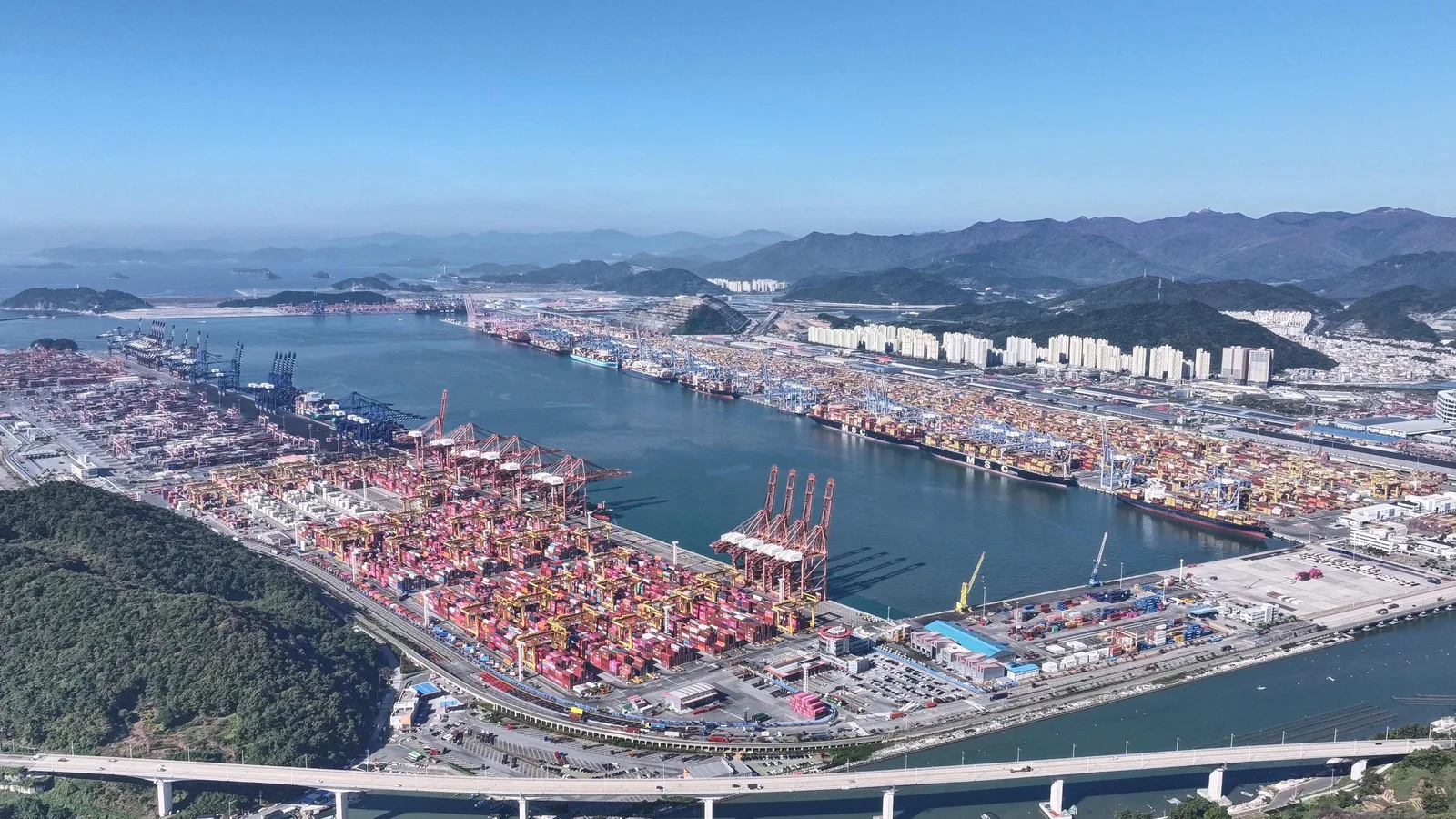
On November 19, 2026, South Korea crossed the threshold of $1 trillion in annual exports, marking another decisive stage in its industrial development. The country joined the small group of economies to have achieved this scale of merchandise exports, alongside China, the United States and Germany. Yet the significance of this achievement extends well beyond the headline figure. It reflects an accelerated transformation in the composition of international trade, as the equipment and components required for artificial intelligence become increasingly important and advanced manufacturing capabilities acquire greater strategic value.
The transformation is unfolding in a paradoxical international environment. Global commerce remains exposed to geopolitical tensions, technological restrictions, protectionism and supply-chain disruptions. Nevertheless, demand for digital infrastructure has expanded sufficiently to support a powerful new cycle of merchandise trade growth. South Korea occupies a central position in this development because it possesses an industrial combination that is exceptionally difficult to replicate: advanced memory manufacturing capabilities, globally competitive technology companies, specialized suppliers and several decades of accumulated expertise in export-oriented production.
The milestone therefore represents more than the expansion of a national economy. It illustrates a gradual shift in strategic value toward the components that make modern digital systems possible. The central question is no longer simply which countries manufacture the greatest quantity of goods, but which countries control the technologies on which other economies increasingly depend.
An Export Power Built on Industrial Depth
South Korea's commercial ascent originated in an economic transformation that began decades before the emergence of artificial intelligence. From the 1960s onward, Seoul progressively organized its development around industrialization, productive investment and access to international markets. Public policy, bank financing, port infrastructure, technical education and the emergence of large industrial groups helped establish an economy capable of competing with established manufacturers.
This strategy evolved through successive stages. Textiles and relatively simple manufacturing activities initially provided access to foreign markets. Steel, shipbuilding, automobiles, electronics and petrochemicals subsequently enabled a sustained movement into more sophisticated production. South Korean companies gradually moved beyond subordinate positions within supply chains controlled by foreign producers, developing the capacity to design products, master complex manufacturing processes and organize their own international supplier networks.
The importance of this trajectory lies in the accumulation of industrial capabilities. An economy does not become a technological power merely by financing a handful of advanced facilities. It requires experienced engineers, equipment manufacturers, specialized subcontractors, reliable logistics systems and institutions capable of supporting investments whose returns may take years to materialize.
South Korea progressively assembled these capabilities, although its model also generated significant economic concentration around large conglomerates and a structural dependence on external demand.
In 2025, South Korean exports reached approximately $709.7 billion, setting a national record. The expansion recorded in 2026 therefore represents an extraordinary acceleration. By September, cumulative exports had exceeded $814 billion according to government statistics. The trillion-dollar threshold reached in November followed a year in which technological demand fundamentally altered the usual pace of South Korean trade.
It would nevertheless be misleading to attribute the entire achievement to a single industrial policy or a general improvement in competitiveness. Export growth reflects a combination of stronger demand, higher shipment volumes and rising prices for certain components. This distinction is essential: a spectacular increase in export value does not necessarily imply an equivalent expansion in physical production, industrial employment or domestic value added.
Artificial Intelligence Shifts the Center of Global Trade
The expansion of artificial intelligence has introduced a new structure of demand into the international economy. Companies developing advanced AI models must invest heavily in data centers, computing accelerators, memory systems, storage equipment, networks and electricity infrastructure. This demand extends far beyond the final users of digital services. It spreads through successive upstream industries, from semiconductor manufacturing to cooling equipment and energy systems.
South Korea holds a particularly favorable position within this industrial structure. Samsung Electronics and SK Hynix are among the world's major producers of memory components essential to modern computing systems. Their strategic importance has increased with the expansion of high-bandwidth memory, or HBM, used alongside specialized processors for artificial intelligence workloads.
These components enable computing systems to move large volumes of data rapidly between memory and processing units, addressing one of the principal constraints on AI performance.
This specialization is changing the nature of South Korea's competitive advantage. During earlier phases of the digital economy, a substantial proportion of industrial value came from manufacturing electronic products sold directly to consumers. In the present phase, a growing share of demand originates from investment by companies building computing capacity for use by businesses, governments and other industries.
The distinction is fundamental. Smartphones, televisions and personal computers remain subject to relatively recognizable consumer cycles. Artificial intelligence infrastructure, by contrast, responds to strategic competition among digital service providers, model developers and major powers. Investment decisions can involve enormous sums, while performance requirements favor the most advanced components and suppliers capable of manufacturing them at scale.
South Korean trade statistics make this transition particularly visible. During the first half of 2026, information and communications technology exports reached $253.9 billion, an increase of 120.5% from the previous year. Semiconductors and solid-state drives together accounted for 83.7% of these exports. For the first time, ICT products represented more than half of South Korea's total exports over the period.
The concentration of growth around these activities demonstrates that artificial intelligence is no longer merely one promising industry among many. It has become a mechanism transmitting investment demand across the international industrial system.
The New Geography of Technological Value
South Korea's export expansion forms part of a broader reorganization of the international division of labor. The United States is home to many of the companies developing leading AI models, designing computing architectures and financing digital infrastructure. Taiwan occupies a central position in advanced logic semiconductor manufacturing. South Korea possesses essential capabilities in memory production, while Japan, the Netherlands and several other economies supply critical materials, equipment and manufacturing technologies.
This organization rests on exceptionally deep interdependence. None of the principal participants independently controls the entire technological chain. American chip designers depend on Asian manufacturing capacity. Asian manufacturers rely on equipment, software and materials supplied across multiple jurisdictions. Data centers distributed around the world ultimately depend on a relatively limited number of highly specialized industrial facilities.
Economic power can therefore no longer be assessed solely through domestic market size or aggregate manufacturing output. It also depends on a country's position within value chains where certain functions are exceptionally difficult to replace.
World Trade Organization figures confirm the scale of this transformation. In 2025, trade in AI-enabling goods reached approximately $4.18 trillion, an increase of 21.9%. Although these products represented roughly one-sixth of global merchandise trade, they accounted for 42% of its growth in value. During the first half of 2026, their contribution increased further, approaching half of the growth in world merchandise trade by value.
These figures require careful interpretation. AI-enabling goods constitute a broader category than the components directly used to train advanced models. The statistics also incorporate price effects, which have been particularly significant in semiconductors. Nevertheless, the underlying development is unmistakable: an increasing proportion of international trade growth depends on technological investment concentrated within a relatively small number of countries and industrial groups.
This concentration benefits economies that already possess advanced technological capabilities. At the same time, it risks widening the distance between those economies and countries whose participation in global trade continues to depend primarily on commodities, relatively unsophisticated manufacturing or lower-value services.
Washington, Beijing and Seoul: Interdependence Under Pressure
South Korea's commercial expansion is occurring as economic relations between the United States and China continue to change. Restrictions on advanced technologies, industrial reshoring policies and national security considerations increasingly influence the conditions under which companies organize production and investment.
For Seoul, this environment creates a lasting strategic contradiction. The United States is an essential partner in national security, advanced technology and export markets. China remains a major participant in Asian manufacturing networks, an important market and an industrial location where several South Korean groups have established substantial production capabilities.
Semiconductor manufacturers must therefore preserve commercial relationships while complying with technological control regimes that may restrict certain activities. Investment decisions are no longer determined exclusively by profitability. They increasingly incorporate the geographical location of factories, export controls, equipment availability and the possibility of political disruption.
This development does not mean that industrial globalization is disappearing. Rather, value chains are being reorganized under new constraints. Some capabilities are relocated, others duplicated, while companies seek to diversify their geographical exposure without abandoning the economic benefits of specialization.
South Korea possesses considerable advantages in this reconfiguration, but its position remains delicate. A highly export-dependent economy benefits from open markets at the very moment major powers are expanding the instruments used to control strategically important technologies.
As semiconductors become more central to economic security, their international trade is increasingly exposed to political decisions.
South Korea's success consequently reveals a fundamental tension in the emerging industrial order: the most strategically important technologies are produced through deeply integrated international networks precisely when governments are attempting to reduce their external dependencies.
The Risks of Concentrated Prosperity
The scale of South Korea's exports should not obscure the vulnerabilities of its economic model.
The first concerns growing dependence on a limited number of products. Semiconductors have historically been cyclical, experiencing periods of rapid expansion followed by sometimes severe corrections. Demand associated with artificial intelligence may extend the current cycle, but it does not eliminate the risks of overinvestment or fluctuations in memory prices.
Capital expenditure decisions by major technology companies now exert disproportionate influence over the prospects of certain manufacturers. If investment in data centers slows, if manufacturing capacity expands too quickly or if the economic returns expected from artificial intelligence take longer to materialize, the consequences could rapidly spread through component suppliers.
The second vulnerability concerns the domestic distribution of prosperity. Exports can expand rapidly without producing a comparable improvement in household incomes. Advanced technology industries are capital-intensive, employ highly specialized workers and concentrate a substantial share of profits within large corporations. Their expansion therefore does not automatically generate proportional increases in employment or domestic consumption.
South Korea continues to face significant structural challenges, including demographic pressures, housing costs and social disparities. Population aging, exceptionally low fertility, inequalities between major conglomerates and smaller businesses, and the geographical concentration of economic activity complicate the translation of export success into broadly shared prosperity.
The third vulnerability is energy-related. Semiconductor production requires stable electricity supplies, substantial quantities of ultrapure water and complex industrial infrastructure. As global demand expands, energy and environmental constraints become increasingly important determinants of competitiveness.
Security of energy supply represents an additional challenge for an economy that remains heavily dependent on imported energy.
The trillion-dollar export milestone is therefore an undeniable industrial achievement, but it is not a complete measure of economic resilience. The decisive question is whether commercial gains can finance innovation, improve productivity in other sectors and produce lasting improvements in living standards.
Artificial Intelligence Is Redefining Industrial Hierarchies
One of the most important lessons of South Korea's trajectory concerns the relationship between the digital economy and manufacturing.
For years, the expansion of digital platforms and software services encouraged the assumption that economic value would progressively migrate toward increasingly intangible activities. Artificial intelligence reveals instead the enormous physical infrastructure required to develop and operate digital technologies.
Advanced models require processors, memory, networks, data centers and electricity. Their development mobilizes international production networks, high-precision manufacturing capabilities and substantial industrial investment.
The distinction between digital technology and manufacturing consequently becomes less useful for understanding the actual distribution of economic value.
This does not mean that every manufacturing industry will benefit equally from the expansion of artificial intelligence. The strongest advantages accrue to segments characterized by substantial technological barriers, demanding quality requirements and high entry costs.
Companies capable of mastering these segments enjoy greater bargaining power, particularly when their products are indispensable to systems whose performance depends on a small number of critical components.
South Korea demonstrates that an economy can retain considerable global influence without controlling the dominant digital platforms or the most widely used artificial intelligence models. Its strength derives from its capacity to supply physical components on which those technologies depend.
This position nevertheless has limits. Control over an essential component does not guarantee the capture of all the value generated downstream. Companies designing computing architectures, operating data centers and commercializing digital services retain their own competitive advantages.
International competition therefore concerns not only technological mastery but also the distribution of value across increasingly complex production systems.
An Industrial Lesson for Emerging Economies
South Korea's experience offers important lessons for countries seeking to strengthen their position in international trade.
First, participation in global markets does not automatically produce technological upgrading. Moving into more sophisticated activities requires sustained investment in skills, infrastructure, research, manufacturing capabilities and relationships among firms.
The South Korean experience also illustrates the importance of industrial continuity. Its current position in semiconductors is the result of decades of technological accumulation and investment across successive economic cycles. Such capabilities cannot be reproduced quickly through the announcement of government programs or the establishment of industrial zones alone.
For emerging economies, the objective should not necessarily be to replicate the South Korean model in its entirety. Entry costs in the most advanced technologies have become extraordinarily high.
A more realistic strategy may involve identifying specialized segments where an economy possesses credible advantages: electronic components, electrical equipment, advanced assembly, engineering services, energy infrastructure or industrial activities associated with data centers.
This approach is also relevant to economies seeking to attract investment as multinational companies diversify their supply chains. The reorganization of global trade creates new opportunities, but these will translate into sustainable development only when industrial investment is accompanied by stronger local capabilities, skills transfer and productivity gains.
The essential question is not simply whether a country participates in a global production network. It is whether that participation progressively enables it to master more complex functions and retain a larger share of the value generated.
Global Trade Enters a New Phase of Strategic Concentration
South Korea's passage beyond $1 trillion in exports comes at a time when the traditional drivers of globalization are evolving. The search for lower production costs continues to influence industrial location decisions, but it increasingly coexists with technological security requirements, energy resilience and access to scarce manufacturing capabilities.
Artificial intelligence is accelerating this transformation. It supports international trade while concentrating a substantial proportion of its growth around a limited set of technologies, companies and territories. It simultaneously strengthens industrial interdependence and the political incentives to control it.
Within this system, South Korea occupies a distinctive position. Its economy does not possess the scale of the American domestic market or the breadth of China's manufacturing base. Nor does it independently control the leading computing architectures or global digital platforms.
Yet it possesses industrial capabilities sufficiently strategic to influence the pace at which a technology central to international investment decisions can develop.
The trillion-dollar milestone consequently represents more than a commercial record. It embodies a transformation in which national economic power increasingly depends on the capacity to master the physical infrastructure of the digital economy.
For Seoul, the next challenge will not simply be to sustain export growth. It will be to reduce exposure to technological cycles, diversify sources of value and translate industrial success into more broadly distributed economic gains.
For the rest of the world, South Korea's performance confirms a fundamental reality: artificial intelligence is not dematerializing the international economy. It is making certain industrial capabilities more indispensable than ever, while concentrating an increasing share of economic power in the countries capable of producing them.
Atlas Limits Research Desk
Atlas Limits’ editorial and analytical desk.